Little girls and bigger ones see a lot of what I call “makeover movies:” in a crucial scene Our Heroine gets a new dress and hairstyle (or just takes off her glasses) and her life changes. Sometimes she transforms herself, as Ella does in “The Bells are Ringing” , causing her to have enormous conflicts and self-doubt. More often, she is transformed by someone else. Cinderella gets a dress to go to the ball, where the prince falls in love with her. Sleeping Beauty’s ballgown is so crucial that the fairies’ fight over its color literally leads the bad fairy to her hideaway. The modern counterparts are Eliza Doolittle, who, like Cinderella, goes to a ball in borrowed finery (and accent) and dazzles everyone there (“My Fair Lady” ) and “Gigi” who is actually groomed by her grandmother and great-aunt to be a very elegant prostitute, trained almost like a geisha in manners and skills for pleasing a man. Over and over, we see the heroines rewarded for being passive pleasers.
Transformation themes have been a central part of stories long before there were movies. The examples above were fairy tales before they were on screen. And girls and women are not the only ones who are transformed; superheroes all have origin stories that are a form of makeover, though they are changing to fantasy versions for themselves, and not to get positive attention from the opposite sex.
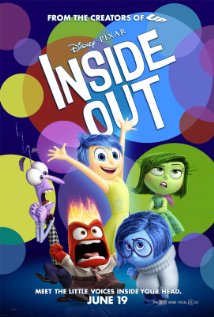
Inside “Inside Out” — Takes on Pixar’s Hit Movie About Feelings
Posted on July 6, 2015 at 3:35 pm
“Inside Out” is not just one of the best movies of the year (animated and live action). It is also one of the most psychologically profound and astute films about emotions and the mind ever made. It set the all-time box office opening weekend record for a non-series film and reached number one at the box office this week, out-doing two huge holiday weekend releases, “Terminator Genisys” and “Magic Mike XXL.” Copyright 2015 Pixar
And it has provoked some exceptionally thoughtful responses from movie critics and specialists in child development. My friend Jen Chaney wrote one for The Dissolve, tying the movie’s themes to other Pixar films that touch on the bittersweetness of the end of childhood, but explaining how this film takes it to a new depth.
According to Inside Out, the middle-school-girl brain is simultaneously orderly yet fragile, crowded with highly charged voices (some previously heard on NBC sitcoms, The Daily Show, and/or Saturday Night Live), and aesthetically similar to a pinball machine, a Lite-Brite, and multiple levels of Candy Crush. It’s rare in a children’s film—or for that matter, any film—to see elements of the human nervous system rendered with such exquisite care and unmitigated glee.
But the film’s point of view is more important than its plot, or its sophisticated view of the machinations behind Riley’s meltdown. For the first time, a Pixar film is confronting how much it hurts when a child realizes her childhood will end—while it’s still ending. It literally gets inside her head, then bluntly announces that being a kid hurts because it doesn’t last. That feels refreshingly candid, even for Pixar.
he movie’s portrayal of sadness successfully dramatizes two central insights from the science of emotion.
First, emotions organize — rather than disrupt — rational thinking. Traditionally, in the history of Western thought, the prevailing view has been that emotions are enemies of rationality and disruptive of cooperative social relations….Second, emotions organize — rather than disrupt — our social lives. Studies have found, for example, that emotions structure (not just color) such disparate social interactions as attachment between parents and children, sibling conflicts, flirtations between young courters and negotiations between rivals.
They would have preferred that Sadness have a less dreary affect. And they note that they recommended many more emotions, but Pixar explained that they could not handle that many characters.
he emotional messages of most entertainment for kids are pretty relentlessly positive: Love your family, stay true to yourself, keep positive, never give in to despair. As the research of Stanford’s Jeanne Tsai has shown, one of the emotions that Americans in particular privilege is joy—excited pleasure. Children see around them, in books and movies and advertisements, exemplars of delight at growing up. “That makes it harder to grapple with sadness,” University of California, Berkeley psychology professor Dacher Keltner told me. “It’s a vacuum in our culture.”
But, points out Keltner, who consulted with Pixar’s Pete Docter on the film, sadness is a powerful tool, a trigger that sends kids back to their parents for comfort and connection. “You gotta hang on to that sadness,” he told me, because in the tumult of early adolescence, it’s the thing that can bring parent and child back together.
Major kudos are due Pixar and Disney for elevating the importance of the emotional lives of children and providing a creative vehicle for helping kids learn to understand and manage their complex emotions. Most importantly, the film reminds parents that having a happy child does not mean your child must always be happy.
Young children are deeply feeling beings. Starting in the earliest months of life, well before they can use words to express themselves, babies have the capacity to experience peaks of joy, excitement, and elation. They also feel fear, grief, sadness, hopelessness, and anger—emotions that many adults understandably find it hard to believe that such young children can experience. But just as Riley in the film needs her parents to hear and empathize with her difficult feelings of pain and loss—which helps her move on in positive ways—so do babies and toddlers.
She concludes with some very practical recommendations for parents.
And be sure to listen to co-writer/director Pete Docter, who spoke about what was behind the film and the crucial moment that changed everything in an interview with “Fresh Air’s” Terry Gross.
“Spy” beat “Entourage” last weekend in the battle of the two R-rated raunchy comedies. The one featuring women in all the lead roles was first at the box office with a robust $29.1 million, and the one featuring men in all the lead roles came in third, after the previous week’s release, “San Andreas.” This continues a strong run for women-led films. In May, Forbes pointed out that six of the top ten films were “girl-powered,” including “Pitch Perfect 2,” “Tomorrowland,” and “Mad Max: Fury Road.” “Moreover, three of them were somewhat gender-neutral. Only one wide release in the top twelve was wholly male-centric. ”
Call it causation, call it correlation, or merely call it coincidence. Come what may, last weekend showed that a Hollywood release slate with copious female-centric options at the multiplex did not harm the overall box office one bit. Not all of these films are good, not all of them are explicitly “feminist” and not all of them are necessarily marketed in a way that highlights their female-centric nature. Yet they are major studio releases, playing at a theater near you, that star women, tell stories concerning women, and (in some cases) concern relationships and conflicts at least tangentially related tothe gender of their protagonists and/or antagonists.However, they exist, and they are making money.
Brad Bird’s gorgeously imagined “Tomorrowland” is not just inspired by an area in the original Disneyland, celebrating its 60th anniversary this week, it is a tribute to the sensationally imaginative work of the “imagineers” and artists who created it and an explicit invitation to everyone in the audience to bring their own ideas and creative energy to join in, and to help create a “great new beautiful tomorrow, shining at the end of every day.” If it feels at times like the sunny introductory videos that set the stage while you’re waiting in line for an attraction at the theme park, well, that is part of the fun.
It is also very much in the spirit of the 1964 World’s Fair in New York City, with the theme “Peace Through Understanding.” Early in the movie a boy named Frank (Thomas Robinson) visits the fair, bringing his invention, a jetpack. I got a special kick out of that because I went to the fair with my family and remember very well being completely enchanted by my first time on the It’s a Small World ride, which premiered there and which plays a very important role in the film. I also remember the Carousel of Progress, and its theme song heard in the film. I check it out on every trip to Disney World to see how it is been updated.
One scene in “Tomorrowland” features a diorama with four of the 20th century’s greatest “imagineers.” They are:
Nikola Tesla: This mysterious genius was a Serbian American inventor, electrical engineer, mechanical engineer, physicist, and futurist best known for his contributions to the design of the modern alternating current (AC) electricity supply system. 21st century imagineer Elon Musk named his electric car in Tesla’s honor.
Thomas Edison: The most prolific inventor of his era, Edison was dubbed “the Wizard of Menlo Park” for his work on the electric light, the phonograph, and movie cameras and projectors. He had over 1000 patents, and his inventions established the foundation for enormous advances in industry and technology.
Jules Verne: Before something can be invented, it must be imagined. Verne’s novels include Journey to the Center of the Earth, Twenty Thousand Leagues Under the Sea, From the Earth to the Moon, and Around the World in Eighty Days. He not only inspired the entire genre of science fiction; he inspired the creation of some of the technology he imagined.
Alexandre Gustave Eiffel: The man for whom the Eiffel Tower is named was a French engineer and architect. He also worked on the Statue of Liberty, a gift from France to the United States. The Eiffel Tower was also created for a World’s Fair, and it plays an important role in “Tomorrowland.”




 . Ethan Hawke picked the provocative
  by Georges Bataille. Felicity Jones suggested
  , by David Garnett. What book would you pick?