Disney Buys Lucasfilm and Announces a New Star Wars Trilogy
Posted on October 30, 2012 at 11:42 pm
The Force is going to be a whole new generation. Disney bought Lucasfilm for $4 billion and has announced that it will produce a new Star Wars trilogy, with the first one coming out in 2015. As all true fans know, George Lucas intended a nine-film series, so this may mean that his original outlines for chapters 7, 8, and 9 (or VII, VIII, and IX) are about to go into production. There were a lot of jokes today about mixing in the Star Wars characters with the Muppets, Marvel, and Mickey Mouse. But I am betting that Disney understands the value of the franchise well enough to make the next “Star Wars” more like the first “Pirates of the Caribbean” and less like “Tron: Legacy.” Or Jar-Jar Binks.
People often ask me if I’ve ever walked out of a movie. Fortunately, I seem to have an endless tolerance and sometimes even affection for bad movies. But just once, I did insist on leaving the theater, and a delightful tribute to William Castle’s horror movies on Turner Classic Movies reminded me of the film that did drive me from the theater. It was Castle’s 13 Ghosts.
While William Castle worked with legendary Hollywood artists like George Stevens and Orson Welles, he is best remembered for his cheesy horror films, produced on micro-budgets but marketed with magna-artistry. Indeed, his marketing campaigns were far more creative than his films with fantastic gimmicks like a life insurance policy for anyone who died of fright during the film and a plastic skeleton that flew out into the audience from a wire above the screen. He even wired seats in the theater to give the audience an electric shock for The Tingler.
As often happens in thrillers, there comes a point near the climax when a character is warned not to go into a dark, menacing house. Of course, she goes anyway, but before she does, the movie gives us a “fright break.” A stopwatch on screen counts down 45 seconds to give those who are too terrified to find out what is inside that house to leave and get their money back. According to director John Waters, a Castle fan, when people actually took advantage of this offer,
William Castle simply went nuts. He came up with “Coward’s Corner,” a yellow cardboard booth, manned by a bewildered theater employee in the lobby. When the Fright Break was announced, and you found that you couldn’t take it any more, you had to leave your seat and, in front of the entire audience, follow yellow footsteps up the aisle, bathed in a yellow light. Before you reached Coward’s Corner, you crossed yellow lines with the stenciled message: “Cowards Keep Walking.” You passed a nurse (in a yellow uniform?…I wonder), who would offer a blood-pressure test. All the while a recording was blaring, “Watch the chicken! Watch him shiver in Coward’s Corner!” As the audience howled, you had to go through one final indignity — at Coward’s Corner you were forced to sign a yellow card stating, “I am a bona fide coward.’“ Very, very few were masochistic enough to endure this. The one percent refund dribbled away to a zero percent, and I’m sure that in many cities a plant had to be paid to go through this torture.
I hope not many got their money back. The surprise in the house is pretty wild!
In “13 Ghosts,” a family moves into a spooky house. The gimmick is explained by Castle himself at the beginning of the film. I was so sure that the ghosts were real that I insisted my mother take me out of the theater. But now, I own the DVD, which of course came with its own ghost viewer.
Still Puzzling about “Cloud Atlas?” Here’s Some Help
Posted on October 27, 2012 at 8:25 pm
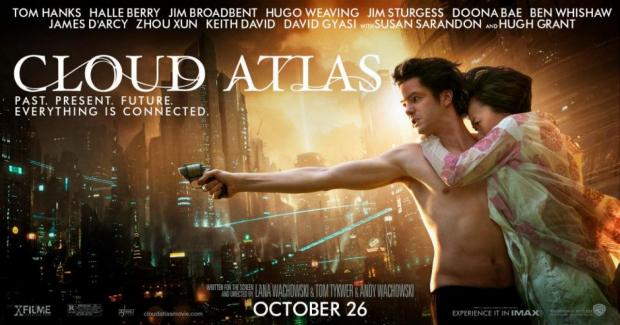
“Cloud Atlas” is confusing, with six different stories set in six different time periods told in six different styles but with the same actors in different roles in all of them and the same themes — fighting tyranny and oppression, the power of love, the spirit of creation. And a comet-shaped birthmark. Those who are still trying to figure it all out and would like some help should try:
Slate also has a glossary for the annoying Jar-Jar Binks-style patois of the episode set farthest in the future. And the Slate Spoiler Special podcast has the kind of post-movie discussion you could have, too, if your friends were in grad school.
Foucault gave us insight into power in the postmodern world, and now we understand it in a different way than Homer did, but power will be a subject in the human story, I think, as long as we’re human. And so when we first read David Mitchell’s book, I thought it was an unbelievable examination of incredibly varied perspectives, and also the relationship between the responsibility we have to people we have power over, and the responsibility we have to the people who have power over us. Are we meant to just accept their conventional construct of whatever they imagine the world to be? Or are we obliged in some way to struggle against it? In the reverse, what is the obligation of the person whose life we have power over? Are they obliged to struggle against that conventional relationship? This is stuff of good stories.
Common Sense Media‘s Betsy Bozdech has a timely post about classic family movies that some children find upsetting. Everyone I’ve ever talked to about watching movies as a child had an immediate title when asked what a movie that was too scary for them. (Mine: Darby O’Gill and the Little People — with a singing Sean Connery! The banshee coach still scares me.) It is impossible for even the most attentive parent to predict what any individual child will find upsetting all the time. The best you can do is help your child develop some techniques for responding to being scared. Just knowing those options are there will add to the child’s confidence and reduce the intensity and duration of any disturbance. Some good techniques are to talk about what the child would like to say to the scary character or how the child would like to see the story end instead.


 on Turner Classic Movies reminded me of the film that did drive me from the theater. It was Castle’s
  .
. .
. , in my new book,
  .
.
 — with a singing Sean Connery! The banshee coach still scares me.) It is impossible for even the most attentive parent to predict what any individual child will find upsetting all the time. The best you can do is help your child develop some techniques for responding to being scared. Just knowing those options are there will add to the child’s confidence and reduce the intensity and duration of any disturbance. Some good techniques are to talk about what the child would like to say to the scary character or how the child would like to see the story end instead.