What Makes a Movie Line So Quotable?

Posted on April 21, 2012 at 3:56 pm

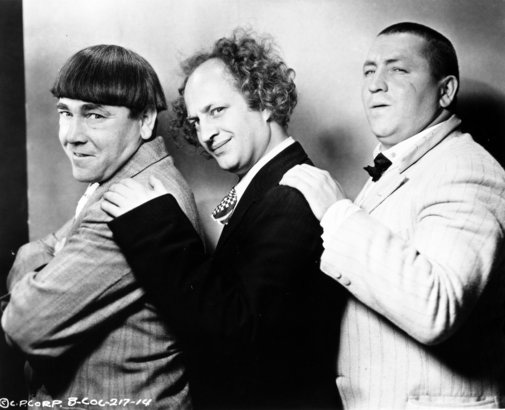
The Huffington Post reports on a new computer analysis of the movies’ most quotable lines of dialog.

he study’s authors compiled scripts from 1,000 movies, and identified, using IMDb, Google and Bing, the lines from those movies that are quoted and remembered the most today. They paired each memorable line with other lines of similar length, voiced by the same character in the same scene, then ran each pair through a computer program to identify linguistic trends.

“Our goal is to understand what general features of language will tell you how memorable a quote will be,” fifth-year Ph.D. student Cristian Danescu-Niculescu-Mizil, one of the study’s authors, told the Huffington Post.

The features that emerged were widespread applicability, straightforward syntax and distinctive diction.

If you think this brings us a step closer to computer-generated movie scripts, you’re on the same wavelength as Danescu-Niculescu-Mizil.  Not that it could make them any more formulaic than much of what is currently produced in Hollywood.

Related Tags:


Understanding Media and Pop Culture

Talking about Fairy Tales on WAMU

Posted on April 18, 2012 at 11:44 am

Many thanks to the Kojo Nnamdi Show for inviting me on to talk about fairy tales — their enduring popularity and their prevalence in today’s media — with two men whose books I have read and enjoyed, Jack Zipes and Beliefnet’s own Chris Epting.  Guest host Rebecca Roberts led a wonderful discussion, now available online via transcript or podcast.

Related Tags:


Media Appearances Parenting Understanding Media and Pop Culture

“Bully” to Get a PG-13 Rating

Posted on April 5, 2012 at 3:18 pm

After appeals and a petition from a teenager that got half a million signatures, the documentary “Bully” will receive a “PG-13” rating from the Motion Picture Association of America (MPAA) in time for the film’s April 13 expansion to 55 markets, and that despite three minor edits, a major scene in the movie that had been at the forefront of the film’s ratings battle will be kept intact.

The MPAA had been at the center of an extraordinarily popular online petition on Change.org, started by bullied high school student Katy Butler, urging the MPAA to drop the film’s original “R” rating, which was given because of some explicit language used by bullies in the movie. More than 500,000 people, including 35 Members of Congress and celebrities like Ellen DeGeneres and Meryl Streep, expressed their support for Butler’s petition.

“On behalf of the more than half a million supporters who joined me on Change.org in petitioning the MPAA, I want to express how grateful I am not only to the MPAA for lowering the rating without cutting a vital scene, but to all of the people who used their voices to put a national spotlight on this movie and its mission,” said Butler, who started her campaign on Change.org after experiencing severe bullying in school. “The brief usage of language in this film reflects what so many kids hear each day in school when they’re being bullied. No one removes it from the halls and playgrounds of schools.”

“I wish ‘Bully’ was around when I was in middle school, and experienced some of the worst bullying I could imagine,” said Butler. “But it makes me incredibly happy that kids in middle school and high school today will be able to see a film like ‘Bully’ and share that experience with their friends.”

Butler’s campaign on Change.org attracted support from major international celebrities, with Ellen DeGeneres inviting Butler to appear on her show and urging her viewers to support the petition, and Meryl Streep, Johnny Depp, Demi Lovato, Randy Jackson, Anderson Cooper, Kelly Ripa, Justin Bieber, and Drew Brees all encouraging their fans to sign Katy’s petition or show support to “Bully.”

Butler’s petition also gained support from 35 Members of Congress, who endorsed a congressional sign-on letter issued by Rep. Mike Honda (D-California) urging the MPAA to change “Bully’s” rating from “R” to “PG-13.”

Related Tags:


Understanding Media and Pop Culture
More “Hunger Games” Craziness

More “Hunger Games” Craziness

Posted on March 26, 2012 at 9:06 pm

It’s inevitable that any movie as high-profile as “The Hunger Games” would be grabbed for political advocacy by all sides.  My friend Rebecca Cusey writes in Patheos:

It seems “The Hunger Games” is a bit of a Rorschach test for people politically. Do the districts represent #Occupy protesters? Ayn Rand workers oppressed by their government? Fodder for meaningless wars? Or something more?

Some will argue that the rebellion against the totalitarian state in “The Hunger Games” trilogy is an allegory for conservative principles in favor of limiting the role of government.  Others will argue that it is an allegory for progressives fighting for the rights of the oppressed.  That’s part of the strength and the appeal of fiction. The same thing happens with many powerful films.  People are still arguing about whether the original “Invasion of the Body Snatchers” was an allegory of the fight against communism or the fight against McCarthyism.

It makes me sad to see the increasing efforts to impose reductionist templates Procrustean-style, making everything into “us” or “them.”  The good thing is that the more both sides claim ownership, the clearer it is that fiction transcends such pettiness.

Speaking of pettiness, there were also some unfortunate problems with idiotic tweets from fans of the book who were disappointed that some characters were played by black actors.  Hunger Games Tweets on Tumblr has a selection along with some funny responses.  My favorite was “I hear that Donald Trump is trying to prove that Rue wasn’t even born in Panem.”  Rue was my favorite character in the book.  She was my favorite character in the movie.  Amanadla Stenberg was perfect for the role.  It is a tribute to the power of these books that some people project their own ideas of what the characters look like (in some cases disregarding the author’s descriptions) and are unable to accept the reality of the movie version.  But it is unfortunate that these projections can reflect conscious or unconscious bigotry and even more unfortunate that they have the bad judgment to make it public.

Related Tags:


Commentary Understanding Media and Pop Culture
THE MOVIE MOM® is a registered trademark of Nell Minow. Use of the mark without express consent from Nell Minow constitutes trademark infringement and unfair competition in violation of federal and state laws. All material © Nell Minow 1995-2026, all rights reserved, and no use or republication is permitted without explicit permission. This site hosts Nell Minow’s Movie Mom® archive, with material that originally appeared on Yahoo! Movies, Beliefnet, and other sources. Much of her new material can be found at Rogerebert.com, Huffington Post, and WheretoWatch. Her books include The Movie Mom’s Guide to Family Movies and 101 Must-See Movie Moments, and she can be heard each week on radio stations across the country.

Website Designed by Max LaZebnik