“Hunger Games” Apology (sort of) from Jeffrey Wells

“Hunger Games” Apology (sort of) from Jeffrey Wells

Posted on March 26, 2012 at 11:05 am

Hollywood Elsewhere’s Jeffrey Wells has conceded my points about his appalling comments on “The Hunger Games,” perhaps more than he realizes.

To recap: I wrote about his offensive comments regarding the body of the movie’s lead actress, Jennifer Lawrence.  He said she was “too big” for co-star Josh Hutcherson, revealing his assumptions that (1) for the purposes of aesthetics and credibility, the male lead has to be significantly bigger than the female lead, and (2) it is the obligation of the female star of a film, even if she is playing the most important role, to accommodate any perceived size inadequacy of her male co-star.  Not content to insult Lawrence, actors and actresses in general, and the audience of fans, he also went on to insult female film critics, writing that they could not be trusted to evaluate this film.  As I wrote earlier:

To add insult to injury — and some more insult, too — Wells advises his readers to beware of the reviews of “The Hunger Games” by female critics ”as they’re probably more susceptible to the lore of this young-female-adult-propelled franchise than most.”  Um, “most?”  Who would that be again?

He seems to have some Victorian notion that women get the vapors and cannot think straight.  And that women somehow don’t count in deciding who makes up “most” ticket-buyers or members of the population.

I was pleased to see that Wells responded promptly, and if his reaction was a bit shrill, well, perhaps he is experiencing a bit of the vapors himself.  Being wrong can do that.  It is rather telling that until corrected by an alert commenter, he thought I was a man, referring to me as “Neil Minow.”  I take it as a compliment to the validity of my post that he assumed it had to come from a bro and not a “susceptible” female.

But he made some important concessions and I want to give him credit for them.  First, he agreed that if he was going to make a point about the mismatch of size of the two leads, his focus should have been on the co-star, not the lead.  Second, although he did not mention that he amended the original post I quoted above (thank goodness another alert commenter called him on it), he did soften his indefensible comment about female critics, by revising it to say that “certain” female critics “may” be susceptible.  “The use of ‘certain’ and ‘may’ make the difference between a blanket statement and a carefully phrased one,” he says. It is still an idiotic point, but by adding “certain” and “may” he shows that at some level he recognizes that.  It would have been classier, though, if he had admitted that he backed down from what he himself calls a blanket statement.  And “careful phrasing” would have dropped “female” entirely, I believe.

Wells ends by noting as though anyone had argued otherwise, that everyone brings some bias to a film.  Where I come from, we prefer to call it a point of view, but certainly, there is no such thing as pure objectivity, which means that male critics are just as likely to be biased against a female action lead as female critics are to be biased in her favor.  I am glad that “The Hunger Games” will be reviewed by fans of the book, people who have not read the book, people who consider it an anti-big government allegory, people who consider it an anti-fascism, pro-99% allegory, men, women, young critics and older critics.  If there are film critics in District 12 and Capital City, I’d love to see what they have to say.  I welcome all of these perspectives, even unreconstructed critics who think that the job of the female star is to conform to some notion of “appropriate” size and that the job of the female critics is to leave their gender at the door of the theater.  But there is no excuse for making a sweeping generalization, refuted by the facts, that female critics and only female critics will over-praise the film.  Fortunately, Wells’ admission that everyone is biased implicitly includes himself, so I am going to read that as an admission and apology and hope for better from him next time.


Related Tags:


Critics Understanding Media and Pop Culture

Appalling Critiques of Jennifer Lawrence’s Body in “Hunger Games”

Posted on March 24, 2012 at 10:58 am

Thanks very much to L.V. Anderson for a piece in Slate about truly horrifying discussions of Jennifer Lawrence’s body in reviews of “The Hunger Games.”

A baffling, infuriating trend has cropped up in reviews of The Hunger Games: critics bodysnarking on Jennifer Lawrence. “A few years ago Ms. Lawrence might have looked hungry enough to play Katniss,” writes the New York Times’ Manohla Dargis, “but now, at 21, her seductive, womanly figure makes a bad fit for a dystopian fantasy about a people starved into submission.” The Hollywood Reporter’s Todd McCarthy comments that Lawrence’s “lingering baby fat shows here.” And—most bluntly—Hollywood Elsewhere’s Jeffrey Wells calls Lawrence a “fairly tall, big-boned lady” who’s “too big” for Josh Hutcherson, who plays Katniss’s romantic interest.

As Anderson points out, Lawrence is very slender and attractive.  If she does not look super-model skinny (the kind of severely underweight body recently outlawed in Israel for models in ads in an effort to combat eating disorders), I consider it a major step forward to give audiences  heroine whose body communicates health and strength.

Oh, and one other appalling — and revealing — aspect of Wells’ comment.  Why make the obligation of physical suitability on Lawrence?  Why not say that Hutcherson, who is in a supporting role, is too small for her?

To add insult to injury — and some more insult, too — Wells advises his readers to beware of the reviews of “The Hunger Games” by female critics “as they’re probably more susceptible to the lore of this young-female-adult-propelled franchise than most.”  Um, “most?”  Who would that be again?”

Once again, the male gaze, or Wells’ male gaze, is the norm and everyone else is just an outlier.  Thanks to Matt Singer of indieWire for pointing out that there is no statistically significant difference between the ratio of positive to negative reviews of this film by male and female critics.

Related Tags:


Understanding Media and Pop Culture
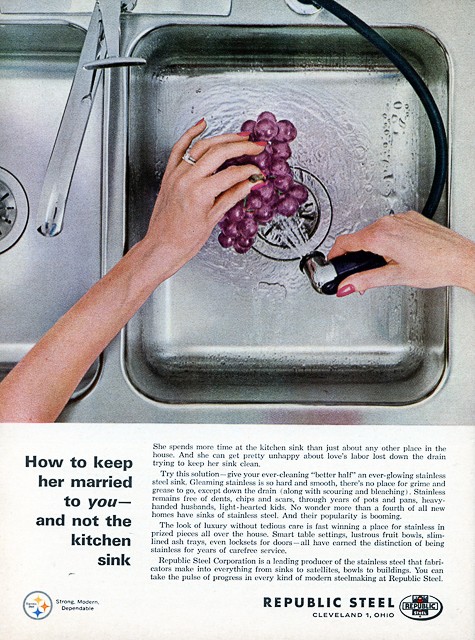
Mad Men-era Ads in Newsweek

Mad Men-era Ads in Newsweek

Posted on March 24, 2012 at 8:00 am

Newsweek salutes the long-awaited return of “Mad Men” with a special issue this week, including examples of real and unabashedly sexist ads that ran in the magazine back in the 1960’s.  These are what the real Mad Men of the era were working on, along with some pioneering and underpaid Mad Women like Peggy.

As another ad of the era would say, “We’ve come a long way, baby.”  (Of course, that was an ad for a “women’s” cigarette!“)

Related Tags:


Advertising Television Understanding Media and Pop Culture
Intro to “The Hunger Games”

Intro to “The Hunger Games”

Posted on March 19, 2012 at 3:59 pm

This week’s release of “The Hunger Games” is the most anticipated film of the spring and likely to be the biggest hit since the “Twilight” series.  It is based on the first of a wildly successful trilogy of books by Suzanne Collins.  For those who have not read the books, here is a brief introduction:


When and where does it take place?  It takes place in the future when North America has become a totalitarian country called Panem following an apocalyptic catastrophe.  Panem has a capitol city and thirteen numbered districts, each with its own specialty (lumber, mining, agriculture, textile, grains, etc.).

Who are the lead characters?  The book’s story is told by Katniss Everdeen, a 16-year-old who lives in the poor, coal-mining District 12 with her mother and younger sister, Prim.  They are very poor and ever since her father died, Katniss has been responsible for taking care of the family.  She is brave and loyal and a very skilled archer, hunter, and trapper, and uses those skills to find food for her family.  She is played in the film by Jennifer Lawrence.

Peeta Mellark also lives in District 12 and is the son of a baker.  He is kind-hearted and sympathetic and admires Katniss.  He is played in the film by Josh Hutcherson.

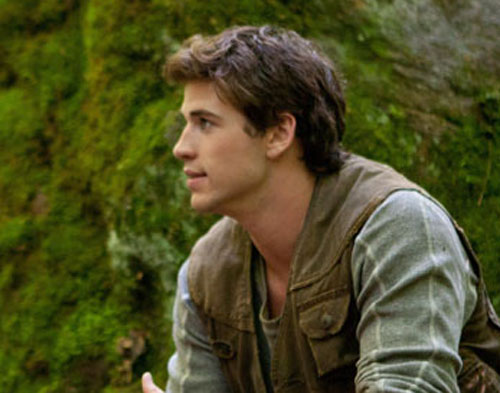
Gale Hawthorne is two years older than Katniss and has been her friend and has taught her how to hunt and helped her feed her family.  He is very responsible but angry at their circumstances and the unfairness of the government.  He is played in the film by Liam Hemsworth.

What are the Hunger Games?  The brutal leadership of Panem operates a system something between a gladiator fight and a reality television show each year called “The Hunger Games.”  Teenage boy and girl “tributes” are selected by lottery from each of the districts.  They are taken to the capitol where they are dressed up and prepared for a fight to the death that is nationally broadcast.  Katniss and Peeta compete in the games, advised by a previous champion, Haymitch Abernathy (Woody Harrelson).

What’s the deal with the bird pin?  Mockingjays are a unique hybrid species of bird in Panem.  Katniss wears a special mockingjay pin given to her by a friend from District 12 and the bird becomes a more important symbol later in the series and is the title of the final book in the series.


Related Tags:


Based on a book Books Understanding Media and Pop Culture

Marketing Legos to Boys and Girls

Posted on March 13, 2012 at 8:00 am

Thanks to my friends at the Campaign for a Commercial-Free Childhood for pointing me to this look at the different way Legos are marketed to boys and girls.  I love the way the website lets you make your own mash-up.

I understand that children and teenagers can exaggerate gender differences to establish a margin of safety as they attempt to understand the complexities of gender and culture and advertisers and their clients want to appeal to them.  But as shown most vividly in the viral video of the little girl who was furious that Toys R Us seemed to think she would only want toys that were pink, marketing this way reinforces a lot of stereotypes that are not appreciated by today’s children.

I like this commentary by CNN’s Mark Joyella:

The new range of girl-targeted Lego toys (by which I mean figures and accessories in addition to the classic blocks that date back decades) features such forward-thinking concepts of what girls want in a set of plastic blocks as a beautician, a pop star and a “social girl.”

I’ll admit all I know about girls is what I’ve learned from my daughter over the last eighteen months since her birth. But the idea of forking over any amount of money for toys that limit her vision to 1950’s stereotypes? C’mon, Lego. You can do way better than that.

As Bloomberg Businessweek’s Brad Weiners reported this week, “now, after four years of research, design and exhaustive testing, Lego believes it has a breakthrough in its Lego “Friends” … a full line of 23 different products backed by $40 million global marketing push. ‘This is the most significant strategic launch we’ve done in a decade,’ says Lego Group Chief Executive Officer Jorgen Vig Knudstorp.”

Four years of research to create a Lego beautician and a “social girl”? Didn’t Barbie pretty much cover that ground sometime before 1960?

These ads give families a good opportunity to talk about how commercials try to trick us into wanting and even thinking we need things and about the importance of asking ourselves who the messages are coming from and what the messages are.


Related Tags:


Advertising Commentary Elementary School Marketing to Kids Parenting Preschoolers Understanding Media and Pop Culture
THE MOVIE MOM® is a registered trademark of Nell Minow. Use of the mark without express consent from Nell Minow constitutes trademark infringement and unfair competition in violation of federal and state laws. All material © Nell Minow 1995-2026, all rights reserved, and no use or republication is permitted without explicit permission. This site hosts Nell Minow’s Movie Mom® archive, with material that originally appeared on Yahoo! Movies, Beliefnet, and other sources. Much of her new material can be found at Rogerebert.com, Huffington Post, and WheretoWatch. Her books include The Movie Mom’s Guide to Family Movies and 101 Must-See Movie Moments, and she can be heard each week on radio stations across the country.

Website Designed by Max LaZebnik