
Life of Pi

Posted on November 20, 2012 at 6:00 pm

B+
Lowest Recommended Age: Middle School
MPAA Rating: Rated PG for emotional thematic content throughout and some scary action scenes and peril
Profanity: Mild language
Alcohol/ Drugs: Wine
Violence/ Scariness: Scary shipwreck, frequent peril, deaths of characters and animals, some scary images including dismembered animals
Diversity Issues: Diverse characters
Date Released to Theaters: November 22, 2012
Date Released to DVD: March 11, 2013
Amazon.com ASIN: B005LAIIHG

“Oh God, thy sea is so great and my boat is so small.”

This classic Breton fisherman’s prayer describes “Life of Pi,” Ang Lee’s exquisitely beautiful fairy tale story of an Indian boy shipwrecked with a Bengal tiger, and their journey home.

The book by Yann Martel is an award-winning national best-seller, filled with meditations on life, faith, and zoos.  Pi, played as an adult by Irrfan Kahn and as a teenager by newcomer Suraj Sharma, was named Piscine Molitor after a swimming pool in France.  He insisted on shortening it to Pi after the kids at school teased him, and showed off by memorizing pi to the hundreds of places.  Pi’s family owned a zoo in Pondicherry, India, or, rather, the community owned the zoo and his family owned the animals.  When they must leave India, his parents sell most of the animals and pack up the rest  with Pi and his older brother to travel to Canada by ship.  On a stormy night, the ship sinks and, according to the story the adult Pi tells to a visitor, the only survivors are Pi, a zebra with a broken leg, a hyena, an orangutang named Orange Juice, and a Bengal tiger improbably named Richard Parker thanks to a clerical error and always referred to by his full name.  Soon, it is just Pi and the tiger.

Pi is an unusually thoughtful boy who considers himself at the same time a Hindu, a Moslem, and a Christian.  (This is described in much more detail in the book, including an amusing encounter between two of his teachers.)  His parents are not religious and his father jokes that if he picks up a few more faiths every day will be a holiday.  He is a thoughtful, observant boy who considers matters deeply and wants to understand.  In the lifeboat, he considers his options carefully, making an inventory of the food and equipment and lashing together a small raft to protect himself from the hungry tiger.  As it becomes clear that they will have to sustain themselves for an indefinite time, Pi uses what he knows about animals to establish his territory and earn the tiger’s trust.  In a sense, his life has been simplified to its essence, as everything — home, family, plans, community, food, water, — is taken from him.  In another sense, these losses open him up to a depth and spiritual richness that would not be possible in a busy world of connections and obligations.

Pi and Richard Parker weather storms.  They share unexpected riches when flying fish literally jump into their laps, and soul-expanding beauty, especially a great luminous leap by a whale the size of a motor home.

When he was a young boy, Pi tried to feed a tiger.  His father arrived just in time to prevent him from being the tiger’s lunch and gave him an unforgettable lesson by making him watch as the tiger attacked a live goat.  Pi insists that he can see the tiger’s soul in his eyes.  His father insists that there is nothing behind his eyes but the law of the jungle.  Pi has a great heart and the gift of faith.  Both are tested.  And it is only when everything he thought he could not live without is taken from him that he realizes how much he has gained, and how it is the troubles he has faced that have kept him alive.

The rapturous visual beauty of the film is itself a spirit-expanding experience.  The lyrical poetry of the images and the skillfully immersive effects surround us with a powerful sense of connection to the divine.

Parents should know that the plot concerns a boy lost at sea with a Bengal tiger and it includes sad deaths of family members and animals, some graphic and disturbing images, and extended danger and peril.

Family discussion:  Why does a character say the story will make you believe in God?  Which story do you prefer?  How did Richard Parker keep Pi alive?  What do we learn about Pi from his questions about the dance?  From his reaction to the island?

If you like this, try: the book by Yann Martel
Related Tags:


3D Action/Adventure Based on a book Drama DVD/Blu-Ray Pick of the Week Spiritual films

Wreck-It Ralph

Posted on November 1, 2012 at 6:00 pm

B+
Lowest Recommended Age: Kindergarten - 3rd Grade
MPAA Rating: Rated PG for some rude humor and mild action/violence
Profanity: Some schoolyard language
Alcohol/ Drugs: None
Violence/ Scariness: Cartoon-style action violence and peril, guns, explosions
Diversity Issues: Strong female and disabled character
Date Released to Theaters: November 2, 2012
Date Released to DVD: March 4, 2013
Amazon.com ASIN: B00A7OIXW6

No one wants to be the bad guy anymore.  In “Despicable Me,” Gru’s delightfully dastardly plans were no match for the overpowering adorableness of three little girls.  “Megamind” found that being the bad guy was no fun after he vanquished the hero.  Even the sharks in “Finding Nemo” became vegetarians, with support group meetings to chant, “Fish are friends, not food.”

And now there’s Ralph (John C. Reilly), having something of an existential crisis.  Back in the 80’s era of arcade video games, before people had home computers and game stations and televisions that were part computer and part game station to play on, if you wanted to play a game you had to go to an arcade and get a roll of quarters.  The primitive 8-bit games had a charm of their own, in part from the novelty of games on a screen instead of being based on mechanical balls and levers, and in part because their very simplicity left a lot of room for the player to fill in the details from his or her own imagination. The brilliant documentary The King of Kong: A Fistful of Quarters explains that in some ways these older games still provide more of a challenge — they continue to fascinate competitive players.
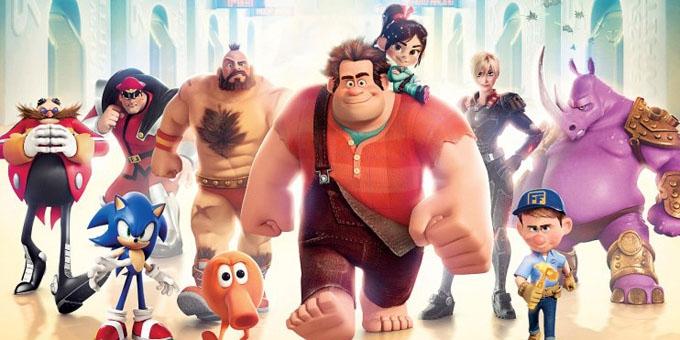
This is a marvelous environment for a story, whether you grew up with these games and recognize the in-jokes or haven’t played a game since Pong and Tetris, even those who do not know a Wii from a Playstation.  Wreck-It Ralph is so persuasively authentic it seems to be entirely at home with what has been referred to as “the Roger Rabbit of video games.”  Ralph keeps knocking down the building inhabited by the Webelo-like residents of Niceville, and the relentlessly cheerful Fixit Felix, Jr. (“30 Rock’s” Jack McBrayer), with the help of the quarter-loading player, rebuilds so fast that Ralph gets thrown off the roof of the building and everyone in Niceville has a party.  Ralph doesn’t break things to be mean.  It’s just his job.  It’s in his code.  He feels that he is as much a part of the game as Frank and the building inhabitants.  Ralph shares his conflicts with an adorable villain support group (love the zombie with axes attached to his hands).  But he wants more.

Ralph is just lonely.  He wants to go to the party.  He wants to make friends.  He wants people to like him.  But just as he is coded to break things, the Niceville residents are coded to be scared of him.  Just to get rid of him, one of them tells him that if he can win a hero’s medal, he can be their friend.  So Ralph leaves his game to find a place where he can be a hero.

Ralph visits an intense and violent military game called Hero’s Duty with a tough female commanding officer named Calhoun (Jane Lynch).  She is “programmed with the most tragic backstory ever” and probably inspired by video game voice star Jennifer Hale, the combination Meryl Streep and Angelina Jolie of the video game world.  Everything seems to go according to plan until he somehow ends up in Sugar Rush, a game for children that looks like NASCAR if it was designed by Katy Perry.  Adorable little children race cars made out of candy and cookies.

Maybe not so adorable.  Just as Ralph is not so bad, the cute little kids of Sugar Rush are not so sweet.  He is annoyed by Vanellope (Sara Silverman), a bratty little girl, but then joins forces with her to help her build a race car.  And then he meets the “heroes” of Sugar Rush and finds that the line between good guy and bad guy is not what he thought it was.

The witty and vibrant worlds are gorgeously imagined (and of course now available in game form themselves), with a satisfying balance of heart and humor.  The story nimbly mixes existential questions of identity, purpose, and destiny with a sweet friendship and knowing humor about the world of games and gamers and even some Joseph Schumpeter-style creative destruction.  I loved the Mentos jokes and the detour to the car-building site.  And I loved the constant playing with almost Pirandello-esque notions of the way we create our worlds and the assumptions that underly them.

Parents should know that this movie includes video game violence with guns and explosions, some mildly disturbing images, characters in peril, and some potty humor.

Family discussion:  How do you know what is “in your code” and what you can change?  Can a bad guy become a hero?  What did Ralph learn from Vanellope?  Why did Vanellope love her car?

If you like this, try: Two more movies with bad guy-good guys, “Despicable Me” and “Megamind,” as well as “King of Kong,” the brilliant documentary about a video game competition.

Related Tags:


3D Action/Adventure Animation Comedy DVD/Blu-Ray Pick of the Week For the Whole Family

Secret of the Wings

Posted on October 19, 2012 at 9:32 am

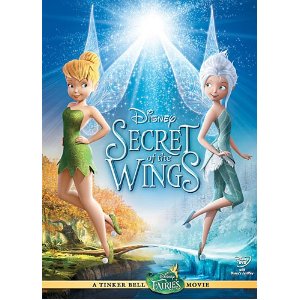
Where do fairies come from?  When a baby laughs, a fairy is born.  And Tinker Bell (Mae Whitman) learns in this sweet animated tale that the baby’s laugh that gave her life must have been extra merry because two fairies appeared.  The Secret of the Wings is that Tink has a sister she never knew she had in a place she has never been.

Tinker Bell is a summer fairy who lives happily with her friends.  But she is curious about the adjoining land of the winter fairies.  Summer fairies send baskets of food across the bridge where the frost fairies live in a land covered with ice and snow.  Animals can cross over, too, but fairies are forbidden from entering each other’s lands by order of Lord Milori (Timothy Dalton), who is the ruler of the winter fairies.  Tinkerbell disobeys the rules and discovers a fairy named Periwinkle (Lucy Hale), who turns out to be her twin.  They instantly bond and are delighted to get to know one another.  “You collect lost things, too?”  “I call them found things!”

But summer fairies can be injured by the cold temperatures.  And when Periwinkle comes to visit Tinker Bell, even Tink’s clever contraption for keeping Peri cool is not enough to protect her from the damage caused by the warm climate.

The Disney artists have created two enchanting lands with pause-button-worthy details and swooping 3D effects.  The sweet story is unfortunately marred by brief boy-girl silliness, but Tink herself is an independent, resourceful, and loyal heroine.  She is respectful but willing to question authority, she is curious — I liked seeing her go to the library to do research — and she is skilled with tools and good at solving problems.  The sparkly twins will delight children and the grown-up voice talent like Dalton and Angelica Houston and imaginative visuals will give parents something to enjoy as well.


Related Tags:


3D Animation Fantasy Series/Sequel

Frankenweenie

Posted on October 4, 2012 at 6:00 pm

B+
Lowest Recommended Age: 4th - 6th Grades
MPAA Rating: Rated PG for thematic elements, scary images, and action
Profanity: Schoolyard language
Alcohol/ Drugs: None
Violence/ Scariness: Ghoulish horror images and some peril
Diversity Issues: Diverse characters
Date Released to Theaters: October 5, 2012
Date Released to DVD: January 6, 2013
Amazon.com ASIN: B005LAIIA8

Mary Shelley’s Victor Frankenstein was a scientist who wanted to create life.  Tim Burton’s Victor Frankenstein is a kid who just wants his dog back.

Writer/director and master of the macabre Burton first developed this idea in a 1984 live action short film that got him fired by Disney because it was too scary for children.  Times have changed, and Disney came to Burton to ask him to develop a feature length remake in 3D stop-motion — and in black and white.  Burton, who had worked in black and white (“Ed Wood”) and stop-motion animation (“The Corpse Bride,” “The Nightmare Before Christmas”) tells a deliciously ghoulish story with visual wit, panache and a lot of heart.

It is, after all, the story of a boy and his dog.  Victor (Charlie Tahan) is a bit of a loner and his dog Sparky is his best friend.  When Sparky is killed by a car, Victor decides to harness the power of lightning to try to bring him back to life.  At first, it does not seem to work, but then Sparky’s tail starts wagging.  And then it wags itself off.  “I can fix that!” the happy Victor reassures his re-animated pet.  It’s just a matter of a few quick stitches.

One of Victor’s classmates is Edgar “E” Gore (“The Middle’s” Atticus Shaffer), a mishappen but cheerful kid fascinated with creepy things.  (His name is “E” Gore, get it?)  He pressures Victor to tell him what happened and soon all the kids are trying their own experiments.  And then, perhaps because their hearts are not as pure as Victor’s (they want to win the science fair), because they are not as careful and knowledgeable, or just old-fashioned hubris, that is when things begin to go terribly wrong.

This first-ever black and white stop-action animated film is a visual treat with dozens of witty details.  I loved it when Sparky’s poodle doggie crush next door (they have a Pyramus and Thisbe-style fence between them) gets enough of an electronic jolt to give her fur white streaks in tribute to Elsa Lanchester’s iconic Bride of Frankenstein.  Martin Landau, who won an Oscar in Burton’s “Ed Wood,” gives a delicious performance as Victor’s teacher.  Burton’s own pleasure in the twisted and demented is evident in the comic grotesquery of the characters.  One creepy little girl insists on seeing omens in her cat’s poop, and when Victor’s classmates try to appropriate his methods, things go bizarrely off-kilter.  It does not reach the poetry of “A Nightmare Before Christmas,” but there are plenty of tricks and treats.

Parents should know that this film has ghoulish and macabre themes inspired by classic monster stories, children and adult characters in peril, a sad death of beloved pet, some potty humor, some violence and disturbing graphic images, and some schoolyard language.

Family discussion:  How is this story most like the original “Frankenstein?”  How is it most different?  Which monster is the scariest and why?  Why was it hard for Victor to make friends?

If you like this, try: “ParaNorman,” “Monster House,” “Beetlejuice,” and “The Nightmare Before Christmas”


Related Tags:


3D Animation DVD/Blu-Ray Pick of the Week Fantasy Horror Remake Stories About Kids

Hotel Transylvania

Posted on September 27, 2012 at 6:00 pm

B
Lowest Recommended Age: 4th - 6th Grades
MPAA Rating: Rated PG for some rude humor, action, and scary images
Profanity: Some schoolyard language
Alcohol/ Drugs: None
Violence/ Scariness: Funny-scary monsters
Diversity Issues: A theme of the movie
Date Released to Theaters: September 28, 2012
Amazon.com ASIN: B0034G4OYA

What scared me most about “Hotel Transylvania” was the prospect of another film starring Adam Sandler and Andy Samberg.  Their last collaboration was “That’s My Boy,” by far the most excruciatingly painful experience I’ve had at a theater this year. Thankfully, just providing voices for this PG animated horror comedy written by five other people, Sandler and Samberg are charming.  It is a sweet, funny story about monsters who want to enjoy a peaceful life far from humans and the human who finds them anyway.

Sandler plays Count Dracula, a doting if over-protective vampire father who builds the hotel as a refuge so he and his daughter Mavis (Selena Gomez) can be safe from scary people with their pitchforks and torches.   Dracula croons a tender lullaby: “Hush little baby, don’t say a word, papa’s going to bite the head off a bird.”  Next to the changing table is a coffin-shaped diaper pail.

Mavis gets a little older, with cute little baby tooth fangs, and her caped father makes sure she’s wearing a helmet before he teaches her how to transform into a bat and fly.  The hotel is a castle surrounded by a haunted forest and a graveyard populated by the undead. “Human-free since 1898,” the hotel proudly proclaims.  And so things stay for over a century.

This Dracula has no need for human blood (“it’s so fatty and you don’t know where it’s been”).  He relies on synthetic.  All he wants is to take care of his guests, give his daughter a wonderful 118th birthday party, make sure she never leaves home, and never, ever see a human.   But then, just as all of the monsters have arrived for the party, an easy-going bro with an enormous back-pack walks in.  His name is Jonathan (Samberg), he thinks the monsters are cool, and he likes Mavis’ goth-girl vibe.  This is worse than torches and pitchforks.  A human who wants to get rid of monsters is one thing but a daughter who might fall in love with one is even scarier.  And yes, there a wink at “Twilight.”

Of the three animated horror 3D comedies this fall, “Hotel Transylvania” is the least aesthetically ambitious, the most accessible for younger children, and the closest to the comfortingly silly scares of “Scooby-Doo.”   Like this film, “ParaNorman” (now in theaters) and “Frankenweenie” (opening next week), the focus is on showing us that what we think is scary really is not very frightening after all.  Of the three, this one has more all-out comedy, much of it coming from the monster-fied setting and the ghoul-ification of ordinary life.  At Hotel Transylvania, the Do Not Disturb signs hanging from the doorknobs are shrunken heads — very outspoken ones.  Mavis likes to eat “scream” cheese, which amusingly rises up from the cracker to let out a squeal as she takes a bite.  Guests are greeted by zombie bellman, a Jack Pumpkinhead doorman, and a skeleton mariachi band with hats and sarapes.  When the Invisible Man (David Spade) attempts to play charades, it is a hoot.

First-time director Genndy Tartakovsky was a storyboard artist on films like “Iron Man 2,” so he has an exceptional understanding of the mechanics and timing of the action sequences, and 3D adds a vertiginous thrill to a chase on flying tables and a touch of claustrophobia to a maze of underground corridors.  It is telling that both of those highlights involve the most vivid vampire/human relationship at the heart of the story — Dracula and Jonathan. Despite a lot of talk about romantic “zing,” the bromance is much more real than the love story.  And when they leave the castle for that most overused of climax cliches, the race to the airport, the story sags.

Top voice talent includes Kevin James as a sweet-natured Frankenstein and Fran Drescher as his bride, Steve Buscemi and Molly Shannon as the Wolf couple with innumerable cubs, and Ceelo Green as the outgoing Mummy.  But the real stars are character designers Carter Goodrich (“Despicable Me”), Greg Kellman (“Madagascar”), and Carlos Grangel (“King Fu Panda”), whose monsters pay affectionate homage to their origins but are so endearing that families may want to pay a visit to have room service deliver an order of scream cheese.


Parents should know that the monsters in this movie are intended to be more funny than scary but there are some grotesque and macabre images that may be frightening to young or sensitive children as well as some potty humor and peril.

Family discussion: Why was Dracula so afraid to let Mavis leave home?  How can parents know when their children are ready for more responsibility?  Which monster was your favorite?

If you like this, try: “ParaNorman,” “Monster House,” “Monsters vs. Aliens,” and “Scooby-Doo”


Related Tags:


3D Animation Comedy Fantasy Movies -- format Romance
THE MOVIE MOM® is a registered trademark of Nell Minow. Use of the mark without express consent from Nell Minow constitutes trademark infringement and unfair competition in violation of federal and state laws. All material © Nell Minow 1995-2026, all rights reserved, and no use or republication is permitted without explicit permission. This site hosts Nell Minow’s Movie Mom® archive, with material that originally appeared on Yahoo! Movies, Beliefnet, and other sources. Much of her new material can be found at Rogerebert.com, Huffington Post, and WheretoWatch. Her books include The Movie Mom’s Guide to Family Movies and 101 Must-See Movie Moments, and she can be heard each week on radio stations across the country.

Website Designed by Max LaZebnik