
The Twilight Saga: New Moon

The Twilight Saga: New Moon

Posted on March 16, 2010 at 8:00 am

“You’re good with weird,” a character tells Bella mid-way through “The Twilight Saga: New Moon.” That’s an understatement. In the first Twilight movie, as in the first of the series by Stephanie Meyer, high school student Bella Swan (Kristen Stewart) moved to the rainiest town in the US, Forks, Washington and fell deeply in love with Edward (Robert Pattinson), who looked like a teenager but was in fact a vampire who was more than 100 years old. He and his “family,” the Cullens, are sort of vampire vegetarians, living on animal blood. But there are other vampires who continue to prey on humans, and they almost killed Bella before Edward rescued her. And then they lived happily ever after until it was time for another book/movie, and that is where we begin.
Edward, convinced that their relationship will always put Bella in danger, leaves, telling her he will never see her again. She is devastated and isolates herself from everyone. She discovers that Edward appears to her when she is in danger, so she takes some foolish risks, just to feel close to him. But then the quiet support and gentle teasing of her friend Jacob (Taylor Lautner) begin to make her feel that she is able to be a part of the world again.
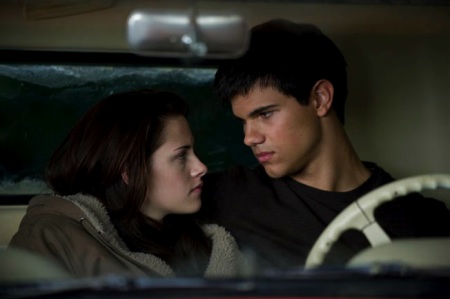
bella-jacob-072309.jpg Like Edward, Jacob loves Bella and would do anything to protect her. And like Edward, Jacob has a secret. He is part of a tribe of wolf-people. Like “The Hulk,” his anger manifests itself in a powerful transformation. And Bella finds herself at the center of a centuries-old war between the vampires and the wolves.
The wildly popular Twilight Saga has the core elements of girl-friendly romances from “Wuthering Heights” to “Titanic:” a boyfriend who is not approved by parents who is utterly undone by the appeal of the female lead, and something to make sure that their relationship is about longing, not satisfaction. Just in case you aren’t paying close attention, we see Bella sleeping with a copy of “Romeo and Juliet” on her pillow, and her English class watching a video of the play. The teacher calls on Edward to recite one of Romeo’s speeches. And later, Edward, like Romeo, believes that his love is dead and decides he cannot live without her.
There is a lot of longing. Characters exchange meaningful looks and take an extra beat before responding to allow for some strategic intakes of breath and swelling of the score. There are moments that are more perfume commercial than movie. And as in the book, this big love Bella and Edward feel is expressed mostly in talking about the big love they feel. In a way, this is wise; we never see them doing or seeing anything that would interfere with our ability to project onto them whatever the specifics of our own fantasies of love look like. All we know or need to know is that Bella and Edward have the big, total, all-encompassing, would do anything for each other love. Just like Romeo and Juliet.
And we have Lautner’s excellent abs, which play such a significant role they should have their own billing. Lautner also has an easy confidence and sincerity on screen that nicely leavens the intensity and drama of the Bella-Edward connection. The screenplay is seasoned with some humor and a reference to self-referential cleverness that is almost meta.
New director Chris Weitz does not have Catherine Hardwicke’s feel for the rhythms of teenage interactions and the intensity of teen romance. And he does not have her ability to tell the story through the settings; we miss the lush natural world of the first chapter. Weitz and screenwriter Melissa Rosenberg also have to grapple with a transitional story that translates less well to screen than the first one. But the film benefits from his greater experience with special effects and a bigger budget. He catches the spirit of the story and allows the natural chemistry between his leads do the rest. And that is enough to make this movie enormously enjoyable and keep us looking forward to the next one.

(more…)

Related Tags:


Based on a book Fantasy Romance Series/Sequel

The Princess and the Frog

Posted on March 15, 2010 at 8:00 am

A-
Lowest Recommended Age: 4th - 6th Grades
MPAA Rating: G
Profanity: None
Alcohol/ Drugs: Social drinking
Violence/ Scariness: Some scary images including skeletons, voodoo, alligators, characters in peril, sad deaths
Diversity Issues: Diverse characters, strong female characters
Date Released to Theaters: December 11, 2009
Date Released to DVD: March 16, 2010
Amazon.com ASIN: B0034JKZ86

Disney has cooked up a yummy batch of gumbo with this blend of the past and present. “The Princess and the Frog” is a satisfying and thoroughly entertaining return to the hand-drawn animation that built the studio. Although it is set in 1920’s New Orleans, it has a modern twist with the studio’s first African-American “princess” — and this is not a heroine who warbles about waiting for the prince to come and rescue her. This is a working woman and the prize she has her eyes on is not some happily-ever-after fairy tale wedding. She wants to run her own business — a restaurant. Like Gepetto, she wishes on a star, but as her father advises her, “that old star can take you only part of the way. You have to help it out with hard work of your own.”

We first see Tiana as a little girl, playing with a good-hearted but spoiled little girl named Charlotte. They enjoy listening to Tiana’s mother, Eudora (Oprah Winfrey) read them the story about the princess who kissed a frog and turned him back into a prince. But Charlotte is wealthy and Eudora is employed by her father (John Goodman) as a seamstress. Tiana’s family may have modest means, but her parents love her dearly and she shares her father’s passion for cooking that signature New Orleans dish, gumbo.

When she grows up, Tiana (Aniki Noni Rose of “Dreamgirls” and “The No. 1 Ladies Detective Agency”) is working hard, determined to make her father’s dream of a restaurant come true. (It is implied that he was killed in World War I.) So she works two jobs while her friends tease her about not having any fun.

Meanwhile, Prince Naveen (Bruno Campos of “Nip/Tuck”) arrives in town, hoping to marry a rich woman but much more interested in playing music and having fun. When he is turned into a frog by Voodoo villain Dr. Facilier (“Coraline’s Keith David), he must find a princess to break the spell. That does not include Tiana, even though she is dressed like a princess at Charlotte’s masquerade ball. He persuades her to kiss him by promising to give her the money she needs to get the building for the restaurant. Since she is not a princess, it goes wrong and she turns into a frog instead.

And that puts them on a journey through a swamp to find a way to become human again. At first the free-wheeling prince and the serious-minded would-be restaurateur have little in common. But soon, as they make new friends (a horn-blowing alligator named Lou and a brave firefly named Ray) and try to keep away from frog-hunters and other dangers, they discover that they get along. They inspire each other to be their best but they like each other for who they are. And that, it turns out, is the real magic.

There is some real Disney animation magic in the details of the settings, especially the jaunty New Orleans of the Roaring 20’s and a musical number in the swamp with fireflies that is heart-stoppingly lyrical. The lively score by Randy Newman pays tribute to the vitality of New Orleans influences, with some zydeco spiciness, but there is sweetness as well, especially when she sings about her dream for the restaurant and imagines what it will be like.

Because this is Disney’s first African-American princess, there has been some extra scrutiny and some extra sensitivity. Some have already been critical of the film because Tiana is not a “real” princess, because she spends a good bit of the story neither black nor white but green when she is a frog, and because her romantic interest is not African-American but from the fictional European country of Moldavia (Campos is from Brazil). There will also be criticism because of the voodoo (with some scary skeletal images) and SPOILER ALERT this is the first Disney film in my memory where one of the key sidekick characters is actually killed by the villain.

I like the fact that Tiana is not a “real” princess like Jasmine, Snow White, Sleeping Beauty, and Ariel. Like Belle, she is non-royal, but romantically involved with a prince. More important, she is an independent, self-supporting, hard-working woman with ambition that goes beyond some sort of romantic rescue. The movie lightly touches on but does not ignore the racism of the era. I like the inter-racial romance (and note that the only other loving couple is Tiana’s parents, both African-American, voiced by Winfrey and Terrance Howard). Setting the story in New Orleans, an exceptionally diverse city, and in the 1920’s, an era of great creative vibrancy, was an especially clever idea. As for spending most of the movie as a frog; well Mulan spent most of her movie as a man. Transformation is at the heart of fairy tales. And in her human form, Tiana is as lovely as any Disney character in history, without being squeezed into a wasp-waist and harem pants like Jasmine. I have some smallish quibbles with the voodoo villain and some overly complicated plot twists, and a more medium-sized quibble with the death of a character. Though it is handled with some grace, it is still unnecessary and likely to upset some younger audience members.

But the movie is genuinely enchanting and the old-fashioned, hand-drawn, 2D animation has a timeless quality that makes us feel welcome. It turns out you don’t need CGI and 3D to feel that you can almost smell that spicy gumbo.

Related Tags:


Animation Based on a book Comedy Drama DVD/Blu-Ray Pick of the Week Musical

Precious: Based on the Novel Push by Sapphire

Posted on March 12, 2010 at 3:57 pm

Claireece (newcomer Gabourey ‘Gabby’ Sidibe) is a 16-year-old, still in middle school, illiterate, pregnant with her second child. The first baby has Down Syndrome. Both pregnancies are the result of rape by her own father. She is subjected to constant physical, emotional, and sexual abuse and has retreated so far inside herself that she barely exists in the world. And in a cruel parody of tenderness, she is called by her middle name, “Precious.” In a cruel demonstration of the constrictions of her world, Precious knew no other name to give her Down Syndrome child than “Mongo.”

Inside 350 pounds of weight, a moat of flesh, her wall against the world, Precious hides as far from everyone as she can go. She has little wisps of dreams cobbled together from television, a light-skinned boyfriend, a stroll down a red carpet, surrounded by cameras and adoring fans. But she is so limited in experience and opportunity that she literally cannot imagine a genuine alternative to what she has. She does not even know what the word “alternative” means. When the middle school principal arranges for her to attend a special “each one teach one” alternative school, someone has to explain to her what an alternative is. It is, a distracted administrator tells her, “a different way of doing.” And it is that recognition, more than the program itself, just the realization that there are different ways of doing, that leads her to understand that there may be choices available to her.

Seeing Precious understand for the first time that she is worthy of love and capable of learning is the expected pleasure of this movie. But it is also the challenge of the film. Even slightly toned down from the novel, by poet and teacher Sapphire, the abuse is so relentless, so outrageous, even beyond the usual struggles we see in fiction and on the talk shows and tabloid covers.

They thrive on exploitative confessions, a secularized testimony that tries to disinfect the prurient pleasures of wallowing in degradation and tragedy with the superficial pieties of simplistic redemption. The post-production sign-on of Oprah Winfrey and Tyler Perry as producers, both survivors of abuse and highly successful purveyors of abuse melodrama, is a sign to be wary. And even with a sensitive performance by Sidibe, this film would risk falling into that trap of easy sentimentality. That it does not is due to one character and one actress, comedienne Mo’Nique in her Oscar-winning, fearless portrayal of the mother, a monster named, with grim irony, Mary.

Two key scenes in the film focus on Mary’s interactions with social workers. In the first, like a theatrical director, she barks out orders to set the stage for a visit, casting herself in the role of a loving grandmother, to persuade the social worker that she is doing everything necessary to qualify for welfare payments for her extended family. Where moments before she seemed completely out of control, wavering back and forth between stupor and rage, when she has to pull it together, she does, slapping on a wig and cuddling the baby. The instant the door shuts, the monster returns.

And then, near the end, in another meeting with another social worker (beautifully underplayed by pop diva Mariah Carey), Mary starts to talk and for the first time we see her as the victim as well as the inflicter of damage. In a monologue she seems to forget where she is and who she wants to appear to be and opens herself up in a moment so raw, so naked, so vulnerable that it takes the entire film to a different level.

Director Lee Daniels, like his producers Winfrey and Perry, brings a sincerity to telling these stories that tempers the potential for exploitation. He has a sure, if unconventional, eye for casting. In addition to Mo’Nique and Carey, he gets small jewels of performances from talk-show and sit-com star Sherry Shepherd as the alternative school administrator and musician Lenny Kravitz as a sympathetic nurse. The lovely Paula Patton brings understated grace to the role of the alternative teacher, and the assortment of young performers who play the classmates at Each One Teach One manage to avoid the “Welcome Back Kotter” syndrome and evoke full characters. But Mo’Nique’s fierce and fearless performance as Mary holds the story together and takes it to another level. She does not let us hate her because she does not let us compartmentalize her. By opening herself up on screen, she forces us to look into the source of her damaged heart. And that moment, more than any other, shows us what Precious has had to overcome.

Related Tags:


Based on a book Drama Family Issues

Up in the Air

Posted on March 9, 2010 at 8:00 am

To the list of the biggest lies of all time (“The check is in the mail,” “I’ll still respect you in the morning,” etc.) this must now be added: “All the answers are in your packet.”

No, they aren’t. Many answers are in the packet you get handed after someone tells you that your position at work no longer exists, but they do not tell you anything about the questions you care about most: Will I get another job? How will I pay my bills? Did anything I did here mean anything at all?

Most people in that position will not be asking questions about the person who is handing them the packet, but “Up in the Air,” based on the novel by Walter Kirn, he is our hero. Close enough, anyway, as he is played by George Clooney, whose sleek movie star glow and perfect tailoring give his character a surface perfection that contrasts with his struggle to hold onto his freedom and make sure nothing holds onto him. For him, being a professional brought in by corporate management to fire people in massive layoffs is the perfect job, each relationship with an almost-immediate ending.

Clooney plays Ryan Bingham, a man who is most at home away from where he lives. Even the most generic of hotel rooms has more personality than his apartment, too personality-less even to be considered spare. The 290 days he spent on the road last year were the ones where he felt most connected, most authentic, most at home. In his apartment, he feels rootless. What he loves about travel is the thousands of micro-encounters, all encapsulated into tiny predictable pieces. His affinity points at hotels and airlines gets him an extra “Nice to see you again, Mr. Bingham!” with a smile as fake as Bingham’s assurances that the answers are in the packet. But it is the very fake-ness of it that makes Bingham feel at home because he understands it and it understands no more about him than he wants it to.

At one point in the movie, his sister, who is about to be married, sends him a cardboard cut-out photograph of herself with her prospective husband so that Bingham can take pictures of it in different locations for a scrapbook they are creating instead of the honeymoon trip they can’t afford. Reitman creates a nice, understated contrast between the artificiality of the “travels” by the cardboard duo and Bingham and his fellow road warriors.

Bingham is not the first person and certainly not the first movie character to think that he can get through life with maximum efficiency, with as little weighing him down or holding him back as possible. He has systems for maximizing momentum and minimizing inertia from a small group of impeccable and virtually identical suits to the formula for getting the most out of frequent flier miles. When he finally meets a woman (Vera Farmiga) who speaks his language — their flirty banter about who has more prestige points and which hotels have the best amenities is more delicious than a warm chocolate chip cookie at your check-in — part of what makes it fascinating is that neither Bingham nor the audience can tell at first whether this is just one more frictionless encounter or a connection that will make him re-think his attachment to being unattached. Farmiga matches two-time Sexiest Man Alive Clooney’s rhythms perfectly, and watching these two glossy creatures circle and parry is one of the great cinematic pleasures of the year.

In one respect, Bingham harks back to the iconic American cowboy, alone in the wilderness. In another he is the essence of 2009, in the one sector of the American economy that is benefiting from the catastrophic avalanche of failure that will forever identify the end of this milleneum’s first decade. Co-screenwriter/director Jason Reitman (“Thank You for Smoking,” “Juno”) shrewdly puts Bingham in the middle between his tantalizingly silky no-strings counterpart and a spooky, Scrooge-like vision of another aspect of himself. A young, ambitious newcomer (a superb Anna Kendrick) to his office has an idea about how to save money by being even more ruthlessly efficient. Why do all that flying when you can fire people by video chat?

Reitman continues to populate his films with characters we want to know better and actors who make even small parts into gems of poignancy and meaning. Melanie Lynskey, Danny McBride, Jason Bateman, and J.K. Simmons are irresistible, but there is also a mosaic of reactions from the newly terminated that is even more unsettling when you find out that these are real-life survivors of lay-offs, recruited by Reitman for what they thought was a documentary about the impact of the economic crisis. And be sure to stay through the credits for another telling real-life moment.

“Up in the Air” is very much of its time but it is also one of the best films of the year for its sympathetic and layered understanding of the issues that affect us in good and bad economic times and its recognition that it is here, in these stories, where the questions left unanswered in the packet are explored.

Related Tags:


Based on a book Drama Romance

Ponyo

Posted on March 2, 2010 at 8:00 am

Hayao Miyazaki has produced another trippy fantasia, this time a fish out of water story along the lines of “The Little Mermaid.” A little girl goldfish with magical powers loves a little boy and turns herself into a human, by ontogeny recapitulates phylogeny-mode stopping at a few evolutionary species along the way and sometimes reverting back to chicken feet in times of stress.

The boy is Sosuke (Frankie Jonas) and he dubs the fish Ponyo (Noah Lindsey Cyrus). In a bit of stunt casting, both main character voice talents are the younger siblings of Disney mega-pop stars. Ponyo’s father (voice of Liam Neeson), angry over the human’s mistreatment of the oceans and concerned that her leaving may upset the balance of the world, wants her back in her original fishy form. A storm rises and creates enormous flooding. While Sosuke’s mother Lisa (Tina Fey) is taking care of the wheelchair-bound elderly women at the nursing home (voices include Betty White and Cloris Leachman), Ponyo uses her magic to enlarge Sosuke’s toy boat and they go out onto the water.

Stunning bursts of imagination and sensational, almost psychedelic images make the film a garden of unearthly delights. The undersea settings, including the flooded village, are filled with intricate detail and grand concepts, like waves that turn into enormous leaping fish. Ponyo uses her new feet to race across the tops of the waves in a moment of pure exhilaration. The images are visually rich and engrossing and the tenderness between the two children is affecting. But they are also at times disconcertingly grotesque and as in past films Miyazaki cannot make visual splendor compensate for moments in the storyline that are random and inconsistent.

Related Tags:


Animation Based on a book For the Whole Family
THE MOVIE MOM® is a registered trademark of Nell Minow. Use of the mark without express consent from Nell Minow constitutes trademark infringement and unfair competition in violation of federal and state laws. All material © Nell Minow 1995-2026, all rights reserved, and no use or republication is permitted without explicit permission. This site hosts Nell Minow’s Movie Mom® archive, with material that originally appeared on Yahoo! Movies, Beliefnet, and other sources. Much of her new material can be found at Rogerebert.com, Huffington Post, and WheretoWatch. Her books include The Movie Mom’s Guide to Family Movies and 101 Must-See Movie Moments, and she can be heard each week on radio stations across the country.

Website Designed by Max LaZebnik