
For Mother’s Day: Irene Dunne in “I Remember Mama”
Posted on May 12, 2013 at 3:40 pm
Posted on May 12, 2013 at 3:40 pm
Posted on May 9, 2013 at 6:00 pm
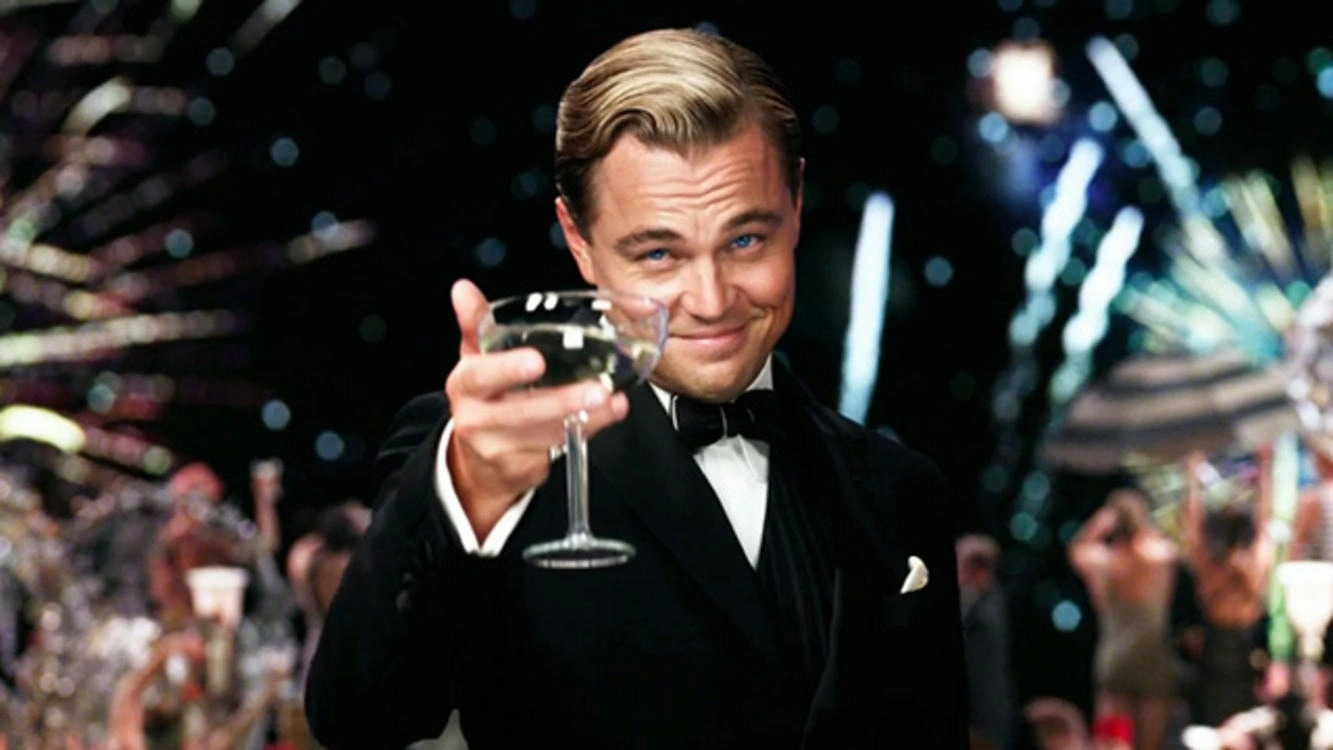
Kids, here’s a hint: Don’t think you can pass a sophomore English exam on F. Scott Fitzgerald’s jazz age classic and high school reading list perennial by watching this movie. While this version of the story of a man who changes everything about his life so that he can win back the woman he loves hits the Cliff’s notes highlights, spending more time on the green light on the dock than Gatsby and on the eyeglass billboard than Nick Carraway, co-writer and director Baz Luhrmann misses the forest for the trees. His trees are fun to look at, though. 
It goes off the rails from the very first moment, when it turns out that narrator Nick Carraway (Tobey Maguire) is telling the story in a snow-covered sanitarium, presumably because the events he is about to disclose are so traumatic they have caused him to have a breakdown. Or, perhaps this is Luhrmann’s way of eliding Carraway with Fitzgerald himself, though there is no indication that Fitzgerald wrote this book as therapy.
The more significant violation, though, comes from the mangling of the book’s famous opening lines. Like the book, the movie begins with Carraway telling us that his father warned him not to judge people. But it leaves out the most important part — the reason why. “In my younger and more vulnerable years my father gave me some advice that I’ve been turning over in my mind ever since. ‘Whenever you feel like criticizing anyone,’ he told me,‘just remember that all the people in this world haven’t had the advantages that you’ve had.’” This is crucial for understanding the way Nick looks at Gatsby and his rival, Tom Buchanan. But Luhrmann inexplicably does not think it is worth including.
Perhaps it is because he is so eager to get to what matters to him, the pageantry. He is the genre/mash-up “Moulin Rouge” guy whose motto seems to be “more is still not enough, even with glitter on it. And firecrackers. And 3D. And Jay-Z.”
The story takes place in 1922. Nick is a WWI veteran who has literary tendencies but is working at a low-level job “in bonds” on Wall Street. He is living in a small cottage in the Hamptons, next door to a vast mansion owned by a mysterious man named Jay Gatsby (Leonardo DiCaprio), who gives fabulously decadent parties but is seldom seen. They are across the bay from the old-money side, where Nick’s cousin Daisy (Carey Mulligan) lives with her wealthy, upper class, polo-playing brute of a husband, Tom Buchanan (Joel Edgerton). He is having an affair with Myrtle (Isla Fisher), the restless wife of the struggling owner of a garage.
It turns out that Daisy and Gatsby knew each other five years earlier, when he was in the military and before she was married to Tom. But “rich girls don’t marry poor boys.” Gatsby has changed everything to change himself into the man Daisy could have married. He lives across from her home so he can look toward her (and the green light on her dock). He hopes that his parties will lure her to his home. When he discovers that his neighbor is her relation, he goes to great lengths to assure Nick that he is trustworthy and to persuade Nick to invite him to tea with Daisy, so he can see her again. He is convinced that they can erase the past and go on together as though five years that included her marriage and child never happened. Nick admires Gatsby for his ability to hope. And in Lurhmann’s version, that is a quality that more than makes up for the compromises and selfishness of Gatsby’s single-minded quest.
Of course, thoughtful consideration of issues like those is not the purpose of this film. It is a confetti gun of a movie, all sensation and senseless mash-up. The party scenes and period details are gorgeous for the sake of gorgeousness, with no sense of perspective or irony. Fitzgerald, who had a love-hate relationship with wealth and status, had some ambivalence in his descriptions of the characters luxuries, but in general Lurhmann’s portrayal of the negligent opulence of the old money Buchanans and gauche display of the new money Gatsby is somewhere between awe and envy. The Jay-Z-produced soundtrack is not as anacronistically intrusive as one might fear, only because the sensory overload barely allows it to register. But it is thin compared to the book. Fitzgerald’s carefully chosen songs and the lyrics of the era that he included are far more evocative and illuminating as words on a page than all of the thump thump thumping of the music we hear.
Luhrmann may be trying to make some point with the marginalization of African-American characters, relegated to playing music, dancing, and looking on at what the white folks are doing from tenements. But it is distracting and unsettling to see them treated as just another set of props. But then, the white characters are not much more than props, either, with a director more interested in posing them and moving the camera than in any kind of performance. Daisy’s friend Jordan (Elizabeth Debicki), impossibly long and thin, is like a Giacometti sculpture towering above mere mortals. DiCaprio has some affecting moments, but seems too old and too sleekly comfortable for the role.
After at least five unsuccessful attempts to make this novel into a movie, it may be time to declare it unfilmable. There is no cinematic equivalent to Fitzgerald’s voice. This is not “The Great Gatsby.” It’s an often-visually pleasing kaleidoscopic music video with a 3D shower of shirts.
Parents should know that the movie features violence including murder, suicide, a fatal traffic accident, and domestic abuse, also drinking and drunkenness, pills, smoking, sexual situations that are explicit for a PG-13, and brief strong language including racist and anti-Semitic epithets.
Family discussion: What do the green light and the billboard symbolize? Why does Nick say that Gatsby is hopeful?
If you like this, try: the book by F. Scott Fitzgerald and compare this to the other versions, including the 1974 Robert Redford film, the Mira Sorvino miniseries, and the updated “G”
Posted on May 2, 2013 at 3:59 pm
One of our family’s favorite books is the classic Alexander and the Terrible, Horrible, No Good, Very Bad Day
Posted on April 25, 2013 at 6:00 pm
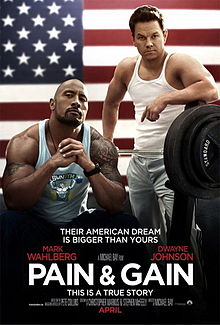
“Unfortunately, based on a true story,” we are warned as this film opens. In case we forget, or, more likely, in case we assume the usual Hollywood embellishments, we are reminded, when things get really bizarre and really, really, really disturbing, that it is, indeed, still true.
Director Michael Bay is known for big movies with big explosions, big special effects, and big, big budgets, including “Armageddon” and the Transformers series. So “Pain & Gain,” a passion project he planned for seven years with only a $40 million budget, is his version of a quirky little indie. Quirky, it is, and his feeling for the material, the too-bizarre-to-be-fictional story of three body builders who got involved with kidnapping and murder is palpable. Bay’s ability to give the audience the same sense of connection to the story is less effective.
Daniel Lugo (Mark Wahlberg, who will be on screen in Bay’s next blockbuster, the fourth installment of the Transformers series) is a body builder who believes in the American Dream. No, not the dream of freedom and democracy; the dream of getting rich without earning it. With two pumped-up compadres, the just out-of-the-clink born-again Paul Doyle (Dwayne “The Rock” Johnson) and steroid-injecting Adrian Doorbal (Anthony Mackie), they create a sort of Dumbfellas posse so they can kidnap a prosperous South American immigrant named Victor Kershaw (Tony Shaloub, playing a composite character based in part on Florida businessman Marc Schiller
The movie is darker than the marketing makes it seem, with very graphic scenes of torture and dismemberment, but it does include some very funny moments as our hapless anti-heroes continually overestimate their own abilities and underestimate those around them. All of the performances are excellent, but Ed Harris steals the film as a former cop-turned detective and Emily Rutherford is a stand-out as his wife, by far the movie’s most appealing character. Bay, with screenwriters Christopher Markus and Stephen McFeely (the next “Thor” and two “Captain America” films) and cinematographer Ben Seresin (the upcoming “World War Z”) skillfully evoke the world of protein shakes, motivational platitudes, and a deep wellspring of resentment. “If I believe I deserve it, the universe will serve it,” Lugo says like a mantra. He also talks about eating a “shame sandwich,” and, in his most revealing moment, tells Kershaw, “I don’t just want everything you have. I want you not to have it.”
Bay is less successful in tying all of this to larger themes worthy of its more than two-hour running time. It feels like a very personal story about his own struggles with ambition and dignity, but a struggle he still does not understand well enough to convey in more than superficial terms. Like its main characters, it has a lot of muscle but not much upstairs.
Parents should know that this film is based on a true story of crimes that include kidnapping, torture, murder, dismemberment, fraud, and drug use. The movie also includes crime and law enforcement violence, graphic wounds, very explicit and crude sexual references and situations, nudity, and constant strong language.
Family discussion: More than one character in the movie talks about what being an American means — which do you agree with and why? What took the police so long to realize what was going on? Do you agree with the punishment ordered by the court?
If you like this, try: “Fargo” and “Welcome to Collinwood” and read the story of the real-life case by Pete Collins
Posted on April 15, 2013 at 7:00 am
In celebration of tax day, enjoy two romantic comedies about IRS agents.
“The Mating Game” stars Tony Randall and Debbie Reynolds in a rollicking story about a warm-hearted farm family that never pays taxes because they do everything on the barter system. Paul Douglas is wonderful in what would be his last performance. If that sounds familiar to PBS fans, it’s because it is based on The Darling Buds of May

And Will Ferrell plays an IRS agent who discovers he is a character in a book in the fourth-wall-breaking delight, “Stranger Than Fiction.”