In the Heart of the Sea

In the Heart of the Sea

Posted on December 10, 2015 at 5:36 pm

Copyright 2015 Village Roadshow

Herman Melville’s Moby Dick is a brilliant novel about humanity, nature, obsession, power, and pretty much everything else, with a lot of technical information about whaling thrown in for good measure and metaphor. Nathaniel Philbrick’s acclaimed book about the tragic real-life whaling expedition that inspired Melville to write Moby Dick is In the Heart of the Sea: The Tragedy of the Whaleship Essex. This film is director Ron Howard’s uneven attempt to give that story the mythic force of Melville’s tale (itself never adequately adapted for film).

Like Moby Dick, this is a story of man against nature, not just the powerful animals man tries to trap and kill but of man against the animalistic elements of his own nature. That is represented, as it so often is, by the conflict between two men. The captain of the Essex is George Pollard (Benjamin Walker). He and everyone on the shop know that he is captain only because he comes from a high-born shipping family. The first mate is Owen Chase (Chris Hemsworth, with his “Rush” director), resentful of Pollard because he was promised the captain job and knows he is more qualified.

On the first night out, Pollard makes a point of cruelly describing Chase’s father’s time in prison to establish his superiority — and his willingness to use humiliation as a management tactic. In his desperation to establish his superiority, he does not realize that it makes him look thuggish and scared. It certainly does not inspire respect or loyalty. But Chase is determined to make it work. This time, if he meets his quota, he has it in writing that his next voyage will be as captain.

The whalers are under enormous pressure. Whale oil powers the world of the 1820’s (there is a clumsy hint that the world may be shifting to fossil fuels). Whaling ships go to sea for years at a time, traveling across the Atlantic to kill whales, extract the blubber, and melt it down.

Ships — whether on water or in space — are ideal settings for stories because they are isolated from the society at large. Everything is heightened because there is no way to leave and no recourse for support or appeal. But that intensity and drama is dissipated here with a useless framing story as author Melville (Ben Whishaw) tries to get the ship’s only survivor (Brendan Gleeson) to tell him what happened. The connection is awkwardly positioned against Moby Dick‘s narrative voice and unforgettable Job-like status as the sole survivor who can carry the story and the survivor character’s sympathetic wife is a distraction and her scenes suggest after-the-fact re-shoots.

Melville was wise to reshape the story. This version has gorgeous scenery, a moving score by Roque Banos, and superb special effects, but the power of the images is undercut by a story that tries to carry more meaning than it can hold.

Parents should know that this is a whaling saga with constant and intense peril and violence including fire, guns, storms, starvation, murder, cannibalism, and sinking ship, many characters injured and killed, brief strong language, and drinking and alcoholism.

Family discussion: Why did Pollard embarrass Chase on the first night out? What were the biggest differences between Pollard and Chase in the way they treated the men? Do you agree with Chase’s “abominable” decision?

If you like this, try: “The Perfect Storm” and Melville’s Moby Dick

Related Tags:


Action/Adventure Based on a book Based on a true story
The Letters

The Letters

Posted on December 3, 2015 at 5:46 pm

Copyright Freestyle Releasing 2015

Mother Teresa, the Albanian nun who devoted her life to “the poorest of the poor” in India, is one of the foremost figures of the 20th century, and on the way to being recognized as a saint by the Catholic Church. Some people are disturbed by discovering through her published letters that at times she felt doubts about herself, her work, and even about God. But it was that same resolute honesty that compelled her to follow her calling and it would be more disturbing if she never doubted or if she doubted and did not feel she could express it. Her accomplishments are even more impressive once we learn how fiercely she wrestled with God.

In “The Letters,” Juliet Stevenson plays Mother Teresa, from her early days as a nun to establishing her own order. At first, in the convent in India, she is teaching young girls in starched uniforms who sit quietly and are eager to learn. But she receives “a calling within a calling” and believes she has been called on by God to work with “the poorest of the poor.” Reconciling this determination with her vow of obedience and her dedication to humility is not easy. Persuading the people that she hopes to help that all she wants is to help them, not convert them, is not easy.

The tall actress Juliet Stevenson does a fine job as the tiny nun. Some people may object that the movie caters to those who are already believers. It does not question Mother Teresa’s greatness or her tactics and it elides over some of the controversies concerning the expansion of her operations and whether her faith-based approach was always best for the people she was helping. Some viewers will find the film slow, though for me that was one of its strengths. Writer/director Bill Riead makes sure that its quiet power is more like a prayer than a biographical portrait, a calling inside a calling inside a calling and one that its subject would find most suitable.

Parents should know that this movie’s themes concern work with the “poorest of the poor,” with extreme deprivation and illness.

Family discussion: What is the best way to help the “poorest of the poor?” Why did Mother Teresa want to help people who were not Catholic?

If you like this, try: “The Life Journey of Mother Teresa,” a documentary

Related Tags:


Based on a true story Biography Drama Spiritual films
My All American

My All American

Posted on November 12, 2015 at 5:32 pm

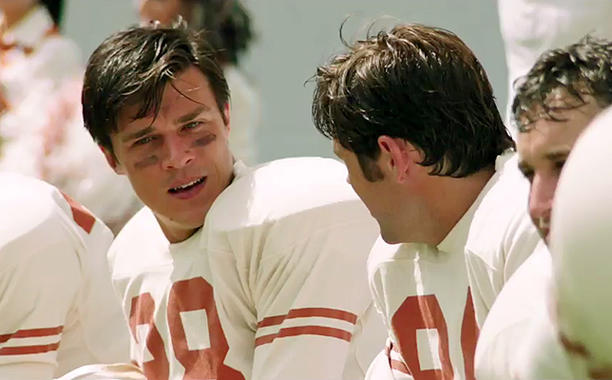
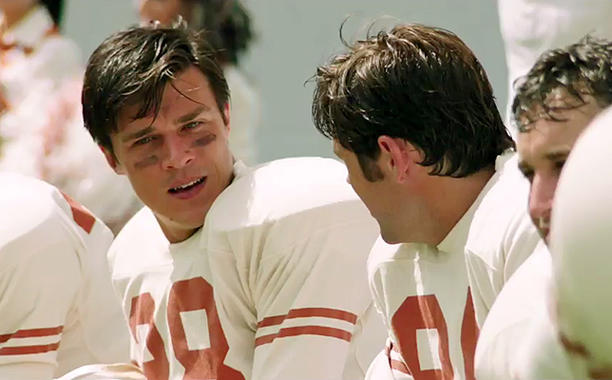
If I wrote this review the way writer-director Angelo Pizzo wrote the script for “My All American,” it would be something like this: I saw a movie. It was about football. Freddie Steinmark worked hard and inspired his team, but then got sick. It was sad.

Copyright 2015 Clarius Entertainment

Pizzo wrote two of the best sports films of all time, “Rudy” and “Hoosiers,” but here, in another real-life sports story, he has decided that the audience needs a kind of running commentary from every character to explain — instead of show — the audience what is going on. In an early scene, Steinmark’s mother (Robin Tunney) tells him that because he is smaller than his friends, he will have to work harder. Later, other characters tell us repeatedly what we should be able to see: that he works harder than everyone else, that he is religious, even that he is handsome. This is a movie where a coach actually says that Steinmark has courage and guts. The dialogue is so exposition-heavy that it is like sawing lumber.

It is good to see a biopic that does not rely on the usual scenes of the girlfriend complaining that the lead character does not spend enough time with her. But Steinmark is portrayed as such an all-around saint that he is bland, without any character beyond niceness and determination. All of the characterizations are paper-thin. It is as though everyone on the screen is just another color commentator, not a character.

Steinmark (Finn Wittrock of “The Big Short”) is the son of hard-working Catholics. His father has two jobs, security guard by day, cop at night, but is so dedicated to his son’s athletics that he never misses a practice or a game. When a teammate suggests that perhaps Steinmark’s father is living his own dreams of an athletic career through his son, Freddie says no and the subject never comes up again. Freddie wants to play for Notre Dame and then the Chicago Bears. But college coaches think he is too small — except for Darrell Royal (Aaron Eckhart) at the University of Texas, who recruits Steinmark and his best friend. Steinmark’s devoted girlfriend, Linda (Sarah Bolger, one of the adorable Irish girls from “In America”), is accepted to UT as well.

Steinmark is so remarkable (as everyone keeps telling us and telling us and telling us) that he is made first-string in his sophomore year. He leads the defense so successfully that the championship is within reach. And then he begins to have a problem with his leg.

There are very clumsy attempts to do what “Rudy” and “Hoosiers” did in creating a sense of time and place. Here, the references to the war in Vietnam (and the protests), the moon landing, long hair, and 60’s songs are jarring and haphazard. The absence of any person of color may be authentic as regards the team, but on the campus? In the hospital? It is so strange that it becomes a distraction. The framing story of an interview decades later with Royal adds nothing. The football scenes are capably staged, but do not move the story forward.

There are references to Steinmark’s faith — he goes to mass every day and we see him pray and encourage his friend to pray. But we never get a sense of what the faith means to him or how it helps him understand his illness. There is more drama and more character in a throwaway scene involving another player who loses his position than there is in the portrayal of Steinmark’s story.

And there is only the slightest reference to one of the most interesting parts of the story; the lack of treatment options for someone with cancer in 1969. Steinmark’s diagnosis came just before the United States made its first major commitment to a “war on cancer,” with federal funds being used for research. This is the kind of context that could have provided the story with the impact it fails to muster.

Parents should know that there is brief strong language and a brief view of a bare tush, as well as discussions of serious illness and a sad death.

Family discussion: Were you surprised by Bill’s reaction to being replaced? What was it about Steinmark that made him so important to his coach?

If you like this, try: “Rudy,” “Hoosiers,” and “The Express”

Related Tags:


Based on a true story Illness, Medicine, and Health Care Sports
Spotlight

Spotlight

Posted on November 12, 2015 at 5:30 pm

“Spotlight” is about the ultimate betrayal of trust from an institution that literally represented the Word of God to many people. And it is about whether we will continue to have institutions that serve the essential function of monitoring the gap between aspiration and actuality, between what people say they are and do and the reality.

Copyright Open Road Films 2015

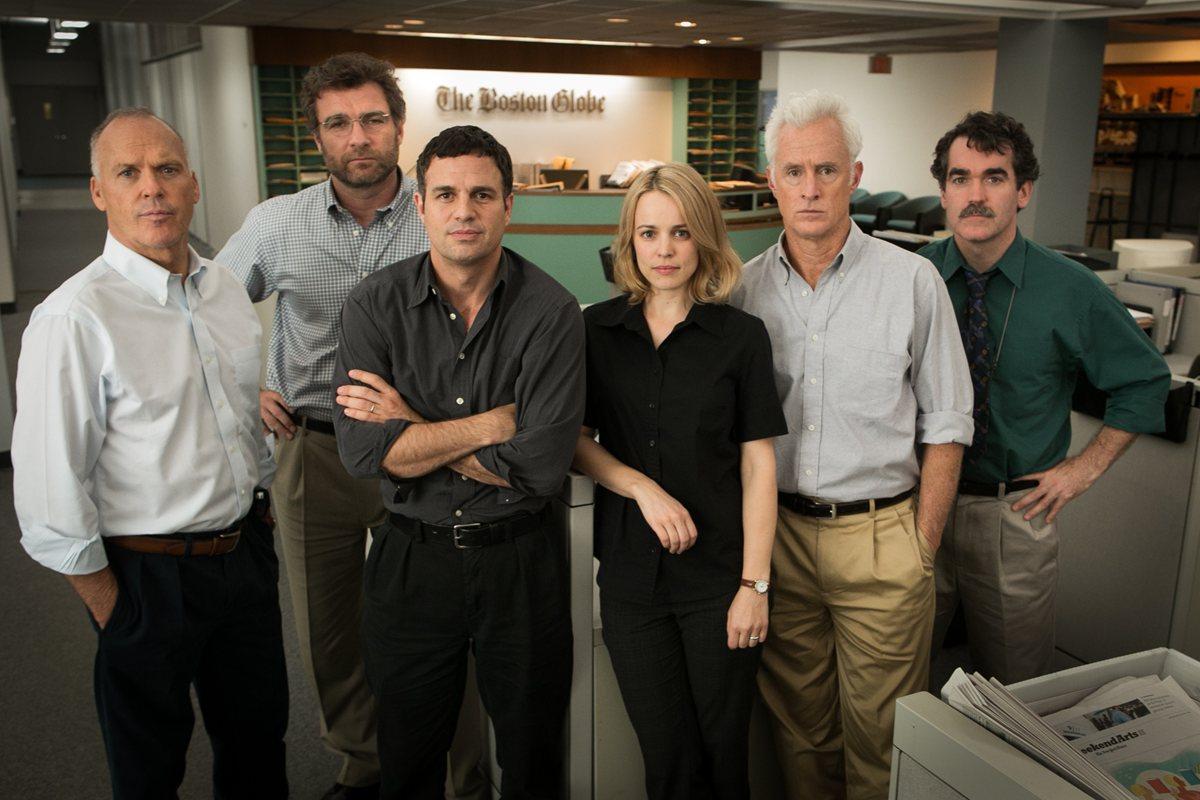
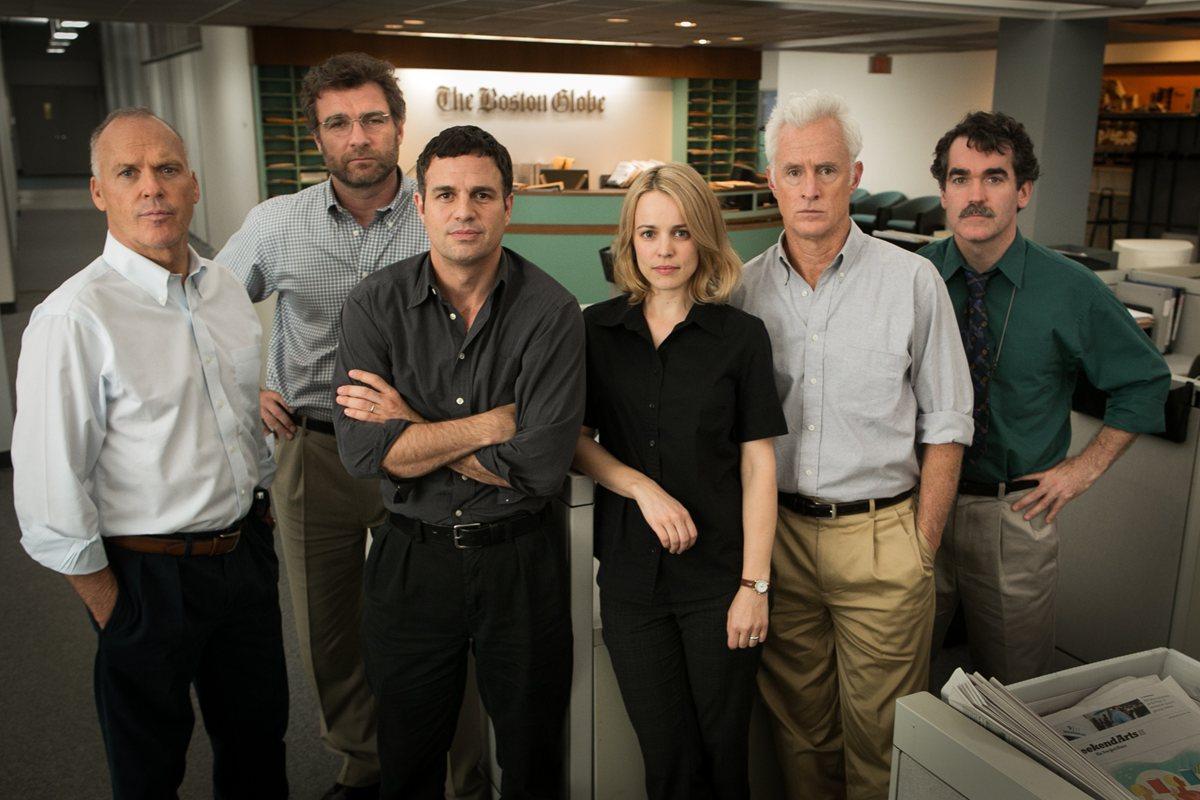
Spotlight is the name for the investigative group of journalists working for the Boston Globe. While their colleagues reported on stories that could be reported and written in days, the Spotlight group had the luxury and the responsibility of taking as much as a year to do the kind of in-depth original research necessary for more complex and difficult subjects.

The staff at Spotlight was let by Walter “Robby” Robinson (Michael Keaton) and included Mike Rezendes (Mark Ruffalo), Sacha Pfeiffer (Rachel McAdams), and Matt Carroll (Brian d’Arcy James).

Like most of the members of the Globe staff they were Boston born and bred, Red Sox fans to the end, and raised Catholic. They had just finished work on a long-term piece when their new editor arrived. He was not Boston born and bred, not a Sox fan, and not Catholic. And perhaps most important, he was not a Boston Globe lifer. He was Marty Baron (Liev Schreiber), most recently from Miami. He was an outsider in every way and they correctly suspected that the Globe was just a stop on his career trajectory. (He is now at the Washington Post.) They were not inclined to follow his idea of what stories they should cover.

But when he asked them about following up on a story about a priest who abused young boys, they could not come up with a reason not to other than it was too awful to imagine that it might be true. They begin to investigate. It turns out it was not one priest. It is a city-wide problem. A priest abuses children, is put on “medical leave” and transferred. The families of the boys are paid off and silenced. Then it happens again.

Director Tom McCarthy (“The Station Agent,” “Win Win”), writing with Josh Singer, really captures the culture of a newsroom, the stale coffee, the stale-er jokes, but the passionate curiosity that drives them all. This film will be compared to “All the President’s Men” because they are both true stories about young reporters getting huge stories everyone else missed. But the more important comparison is the way both movies capture the numbing work that goes into reporting. The doors knocked on. The doors slammed. And in this case, the nine years worth of diocese phone directories gone over, line by line (this was one of the last of the eras of off-line, analog document searches) to follow the “medical leave” priests took weeks of meticulous checking. It shows us reporting on the cusp of monumental technological change as well, when the paper makes the then-innovative decision to make the underlying documents available to readers online.

The reporters face enormous obstacles, starting with overcoming their own assumptions and then the powerful people who try to stop them. The church is an overwhelming force, politically and culturally. Do readers really want to know? Will the paper lose subscribers and advertisers?

There is no betrayal more devastating than to have the most trusted of institutions, the one most intimately involved in family joys and sorrows to be countenancing the abuse of those most deserving of its protection. But by the end of the film, that atrocity, already known to us, is not as troubling as the idea that news organizations may not be able to bring us the next one.

Parents should know that the theme of the movie is the investigation of widespread child sexual abuse and its cover-up, with sexual references, some graphic, and some strong language.

Family discussion: How did the arrival of an outsider affect the decision to do this story? Do today’s newspapers have the resources and support they need to do in-depth investigations like this one?

If you like this, try: “All the President’s Men” and “Truth” and the documentaries “Deliver Us from Evil” and “Twist of Faith”

Related Tags:


Based on a true story Drama Journalism
Our Brand is Crisis

Our Brand is Crisis

Posted on October 29, 2015 at 5:38 pm

Copyright Warner Brothers 2015

As we gear up for one of the most improbable and even outlandish Presidential campaigns in US history, we get a movie based on a real-life Presidential campaign in Bolivia, with imported American political consultants transplanting the media-savvy, scorched-earth, mud-slinging “expertise” that won elections in the US. What could go wrong?

The name of the film is “Our Brand is Crisis,” also the name of the 2006 documentary about what happened when James Carville, an architect of the Clinton campaign, went to Bolivia with his group of consultants and strategists to help elect the Bolivian-born, American-raised Gonzalo Sánchez de Lozada. Actually they went to help re-elect him. He had served as President from 1993-97. He was trying to regain the Presidency, and who better to help than the team who helped the young governor of Arkansas beat a sitting President, George H.W. Bush?

Sandra Bullock, taking a part based on Carville and originally written for George Clooney, plays a consultant known as “Calamity” Jane. She is burned out and living in a remote rural area when she gets a visit from two former colleagues.

Nell (Ann Dowd) and Ben (Anthony Mackie) want her for two reasons. First, she is good at what she does. Second, she is “disposable, expendable, and deniable.” If their candidate (named Castillo in this film and played by Joaquim de Almeida) wins, they get the glory. If he loses, they can blame “Calamity” Jane. Win win, and a good introduction to the small-p politics of the world of strategists and consultants who work on campaigns.

Jane is not interested, even though she needs the money, until she learns that Castillo’s opponent is being advised by her arch rival, Pat Candy (Billy Bob Thornton), a man who has been on the other side “three or four times” and beaten her “three or four times.” Much more interested in trouncing anyone Candy is advising than in any of the issues or the quality of the candidates, she agrees to fly to Bolivia, where she spends the first few days breathing oxygen from a tank and throwing up due to the altitude.

Finally she begins to wake up and her fiercely competitive spirit takes over. She brings in a secret weapon, a young woman with crackerjack online research skills known only as LeBlanc (Zoe Kazan), a sort of Lisbeth Salander who looks like a sophomore at Yale. And she starts barking orders, telling her candidate to take off his jacket and roll up his sleeves and to turn toward the camera if he feels a tear in his eye. “We are the syringe that injects the people’s voice into your campaign,” she barks. He is so far behind in the polls that he has no alternative.

Jane’s short-term goal: to humanize her candidate, who is seen by the electorate as imperious and out of touch. Her medium term goal: to persuade the electorate that there is a crisis and only his experienced hand can guide them through. Her ultimate goal: complete annihilation of Pat Candy, with a side order of public humiliation.

The political sophistication of the screenplay is below the level of an AP history class, with a lot of scorched earth posturing and the inevitable idealistic youngster to provide contrast to all the superficial cynics. A reference to Adam Smith’s theory of the invisible hand is there for a gloss of political sophistication, but the aphorisms are tired (“If you fight with monsters for too long, you become a monster”) and the film is almost as cynical as its characters. The reason to see it is Bullock, who gives one of the best performances of the year, as complex, nuanced, savvy, and honest as the film would like to be. She’s got my vote.

Parents should know that this film includes very strong and crude language, vulgar sexual references, smoking, drinking, and some violence including riots, tear gas, and guns.

Family discussion: Why did Jane take the job? What will she do next?

If you like this, try: the documentary of the same name that inspired this film and “No,” starring Gael Garcia Bernal, based on the 1988 election in Chile

Related Tags:


Based on a true story Drama Politics
THE MOVIE MOM® is a registered trademark of Nell Minow. Use of the mark without express consent from Nell Minow constitutes trademark infringement and unfair competition in violation of federal and state laws. All material © Nell Minow 1995-2026, all rights reserved, and no use or republication is permitted without explicit permission. This site hosts Nell Minow’s Movie Mom® archive, with material that originally appeared on Yahoo! Movies, Beliefnet, and other sources. Much of her new material can be found at Rogerebert.com, Huffington Post, and WheretoWatch. Her books include The Movie Mom’s Guide to Family Movies and 101 Must-See Movie Moments, and she can be heard each week on radio stations across the country.

Website Designed by Max LaZebnik