Television Takes On Two of the Biggest Crime Stories of the Past 25 Years
Posted on February 3, 2016 at 11:02 am
Oscar-winner Richard Dreyfuss stars in the story of one of the biggest financial frauds of all time, Bernie Madoff’s $65 billion Ponzi scheme, with Blythe Danner as his wife.
People who want to know more should watch the documentary “Chasing Madoff.”
Robert De Niro and Michelle Pfeiffer will appear in another Madoff movie, “The Wizard of Lies,” directed by Barry Levinson.
And Oscar-winner Cuba Gooding, Jr. stars as O.J. Simpson in the story of his criminal trial for the murder of his ex-wife, Nicole Brown Simpson, and Ronald Goldman.
The cast includes John Travolta as defense attorney Robert Shapiro, Courtney B. Vance as Johnny Cochran, David Schwimmer as Simpson friend Robert Kardashian, Selma Blair as Kris Kardashian, Connie Britton as Nicole Simpson’s friend, Faye Resnick, and Evan Handler as Alan Dershowitz.
Intense scenes of peril, characters injured and killed
Diversity Issues:
None
Date Released to Theaters:
January 29, 2016
Date Released to DVD:
May 23, 2016
Amazon.com ASIN:
B019PQ0NZG
Copyright Disney 2016
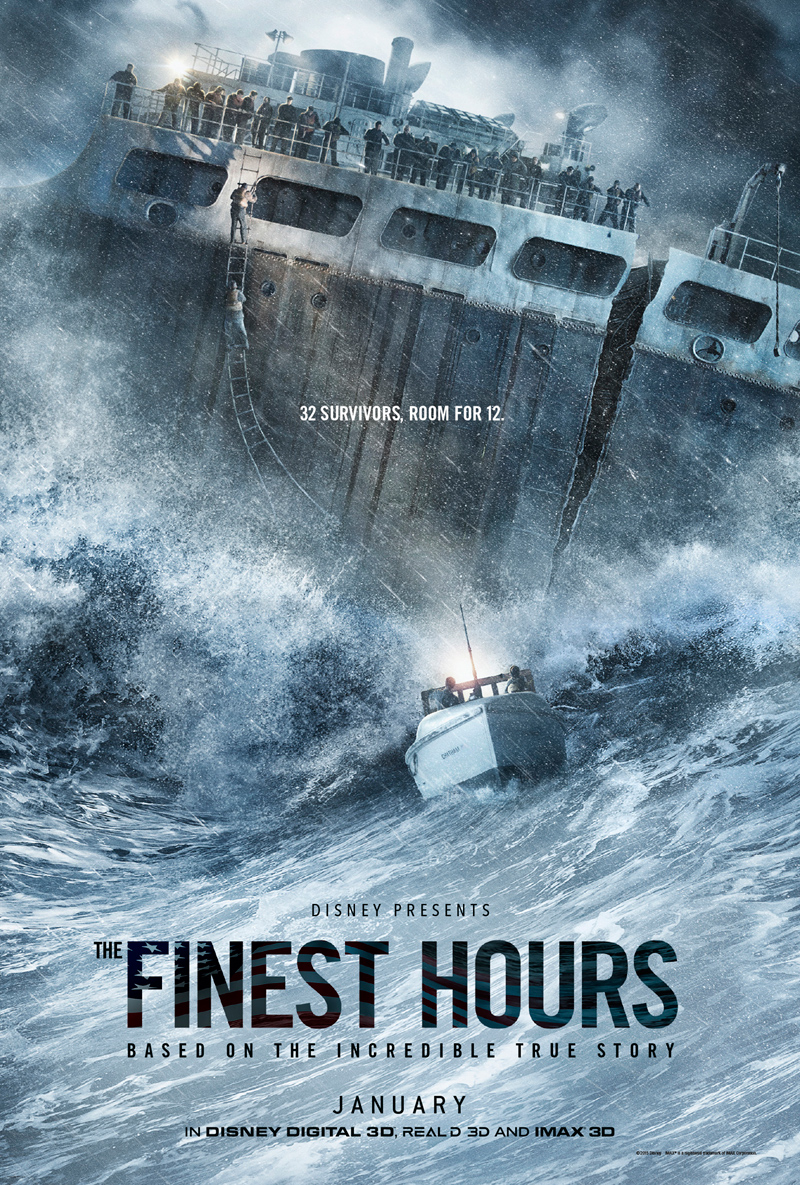
“In the Coast Guard they say you gotta go out. They don’t say you gotta come back in.” It was a big nor’easter storm off the coast of Massachusetts. It was February 1952, so communications technology was limited. And not one but two tankers split in half. The most experienced Coast Guard crew went off to rescue the first one. When word came in that a second one was sinking, four young men, all under 25 and two who had never been on a rescue operation, took a small boat out into the storm.
That second ship was the Pendleton. Knowing that they had no more than two to three hours before their half of the tanker would sink into the icy storm-tossed waves, they had to decide who would be in charge. “No officers, no rules, every man for himself,” a crew member says. But they realize they must choose between the man who wanted to take the lifeboats or the engineer they did not know as well who said he had a plan (Casey Affleck, understated and compelling). “They may not like you, but they know to listen to you,” one member of the crew admits.
Based on the true story as told in the book by Michael J. Tougias and Casey Sherman, screenwriters Scott Silver, Paul Tamasy and Eric Johnson efficiently introduce us to the characters and the challenges they are facing. Chris Pine plays Bernie Webber, a departure from his usual cocky, confident roles. Bernie is a little shy, but very sincere, and he believes in the rules, not in a rigid way but in a careful way. When we first see him, he is about to see the girl he has been talking to on the phone for the first time and he does not want to get out of the car because he is afraid she will not like him.
And of course she does like him. Her name is Miriam (British actress Holliday Grainger, last seen as an evil stepsister in “Cinderella”). Director Craig Gillespie (of the wonderful “Lars and the Real Girl”) gives them just enough time to get invested in their relationship — and to get us invested in it — before the storm comes in.
Gillespie really gets going when the storm does, though, and those scenes are powerful and exciting. We are in the small boat with Webber as the window shatters and the compass is wiped out. The boat is tossed around like a cork, at one point completely on its side, with monster waves crashing down. And we are in the Pendleton’s engine room as seams burst and beams come down. And then we are back on land, as Miriam tries to find out what is going on, tries to get the commanding officer to bring the rescue team back, and then learns what it is to love a man who risks his life as a part of his job.
In a film like this, the most important job of the director is to make sure we understand how daunting, even impossible, the task is, and then to make sure we get to see what goes into surmounting the obstacles. Some of that is missing here, as when we are told that there are too many men on the Pendleton for the small boat to carry, and then somehow it carries them. The compass is out, there’s no communication, and yet somehow Webber’s crew finds the Pendleton. It may be that no one knows how it worked, but it undercuts the drama to skip over some of those details.
The quiet heroism of these characters is movingly portrayed, and these days, when heroes are hard to come by, this is a touching story of selflessness, courage, and dedication, and exactly the kind of story that Disney tells best.
Parents should know that this story concerns a real-life catastrophic storm with many lives lost. There are scenes of very intense peril, some mild language, and social drinking.
Family discussion: How did the men on the tanker decide who should be in charge? How did Bernie decide when to follow the rules and when not to? What did Miriam learn from her visit to the widow’s house?
If you like this, try: “The Perfect Storm” and “The Hunt for Red October”
What connects us to each other? What creates a sense of obligation? Why is it that we somehow find ourselves alone when we don’t want to be and with others when we don’t want to be? Are there secrets that completely change the way we think about people we thought we knew?
And is it possible to be fair to the other people in our lives when we tell stories about them?
Writer Alan Bennett (“The History Boys,” “The Madness of King George”) got an urgent appeal from a disheveled woman in a kerchief. You know the kind of person I am talking about, the ones we ignore or pretend to ignore. She is not exactly homeless. She has a dilapidated, broken-down van parked on the street near his new home. His neighbors are not unkind. One even tries to bring her food. But for some reason, Miss Shepherd (Maggie Smith) likes Bennett. And for some equally inexplicable reason, he kind of doesn’t dislike her. And for another equally inexplicable reason, as frustrating and annoying and inconvenient and often infuriating as Miss Shepherd (as he always calls her) is, he finds it easier to deal with her than with his own mother, who is beset with her own cognitive challenges.
“A writer is doubled,” Bennett tells us, “the one who writes, the one who lives.” He is clearly most comfortable as the one who writes. And we get to see them both. Alex Jennings plays two slightly different variations on Bennett, the subtle variations of clothing and attitude showing us the tension as he wavers between being involved and observing. Part of him recoils from Miss Shepherd’s “multi-flavored aroma” with a thin layer of talcum powder. Part of him knows that she could lead to exactly what we are watching — a book, a radio play, a theatrical production, a movie with an Oscar-winning Dame in the title role. Yes, she asks if she can park temporarily in his driveway and stays for 15 years. But given the money he made from the story, who was sponging on who?
A writer will inevitably be drawn to the peculiar mix of sense and nonsense, sometimes called a word salad, coming from someone like Miss Shepherd. There’s something about the way she ends her mildly preposterous statements with equivocation. “I’m in an incognito position, possibly,” she tells Bennett. He will learn more about her past, but Bennett has enough respect for us and for Miss Shepherd that there is no attempt to try to explain her. It is just to help us do what he did instinctively, though perhaps reluctantly — to see the person inside the weirdness.
“A proper writer might welcome such an encounter.” Yes, he might. Yet, he thinks, “You won’t catch Harold Pinter pushing a van down the street.” Shouldn’t a writer get to pick his subject? “I don’t want to write about her,” he says. “I want to write about spies.” He knows that “you don’t put yourself into what you write; you find yourself.” And his two selves seem to come closer together as Miss Shepherd disintegrates further. If, as Arthur Miller wrote in “Death of a Salesman,” attention must be paid to people we would prefer to overlook, Bennett has done that for Miss Shepherd, with grace and humanity.
Parents should know that this film includes themes of mental and physical illness, fatal car accident, blackmail, and non-explicit sexual situations and bodily functions.
Family discussion: Why did Alan treat his mother and Miss Shepherd differently? Why does he let her stay? Why are there two Alans and what can we tell from the way they dress and speak?
If you like this, try: “The Madness of King George” by the same author and his early work in “Beyond the Fringe”




 , a radio play, a theatrical production, a movie with an Oscar-winning Dame in the title role. Yes, she asks if she can park temporarily in his driveway and stays for 15 years. But given the money he made from the story, who was sponging on who?