The Big Short

The Big Short

Posted on December 10, 2015 at 6:16 pm

A
Lowest Recommended Age: High School
MPAA Rating: Rated R for pervasive language and some sexuality/nudity
Profanity: Constant very strong and crude language
Alcohol/ Drugs: Drinking, smoking
Violence/ Scariness: Fraud, corruption, economic upheavals
Diversity Issues: None
Date Released to Theaters: December 11, 2015
Date Released to DVD: March 15, 2016
Amazon.com ASIN: B0177ZM3LO
Copyright 2015 Plan B Entertainment

Director Adam McKay is so obsessed with the 2008 financial meltdown that he inserted a series of charts and graphs and statistics about it over the closing credits of the silly buddy-cop comedy, The Other Guys. Yes, there was a villain played by Steve Coogan who was up to some financial jiggery pokery, but only the most careful viewers of that film could have deduced that what McKay, best known for raunchy Will Ferrell slob comedies, secretly yearned for, as Michael Caine might say, was to blow the bloody doors off the Wall Street bankers who treated the American economy like a bull treats a china shop.

We’ve had sober documentaries like The Flaw and Oscar-winner Inside Job and the superb drama Margin Call, all outstanding, insightful, and illuminating and essential companion pieces to this movie. But “The Big Short” has several advantages in telling the story. First, by giving us someone to root for, however imperfect the heroes of this story are, it keeps us emotionally connected to the story. Second, because it is in most respects a comedy, McKay has a wider range of tricks on hand to make us understand what happened. This fierce, fiery rant of a film is going to make you understand that the people we entrusted with our economic stability were truly despicable and truly stupid. It is funny and infuriating and then funny again and then, when he tells you that the bad guys went to jail and the big banks were broken up — no, just kidding, they weren’t — it is monumentally infuriating.

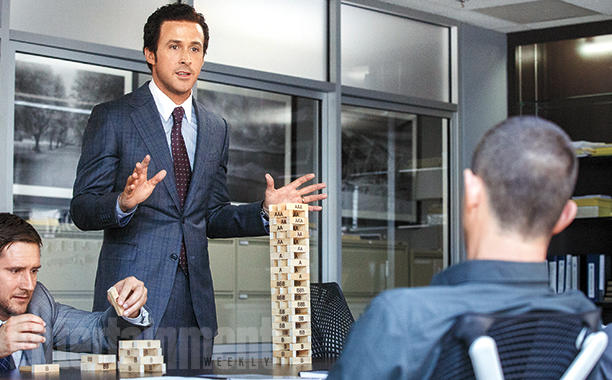
I’ll add a footnote below to give my own very short explanation of what happened.* (And one thing they got wrong.** Pretty much everything else is literally right on the money.) Or, you could listen to Margot Robbie talk you through it, as she sips champagne in a bubble bath. Yes, McKay knows what gets people’s attention and he uses Robbie and other celebrities to come in and explain the parts that the bankers intentionally did their best to obfuscate, using words guaranteed to put everyone to sleep so they could pick our pockets a little while longer. Ryan Gosling also serves as a guide, playing a real-life insider who saw that the mortgage-backed securities were going to tumble down like a Jenga tower.

The real-life acronym used by the bankers during this period was IBGYBG, which stood for “I’ll be gone; you’ll be gone,” meaning that if they could just keep passing the hot potato of economic Armageddon going around the circle a couple more times to collect the fees, they could get out before it all came tumbling down. And many of them did. As Michael Lewis notes in the the book that inspired this film (subtitled The Doomsday Machine), and, if you don’t remember anything else, remember this: the heroes of his book, the small group that bet against the bankers, made fortunes. But so did the people who lost that bet. Everyone on both sides of these deals made a lot of money. Everyone else across the country lost a lot of money, jobs, and homes.

As noted, Lewis’ book and McKay’s movie (the Oscar-winning script is co-written with Charles Randolph of the underrated “Love and Other Drugs”) wisely allow us to enter the story via the scrappy little group of misfit toys who figure out that the game is cooked, that it can’t stay that way, and that there has to be a way to bet against the other side. This grown-up Bad News Bears bunch (two of them barely qualifying as grown-ups) have a couple of things going for them. First, they are skeptics. Actually, they are cynics. They assume everyone is lying to them and just about everyone is cheating them. Michael Burry (Christian Bale), who insists on being called Dr. Michael Burry (he’s a neurologist-turned investment manager) and Mark Baum (Steve Carell) are both men who were already inclined to be skeptics and then faced terrible pain and loss that disabused them of the sense that life was fair. Jamie Shipley (Finn Wittrock) and Charlie Geller (John Magaro), two young partners literally running an investment firm out of a garage, had made almost $30 million finding unseen risks but were so naive about Wall Street that they did not know what the requirements were for being able to trade as an institution and not as an individual. These guys were all outsiders. (All names are fictional except for Burry.)

The second thing they had going for them was that they were not just willing to do their homework; they insisted on it. While the money gusher was going, no one else wanted to check the math (and no one was getting paid to do so). But, in some of the most entertaining moments of this riotously entertaining film, these guys who did not believe what they were told, went to check it out. Burry unpacked the securities to examine each of the hundreds of mortgages they contained to see if they were as secure as promised. They were not. Baum’s colleagues (Rafe Spall and Hamish Linklater) went to Florida to see the homes that were mortgaged. They were abandoned. Baum’s guys spoke to the mortgage brokers who happily explained that they preferred to give mortgages to people who had no possible means of paying them. (Max Greenfield is superbly sleazy in this role.) “They’re not confessing,” one of Baum’s partners says in amazement. “They’re bragging.”

By the time a stripper explains to Baum that she has mortgages on five houses and a condo and has been assured she can refinance when her adjustable rate jumps up, he begins to see the potential in betting that these securities will fall as people like this cannot pay the mortgages. When he goes to a convention of financial types working in this field (Byron Mann is almost deliciously corrupt as the arrogant and ethically vacant Mr. Chau), he knows he is right.

At the same convention, Shipley and Geller are jubilant when they are able to make a big bet against the bankers. And then they get a reality reminder from their their mentor, played by co-producer Brad Pitt. He could not take the corruption of Wall Street any more and left for a life somewhere between disaster prepper and artisanal farmer, wearing a face mask when he goes to town and urging everyone to get colonics. He met the young investor when they were walking their dogs. He reminds Shipley and Geller not to be so happy. When they win big, it will be because the economy is collapsing, causing real, devastating pain.

This is an outstanding film, with sensational performances by a brilliant ensemble cast. It is one of the best of the year and the most important as well.

Parents should know that this film includes constant very strong and crude language, vulgar sexual references, strippers, nudity, and extreme widespread fraud and corruption.

Family discussion: What made just these men able to see what so many other people did not? How did they verify their analysis? Will it happen again?

If you like this, try: the book by Michael Lewis and documentaries about the financial meltdown including “The Flaw” and “Inside Job” as well as feature films “99 Homes” and “Margin Call”

*Here’s what happened, without the jargon or the bubble bath. As you see at the beginning of the movie, Lewis Ranieri, now one of the wealthiest people in the world, came up with the idea of essentially crowd-funding mortgages. He took lots and lots of mortgages, bundled them into bonds, and let big institutional investors, like pension funds, buy them. It was a great investment for them because pension funds need a safe and secure source of income to pay retirees and these were safe and secure — much more than stocks — because people almost never defaulted on their mortgages and because so many mortgages were bundled up together that even if some did default it would have almost no impact. These bundles of mortgages were so popular that the banks ran out of safe and secure mortgages to put into bonds. And so, they started pushing mortgage brokers to issue more mortgages, and that meant giving mortgages to people who would not otherwise have qualified. (Some people will tell you that the government was at fault for pushing home ownership on people who could not afford it. They are wrong. Most of the pressure was coming from people who wanted to buy mortgages, not people who wanted to buy houses.) So, the formerly safe and secure bonds started filling up with less and less safe and secure mortgages. And the people responsible for differentiating the risk of the bonds, including the rating agencies, decided to just keep rating and selling the new, less secure securities as though they were exactly the same as the earlier ones. All of the “formulas” (sometimes called “algorithms” or “models”) used to justify this were bunk. Imagine it this way: there’s a vineyard that makes superior wine that everyone wants to buy and there are strong legal and economic incentives to buy it. But you only have so many grapes, so you start watering it down, still selling it at the same price, and getting the people who rate wine to continue to give it the same rating. Then you run out of water so you start blending it with turpentine, and all of your projections show that it is just as good and will still sell just as well so you price it that way and assume there is no risk.

Here’s the important part: everyone at every part of this conveyer belt of increasingly risky securities all being treated as though they were not risky was being paid based on the number of transactions, not the quality of the transactions, a sort of very big, very expensive game of tag, where there was never any “it” until finally “it” was everyone.

**Actually, because of the immense lobbying power of the bankers (see 13 Bankers: The Wall Street Takeover and the Next Financial Meltdown) the SEC had no authority to regulate these mortgage-backed securities. The agency that should have had jurisdiction was the Commodities Futures Trading Commission. When then-Chairman Brooksley Born suggested that they might look into some kind of oversight, Congress and the then-Treasury Secretary made sure she could not. Also, there are post-employment restrictions that prevent SEC staff from going to work for the people they supervise.

Related Tags:


Based on a book Based on a true story Comedy Drama DVD/Blu-Ray Pick of the Week Satire
The Night Before

The Night Before

Posted on November 19, 2015 at 5:57 pm

Copyright Sony 2015
Copyright Sony 2015

Seth Rogen. Not very surprising guest stars. Many mind-altering substances. Many bodily fluids and functions. Many bad choices. No ability to allow women to be funny, even with some of the best comic actresses of our time in the cast. Haven’t we been here before?

That’s the question the characters in this film are asking, too. Isaac (Rogen), Chris (Anthony Mackie), and Ethan (Joseph Gordon-Levitt) are friends who get together each year on Christmas Eve for a series of traditions, from visiting the tree at Rockefeller Center to a karaoke bar and a toy store to play on the giant piano keyboard from “Big.” Plus donning ceremonial holiday sweaters and getting wasted. Ethan’s parents were killed just before Christmas by a drunk driver 14 years ago, and Isaac and Chris promised him they would be his family for the holidays. More than a decade later, they’ve agreed this will be the last time. Chris is getting to be a big time athletic star in the NFL, and that means endorsement money and extending his personal brand via social media. He’s a spokesman for Red Bull, which has provided a limo for the evening. And he is hiding the secret of his recent jump in performance.

Isaac is married to Betsy (criminally underused Jillian Bell), and they are about to have a baby. She is refreshingly on board with his going out for a wild night with the boys that she gives him an early Christmas gift — a box of drugs, a sort of Whitman’s Sampler with everything from ‘shrooms to Molly, with some weed and cocaine thrown in for good measure (though, as Isaac points out with a tolerant chuckle, she does not know enough to get the proportions right). Ethan is drifting professionally and personally, never following through on his music and mourning a recent breakup with Diana (criminally underused Lizzy Caplan) because he could not commit to meeting her parents or moving in together.

Many years before, on one of their Christmas eve outings, they heard about a legendary party. I mean a PARTY. I mean THE PARTY, Platonic perfection of party-dom. It has always been their fondest wish to be there. Ethan, working as a coat check elf (his elf face really is very impressive), finds three tickets to the party in a guest’s coat pocket, steals them, and walks out. The party location won’t be announced until 10, so the trio has a few hours for their traditional activities, and plan to limo over to THE PARTY to cap off the evening.

This means encounters with old friends (Diana and her friend, played by the criminally underused Mindy Kaling, plus Michael Shannon as their weed dealer back in high school, Mr. Green), and odd substances (Rogen is actually quite funny as someone going through many different effects from many different drugs). There are cheap jokes about other Christmas movies and changes in technology over the past 14 years. A pay phone. A flashback with people amazed that an iPod can like hold “like 100 songs!” A revisit to Goldeneye on Nintendo 64 at Chris’ mother’s apartment.

There are some new friends, too. “Broad City’s” Ilana Glazer is a Christmas-hating fan who has sex with Chris in a club bathroom and then turns out to be Grinch-y. Various items and people are lost and must be searched for. Isaac’s bad trip is long, strange, and barf-y. And then there is a party with some not-so-surprising guest stars and some even less surprising Christmas-y confessions, apologies, and reconciliations.

“It’s hard to stay friends when you’re older,” Isaac says. It’s also hard to translate “Superbad”-style humor into something for actors in their 30’s. It should not be so hard to find a role for female characters that goes beyond infinite understanding and adoration. There are some enjoyably silly laughs here, and not all of them are in the “oh, no, you didn’t” category. There is a sense of groping toward something more — director Jonathan Levine worked with Rogen and Gordon-Levitt in the excellent fact-based “50/50,” and there are flickers that indicate a wish for something behind drug and barf jokes. One of my Christmas wishes is that the people making this movie learn something from the characters they put on the screen and give us something better next time.

Parents should know that this film is an extremely raunchy comedy with drinking, extensive and varied drug use, constant strong and crude language, some violence, explicit sexual references and situations, and very graphic nudity.

Family discussion: How do you decide which traditions to continue and which to give up? What did Mr. Green teach Ethan, Isaac, and Chris? Is it hard to stay friends as you get older?

If you like this, try: “The Hangover,” “Pineapple Express,” and “Ted”

Related Tags:


Comedy
Lost Preston Sturges Film: Hotel Haywire

Lost Preston Sturges Film: Hotel Haywire

Posted on November 10, 2015 at 3:17 pm

Copyright 1937 Paramount Pictures

A column by Michael Hiltzik in the LA Times about 700 “lost” Paramount films caught my attention. The first paragraph mentioned one of my favorite movies, “Alias Nick Beal,” with Ray Milland as Satan bargaining for the soul of a politician played by “Gone With the Wind’s” Thomas Mitchell. And then it mentioned a film I’d never heard of, written by one of my all-time favorite screenwriters (and later a director as well), Preston Sturges, a master of wisecracking screwball comedy (“The Lady Eve,” “Sullivan’s Travels,” “The Miracle of Morgan’s Creek”).

The film is “Hotel Haywire,” originally written for Burns and Allen, and then rewritten when they were not available. It was directed by Arthur Archainbaud, apparently his only credited film.

Copyright 1937 Paramount Pictures

Fortunately, I live just outside of Washington, DC, which means that the Library of Congress is practically my neighborhood library. I love their Motion Picture and Television Reading Room, which has the nicest and most knowledgeable staff any movie lover could ever hope for. They have been inestimably helpful to me many times. It took them about ten minutes to track down the film at their Culpepper, Virginia storage facility and arrange for it to be brought in for me to watch.

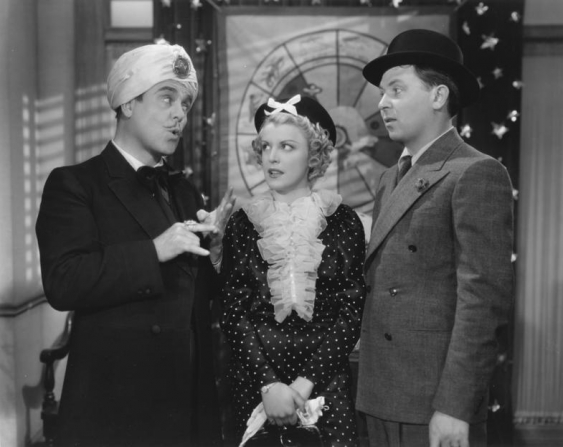
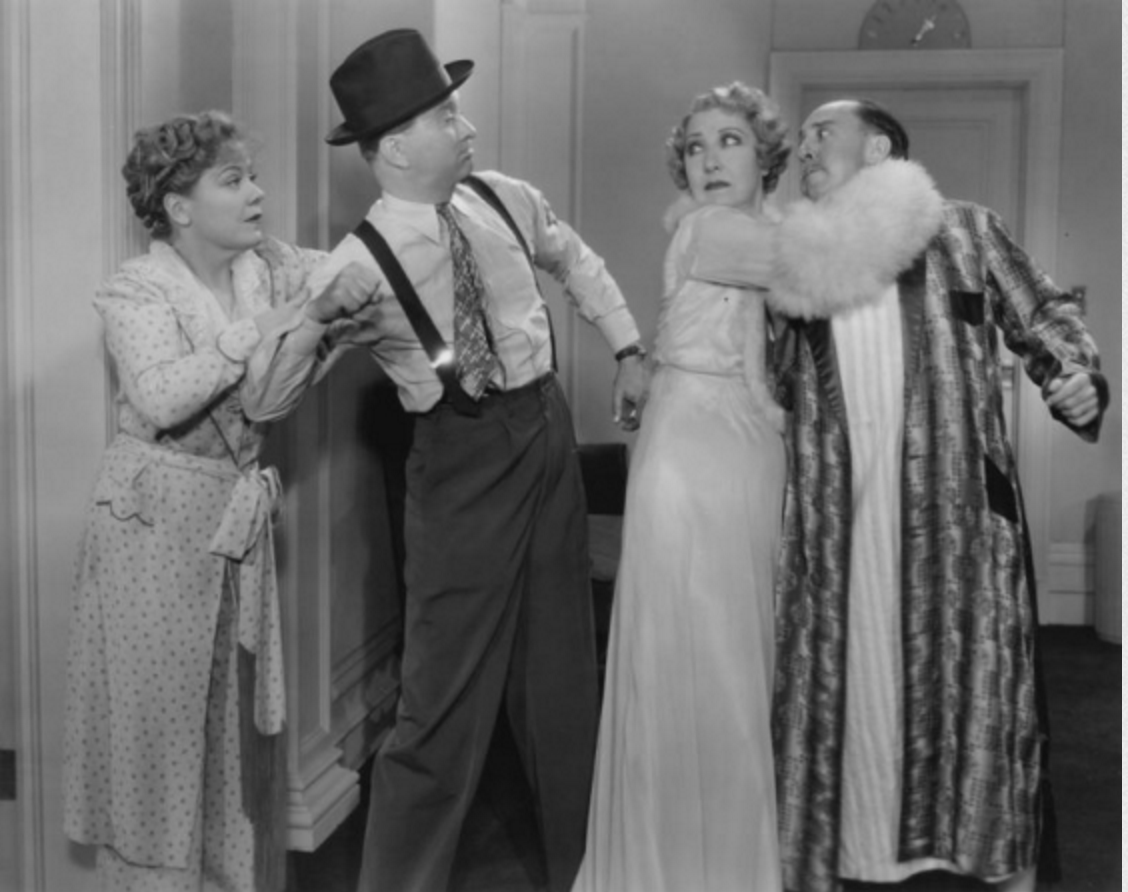
It’s not a classic, but it was a lot of fun, partly because it was a rare lead role for Spring Byington, who usually played the mother of the main character (“Little Women”).  In this, she plays the wife of a dentist (Lynne Overman) who is very caught up in spiritualism and horoscopes, as practiced by a charleton known as Dr. Zodiac Z. Zippe (Leo Carrillo). The dentist plays a prank on a friend by slipping a frilly camisole into his pocket, but the friend outsmarts him and puts it in the dentist’s pocket instead. When the wife finds it, instead of asking him about it she consults Dr. Zippe, who ends up advising both husband and wife in a manner that creates as much chaos as possible, especially after he hires some out-of-work vaudevillians as his “detectives.” Oh, and there’s also the dentist’s daughter, who wants to marry her boss’ son. And it all ends up in some door-slamming, who’s in what room shenanigans in a haywire hotel.

I hope this film, and the other 699 Hiltzik wrote about, will all be available soon, via streaming or DVD. Until then, we have the Library of Congress, and I will try them on another lost gem soon.

Related Tags:


Comedy Film History Neglected gem

This Year’s Best New Show: Crazy Ex-Girlfriend

Posted on November 9, 2015 at 3:23 pm

The only new show to make it to my DVR series list is “Crazy Ex-Girlfriend,” co-created by its sensationally talented star, Rachel Bloom. Each episode is a full-on original musical that takes place mostly inside the head of its slightly demented heroine, Rebecca, a Harvard and Yale-educated lawyer who walked away from her type-A career in a New York City law firm to move to West Covina, California, where her boyfriend from summer camp lives.

https://www.youtube.com/watch?v=-ctFmXGm_yE

It has a tremendous cast of singers and dancers, most with Broadway experience, including Donna Lynne Champlin, who plays Rebecca’s new friend, Paula, Santino Fontana (from the Broadway “Cinderella”) as a bartender who for some reason he cannot understand is drawn to Rebecca, and Vincent Rodriguez III as Josh, the object of Rebecca’s obsessional affection.

My favorite musical number so far is NSFW, the very funny “Sexy Getting Ready Song.” Here’s my runner-up, Rebecca’s boy band fantasy song, performed by four Joshes.

https://www.youtube.com/watch?v=4C5fHfG_ptE

And here’s an Astaire-and-Rogers themed song with Fontana.

The songs are by Fountains of Wayne’s Adam Schlesinger, who created the pitch perfect title number for “That Thing You Do” and the songs for the Drew Barrymore/Hugh Grant film “Words and Music.” They are funny and smart and earwormy in the nicest possible way. It’s on the CW Monday nights at 8/7 central and you can catch up on the previous episodes on Hulu.

Related Tags:


After the kids go to bed Comedy Television
Big Stone Gap

Big Stone Gap

Posted on October 8, 2015 at 5:51 pm

B
Lowest Recommended Age: High School
MPAA Rating: Rated PG-13 for brief suggestive material
Profanity: Mild language
Alcohol/ Drugs: Drinking and drunkeness
Violence/ Scariness: Tense confrontations, sad death
Diversity Issues: Ethnic diversity
Date Released to Theaters: October 9, 2015
Copyright 2015 Picturehouse

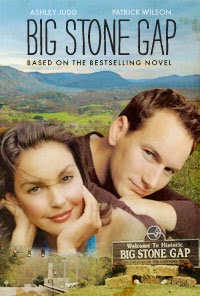
Even in small towns, big things can happen. Sometimes the most famous movie star in the world stops by and makes international headlines. And even bigger things happen, too — they just don’t get into the newspapers. Adriana Trigiani’s best-selling novels about her home town of Big Stone Gap, Virginia are loving tributes to the down-home values and adorably quirky characters she grew up with. Big things happen. There are sad losses and disappointments. But there is love and honor and generosity, too. In her first feature film as a director, Trigiani has assembled a superb cast, mixing top Hollywood and Broadway talent with some locals. Ashley Judd is at the center as a woman whose discovery of a secret about her past makes her think differently about her future.

It takes place in 1978. The woman is Ave Maria Mulligan, the owner of the local pharmacy. With a name like that, there has to be a story. When her beloved mother dies, she learns for the first time that her mother’s husband was not her father, as she thought. Her mother has left her a letter explaining that her father was a man she loved in Italy. Ave is determined to find her real father, though she has never traveled anywhere. She has great friends with colorful names and personalities, especially wisecracking Fleeta Mullins (Whoopi Goldberg) and starry-eyed bookmobile librarian Iva Lou Wade (Jenna Elfman). Then there’s Theodore Tipton (John Benjamin Hickey), the high school band and choral director who works with her on the town’s legendary annual “Trail of the Lonesome Pine” pageant and is Ave’s sort-of boyfriend and a handsome coal miner with the rare ordinary name of Jack (Patrick Wilson), who has a very possessive girlfriend (Jane Krakowski as Sweet Sue Tinsley).

It takes place in an eternally cozy past where coal mining is romantic because it creates electricity and there’s no mention of black lung disease. It’s corny cornpone, but unpretentious and it goes down easy, like sweet tea brewed by sunshine.

Parents should know that this film has some sexual references including potency, paternity, and a closeted gay character and non-explicit situations, drinking and drunkenness.

Family discussion: How is Ave Maria different from the people around her? Why did her mother keep the secret so long?

If you like this, try: the book series by Adriana Trigiani and the film “Win a Date with Tad Hamilton!”

Related Tags:


Comedy Movies -- format Romance
THE MOVIE MOM® is a registered trademark of Nell Minow. Use of the mark without express consent from Nell Minow constitutes trademark infringement and unfair competition in violation of federal and state laws. All material © Nell Minow 1995-2026, all rights reserved, and no use or republication is permitted without explicit permission. This site hosts Nell Minow’s Movie Mom® archive, with material that originally appeared on Yahoo! Movies, Beliefnet, and other sources. Much of her new material can be found at Rogerebert.com, Huffington Post, and WheretoWatch. Her books include The Movie Mom’s Guide to Family Movies and 101 Must-See Movie Moments, and she can be heard each week on radio stations across the country.

Website Designed by Max LaZebnik