Ted 2

Ted 2

Posted on June 25, 2015 at 5:22 pm

“Subtle” is not a word that naturally comes to mind for a movie that features a bong in the shape of male genitalia (which is more powerful — the longing for weed or the ew-factor of a straight guy who does not want to appear to be sucking on a dong-shaped bong)?  Or for a movie that shows us a fertility clinic accident drenching a character with an output of said body part, followed by a joke insulting African-American men and those with a genetic ailment.  A trifecta!

The raunch-fest “Ted 2” does indeed rely on gross-out, juvenile, misogynistic, homophobic, racist, marijuana-philic, oh-no-they-didn’t humor, though much of it is more humor-ish, fake-funny, outrageousness pretending to be comedy.  It spends most of its running time, too long at almost two hours, on jokes about bodily parts and functions, drugs, the joys of slackerdom, and pratfalls, which I admit pretty much sums up my least favorite kind of comedy.  So if the two examples above strike you as hilarious, kick my rating up a couple of notches and go enjoy yourself.

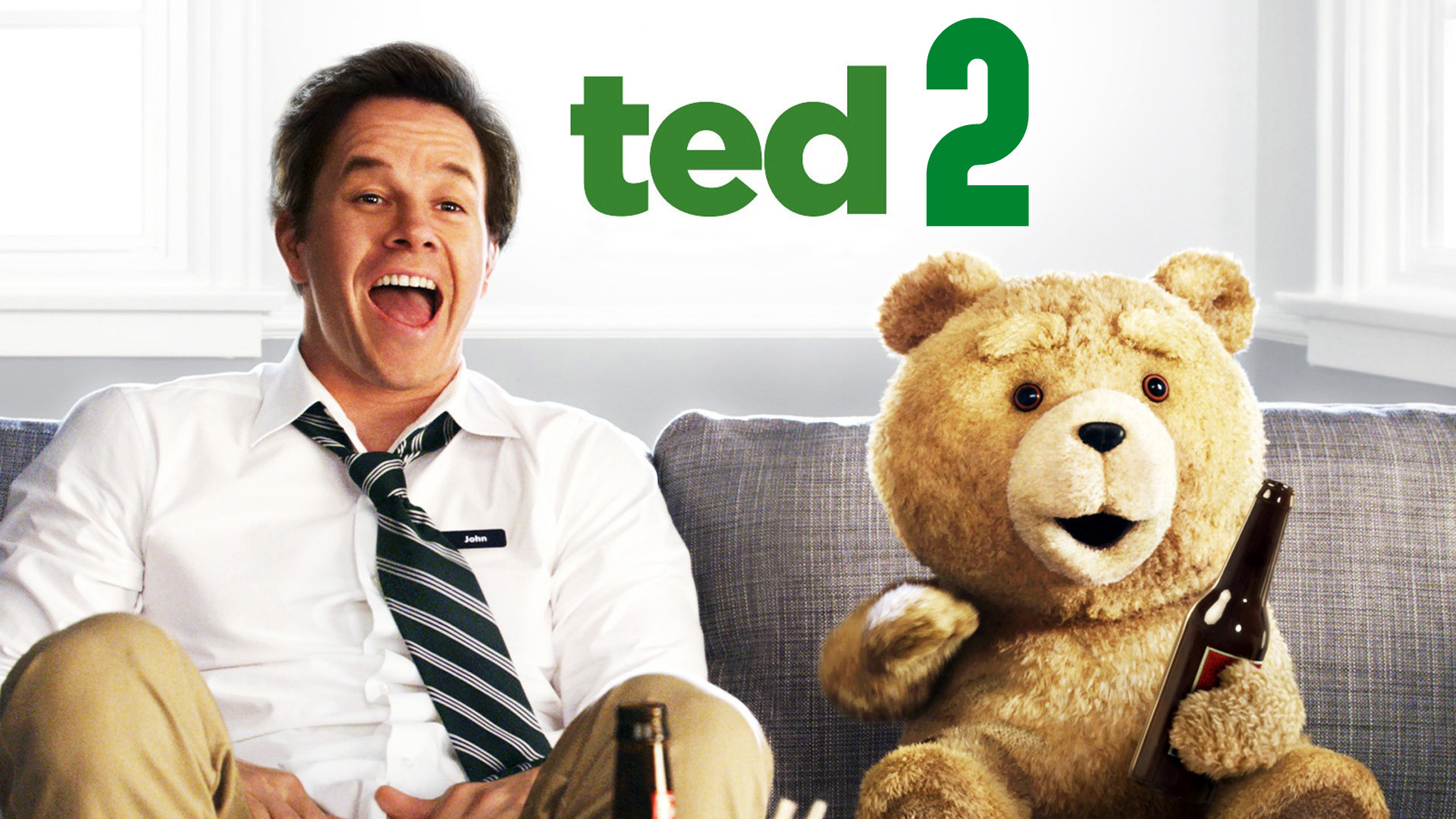
The parts I did enjoy were the low-key, random, off-beat moments, especially in the performances of Mark Wahlberg and, briefly Liam Neeson.  The gimmick may be the talking teddy bear, but the star of the film in every way is Wahlberg, who in the midst of a slob comedy gives a performance that is so precise and witty it is close to adorable.
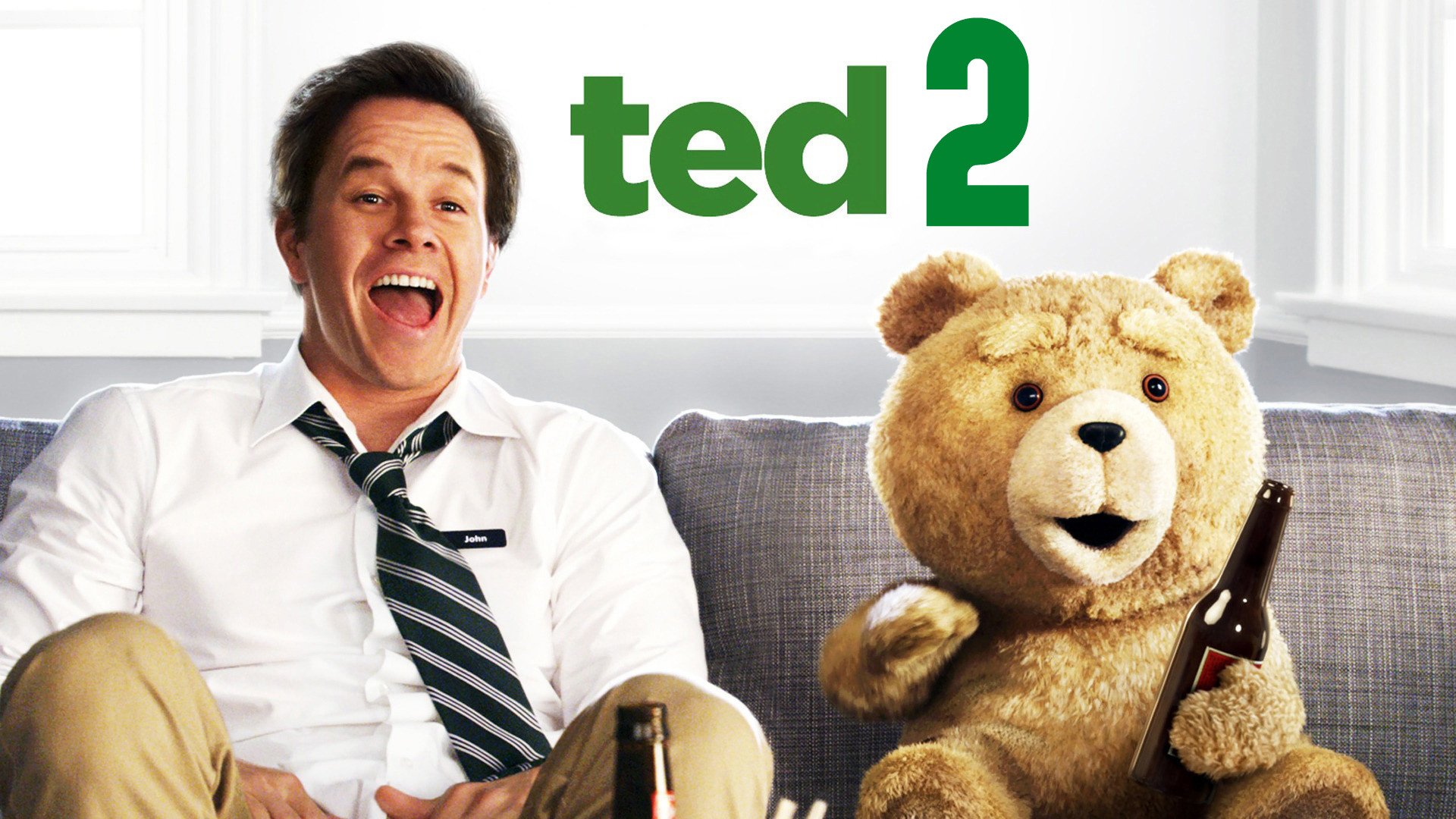
Copyright Universal 2015

“Ted” was an amiably crude film about a boy named Johnny who wished that his teddy bear would come alive, like Pinocchio, or the Nutcracker.  Ted does come to life and decades later, John (Wahlberg) and Ted (voiced by writer/director Seth MacFarlane), are happily still best friends, enjoying the pleasures of adulthood (sex, porn, weed, beer) while happily holding on to childhood when it comes to thunderstorms and responsibility.  The happy ending of course has to be unraveled for a sequel, so we begin with John now divorced from the long-time girlfriend who gently suggested he might want to grow up, and Ted getting married to his girlfriend, Tami-Lynn (Jessica Barth).  After a great musical production number right out of a Busby Berkeley film, we skip ahead a year, and find Ted and Tami-Lynn bickering to the point of not speaking to one another.  So, of course they decide to have a baby.  This requires the assistance of a fertile male human.  Ted’s first choice is, of course, Tom Brady, so he and John come up with a plan to obtain a sample without Brady’s finding out.

It does not end well, so John volunteers to provide the sample himself, leading to the scene described above.  That does not work out well, either, so they try adoption, which brings Ted’s situation to the attention of the authorities.  Apparently, one has to be human to adopt a child.  Ted is classified as property, and is thus ineligible to adopt, work, or even be married.  This being America, they find a lawyer (Sam L. Jackson — get it? played by a very game Amanda Seyfried) to go to court and have Ted declared human.  This leads to a thoughtful exploration of existential ontology.

Kidding!  It’s just a series of dumb situations and dumb jokes made by dumb characters in various locations, including the aforesaid fertility clinic, courtroom, and very lovely home of Tom Brady, plus a pot farm and New York Comic-Con.  Giovanni Ribisi returns as the demented Donny, who conspires with the head of Hasbro (did they really consent to product placement in this film) to kidnap Ted because, oh, who cares.  Certainly not MacFarlane, who makes no attempt at any kind of storyline or character.  He just throws in a gross joke, pop culture shout-out, or surprise cameo (the cast of SNL!  Some “Star Trek” actors!  Liam Neeson, who clearly did not learn anything from his appearance in “A Million Ways to Die in the West!”  Patrick Warburton in a Tick costume!) instead.  Neeson is wonderful.  Wahlberg is terrific. But not enough to overcome the movie’s limp, puerile, vapidity.

NOTE: Stay all the way to the end of the credits for an extra scene.

Parents should know that this film has constant very strong language with crude and explicit sexual references, sexual situations, drinking, extensive drug use, comic peril, and violence.  Some of the humor is intentionally offensive. Some is is just offensive. See the thoughtful discussion of the racist themes and jokes by Wesley Morris in Grantland.

Family discussion: Is Ted human?  Who should decide?

If you like this, try: “Ted” and “Harold and Kumar Go to White Castle”
Related Tags:


Comedy Scene After the Credits Series/Sequel
Inside Out

Inside Out

Posted on June 18, 2015 at 5:53 pm

A-
Lowest Recommended Age: Kindergarten - 3rd Grade
MPAA Rating: Rated PG for mild thematic elements and some action
Profanity: Some schoolyard language
Alcohol/ Drugs: None
Violence/ Scariness: Some peril and anxiety, sad death
Diversity Issues: None
Date Released to Theaters: June 19, 2015
Date Released to DVD: November 3, 2015
Amazon.com ASIN: B00YCY46VO
Copyright 2015  Pixar
Copyright 2015 Pixar

Roger Ebert liked to refer to movies as an “empathy machine.” He said that the great gift of movies, more than any other art form, is the way they can put us inside the world, experiences, culture, and perspective of someone completely outside our own experience. But the best movies do that in a way that helps us understand ourselves as well. “Inside Out” is a rare film that takes us inside the mind of one very particular 11-year-old girl in a way that illuminates the vast breadth of human experience, with deep insights about our own particular quirks, struggles, and emotions. It is exciting, hilarious (two of the funniest jokes you will see on screen this year), and deeply profound, making the most complex concepts accessible in so that children and adults will learn more about who they are and how they got that way.

Riley (Kaitlyn Dias) is in the midst of internal and external turmoil. She was very happy in Minnesota, playing on a hockey team, with lots of friends, and feeling, well, at home. But her parents have just moved to San Francisco, so that her father can take a new job with a start-up. Everything is new and different and scary. Everything she liked about her life, everything she took for granted, is up for grabs. And all of this is happening just as that developmental leap that comes around age 11 is causing her to change from the bright-spirited, optimistic, happy little girl who was confident in herself and in her family.  She is getting old enough to see and feel more of what is going on inside and out. Her parents try to be reassuring, but she knows that her father’s new job is risky. She does not know anyone at school and they do not know her. The old friends from the place she still thinks of as home do not have as much time for someone who is far away.

Of course we have seen this before. There are a lot of movies about people of all ages who are forced to adjust to changed circumstances, or to find a way to make a strange new place feel like home. What is different about “Inside Out” is that Riley is not the character we follow through this story. She has her own adventure, but the story takes place in her mind and it is her emotions who take center stage. They operate the helm of the — yes — Headquarters.

The characters are Joy (Amy Poehler), a pixie-ish blue-haired sprite who is resolutely energetic and upbeat, Anger (Lewis Black), a stocky red fellow who is fiery-tempered and easily outraged, Disgust (Mindy Kaling), green, with a round head, long eyelashes, and a sensitive spirit quick to resist anything new or icky, Fear (Bill Hader), a lean blue creature who usually assumes the worst, and Sadness (Phyllis Smith), who feels everything very, very, very, very deeply. Each of these characters is introduced with what they help Riley do. Anger helps her see unfairness. Disgust helps her to avoid poisonous foods. Fear helps keep her safe. Joy helps her see the world as a place filled with imagination, adventure, and opportunity. And Sadness — we will learn more about what Sadness does later, but for now we will say that it helps her feel empathy. Joy is the leader of the group. She is the most focused and direct and the best able to negotiate with the others. But her goal is to keep all of Riley’s memories happy, and that might not be possible.

As Riley tries to use her mind, her memories, and her emotions to navigate her new community, Joy and Sadness are accidentally transported to where Riley’s memories are stored, and they must make it through an Oz or Wonderland-style land where we learn about everything from abstract thinking to why you CAN’T GET THAT DARN JINGLE FROM THAT STUPID COMMERCIAL OUT OF YOUR HEAD.  A surprising — in every sense of the term — new character shows up to provide support and insight, and to embody the sweet sorrow of growing up.  Co-writer/director Pete Docter told Terry Gross that it was when Mindy Kaling came to talk to him about the film that he understood what it was really about: you have to grow up, and it’s okay to be sad about it.  That applies whether you are the one growing up or just watching it as a parent or friend.  This movie speaks to all of us, whether we have children, are children, were children, or still keep the child we were near our hearts.  A lot of good movies are smart.  But this one is wise.

Parents should know that this movie includes some mild peril, family tension, running away, and a sad death.

Family discussion: Can you think of a time that Joy was steering your mind? How about the other emotions?  When can you feel them working together?  Did you have a Bing Bong? Why did he make that choice?

If you like this, try: “Everybody Rides the Carousel,” “Up,” and “Monsters Inc.”

Related Tags:


3D Animation Comedy Coming of age Drama DVD/Blu-Ray Pick of the Week For the Whole Family
Spy

Spy

Posted on June 4, 2015 at 5:44 pm

B+
Lowest Recommended Age: Mature High Schooler
MPAA Rating: Rated R for language throughout, violence, and some sexual content including brief graphic nudity
Profanity: Very strong and crude language
Alcohol/ Drugs: Drinking
Violence/ Scariness: Extensive action-style violence, some disturbing images, characters injured and killed
Diversity Issues: A theme of the movie
Date Released to Theaters: June 5, 2015
Date Released to DVD: September 8, 2015
Amazon.com ASIN: B00YWE6LXK
Copyright 2015 Twentieth Century Fox

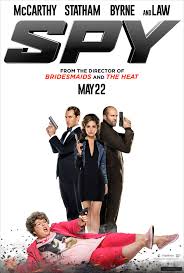
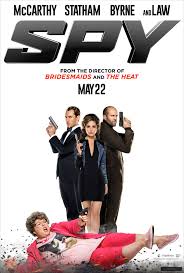
It is time to celebrate. Melissa McCarthy finally has the movie role she deserves. Writer/director Paul Feig, who directed her in “Bridesmaids” and “The Heat” has wisely given her center stage and allowed her to be quirky and awkward, which we knew she could do, and improvise crazy lines and scenarios, which we also knew she could do, but also let her play someone who is extremely capable and loyal, smart, brave, and completely captivating, which we always knew she could do, but rarely got to see more than a hint of it.

Feig does not just thoroughly understand the genre he is shredding. He clearly loves it. All of the classic spy movie necessities are there, a sultry song over the opening credits, impeccable tailoring, a beautiful car, fine wine, pretty girls, chases and shootouts, cool gadgets, glamorous world capitals, a formal high society party with tons of security that must be breached, a club scene with EDM, betrayal by a trusted insider, an evil megalomaniacal villain, and — of course — the fate of the entire world depending on our secret agent with a license to kill saving the day. Dippold avoids the usual spoof go-to “jokes” of incompetence, slapstick, and instantly-old cultural references, allowing the characters to take the stakes and the relationships seriously enough so that the comedy is honestly earned and all the funnier for it. It is genuinely refreshing to see women as not just hero and villain but also as hero’s boss and her best friend. The male stars are excellent, especially Jude Law and Jason Statham, who get to riff on their own leading man images as well as larger-scale action hero conventions. But the ladies are in charge here, and they are killing it. Imaging Miss Moneypenny and Pussy Galore plus Dame Judi Dench as M running the show, with Bond as eye candy.

McCarthy plays Susan Cooper, a teacher turned desk agent for the CIA. As super-cool Bradley Fine (Law) tosses off a glass of champagne, pausing to admire the crystal flute glass before smashing it and sneaking out to find the super-powerful, super-compact bomb, Susan is talking through his earpiece, letting him know which way to turn through the labyrinthian tunnels every self-respecting bad guy has to have under the elegant party going on up above, and which direction the henchmen are coming from. He is fond but patronizing. She is capable but a bit fluttery and insecure.

Unfortunately, there is a lot of pollen in the air and Bradley sneezes at the wrong time, accidentally making his gun go off and killing the bad guy. Also unfortunately, the bad guy’s successor, his daughter Rayna (Byrne, with what looks like several dead animals hiding in her hideous hairdo), has access to the names of all of the current field agents. With no alternative, the humorless CIA deputy director (Janney) sends Susan out into the field, just to track and report, not to engage. Susan is nervous but excited, though disappointed when she receives her cover. No sophisticated bespoke attire and fancy hotel rooms. She will be a dowdy, nondescript woman with a very bad perm.

She doesn’t get the cool hoverboard from the Q-equivalent. She gets weaponized versions of the things a woman like her cover identity would have in her purse. And her cover involves hilariously tacky wardrobe and a disastrous perm-looking wig.  Of course she soon abandons the “no engagement” part. A rogue agent (Statham) trying to find the bomb on his own mostly gets in the way. But she relies on her excellent observational powers, quick thinking, and some mad skillz in hand-to-hand combat, even if killing a guy grosses her out. And she gets some help from her best friend Nancy (the wildly funny Miranda Hart).

It is exciting, funny, and even heartwarming. And best of all, there’s a hint at the end of a possible sequel. More Susan Cooper, please, and lots and lots more McCarthy.

Parents should know that this film includes very strong and crude language, sexual references, sexual humor, and non-explicit sexual situations, graphic nudity, extensive violence with some graphic and disturbing images, and characters injured and killed.

Family discussion: What do you think it takes to be a great spy? If you were going undercover, what would your name be?

If you like this, try: “Get Smart,” “Bridesmaids,” and “The Heat”

Related Tags:


Action/Adventure Comedy DVD/Blu-Ray Pick of the Week Spies
Entourage

Entourage

Posted on June 2, 2015 at 5:32 pm

I sometimes muse that it might be nice to have a rule that I spend no more time writing a review of a film than the screenwriter spent writing the script.  If I had, this review could end right here, with these words: not unpleasant but entirely forgettable.

Alas, no such rule exists, so here I go.  Recently, I learned the term “fan service,” and if you do not know what that means, the “Entourage” movie will do to explain it.  There are movies that pander to the fans, and then there are movies that pander proudly, and “Entourage” panders proudly and is seemingly unaware that there is any other kind of movie to make.  This is a little sad because to the minimal extent it is supposed to be about anything, it is supposed to be about artistic integrity in the midst of soulless Hollywood.  And by “supposed to be about,” I mean that the characters appear to come down on the side of artistic integrity.  The filmmakers, not so much.

Copyright 2015 HBO
Copyright 2015 HBO

The dwindling fans of HBO series will enjoy the pretty girls in pretty settings, the passes at those pretty girls that are warmly received (vicarious thrills) and those that are not (vicarious schadenfreude), the Hollywood triumphs (v. thrills), and the Hollywood failures (v. schadendreude) .   They will get a kick out of the guys’ loyalty (v. t.) and the industry betrayals (v.s.).

They will enjoy the insider-y feeling of the in-jokes, call-outs, and guest stars.  All of that is entertaining, especially Liam Neeson giving Ari (Jeremy Piven) the finger and Jessica Alba in costume yelling at him about her passion project.  I quite liked Warren Buffett calling out advice from a studio lot golf cart.  And there were probably some sports people in it that I couldn’t recognize.

Like the series, the film was produced by Mark Whalberg, inspired by his life before he became a devoted husband and father, when he was taking advantage of being young, handsome, and successful in Hollywood and and his pals from back home were taking advantage of him.  It ended with the young star Vince (Adrian Grenier), having starred in the biggest box office movie of all time, marrying a beautiful girl, and his volcanically profane agent, Ari (Jeremy Piven) retiring.  Both the marriage and the retirement are dispatched in the first few minutes, with Ari coming back to head up a studio and offering Vince a job in a big film called “Hyde,” an updated version of Dr. Jekyll and Mr. Hyde.

But Vince wants to direct.  Not because he has any special artistic statement he wants to make or because he has spent his time on movie sets learning how it’s done — Vince continues to be a cypher.   No, it’s just to give Ari something to melt down about.
Vince’s buddies have two modes.  Most often, they are razzing each other.  Second to that is talking about banging chicks, much of which also involves their razzing each other.  Every so often, some light-weight plot spurs them to bro out and demonstrate some loyalty.  Rinse and repeat.

There is some good, silly fun, and seeing Piven go nuts is so delightful it is disappointing this film has him working on his anger management.  But there’s nothing here that shows any particular insights into people or show business.  Like Vince, it’s blank.  And like his parties, you won’t feel so good about yourself afterward.

Parents should know that this film includes a lot of debauched behavior, with parties, drinking, drugs, and crude and explicit sexual references and situations and a brief fight scene.

Family discussion:  Which of the guys is the best friend to Vince?  If you made it big, which friends would you bring with you?  Which one of your friends would you follow to Hollywood?

If you like this, try: the HBO series and “The Player”

Related Tags:


Based on a television show Comedy Drama Romance Scene After the Credits
Aloha

Aloha

Posted on May 28, 2015 at 5:37 pm

Copyright 2015 Columbia Pictures
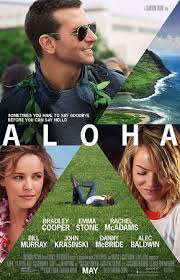
Writer/director Cameron Crowe presents us with an attractive and talented but messy and compromised hero in “Aloha,” and asks us to root for him. The problem is that the film itself is attractive, talent-filled, messy, and compromised, and harder to root for than the hero of the story.

That hero is Brian Gilcrest (Bradley Cooper), once an 11-year-old who loved the sky so much he wanted to identify everything in it. In a quick narrated recap that opens the film we learn that after he grew up things went well for him (in the military) and then not so well, and then badly. While working for a private contractor in Kabul, he was badly injured, and apparently not in the way that gets you a Purple Heart.

Brian arrives in Hawaii and needs to prove himself. His former employer, Carson Welch (Bill Murray) is one of the wealthiest men in the world, presiding over a telecommunications empire. He and the Air Force are working together on a big project that involves the development of land on the island that was a burial ground for the indigenous people. The Air Force assigns a “fast burner” named Sergeant Ng (Emma Stone) to work with get the cooperation of the King of the native population to build on that property, and to show that by performing a blessing ceremony. The King is played by real-life King Dennis “Bumpy” Kanahele, and he is one of the few from Brian’s past who seems to like him much. Welch does not. The Air Force General (Alec Baldwin, volcanically angry) does not. Then there is Brian’s ex-girlfriend, Tracy (Rachel McAdams), now married to an Air Force pilot and the mother of two children.

It totally goes off the rails several times, with a plot that would daunt a Bond villain thwarted by a completely ridiculous hacking scene, plus a last-minute redemptive reconciliation that is so far off the mark of any known human response the characters would be just as likely to sprout feathers and levitate off the ground. While the Hawaiian natives and their struggle against what they see as American imperialism and colonialism are sympathetically portrayed, it is still a story that is about white people and their problems. And the casting of Emma Stone as bi-racial is insensitive at best.

But like its hero and its writer/director, it won me back with the crackle of its dialog and charm of its poetry, even in the hacking scene, and especially in a statement of romantic intent that is one of the best I’ve seen in many months. It is also very funny, with a wonderfully expressive performance from Krasinski as the taciturn Woody, and thoughtful work from Cooper, who keeps getting better at finding moments of surprising insight and nuance with every performance.

Parents should know that this film includes strong language, sexual references and non-explicit situation, paternity issue, references to war-related violence and injuries and to weapons of mass destruction, references to imperialism and colonialism, and alcohol.

Family discussion: Why did Ng talk so much about being one-quarter Hawaiian? Why was the King the only person from Brian’s past who seemed to like him? What happens when billionaires make decisions that used to be made by government?

If you like this, try: “The Descendants,” and “Almost Famous”

Related Tags:


Comedy Drama Romance
THE MOVIE MOM® is a registered trademark of Nell Minow. Use of the mark without express consent from Nell Minow constitutes trademark infringement and unfair competition in violation of federal and state laws. All material © Nell Minow 1995-2026, all rights reserved, and no use or republication is permitted without explicit permission. This site hosts Nell Minow’s Movie Mom® archive, with material that originally appeared on Yahoo! Movies, Beliefnet, and other sources. Much of her new material can be found at Rogerebert.com, Huffington Post, and WheretoWatch. Her books include The Movie Mom’s Guide to Family Movies and 101 Must-See Movie Moments, and she can be heard each week on radio stations across the country.

Website Designed by Max LaZebnik