The Beatles’ second film is not the masterpiece of their first, “A Hard Day’s Night,” but it is colorful, funny, and exciting. And it also has a fabulous soundtrack including the title song and “You’re Going To Lose That Girl,” “You’ve Got To Hide Your Love Away,” “Ticket To Ride,” “I Need You,” “The Night Before,” and “Another Girl.”
It’s a spy spoof about a Beatles fan who sends a ruby ring that is used in a religious ritual to Ringo. The ring is used in a ritual sacrifice. Since it is stuck on Ringo’s finger, the cult members decide he must be sacrificed. So, there is a lot of silly racing around and a scene where Paul gets shrunk. And a lot of great music.
Extras on the first-ever Blu-Ray release this week include:
(1.) ‘The Beatles in Help!’ a 30-minute documentary about the making of the film with Richard Lester, the cast and crew, including exclusive behind-the-scenes footage of The Beatles on-set.
(2.) ‘A Missing Scene’ a film outtake, featuring Wendy Richard.
(3.) ‘The Restoration of Help!’ an in-depth look at the restoration process.
(4.) ‘Memories of Help!’ the cast and crew reminisce.
(5.) 1965 Theatrical Trailers two original U.S. trailers and one original Spanish trailer. (6.) 1965 U.S. Radio Spots (hidden in disc menus)
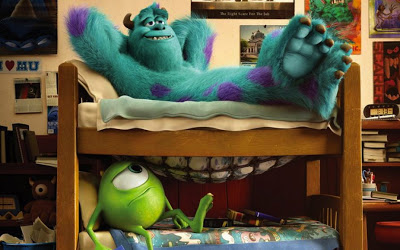
“Monsters Inc.” is one of my favorite Pixar movies, filled with wit, imagination, and heart. This prequel is a lot of fun, still very funny and wildly imaginative, but a little hollow where the heart should be.
One problem Pixar just can’t solve is that a prequel has to end before the original begins. “Monsters Inc.” has a brilliant premise: there’s a monster world fueled by the screams of frightened children. The monsters themselves are terrified of humans, even a toddler named Boo.
There is a power factory that sends them each night into children’s bedrooms. The monsters have to scare the kids without being seen by grown-ups and get home without being “contaminated” by contact. By the end (SPOILER ALERT) the monsters have discovered that children’s laughter is an even better energy source, and the audience goes home feeling happy and reassured. But a prequel has to stick with the idea that scaring children is a worthwhile goal, indeed it needs us to get on board with the idea that we should root for the characters to be really good at it. We know Mike and Sully will end up as friends. So the sweetness and the dramatic tension are dialed down.
Once again, our heroes are Mike (Billy Crystal), the anxious one who looks like a green beach ball with arms and legs and one great big eye, and Sully (John Goodman), the giant polka-dotted furry guy who thinks it all comes naturally and he does not need to work. They both pick the prestigious “scaring” major, under the stern eyes of Dean Hardscrabble (Helen Mirren, impeccable as always) and Professor Knight (Alfred Molina).
Fans of the original will be intrigued to find that in the beginning, Mike and the chameleon-like Randy (Steve Buscemi) were roommates and friends. How that turns to rivalry while the initial enmity between Mike and Sully turned into professional partnership and personal BFF-dom is the story of the film, with some overtones of “Animal House,” “Harry Potter,” and every ragtag group of underdogs movie you’ve ever seen.
Mike is the one who studies all the time. Sully is the party animal who thinks that he can get by on charm and talent. Both find themselves kicked out of the program, with just one chance to get back in. If they can be a part of the team that wins the intramural games, they can get back in the scaring program and become professional human child scarers. They will have to work together — and bunk together — with the oddballs and rejects at the bottom of the school’s social hierarchy, the members of a fraternity known as Oozma Kappa (OK). Their fraternity house is the home of one of the members, with his mom as their RA and chauffeur.
The frat brothers are adorable, especially the two-headed Tracy/Traci (voices of Sean Hayes and Dave Foley), and a fuzzy purple log-shaped guy named Art who looks like a Muppet reject (Charlie Day). Art is a new age philosophy major who eagerly presses his fellow OK-ites to try dream journals. Don (Joel Murray) is a middle-aged guy trying for a new career (apparently there’s a recession in Monster-world, too). None of these monsters is especially smart or strong or fast or scary. They have to compete against the fearsome athletes of Roar Omega Roar (ROR), let by the arrogant Johnny (Nathan Fillion).
There are some exciting and funny moments in the competition, especially a too-knowing obstacle course where the teams have to avoid a truly terrifying foe: human teenagers. The monster-ification of the classic college movie developments is a lot of fun. In making sure each team has a quorum, Johnny sneers, “We count bodies, not heads.” Tracy/Traci only counts as one. Of course, the struggle to be liked by the cool kids is the same whether you’re a person or not.
They did not want to go for the usual ending here, which is admirable, but the result is surprisingly downbeat and disquietingly know-nothing. If is not the loud, over-done “Cars 2,” it is also not the expansive, transcendent “Toy Story” sequels. Second-rate Pixar is still better than most of what is out there, but we expect more.
P.S. As always, the movie is preceded by a marvelous animated short from up-and-coming Pixar-ians. This one echoes last year’s “Paperman” romantic (and meteorological) theme, with blue and red umbrellas finding each other in a rainy city.
Parents should know that this film has some mild peril, bullying, insults, and hurt feelings. Characters cheat and have to pay a penalty.
Family discussion: Why didn’t Mike and Sully get along at first? How were they different? What was good and bad about the fraternities in the movie and how are they like groups you know? How do they make a deficiency into an advantage? How can you?
If you like this, try: “Monsters, Inc.,” “Sydney White,” and “The Lawrenceville Stories”
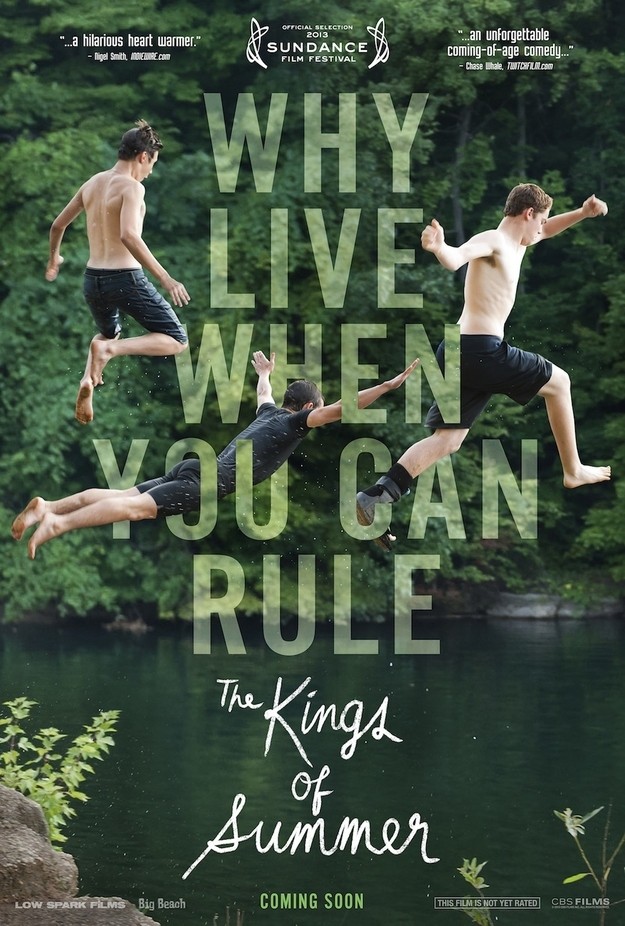
When Mark Twain had Huck Finn leave the kind-hearted widow who hoped to “civilize” him to “light out for the territories,” he tapped into the dream of all teenagers and the teenagers inside all of us to escape from all rules and restrictions and create our lives from scratch. Peter Pan and the Lost Boys had Neverland. Baby boomers sang along with Crosby, Stills, Nash and Young about “trying to get ourselves back to the garden.” Every generation wishes for the simplicity and purity of the natural world. In the wise, touching, and often wildly funny “The Kings of Summer,” three 15-year-olds follow their own call of the wild to run away from home and build a house in the woods. Their parents may see them as boys, but they want a place where they can define what it means to be men.
Nick Robinson, who perfected a look of exquisite pain at the humiliating behavior of his father in a brilliant series of Cox cable commercials, plays Joe Toy. He lives with his widowed father, Frank (“Parks and Recreation’s” Nick Offerman in a witty and heartfelt performance). Of course at that age, a parent does not have to do anything to be excruciatingly embarrassing. It is bad enough that Frank actually exists, but he also has the nerve to tell Joe what to do. Worse, he is dating someone, and worst of all he expects Joe to play a board game with her. The horror!
Joe’s best friend Patrick (Gabriel Basso), is smoldering with his own adolescent fury. His parents say things like, “Rope in the attitude, mister” and just because his ankle is in a cast, they want him to be careful. How dare they! “I’m happy to be where my parents are not,” he says.
Another kid named simply Biaggio (the wonderfully oddball Moises Arias) wants to join them. He does not have any special problem with his family. He just “didn’t want to do nothing.”
Joe, Patrick, and Biaggio build their house in the woods. They breathe the air of free men and rejoice in their liberation from all rules and conventions. They vow “to boil our own water, kill our own food, build our own shelter, be our own men.” If foraging for food in the woods means a stop by the Boston Market across the highway from the forest, well, no one can argue with how good it tastes.
Director Jordan Vogt-Roberts and writer Chris Galletta bring a fresh and sympathetic eye to the story, evoking the pleasure of what feel — for a little while — like endless possibilities. The film perfectly captures that liminal moment when teenagers live in the space between childhood and becoming an adult. And they’re old enough to carry it off, at first. They are young enough to be certain their parents are wrong about pretty much everything — and to be confident that they can do everything better. The house is like something the Lost Boys might build for Peter Pan, with a stolen door from a port-a-potty for the entrance and essentials like a mailbox, a slide, a basketball hoop, and an air hockey table.As is often the case with boys of 15, they look like they are from three different planets. Patrick is muscular and physically much more mature than the others and Biaggio could be 12. Joe is somewhere in the middle. Biaggio’s random and inscrutable pronouncements are amusingly accepted by the other two as if they made as much sense as anything else, or as if making sense did not matter. And of course the most unexpected complication is when a girl comes through the port-a-potty door.
Like that other icon of the dream of escaping the oppression of civilization, Henry David Thoreau, the boys learn that there is a time to go to the woods, and a time to come home.
Parents should know that this movie has very strong and crude language and teen drinking and smoking.
Family discussion: What was the most important thing Joe learned? What about Frank? What would you bring to a house in the woods?
Please, please don’t call this third entry in the story of Celine and Jesse the final chapter of a trilogy. The audience is almost as invested in them as we are in the stories of the “Up” movie documentary series that has visited a group of English people every seven years since they were children and now shows us how they are doing in their 50′. Those of us who follow the series know their stories almost as well as our own and look forward to the next installment as though it was a college reunion of our friends.
We almost feel that way about Jesse and Celine. They may be fictional characters, but they are so closely connected with the actors who play them and co-write the screenplays that are so intimate, so true to the nature of love in ways that movies seldom approach that it invites us into their most intimate moments, and our own. Most movies take shortcuts when the characters fall in love, giving us a quick, “You’re a fan of that esoteric musician/writer/sports figure no one heard of? So am I!” or just a montage with a pop song while the couple bicycles on the beach and marvels over the choices in an open market.
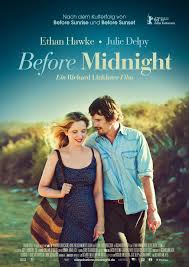
But the first in this series, “Before Sunrise,” was that rarest of films that show us that falling in love is when you start a conversation you never want to end. Jesse (Ethan Hawke), a college student on his last night in Europe before returning to America, impetuously invites a French student named Celine (Julie Delpy) to get off the train and spend the night with him, walking around Vienna. They talk about life, love, and everything and agree to meet in six months and part without exchanging contact information. This was 18 years ago, before texting, tweeting, Google, and Facebook. Writer-director Richard Linklater did not plan to tell another Jesse and Celeste story, though he did include a brief scene with the two of them talking in bed in his animated film, “Waking Life.”
That scene, as marvelous as it was, was non-canon (or, as comic books would say, “an imaginary story”). When we meet them again nine years after their original meeting in “Before Sunset,” they have not seen each other since they said goodbye in Vienna. Like “An Affair to Remember,” one of them was there six months later, and one had a good reason we will find out for not being there. Jesse, married and with a young son, is a writer whose recent novel was inspired by his night with Celine. When he goes to a book signing in Paris, she is there. Once again, he has to catch a plane back to America, and once again they walk through a European city and talk and talk and talk. This time, Hawke and Delpy were credited as co-writers. In the swooningly romantic last moment (spoiler alert), he misses the plane to stay with her.
And now, another nine years have gone by, and they walk around another spectacularly beautiful city, this time on their last night of a working vacation in Greece. Once again, there is a plane returning to America, but this time it is taking Jesse’s son back to his mother, Jesse’s now-ex-wife. It is a wrenching goodbye, in part because Jesse’s son, a young teenager, is so mature and understanding. “It’s like sending him back across enemy lines,” he tells Celine. “This is the one thing I promised myself I would never do.” And then Jesse gets some bad news from home, increasing his sense of isolation from his home.
Jesse and Celine are happily unmarried and the parents of twin girls. In the first movie, they had the excited rhythm of very young people discovering the pleasures of connection. In the second, they had the tentative rhythms of people who knew pain and loss and were struggling to trust again, exploring the possibility of re-connecting. Here, in a long drive from the airport, they talk with the rhythm of people who are deeply connected, laughing, sometimes pointedly, about petty irritations, skirting old wounds. They are comfortable with each other, but struggling to keep a sense of themselves as individuals and as people in love in the midst of domestic chaos. Jesse hates being away from his son, but cannot get custody so he can live with them in France or move back to the United States without disrupting Celine and their daughters.
They have a long, luscious lunch with friends who exemplify every stage of love and talk about meaning and memory and love and art and relationships and the notion of self and the differences between the sexes and the way each generation thinks it is inventing the world and watching it collapse. When they were young, they could not wait and wanted everything to speed up. Now, they want everything to slow down.
Then once again Jesse and Celine go for a long walk and talk, sparing, flirting, testing each other. Their friends have given them every parent’s greatest desire, a night away from the children. They find themselves in a surprisingly generic hotel room, begin to make love, and then enter into the kind of massive meltdown of an argument that only people who know each other very, very well can have. Early in the film, talking about her career, Celine says she is “tired of being a do-gooder that rolls the boulder up the hill” like Sisyphus. We get the feeling that the same applies to the stresses of keeping a relationship strong and intimate when you have to spend so much time scheduling and handing off.
They sit to watch a sunset. Celine says, “Still there, still there, still there….gone.” They know that ahead of them lies loss of all kinds. Will they face it together? There are movies where the sequels are so bad that they reduce your affection for the originals. With this series, each film deepens the meaning and sensibility of the story so that now, taken as one whole, the three (so far) have become one of the most romantic stories in the history of film. I’m counting the days until part four.
Parents should know that this film includes very strong and crude language, sexual references and situations, female nudity, and tense emotional confrontations.
Family discussion: How do the other people who join Jesse and Celine for lunch illuminate the stages of relationships? What do you think will happen to them in the next nine years?
If you like this, try: “Before Sunrise” and “Before Sunset,” the Canadian film “The Barbarian Invasions” and one of the best movies ever made about a relationship over many years, “Two for the Road” with Audrey Hepburn and Albert Finney
Let’s hope that this movie is the much-needed stake in the heart to the triligization of popular movies (okay, with an exception for Richard Linklater’s “Before” series and “Toy Story”). I began to think of the three films as a shell game, with the pea of novelty and humor under just one shell, and shrinking retrospectively as I was dragged through this far distant last in the series, so entirely disappointing that it diminishes any fond memories of the original.
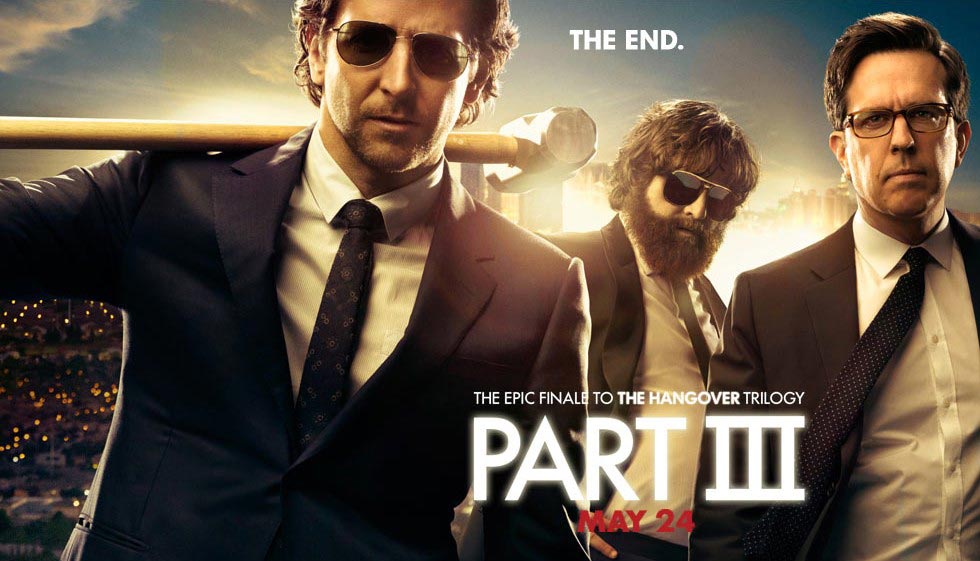
And that is the key word. The first chapter was original. We got to enjoy the speculation and schadenfreude as we lived a night of mostly unintentional debauchery and mayhem backwards. Feral man-child Alan (Zach Galifianakis), cynical Phil (Bradley Cooper), and mild-mannered Stu (Ed Helms), a hapless trio, in Las Vegas for a bachelor party, wake up in the mother of all mornings after and spend most of the movie piecing together the events of the evening before. They have to discover how they ended up with a tiger, a baby, a missing tooth, and a hospital bracelet. And the prospective groom is missing.
In #2, there’s another wedding to make in time, and another morning after. Some people found the second one a garish and cynical retread. I thought it was pretty funny and even managed to find some meta-commentary in the way it rang changes on the first one. And I liked Paul Giamatti.
In #3, director Todd Phillips and Craig Mazin (the execrable “Identity Thief”) take over script duties from the original’s writers, who were off plagiarizing themselves with a college-age version of the very same movie. This one jettisons the backwards-style structure, which is fine, but it plays as though they pulled it out of a slush pile and did a global search and replace to insert the first movie’s characters, who, in one of many increasingly less funny repetitions of almost-jokes we’ve increasingly tired of, are referred to by one character as The Wolf Pack.
Once again, they are separated from Doug (Justin Bartha), who is held hostage by a thug (John Goodman) while they are sent to track down their old frenemy, Leslie Chow (Ken Jeong). We also meet up with the first episode’s characters drug dealer Black Doug and former stripper Jade (the criminally misused Mike Epps and Heather Graham). And here is what we learn:
1. These are really unpleasant people. They are selfish, childish, and uninteresting.
2. A little of Leslie Chow is better than a lot.
3. It is impossible to make the same joke funny three times in a row. The second time may provide a pleasant sensation of remembered humor. The third time is just irritating.
4. It is possible to criminally underuse even John Goodman, completely wasted here.
5. Melissa McCarthy, on the other hand, while also underused, manages to make her five minutes the highlight of the film.
6. It is possible to miss Mike Tyson.
This movie is the bad hangover from the now-tarnished original.
Parents should know that this film includes comic and more serious violence including murder, guns, chases, characters and animals in peril, injured, and killed, extensive drug content, constant very strong language, sexual references (some crude) and situations (male and female nudity), pervasive very bad behavior
Family discussion: Which of the friends makes the best choices? Do you think that the different structure of the story-telling works as well as the original?
If you like this, try: the first “Hangover” movie and “Cedar Rapids”