Peeples

Posted on May 9, 2013 at 6:04 pm
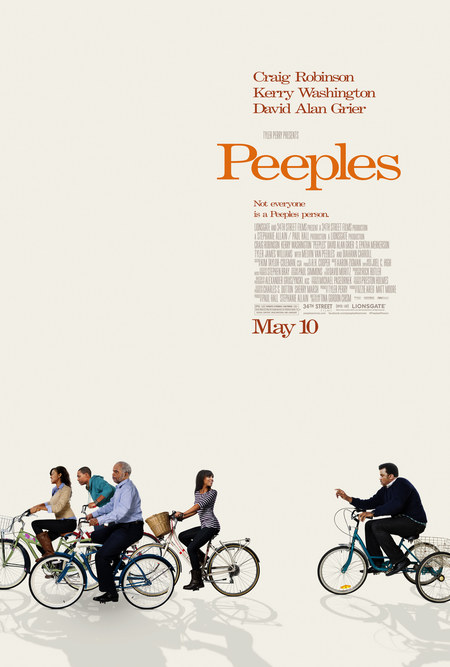
peebles posterSometimes I think that all the myths and fairy tales about scary monsters, dragons, and ogres are just metaphors for life’s most terrifying meeting — the introduction to the family of one’s beloved.  Every family is its own country, with its own language and customs.  The pressure of trying to make a good impression while navigating the dynamics and cultural imperatives of another family and supporting the significant other is terrifying.  And when it happens to someone else, it is funny, which makes it a popular theme in movies going back to “Abie’s Irish Rose,” and up through “Meet the Parents.”

Tyler Perry loves raucous family conflicts, and here he produces the latest “meet the family” comedy, written and directed by Tina Gordon Chism (“Drumline”).  Wade (funny man Craig Robinson in his first romantic and leading role) wants to propose to Grace (“Scandal’s” Kerry Washington).  But she has never let him meet her family, an intimidating group of high-achievers he refers to as “the chocolate Kennedys.”  “Peeples,” the homey family name that makes them sound a little bit like Weebles, is a sly contrast with a group so imposing and remote a better name for them could be “the chocolate Mt. Rushmores.”

Wade decides to surprise Grace by showing up at her family’s magnificent home on the beach.  (“You probably have Oprah dollars.”)  He’s the one who gets surprised when he finds out that his girlfriend has not even told her family that she is seeing someone.  It turns out that her stern and demanding father Virgil (David Alan Grier) has such impossibly high standards that she does not even want to risk allowing him to apply.  Virgil is a judge by profession and a judge by nature.  Grace knows that the easy-going Wade, whose current job consists of singing a song about potty training to children, will not fit in with her highly competitive, uptight family.

But Wade sees immediately that Grace’s family is not as perfect as they want to pretend to themselves and everyone else.  Grace’s mother Daphne (S. Epatha Merkerson) has a couple of secrets.  So do Grace’s broadcast journalist sister (Kali Hawk) and teenage brother (Tyler James Williams).  At first, Wade makes things much worse when he tries to fit in and begins to feel threatened and insecure.  Things get more complicated when his own brother (Malcolm Barrett) shows up.

The humor is often crude and silly, but it is so good-hearted and the performers are so appealing that like Wade and the Peeples, it might win your heart.

Parents should know that this film as very crude and raunchy humor, explicit sexual references and situations, drinking, marijuana, and very strong language.

Family discussion:  What is the scariest thing about meeting the family of your significant other?  What did Grace’s family learn from Wade?

If you like this, try: “Jumping the Broom” and “Meet the Parents”

Related Tags:


Comedy Family Issues Romance

For Tax Day: The Mating Game and Stranger Than Fiction

Posted on April 15, 2013 at 7:00 am

In celebration of tax day, enjoy two romantic comedies about IRS agents.

“The Mating Game” stars Tony Randall and Debbie Reynolds in a rollicking story about a warm-hearted farm family that never pays taxes because they do everything on the barter system.  Paul Douglas is wonderful in what would be his last performance.  If that sounds familiar to PBS fans, it’s because it is based on The Darling Buds of May by H.E. Bates, which became a a 1991 television series starring Catherine Zeta-Jones.

And Will Ferrell plays an IRS agent who discovers he is a character in a book in the fourth-wall-breaking delight, “Stranger Than Fiction.”


Related Tags:


Based on a book Comedy Neglected gem Romance

Admission

Posted on March 21, 2013 at 6:01 pm

Tina Fey and Paul Rudd seem perfect for each other. The characters they play in this movie are not as persuasive.  Fey is so much better than the adorkable rom-com role assigned to her here and Rudd is capable of so much more than the earnest do-gooder relegated to him.  But what really hurts this film is the senseless complications the characters have to try to navigate and the uncertain hold on developments that are are disorientingly off-key.  You can see the studio’s lack of confidence in the movie in the bait-and-switch ad campaign.  The commercials make it look like a standard romantic comedy (and it may have been re-edited to try to fit those rhythms), but the plot line about reuniting with a child put up for adoption feels awkward, cluttered, and intrusive.

Fey is Portia, a tightly-wrapped admissions officer at Princeton, always buried in orange file folders brimming with the hopes and dreams of 17-year-olds and their parents.  They all have excellent grades, community service credentials, positions in student government, athletic achievements, and some sort of artistic streak.  Portia knows how to maintain her composure even when confronted with prospects who are certain that asking just the right penetrating question of the student tour guide will somehow cause the (for the purposes of this film) toughest school in the country to get into to see them as the shining star of perfection their parents always told them they were.  She is less composed when it comes to her own ambitions.  The head of the office (Wallace Shawn) is retiring and Portia is competing with a colleague (“Lincoln’s” Gloria Reuben) who is much smoother at ingratiating herself at Portia’s expense.

Portia is constantly under assault from applicants, parents, and high school college counselors.  Despite the avalanche of applications Princeton receives every year, she has to go out to high schools to encourage seniors to apply.  Princeton is competitive, too.  It wants to make sure that it gets to choose from the the most promising applicants.  And it wants to keep its rejection ratio high so it will top the annual US News rankings.  She gets a call from John Pressman (Rudd) the head of an alternative school.  Like all the other high school administrators, he has a student he wants her to accept.  Like many of them, he wants to make the case that the kid’s file does not reflect his true potential.  But there is one more thing.  John is sure, on the flimsiest of evidence, that an autodidactic polymath named Jeremiah (a likable Nat Wolff of “The Naked Brothers”) is the son Portia gave up for adoption.  The one she never told anyone about.  Jeremiah wants to go to Princeton and Portia’s vestigial maternal instinct jumps to life.  All of a sudden, she finds herself on the other side of the admissions process.

And there’s a lot of other stuff happening with Portia’s professor boyfriend (Michael Sheen), her free-spirited mother (a mis-used Lily Tomlin), and John’s adopted son (Travaris Spears), and John’s parents.  And most of these people at some point in the last third of the film do something so inexplicably inconsistent with what we know about them and what we want for them that it almost seems that we’ve wandered into a different movie.

It would be impossible for Fey and Rudd to be anything other than entertaining and highly watchable.  But I hope their next time on screen does not test that proposition so insistently.

Parents should know that this movie includes references to infidelity and putting an out-of-wedlock infant up for adoption, drinking, and a non-explicit sexual situation.

Family discussion: How did Portia’s mother influence her ideas about parenting? How would you decide who to admit?

If you like this, try: “Clueless” and “Date Night”

Related Tags:


Based on a book Comedy Date movie Romance School

The Croods

Posted on March 21, 2013 at 6:00 pm

I think we can all agree that at least in some respects all children are Neanderthals. It is the grand challenge of parenthood to civilize these sometimes savage little creatures by teaching them language, manners, and keeping safe.  And some of the most difficult choices parents must make come when we try to encourage children to be strong, brave, independent, and adventuresome when it comes to accomplishing goals in school, sports, and chores while protecting them from mistakes that could be hurtful or even devastating.

That’s the idea behind sweet new animated film about a prehistoric cave family. Familiar family dynamics are amusingly exaggerated in the Paleolithic setting, where the most basic necessities require everyone’s full-time attention.  The heavy-boned characters designed by the brilliantly witty Carter Goodrich (“Despicable Me,” “Hotel Transylvania”) may argue with each other, but they demonstrate the strength of their bond on the hunting/gathering expedition.  When this family goes out to get breakfast, they really go out to get breakfast.  In a joyously-choreographed race to get food, parents Grug (Nicolas Cage) and Ugga (Catherine Keener), Ugga’s mother Gran (Cloris Leachman), and their three children work seamlessly together somewhere between extreme dodgeball, an obstacle course, and a rugby game.  Even the happily feral baby joins in for a crucial maneuver.

Other than that, they stay inside the cold, dark, cave.  None of the other families of their community have survived, and Grug is terrified of anything that he cannot control.  So he tells his family that “curiosity is bad and anything that is new is bad” and insists that they all stay inside together.  Keeping everyone alive is his full-time job.  “Never not be afraid,” he warns them.  “Fear keeps us alive.”  “I will never do anything new or different,” promises his son Thunk (Clark Duke).  But rebellious teenagers go back as far as protective fathers, and Eep wants to explore the world outside the cave.  What Grug sees as safe and under control, Eep sees as boring and old-fashioned.

That bigger world Eep wants to see includes a stranger, a guy named Guy (Ryan Reynolds).  He has a lot of new ideas like tools, shoes, a “belt” (a monkey with a theatrical flair for flourish), and “baby suns”  — fire.  Eep wants to learn more.   And soon Grug has to make changes because the tectonic plates start to shift beneath him. Staying the same is no longer safe.  The family must leave the cave to find a new place to live.  Grug has to learn that sometimes new is not bad.  And Eep has to learn the value of what she already has.

Kids will enjoy outsmarting the Neanderthals, whose experience of the world is so limited that they think fire can be extinguished by dry grass and they will marvel at the notion that there had to be a first-ever hug.  They will get a kick out of Guy as a proto-MacGyver who shows his traveling companions how to use rocks, vines, leaves — and strategy — to trap food and protect themselves from predators.  As Grug and his family leave their rocky home they find new environments that are increasingly dazzling, with spectacularly imagined vistas and gorgeous vegetation.  Those images nicely parallel the opening minds and spirits of Grug and his family.  Despite a few too many mother-in-law jokes, “The Croods” nicely makes it clear that even before they had fire, families understood how important it was to cherish and protect each other.  And Eep reminds us that what may feel like teenage obstinacy and foolhardiness may just be the next step in our evolution.

Parents should know that this movie has some scary animals and children and adults in peril, with references to sad off-screen deaths.  There is brief crude humor and there are repeated jokes about Grug wishing that his mother-in-law would die.

Family discussion: How can you tell when it is time to try new things and time to stick with what you know?  What did Guy and Grug learn from each other?

If you like this, try: Visit a museum or do some research in books to look at prehistoric fossils and bones and watch “The Land Before Time,” the “Ice Age” series, and “The Flintstones”

Related Tags:


3D Action/Adventure Animation Comedy Epic/Historical Family Issues

21 and Over

Posted on February 28, 2013 at 10:14 am

The writers of “The Hangover” have written and directed a new film so close to the original they could sue themselves for plagiarism. Once again, it is the story of a a wolf pack of bros looking for a good time who have a wild night with an important deadline the next day, told in a flashback.

We meet our two main characters, Miller (Miles Teller of “Rabbit Hole” and “Footloose”) and Casey (Skylar Astin of “Pitch Perfect”), walking across a university campus at 6 am, naked except for a tube sock each, their rear ends inflamed.  Then we go back a day to find out how this happened.

Miller and Casey (who appear to have just one name each) arrive at the campus of the fictitious Northern Pacific University (filmed at the University of Washington in Seattle) to surprise their high school friend, Jeff Chang (Justin Chon), who is always referred to by his full name.  It is Chang’s 21st birthday, and they want to be there to celebrate by geting him legally drunk.  But Chang’s stern father is there to make sure that his son sticks to his studies and is ready for a very important med school interview at 8 the next morning.  At first, Chang insists that he cannot go out with his friends.  But soon he says he will have just one drink.  And they assure him they will take good care of him and get him right back for a good night’s sleep.  They’re both wrong.

They go to a bar and Chang gets drunk.  When he passes out, Miller and Casey cannot remember where he lives, and so they end up dragging Chang around like a sack of potatoes through a Latina sorority, a pep rally, and a party where Miller and Casey have to win a series of party games, mostly involving more drinking, plus a prank that involves gluing a plush animal to a very personal body part.  It’s regrettably retro, with drinking as an emblem of freedom, an aversion to growing up that would embarrass Peter Pan, and (sigh) heterosexual girl/girl kissing as super-hot but heterosexual boy/boy kissing as unquestionably disgusting and worthy of an old-fashioned homosexual panic.

“The Hangover” worked because it allowed the audience the best of both worlds — to enjoy the unleashed id of the debauched night through the lens of the consequences.  It also benefited from characters like Mr. Chow, Black Doug, Jade, and Mike Tyson, and from the talents of supremely gifted performers.  Teller and Astin are able and likable performers with a good feeling for the rhythms of bro-speak but neither they nor the one-dimensional characters they are given to play are enough to sustain our interest, much less our sympathy.  The story wants to be deliciously outrageous and transgressive.  It is just tawdry and juvenile.

One more note: the producers are adding two additional scenes to the version being released in China.  A Chinese company providing production money insisted that the dubbed version be refitted as a story of a Chinese student who discovers the decadence and other evils of Western ways and returns home a wiser and more obedient young man, a sort of Chinese “Hell House.”  I’m sure that version will not be any better, but I can see their point.

Parents should know that this movie has just about every kind of bad behavior including drinking to excess and drinking games, drugs, extremely strong and crude language including ethnic and racial slurs, and comic violence including a gun, assorted mayhem, a car chase, a one-animal stampede, discussion of assault and attempted suicide, explicit sexual references and nudity.

Family discussion:  What should Jeff say to his father?  Why were these guys friends?  How do you find a balance between doing what is best for your future and finding time to have fun?

If you like this, try: “The Hangover,” “Harold and Kumar Go to White Castle,” and “Superbad”

Related Tags:


Comedy
THE MOVIE MOM® is a registered trademark of Nell Minow. Use of the mark without express consent from Nell Minow constitutes trademark infringement and unfair competition in violation of federal and state laws. All material © Nell Minow 1995-2026, all rights reserved, and no use or republication is permitted without explicit permission. This site hosts Nell Minow’s Movie Mom® archive, with material that originally appeared on Yahoo! Movies, Beliefnet, and other sources. Much of her new material can be found at Rogerebert.com, Huffington Post, and WheretoWatch. Her books include The Movie Mom’s Guide to Family Movies and 101 Must-See Movie Moments, and she can be heard each week on radio stations across the country.

Website Designed by Max LaZebnik