Josh Duhamel narrates this extraordinary documentary about one of our planet’s most precious resources, our oceans. Filmed by directors Yann Arthus-Bertrand and Michael Pitiot, along with an outstanding team of international underwater cinematographers in partnership with OMEGA and with the scientific support of Tara Expeditions, the film aims to explain some of the planets greatest natural mysteries, while reinforcing how essential it is that mankind learns to live in harmony with our oceans. Planet Ocean serves as a reminder of the bond between humans and nature, and the duty that exists to protect and respect our planet. Yann Arthus-Bertrand, Goodwill Ambassador for the United Nations Environment Program, presented this film to the leaders of Rio+20 conference in June 2012.
Spectacular aerial and underwater imagery captured in extreme geographical conditions worldwide, Planet Ocean brings into into the least known regions of our planet. I have one Blu-Ray copy to give away. Send me an email at moviemom@moviemom.com with Ocean in the subject line and tell me your favorite ocean view. Don’t forget your address! (US addresses only). I’ll pick a winner at random on April 21. Good luck!
BONUS FEATURES (BLU-RAY™ and DVD):
· THE MAKING OF PLANET OCEAN
· IN THE SKIES ABOVE RIO: Breathtaking images of Rio de Janeiro’s magnificent shores
· UNDERWATER: Uncover the natural mysteries of marine life with Planet Ocean’s team of underwater cinematographers.
· SHANGHAI: Extraordinary aerial photography of Shanghai’s busy harbor underscores the significance of ocean commerce.
Interview: Janet Tobias of the Holocaust Documentary “No Place on Earth”
Posted on April 7, 2013 at 3:58 pm
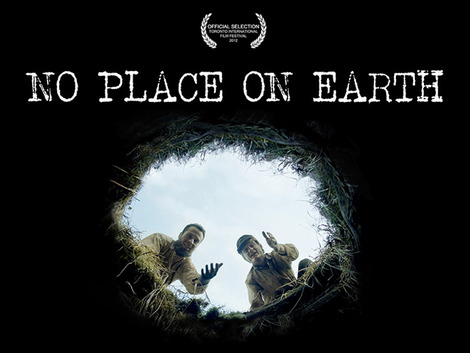
No Place on Earth is the extraordinary new documentary about a small group of Jews from Ukraine who hid from the Nazis in two caves for almost two years. Interviews with the survivors, narration from a book written in the 1960’s by the woman who was one of the leaders of the group, some re-enactments, and a powerful return to the caves 67 years after the end of the war. Tonight, as the annual observance of Yom Hashoah, the day of holocaust remembrance, it is especially meaningful to share this story.
I spoke to director Janet Tobias about making the film.
One of the people in the film says, “We were not survivors. We were fighters.” What do you think that means?
They were fighters. They stuck together. Esther Stermer was an incredible mother and grandmother, a matriarch. She didn’t do the obvious thing. She decided to do what was necessary to survive and to protect her family. It’s an incredible story of what they accomplished. The lesson I take away from it is how much we depend on each other. they were greater as a collective whole than they were individually. Many of them would not have made it on their own. We do much better when we have each other than on our own.
The families were extended families, but it was a tough world. There had to be a group of people from each family who were willing to risk their lives on a weekly basis.
Tell me about the re-enactments of some of the scenes, which you shot in Hungary.
I was blessed with an incredibly great group of Hungarian actors, from Kati Lábán, who played Esther Stermer who is a very well-known actor in Hungary to some who had never acted before. We looked for approximation of physicality but I was not going to be completely literal because it is more important to have the person who has the right understanding of the story and the spirit. We did recreations, a hybrid between documentary and drama, because on the one hand you are in the presence of the last years of people who were eyewitnesses, who can say, “That happened to me. I saw it,” which is an incredible gift in documentary. On the other hand, the Stermers were fighters, as you said. They were actors on their environment. Lots of documentaries are about people contemplating their life. But the Stermers were fighters, not contemplators. They are doers. To show the incredible thing they accomplished, what they got up and did, that needed actors. Esther Stermer had a clock in her head. She kept a cooking schedule, a cleaning schedule. They knew when they could go out without moonlight. They observed the holidays. When they were buried alive, they did not give up and say “It’s over.” They said, “We need to do the following things in construction to even have a chance of figuring this out.” They were dramatic actors in real life, so we needed to match that.
And we had to show what it was like to live in the cave. I had never been in a cave except to walk by the opening on a hike. That world is a crazy strange world, the claustrophobic spaces, the mud, the darkness. It’s really hard to imagine, so we really needed to show people the world they were living in and navigating in, the world they ultimately found safer than the outside world.
You can see how dynamic they still are when they return to the cave, 67 years later. They were so young when they were in the cave.
You do hear Esther’s words in the book she wrote in 1960. And the leadership in the cave passed to young men. It shows how incredibly brave and honorable young men can be. Esther was running things underground but the father was afraid and so the leadership in the cave was teenage boys and young men in their 20’s because they were capable of doing things that kept everyone alive.
The story of the horse is almost like a fairy tale, especially when the families, who are so hungry, decide not to eat the horse but to let him go.
Even Sol did not believe his brother would come back with a horse. For Sol, it was this miraculous thing for his brother to find a horse to help them get supplies. They felt so blessed and lucky that they did not eat the horse.
And when they returned, no one in the town even said hello to them.
After the war, fighting continued in Ukraine. Partisans were fighting the Russians. Their possessions were taken by people who did not want to give them back. There was a lot of hostility to Jews, which is why there are no Jews in that town anymore. Their dog gave them the only greeting. We really wanted their return to be meaningful for them and it was. They are very special people.
Why was it important to show the photographs of the families of the survivors at the end?
What these 38 people did, each with individual experiences, each fighting hard, from the children to the grandparents — the ripple effect is life. All the children and grandchildren and great-children who became lawyers, doctors, construction workers, physical therapists, they are all alive because these people fought. Fighting and survival and preventing genocide, that starts one person at a time. One Polish woodcutter giving information, one person saying “We’re not going to leave our cousin behind,” that has a ripple effect of life with generations who make a difference.
Meryl Streep narrates “To the Arctic,” the story of twin polar bear cubs and their mother that is a great family film. And I have a copy to give away.
It’s an extraordinary journey to the top of the world and a compelling tale of survival in the changing Arctic wilderness they call home. Captivating and intimate IMAX® footage brings audiences up-close and personal with this family’s struggle in a frigid environment of melting ice, immense glaciers, spectacular waterfalls and majestic snow-bound peaks. The vistas and wildlife are breathtaking and the story of the mother and her cubs fighting for survival is touching. And the soundtrack features songs by Sir Paul McCartney.
It’s now available on DVD and Blu-Ray. The Blu-ray 3D Combo Pack features a 3D hi-definition, a hi-definition and a standard definition copy of the film; and the single disc DVD features a standard definition copy. Both the Blu-ray 3D Combo Pack and the single disc DVD include UltraViolet, which allows consumers to download and instantly stream the standard definition theatrical version of the film to a wide range of devices including computers and compatible tablets, smartphones, game consoles, Internet-connected TVs and Blu-ray players.
To enter, send me an email at moviemom@moviemom.com and tell me why you’d like to visit the Arctic. Don’t forget to include your address (US addresses only). I’ll pick a winner at random on April 7. Good luck!
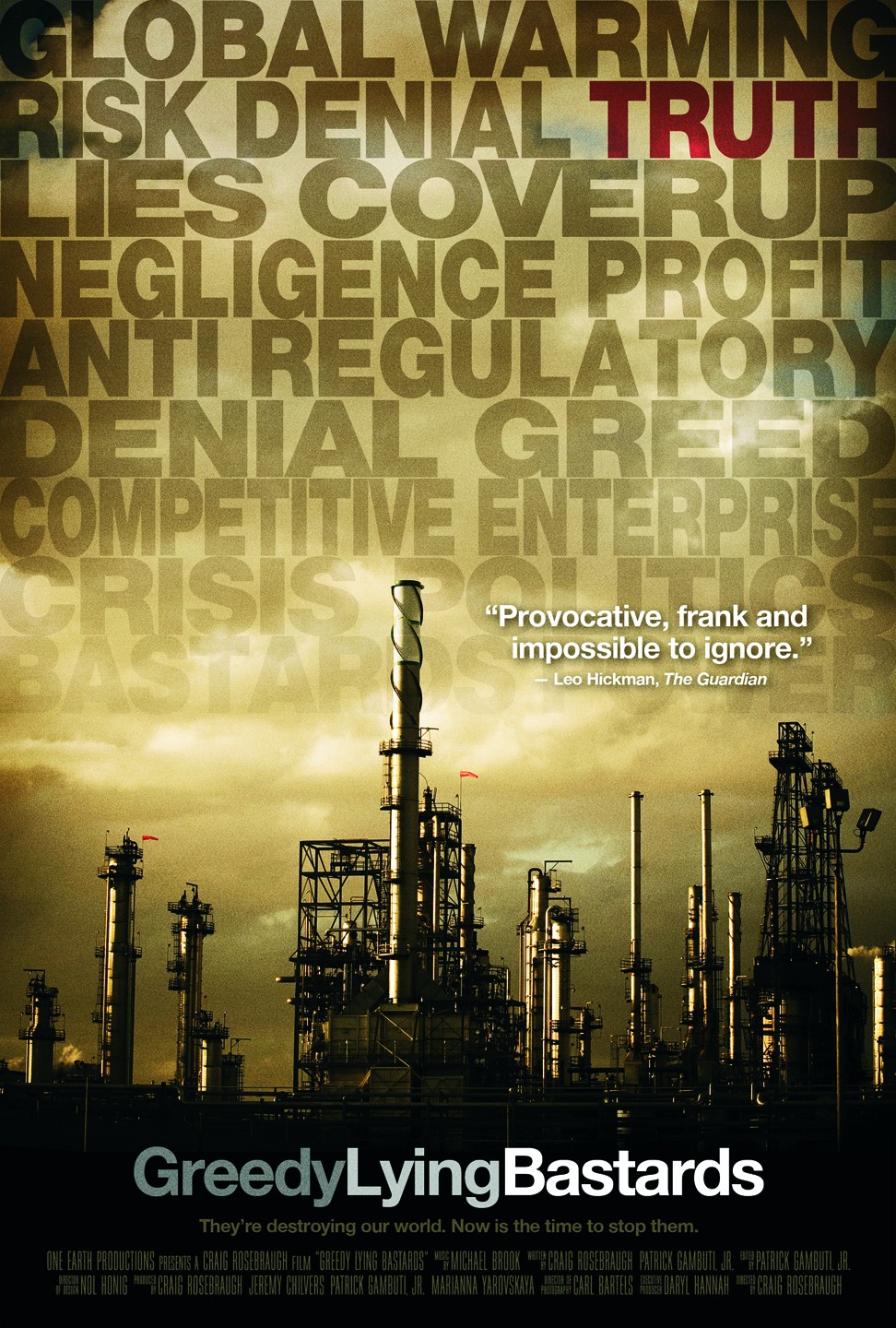
Greedy Lying Bastards is a documentary that takes on two problems — the pernicious impact of industry on the environment and the effect of those changes on communities and the even more pressing problem of the pernicious impact of a small group of corporate executives on politicians and the laws they enact and enforce. As the title makes clear, this is a powerful attack that does not pull any punches or pretend to be objective. It’s no longer an inconvenient truth. It is a question of our survival being put at risk by a few wealthy people who are so determined to get even wealthier that they are either in denial about the consequences or just do not care. The case it makes is dramatic and disturbing.
The late Senator Daniel Patrick Moynihan used to say that “everyone is entitled to his own opinion but no one is entitled to his own facts.” In this film, documentarian Craig Rosebraugh shows how a very small group of unfathomably wealthy industrialists create research and lobbying organizations designed to appear objective and broadly supported but in reality with no commitment to scientific data or to public policy. The most telling information in this film concerns the lack of transparency and accountability of organizations that have such a pervasive impact on legislation and policy. Washington insiders are already very familiar with the story of the Bush administration’s suppression of the most significant scientific report on climate change under the direction of an oil industry lobbyist serving a brief time in the government and allowing his former (and future) employers to edit the report’s findings. But seeing the details of the story in the context of a widespread and chillingly effective program by the Koch brothers and others is very compelling.
It would be nice to have some updates about the most recent campaign and Obama administration. . And while Rosebraugh has some good footage (thanks to a sneaky photo-pen) from the no-cameras-allowed Exxon shareholder meeting, he fails to connect the dots between what these executives do with corporate money and the true owners of the company — the shareholders, mostly through intermediaries like pension funds and mutual funds. As the comic strip character Pogo said when he discovered trash in a once-pristine river, “We have met the enemy and he is us.”
The “what you can do” section at the end should include more than just contacting elected officials, who need the corporate money to win elections. Capitalism is as much at risk from this failure of accountability as the environment. Perhaps that point could be made in Part 2.
Parents should know that this film has brief strong language and scenes of environmental devastation.
Family discussion: Who is in the best position to counter the messages sent by corporate-funded organizations to politicians? Where do you get your most trustworthy information about these issues? How do you know?
If you like this, try: “An Inconvenient Truth,” “FLOW: For Love of Water,” and “End of the Line”
New Aspire Series About African-American Faith Leaders: The Scroll
Posted on February 6, 2013 at 8:00 am
The Scroll is a new series from director Parrish Smith shown on Magic Johnson’s Aspire Network featuring intimate, inspiring interviews with more than 50 African-American clergy.
Some of the faith leaders featured in the documentary are: Bishop T. D. Jakes, Rev. Al Sharpton Jr., Rev. Bernice A. King, Dr. Calvin O. Butts III, Rev. Dr. Jamal Bryant,Bishop Noel Jones, Pastor Floyd H. Flake, Bishop Kenneth Ulmer, Bishop Charles E. Blake, Rev. Dr. Della Reese Lett, Bishop Paul S. Morton, Pastor A.R. Bernard, and Bishop Joseph L. Garlington.
Smith generously took some time to talk to me about the series.
What surprised you most about making “The Scroll?”
How long it took to make it! It was supposed to take one year, but it took three years to get access to the ministers, to get through their staff. We got rejected, we would fax and call and and email and talk to assistants and they would say “who are you?” We got no’s for a long time. After a while, the yeses started to come through but the process took a long time.
What made them reluctant to participate?
Ministers and pastors have bulls eyes on their backs. People have bad intentions and want to exploit them. A lot of people see pastors as crooks. One pastor gets caught in a scandal and all of a sudden all pastors are bad. So many ministers are protective. And there’s the scheduling problem as well. They have traveling ministries and the scheduling is difficult. But the primary problem is they don’t know who you are, and that’s understandable.
Were some of them concerned that revealing too much about themselves would interfere with their ministry?
Not necessarily. We interviewed a few people we did not use because they weren’t being open and forthcoming. But mos of them were.
What makes somebody a great preacher?
A minister told me that “a great sermon is the one you need at that particular time.” A great preacher is subjective. But perhaps he tells a story about how he overcame obstacles. And perhaps you are sitting in the congregation going through something and it hits you at that time and hits other people at that time. A great preacher is someone who can deliver a great message and a timely message from the heart. But it comes from God; it doesn’t come from them. They move themselves out of the way and let it flow through them to the congregation.
What is the importance of music in the church?
Music is a form of ministry, another form of prayer. I know some people who really don’t get much out of church or out of the sermon, but they do from song. Particularly in an African-American church, that tradition of music is historical in our culture. Old gospel spirituals, old hymns, have been with us for a long time. It’s a huge element in church.
Is humor important in ministry?
Yes and no. Humor can help deliver a message. But some people just want a strong, powerful message, very direct. Some people think if it’s humorous, it’s not too strong. I like it. I think it helps to ease what they’re saying. I know ministers who use humor and some who don’t.
What do you think about congregations taking advantage of new technologies to reach people?
If you stay home and watch church, you’re missing the fellowship. If you’re at home watching it online you’re missing the camaraderie that you get in church. But you have to change with the times. You have to evolve and transcend the technology. You can reach people who can’t come to church. They can watch and still get the message.
How can churches reach out to younger people?
Some churches and some denominations are more traditional, like many AME churches. They can lose the younger audience. But if the pastor is young and the service is more upbeat, they can appeal to a younger crowd. I was raised in a church that was very traditional. I got very bored with church. I went to college and didn’t go to church. It wasn’t until I heard Kirk Franklin and more modern gospel that it brought me back to church, a church that wasn’t as structured and traditional, with shorter services. The message was still there but the organ was replaced with more upbeat music. That brought me back.
What do you want people to take away from watching this series?
It’s all about faith and hope. We all go through trials and tribulations in life. Hurricane Sandy, Katrina, the shooting in Connecticut, natural disasters and personal challenges. “The Scroll” is about faith to help us Ministers are often unsung heroes. We are distracted by the small percentage who are in the media for their mistakes instead of focusing on the good that most of them do. Ministers are very smart, they’re great orators, and they give so much. We don’t see them teaching children and going to hospitals and inspiring people every day, all the things that they do. We see them on Sunday but they do so much more. And “The Scroll” is a homage to my father, who was a pastor.