This Dove-approved family film stars Ted McGinley and Daniel Baldwin as one-time high school rivals who find themselves on opposite sides again when they battle over Christmas decorations in a small Alaska town and learn that Christmas is not about what is displayed but what is felt and shared.
22-year-old Hunter S. Thompson wrote a novel about men in their 30’s working for a Puerto Rican newspaper, equally soaked in the title libation and the brinier flavors of cynicism and failure, but it was not published until more than 30 years later.
Now, it is a movie starring Thompson fan Johnny Depp (who played Thompson in Terry Gilliam’s “Fear and Loathing in Las Vegas”). He plays Paul Kemp, a would-be novelist and near-alcoholic who extends his fiction-writing skills to his resume to apply for a job working for a near-broke newspaper in Puerto Rico. He needn’t have amplified his credentials; no one else applied for the job. The exhausted editor (Richard Jenkins) knows he lied but has no other choice and his expectations are even lower than his alternatives. He says all he wants is a writer who won’t drink all the time.
No such luck.
Kemp is most interesting as the reflection of the real-life 22-year-old who was already worried about becoming dissipated, ineffectual, and hopeless. His passionate love of language is palpable. He spins out an elaborate sentence with the exuberance of youthful excess but lands it with breathtaking precision that demonstrates he is already a master. The plot is simple. Kemp is frustrated that the paper will only publish pieces that make the advertisers happy, which means nothing critical of anyone or anything in Puerto Rico. He briefly agrees to moonlight as a writer for a shady real estate development coordinated by Sanderson (Aaron Eckhart), who has a beautiful home and a beautiful girlfriend (the very lovely Amber Heard). And he briefly stops drinking.
There’s an endearing sweetness to the film. The unabashed affection Depp and writer/director Bruce Robinson have for Thompson is contagious as we see Kemp begin to find himself as a writer even as he perhaps begins to lose himself in the gorgeous excess of his appetites. The book is a novel, but the movie concludes by merging the fictional Kemp with the real-life Thompson with a buoyant couple of lines about what happens next.
In one scene Sanderson’s girlfriend and Kemp are driving in a borrowed convertible and she dares him to drive faster: “I’ll bet you scream before I do.” He floors it and they surge ahead, both reckless, ravenous for adventure, seeking the ultimate, no matter the cost. They both scream, and screech to a halt inches from the end of a pier. Knowing what lay ahead for Thompson, it feels good to see a moment when he knew where to stop.
Investors can make bets by promising to buy stock at a higher or lower price than the current day’s valuation. If all goes well, they never actually have to buy the stock. They can keep buying and selling the bets with borrowed money without ever having to buy the underlying securities. But if it does not go well, the investor gets what is known as a margin call and has to come up with the cash.
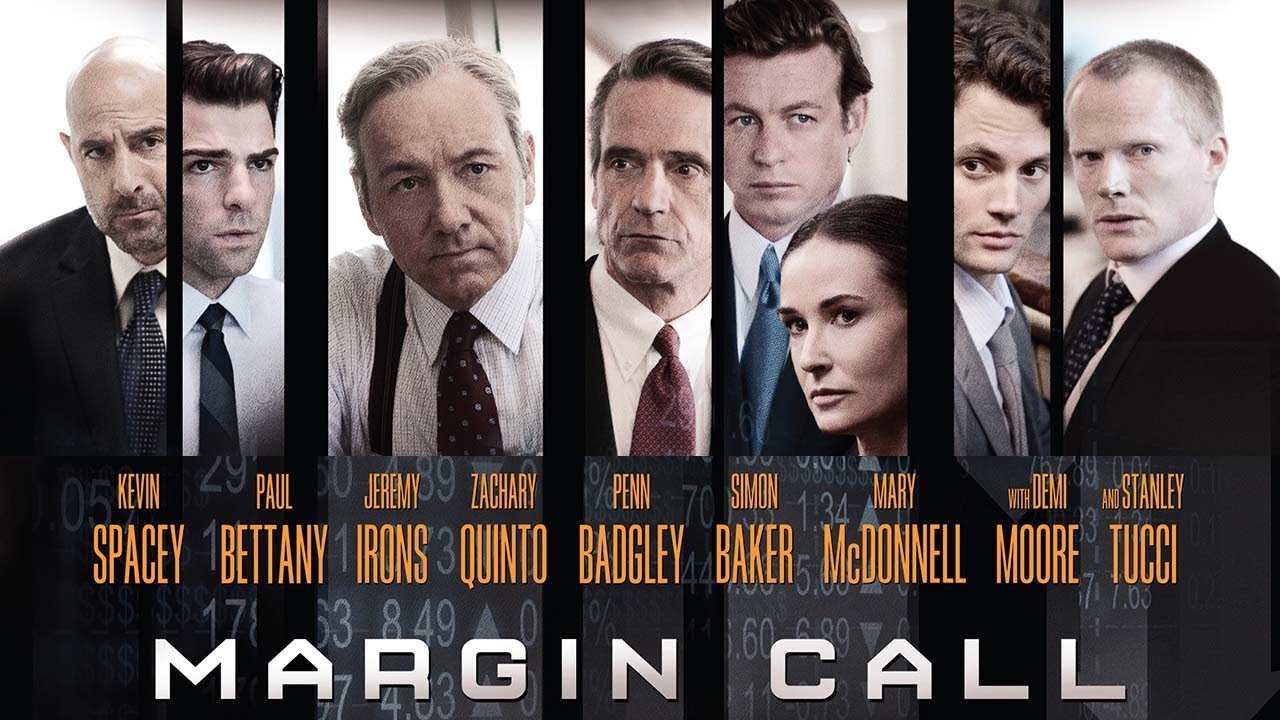
The financial meltdown of 2008 was like a margin call for America, and we will be paying off that debt for a long time. This movie, as tightly wound as a thriller, takes us through a fictionalized version of the night when it all tipped over from going well to not going well at an enormous Wall Street company, and it was time to pay the piper and a lot of others as well.
“You guys ever been through this before?” asks Will (Paul Bettany), as some serious looking people in suits start tapping people on the shoulder and saying, “I’m afraid we have to speak with you” to the people in cubicles “Best to ignore it, keep your head down, go back to work. Don’t watch.”
“The majority of this floor is being let go today,” says the serious woman in a suit. She speaks of “certain precautions that may seem punitive.” She glances down at the paperwork when she speaks of “your — 19 — years” with the (never-named) company. And then we see people carrying cardboard boxes of belongings out the front door of a shiny skyscraper, their eyes blinking in the unaccustomed sunlight.
This is nothing new, as Will’s comment informs us. It is a routine, if brutal pruning of the staff. This is a cutthroat business and periodically some throats get cut. And periodically Will has to speak to those left behind: “These were good people and they were good at their jobs, but you are better. We will not think of them again.” Back to work watching all those screens with all those numbers.
But one of the departed has left something behind. There is evident irony in the name of the division that has been gutted. It is the Risk Management group. And the 19-year veteran who has been shown the door has been working on a new analysis of the firm’s position. He turns his thumb drive over to the young colleague who has been kept on, Peter Sullivan (Zachary Quinto), a literal rocket scientist with “a PhD in propulsion,” who plugs a few holes in the formula that reveal that the firm is in their terms, “projected losses are greater than the current value of the company.” In other words, on the verge of collapse. That is when it gets interesting. Sullivan has proven that there are going to be some devastating losses. The question is who will pay for them.
The rest of the long night will be devoted to answering that question. It is like a long game of musical chairs, except that these people get to decide when to stop the music so they can get to the chairs before everyone else.
The guy at the top is John Tuld (Jeremy Irons). Given a choice between reputation and money, he has no hesitation in choosing money. He tells the head of sales, Sam Rogers (Kevin Spacey) to sell the ticking time bomb securities by assuring their clients that they are solid investments, even though Rogers points out that no one will ever trust them again. “You’re selling something you know has no value.” “We’re selling to willing buyers at fair market value so that we can survive.”
Rogers is not the only one who raises concerns, moral and financial. But writer-director J.C. Chandor lets us see when and how each of them topple, and what makes them topple, which turns out to be money. Dale repeatedly says there is nothing that can get him to go back inside the building and yet there he is, back in the building. Rogers says he will not sell these risky securities to clients because “you don’t sell anything to anybody unless they’ll come back to you for more.” But he does.
This could just as easily be set in the scuzzy world of the real-estate salesmen of “Glengarry Glen Ross” or the “leave the gun, take the cannoli” world of “The Godfather.” Chandor keeps enough of the real story to keep things vivid and meaningful but does not get mired in jargon. Crisp performances by everyone keep things taut until a surprising detour at the end. For the first time we leave the world of glass and concrete for an intensely personal moment of loss and grief. “Our talents have been used for the greater good,” one character says, reminding us that the very selection process that takes people who are capable of more tangible contributions are unable to resist the big money that pays them a many-times multiple for financial engineering over mechanical engineering. And reminding us, too, that if we let people who care only about money make the decisions they will make decisions that are only about money for them.
Café is about that place we all wish we could find, a coffee shop that makes its customers feel at home. Jennifer Love Hewitt plays the girl behind the counter who provides advice and support for the regulars. But then a customer gets a disturbing message on his laptop that causes everyone to question the nature of reality and free will. This touching and thought-provoking film from Marc Erlbaum is worth a look.
Director Craig Brewer doesn’t so much remake 1984’s Footloose as tweak it. At times, it feels almost identical, with small changes that are as likely to be commentary as updates. But the most important thing this version has in common with the original is that the talking parts are too long and the dancing parts are too short. Like the first one, it is not a good movie but it is a lot of fun.
Kenny Wormald, a back-up dancer for Justin Timberlake, takes over the Kevin Bacon role as Ren, a boy from the city (Boston) who moves to a small town in Georgia to live with his aunt and uncle (in this version, the single mother is dispensed with). “Dance With the Stars” favorite Julianne Hough plays the Lori Singer role as Ariel, the daughter of the local preacher (Dennis Quaid) who led the town to impose a curfew and prohibit dancing for teenagers after a car accident that killed five teens on their way home from a party. His son, Ariel’s other brother, was the driver. Five years later, grief and guilt still hang over the town, and the high school students who walk by the memorial display for the kids who were killed every day feel that the restrictions are pointless. The most disturbing change from the original is the decision to begin the film by showing us a group of teens dancing and letting us realize to our horror that these are not the kids we will be watching for the rest of the movie; these are the ones who are about to die. It is intended to give some weight to the otherwise dubious premise but it does not. It just starts things off like another episode of “Final Destination.”
Once that is over with, we get on to the themes of the movie. Ariel has to learn that her risky behavior is not just rebellious; it is self-destructive. And Ren and his new friends have to find a way to make a difference.
But let’s be honest. It’s really just a lot of opportunities to dance. Wormald is not the actor Bacon is, not even close, but he is a sensational dancer with an electrifyingly athletic style (in both versions, part of Ren’s backstory is his experience as a gymnast). Hough is a beautifully supple dancer who makes her joy in movement a part of every step, and she has dazzling aqua eyes that are very expressive. They are better suited physically than the compact Bacon and lanky Singer and generate some real sizzle. Brewer unfortunately does not make the best use of the camera in the dance sequences (compare them to Rob Marshall’s highly kinetic work in “Chicago,” where the camera moved like another dancer). At times he awkwardly cuts off the feet or shoulders just when we most want to see them. But he does show us the explosive energy of kids dancing together because it is just too exciting to be young and have music inside you to do anything else.
While some of the accents are wobbly, Memphis native Brewer (“Hustle and Flow”) understands the Southern rhythms of talk, especially its humor, and it is good to hear something that does not sound like a Californian’s idea of the way Southerners talk. The always-reliable Ray McKinnon is clearly very happy to play a nice guy for once. Miles Teller (“Rabbit Hole”) plays Ren’s cheerfully redneck friend Willard, and, like the late Chris Penn in the original, his scenes are a delight. Brewer, working with the original screenwriter Dean Pitchford, pays respects to the first version with touches like the red cowboy boots and the yellow VW bug, and with witty updates like the Blake Shelton cover of the title song and the effects in the final dance number. I won’t spoil the surprise of the twist he gives to Deniece Williams’ “Let’s Hear it for the Boy.” I liked the expansion of dance styles to include country line-dancing and crunk and loved the Big & Rich song, “Fake ID.” And whenever the talking stopped and the dancing began, I had a wonderful time.


 is about that place we all wish we could find, a coffee shop that makes its customers feel at home. Jennifer Love Hewitt plays the girl behind the counter who provides advice and support for the regulars. But then a customer gets a disturbing message on his laptop that causes everyone to question the nature of reality and free will. This touching and thought-provoking film from
 as tweak it. At times, it feels almost identical, with small changes that are as likely to be commentary as updates. But the most important thing this version has in common with the original is that the talking parts are too long and the dancing parts are too short. Like the first one, it is not a good movie but it is a lot of fun.