Gulliver’s Travels: the Animated Feature

Gulliver’s Travels: the Animated Feature

Posted on December 22, 2010 at 1:16 pm

In the early days of animation, Disney’s biggest rival was the studio run by the Fleischer brothers, whose Betty Boop, Popeye, and Out of the Inkwell cartoons were very popular. Their first feature, released in 1939, was “Gulliver’s Travels.” While it was not as innovative or successful as Disney’s “Snow White,” which came out two years earlier, it is still a charming and delightful film with comedy, romance, drama, and music. The release this week of the new Gulliver film starring Jack Black, has prompted a new DVD release of the film in An Ultimate Gulliver Collection.

In the book, Jonathan Swift’s satiric take on the political squabbles had his tiny characters fighting over the best way to crack an egg. In this version, the plans of the rulers of the adjoining kingdoms to untie their children and their lands in marriage is disrupted because of an equally silly dispute. Which of the two countries’ national anthems will play at the wedding?

“Gulliver’s Travels” is available online. I also have one copy of the new Ultimate Gulliver Collection DVD release to give away and it is truly special because it includes not only Fleischer’s Gulliver and seven more Fleischer studio cartoons but also the early anime film, “Gulliver’s Travels Beyond the Moon” and the adorable four-minute Gulliver movie from George Melies, the magician who invented movie special effects back in the early days of the silent era. Send me an email at moviemom@moviemom.com with “Gulliver” in the title, and I will pick a random winner on Boxing Day (that’s December 26).

Related Tags:


Animation Based on a book Classic Comedy Drama Fantasy For the Whole Family Remake Romance
True Grit

True Grit

Posted on December 22, 2010 at 8:05 am

In a remake of the John Wayne classic that is truer to the Charles Portis book, the Coen brothers have made their most sincere film yet, a western as spare and yet majestic as its unspoiled landscapes. Like all great westerns, it is a meditation about the forces that shaped the American spirit, the determination, resilience, passion for justice, and most of all the mingled pragmatism and idealism.
Joel and Ethan Coen’s previous films have had a preciousness and remove from their often-grotesque characters, a frequent feeling of ironic air quotes in their picaresque speech patterns and fantastic, even mythic plot twists. This time, they give us a sincere and appreciative portrayal of a steely 14-year-old heroine (remarkable newcomer Hailee Steinfeld) who wants to find and kill the man who murdered her father. true-grit-2010.jpg
Steinfeld plays Mattie Ross, a girl whose tight braids demonstrate her no-nonsense determination. She crisply negotiates the disposition of her father’s body with the undertaker and then demonstrates her mastery of horse-trading by selling back to the local broker the horses her father had come to town to buy, and, with a little extra leverage from a threatened lawsuit, getting some cash and a pony out of the deal. And so when she sets her mind to hiring the top tracker in town to find Tom Chaney (Josh Brolin), the man who killed her father, you know she is going to be successful.
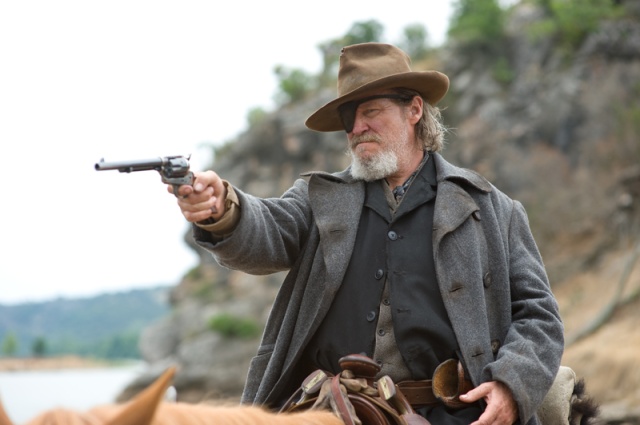
That tracker is Rooster Cogburn (Jeff Bridges), a man who may too old and infirm (he has an eye patch and a drinking problem) and possibly be too quick to kill (he can’t or won’t recall under oath the details of some of the men he’s killed) to do the job. It turns out someone else is looking for Chaney, a Texas Ranger named LeBoeuf (Matt Damon). The two men have no interest in working together and even less in bringing along a 14-year-old girl, but their mutual determination and stubbornness has them soon on the trail together.
The first version, directed by Henry Hathaway, was a bit of a miss-match and a more than a bit meta, with Wayne playing and playing off of his screen persona, pop singer Glen Campbell as LeBoeuf, and Kim Darby, then in her 20’s, playing Mattie. In this film, the actors are far better matched to each other and their roles. Bridges, whose most memorable role may be in the Coens’ “The Big Lebowski,” fully commits to the character, not caricature, of Rooster Cogburn. The asperity and resolve of the young girl are well matched by the man who may be undisciplined and ungovernable but who is also in his own terms honorable. It is these two, both who must continue after dire physical sacrifice, who represent the forging of a social construct that will support frontier society.
The landscape, spare, magnificent, and challenging, is stunningly photographed by the Coen brothers favorite cinematographer, Roger Deakins. Production designer Jess Gonchor makes every shot look like a painting somewhere between Thomas Eakins and Grant Wood. Each shot is meticulously framed to add a transcendent dignity and seriousness of purpose to the story.

(more…)

Related Tags:


Action/Adventure Based on a book Drama Epic/Historical Remake Western
Wall Street: Money Never Sleeps

Wall Street: Money Never Sleeps

Posted on December 14, 2010 at 10:00 am

Is greed still good? Does greed still, for want of a better word, work?
Twenty-three years later, Gordon Gekko is back, still played by Oscar-winner Michael Douglas and now running short on money and even shorter on what he realizes is an even more valuable commodity: time. We see him being released from prison, his personal effects including a gold money clip (empty) and his old cellular phone (the size of a shoebox). He walks out into the sunlight toward a sleek black limo only to see that it is there for someone else, the also-departing rap star.
Balzac famously said that behind every great fortune is a crime. That is literally true in Gekko’s case; he traded on inside information. But it is also true in a larger sense because the real reason for Gekko’s wealth is a fierce and unquenchable passion not for money but for winning. He has had a long time in prison to watch and think and plan his comeback. And so he leverages his notoriety into television and in-person appearances to promote his book.
The sequel is so close to the same framework as the original that at times it feels like a remake. Again there is a bright, ambitious and essentially honest young man with a lower-income parent exemplifying the current financial upheavals who gets drawn by Gekko’s gravitational pull. It’s Jake (Shia LaBeouf), who has the added complication of being engaged to Gekko’s estranged daughter (“An Education’s” Carey Mulligan, LeBeouf’s real-life love). And there is another big-time financier like the one played by Terence Stamp in the first film, Bretton James, played by Josh Brolin. Once again, there is an old guy who is the movie’s repository of wisdom and integrity (a fine Eli Wallach). Once again, the young man thinks he can hold on to his values and once again he will find Wall Street is more treacherous than he thought.
In his brilliant book on the financial meltdown, The Big Short: Inside the Doomsday Machine, Michael Lewis muses that his first expose of the wild world of Wall Street excess, Liar’s Poker was instead viewed “as a how-to manual.” The same is true for the first “Wall Street.” As the costume designer noted, the wardrobe from the first movie was selected for dramatic impact, not authenticity. But it was adopted by the real Wall Streeters, who were as thrilled with Gekko’s look as they were with his bravado, and his wealth.
While Douglas continues to be enough to make the entire movie worth watching, there is little chemistry with LeBoeuf or between LeBoeuf and Mulligan. The first film was an intriguing look at a hidden world. But today, with business news on the front pages and the editorial pages, on 24/7 news channels and thousands of websites, Wall Streeters are less often seen as dashing buccaneers than as the people most responsible for bringing the United States to the brink of economic destruction. The movie itself seems as though it cannot make up its mind what it wants from Gekko.

(more…)

Related Tags:


Drama Family Issues Series/Sequel

Inception

Posted on December 7, 2010 at 8:00 am

Stop right now. I mean it, stop reading. If you have not already seen “Inception,” there is nothing I can tell you that would not diminish your experience of this film. The less you know going in, the better you will appreciate the unfolding, doubling-back, and overall mind-bending stories within stories in one of the year’s best films. So, go see it and then come back and read what I have to say and share your thoughts about what you think it is all about.

* * * * * * * * * * * * * * * * * * * * * * * * * * * * * * * * * * * * * * * * * *

Okay, welcome back.

Christopher Nolan (“The Dark Knight,” “Memento”) has written and directed that rarest of movie pleasures, a fantasy action movie for people who like to think. It’s kind of, sort of, “The Matrix” crossed with “The Sting,” “Fantastic Voyage,” and “Eternal Sunshine of the Spotless Mind.” On crack. It’s the kind of movie people will argue about all the way home, go see again, and argue about some more. Nolan understands that the power of movies is that they allow the audience to plug into a kind of Jungian collective dream and he takes that idea to the meta-level, and then metas it a couple more times.

Dom Cobb (Leonardo DiCaprio) is part of a renegade team that has taken corporate espionage to the next level. They do not steal secrets from the offices and memos of corporate executives. They steal secrets from their minds. Cobb has taken techniques developed by his professor father (Michael Caine) and come up with a way to enter into the subconscious of these people by literally entering and manipulating their dreams. This, of course, has led to the development of a whole new industry of counter-dream espionage through bolstering the subject’s psychological defenses. Within a dream, as with other abstract concepts, they are made explicit and concrete as armed assassins. Being shot by them affects the physical reality of the avatar-like representation of the person entering the subject’s dream. It can hurtle them out of the dream entirely. Or, it can push them into an endless mental limbo.

Audiences may feel (enjoyably) as though they have toppled into an endless mental limbo as the characters’ journey takes them into dreams within dreams, each with its own setting, time (moments in one dream level equal weeks in a deeper one), and properties. Sometimes those properties seep across dream boundaries, with vertiginous shifts in physical properties. In one extraordinary sequence, characters in an otherwise-standard-looking hotel become weightless and fights take place as though they are all under water.

The team knows how to extract thoughts from dreams, even the subjects’ most guarded secrets, made material within the minds’ fortresses and vaults. “Create something secure and the mind automatically fills it with something it wants to protect,” explains a character.

A new client insists that they must do something far more difficult — implant an idea, and do it so quietly that the subject will believe he thought it up himself. All of this is in the context of a slyly chosen, well-worn set-up, the last big heist. Dom wants out. He wants to go home. He wants to see the faces of his children. And this is his last chance.

The visual razzle-dazzle is breathtaking, especially as new member of the team Ariadne (“Juno’s” Ellen Page) is introduced to the world of dream architecture. But what makes the film so enthralling is its own fully-realized intellectual architecture, the rules and consequences of its world view that seem so complete they extend far beyond the borders of the story. This is a film that will reward repeated viewings. It will be the subject of late-night dorm discussions, application essays, and possibly some scholarly exegesis because of the way it poses provocative concepts of identity, responsibility, and consciousness. “Reality is not going to be enough for her, now,” Dom says as Ariadne explores an architect’s ultimate fantasy of creation. Yes, and that’s why we have movies. After all, dreams and reality feed each other. As Humphrey Bogart said in “The Maltese Falcon” and Shakespeare said long before that, they’re “the stuff that dreams are made of.”

Related Tags:


Action/Adventure Drama Fantasy Science-Fiction
What’s Cooking?

What’s Cooking?

Posted on November 24, 2010 at 8:00 am

B+
Lowest Recommended Age: Mature High Schooler
MPAA Rating: Rated PG-13 for some sexuality, brief language and a perilous situation
Profanity: Some strong language
Alcohol/ Drugs: Drinking and smoking, character gets intoxicated
Violence/ Scariness: Child in peril, gun
Diversity Issues: A theme of the movie
Date Released to Theaters: 2000
Date Released to DVD: November 21, 2011
Amazon.com ASIN: B000092T3G

My favorite Thanksgiving movie is What’s Cooking?

The Star-Spangled Banner plays over the credits and we see a classic Thanksgiving poster, only to find that it is on the side of a bus that carries very few passengers resembling its smiling Caucasian family. A very diverse group attends a school Thanksgiving pageant and then we follow four of the families, Jewish, Latino, African-American, and Vietnamese, as they celebrate this most American of holidays.

Co-writer and director Gurinder Chadha is an Indian woman raised in England, and she brings a sympathetic outsider’s eye to the stories of the four families, emphasizing their similarities more than their differences. All four of the families love each other, keep secrets from each other, want acceptance from each other. And all of them drive each other crazy, just like everyone else.

They watch football and the Macy’s parade. They cook. They have kitchen triumphs and catastrophes. They say things like, “You’re so thin!” “Give Grandma some sugar!” “I haven’t called because I’ve been swamped with work.” “That’s a very…unusual recipe.” “Dad, you remember that I’m a vegetarian, don’t you?” and “You never listen to me!” They love to see each other but they can’t stop fighting with each other. As one character says, “I guess you can’t call it a family if someone isn’t speaking to someone else.”

The Jewish parents (Lainie Kazan and Maury Chaykin) struggle to accept their daughter’s lesbian relationship (with Julianna Margulies of “The Good Wife”).  The Latino mother (Mercedes Ruehl in a beautifully warm-hearted performance) wants to introduce her new boyfriend to the family, and her estranged husband has been invited to dinner by their son. The Vietnamese family is coping with a son who has been suspended from school, a daughter who has a condom in her coat pocket, and an older son who is too busy to come home from college. And the African-American mother (the always wonderful-Alfre Woodard) struggles with a demanding mother-in-law and a painful rift between her husband and son.

http://www.youtube.com/watch?v=RWA91OcPa7U

Chadha handles the multiple story lines and large cast with an expert hand, cutting back and forth to underscore the similarities and the differences. We see potatoes prepared by hand, mixer, spoon, and food processor and the assortment of turkey presentations is one of the movie’s best treats. Chadha has a good feel for American diversity — the video store owned by the Vietnamese family has shelves for videos in Talalog, Farsi, and Korean. We get to see a replica of the the all-white Thanksgiving poster with a Latino family.

The stories can get a bit melodramatic, especially a close encounter with a gun near the end of the movie, and the stories veer from archetype to stereotype at times. But there is much to enjoy in its situations, characters, and performances, especially by Woodard and Ruehl, two of the finest actresses in movies, and it holds a lot of promise for future projects by Chadha.

Parents should know that the movie has some strong language and sexual references and encounters, including adultery and homosexuality. Characters smoke and drink. A child is in peril, and it gets very tense. The movie also includes family confrontations that may be upsetting to some people.

Families who see this movie will have a lot to talk about concerning family communication. They should discuss why so many people felt that they could not tell the truth to their families, and how they would respond to some of the crises faced by the family members in the movie. They may also want to talk about some of their favorite Thanksgiving memories.

Families who enjoy this movie will also enjoy “You Can’t Take it With You,” an Oscar-winning comedy about a very eccentric but loving, family.

Related Tags:


Comedy Drama DVD/Blu-Ray Pick of the Week
THE MOVIE MOM® is a registered trademark of Nell Minow. Use of the mark without express consent from Nell Minow constitutes trademark infringement and unfair competition in violation of federal and state laws. All material © Nell Minow 1995-2026, all rights reserved, and no use or republication is permitted without explicit permission. This site hosts Nell Minow’s Movie Mom® archive, with material that originally appeared on Yahoo! Movies, Beliefnet, and other sources. Much of her new material can be found at Rogerebert.com, Huffington Post, and WheretoWatch. Her books include The Movie Mom’s Guide to Family Movies and 101 Must-See Movie Moments, and she can be heard each week on radio stations across the country.

Website Designed by Max LaZebnik