Wild

Posted on December 4, 2014 at 5:58 pm

“If your Nerve, deny you—
Go above your Nerve—”

Cheryl Strayed (Reese Witherspoon) adds the name of the author, Emily Dickinson, to the quote she has inscribed in a journal for hikers kept at her entry point on the Pacific Coast Trail. And then she adds her own name as well. It is her own name in a very real sense as she was not born with it and it was not her husband’s name. It was a name she chose from a dictionary at the end of her marriage as the name she wanted to go on with, a name for going above her nerve.

Copyright 2014 Fox Searchlight

Strayed was lost. Her mother Bobbi (a glowing Laura Dern), the “great love of (her) life,” died of cancer. Her husband Paul (“Newsroom’s” Thomas Sadoski) was loving and supportive but Strayed fell into a self-destructive death spiral, obliterating herself through “detached” sex with strangers and substance abuse that ultimately included shooting heroin. She and Paul recognized their divorce with matching tattoos to keep some part of the idea of permanence connecting them. And then, with nowhere else to go, she decided to take a walk, more than a thousand miles. It was a chance to reconnect with something she knew she loved to do and to get away from the bad choices she was making. The Chinese proverb says that the longest journey begins with a single step. Strayed wanted to take those steps between her old life and whatever was ahead, to begin to feel an un-obliterated life.

Her 60 pounds of equipment filled a backpack called The Monster. She did not practice putting up her tent or using her stove before she left. She was scared, and soon she was also hungry. She had brought the wrong fuel for her stove. A burly farmer driving a tractor gruffly agreed to give her a ride to some food, and then told her he was bringing her back to his house. She looked at him, trying to figure out if he was planning to attack her, hoping he was not. He was not. The farmer and his wife were kind and generous with her. She got the right fuel, and, a few stops later got some advice about getting rid of some of her load, down to burning each night the book pages she had finished reading. Plus, she didn’t really need all those condoms, did she?

Strayed’s book became an international-bestseller, so poetic and inspirational Oprah rebooted her Book Club to endorse it. Like other memoirs combining real and spiritual/emotional journeys, what makes it work is the narrator’s voice. This is as much an internal story as an external one. Screenwriter Nick Hornby (“High Fidelity”) and director Jean-Marc Vallée (“Dallas Buyer’s Club”) understand that this is not a travelogue, though there is some stunning scenery. It is about Strayed thinking back through her chaotic, messy life through the experience of putting one foot in front of the other on her way to a place called The Bridge of the Gods. As she thinks back on her life, we begin to understand the context for this trek at the same time that she does. As we expect from Hornby, there are some great song choices, too.

Strayed’s adventures and encounters along the way resonate with her memories. The farmer is not the only potential danger. The film understatedly but clearly shows how any woman in any sort of wild has to constantly calculate the threat level of the men she encounters. And, in a scene where Strayed comes across another hiker taking a bath in a lake, we get something we rarely see in films, a woman appraising, or maybe just appreciating, a male body. This is a character moment for Strayed, who as we see, has been too impulsive in sexual encounters. But here, she stands back and just savors the moment on its own, owning it without having to do anything about it. “I’m lonelier in my real life than I am out here,” she says.

Feeling your feelings can be painful. Strayed loses toenails and, at one point, her shoes. There are angry, raw patches of skin where The Monster digs into her. She thinks through painful memories of her mother’s illness, her father’s abuse. She remembers being inconsiderate of her mother, a woman who was thrilled to get a chance to go back to school, to think and question and learn. And for the first time, she begins to understand what her mother said about putting yourself in the line of beauty. Just because some things are terrible doesn’t mean everything is. “This has the power to fill you up again if you let it,” someone tells her.

Witherspoon gives a performance of quiet vulnerability and courage. In some ways, as producer as well as star, this was as daunting an undertaking for her as the hike was for Strayed. There was a real risk of making it a glamorized, soapy star vehicle. But as producer and actor, she gives this story the film it deserves.

Parents should know that this film includes explicit sexual references and situations and nudity, substance abuse, references to domestic abuse, and very strong language.

Family discussion: What do you think the quote means and why did Strayed use it to begin her hike? What does it mean to say that wounds come from the same source as power?

If you like this try: Strayed’s books, Wild: From Lost to Found on the Pacific Crest Trail, Torch, and Tiny Beautiful Things: Advice on Love and Life from Dear Sugar, and another 2014 film about a real-life woman on a long, long walk, Tracks.
Related Tags:


Based on a book Based on a true story Drama

The Imitation Game

Posted on December 4, 2014 at 5:03 pm

B+
Lowest Recommended Age: High School
MPAA Rating: Rated PG-13 for some sexual references, mature thematic material and historical smoking
Profanity: Some strong language
Alcohol/ Drugs: Drinking, smoking
Violence/ Scariness: Wartime violence
Diversity Issues: A theme of the movie, homophobia, suicide
Date Released to Theaters: November 21, 2014
Date Released to DVD: March 30, 2015
Amazon.com ASIN: B00RY85CQI
Copyright 2014 The Weinstein Company

Alan Turing was a brilliant mathematician with an enormous intellect, an almost equally enormous ego, and an almost equally enormous secret. He was one of the founding thinkers behind modern computing and it is his name that we use for the test that determines whether a computer has achieved true artificial intelligence status. The Turing test standard is human conversation. If a human cannot tell whether he or she is communicating with a person or a computer, than the program has passed the Turing test and is true artificial intelligence.

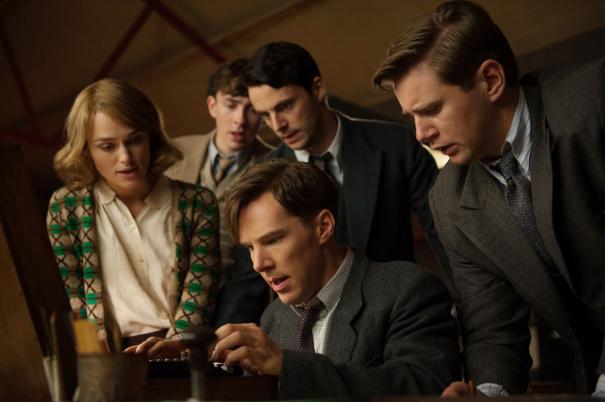
I’m not sure that Alan Turing could have passed the Turing test. Cumberbatch, who also plays a super-smart, arrogant, and obnoxious guy in “Sherlock,” creates a very different character here. Turing himself is an Enigma. In the opening scene, a sort of job interview nightmare in which Commander Denniston (Charles Dance) is trying to interview Turing (Benedict Cumberbatch) for a spot on the team working at the famous Bletchley Park estate to break the code the Germans were using to send orders to their troops. If passing as human means meeting even the most minimal standards of civility and responsiveness, Turing failed that interview. He seemed to think that it was he who was interviewing Denniston to determine whether the task was of sufficient interest and import to merit his attention.

Denniston begins to dismiss him. But when Denniston says that everyone thinks the code, known as Enigma, is unbreakable, Turing says briskly, “Let me try, and then we’ll know for sure.” Denniston does not have a better idea or a better option.

The German code is unbreakable because it is constantly changing, so by the time any one message has been decrypted, whatever was learned could not be applied to whatever comes next. The Allies are perpetually behind. [The process, complicated as it is, has been simplified for the purposes of the movie, glossing over the important work done by Polish mathematicians, the contributions of the French, and the challenges faced as the Germans continued to make the Enigma more complicated and impenetrable as the war continued.) While a bunch of brilliant mathematicians, scientists, and puzzle-solvers (including Joan Clarke, played by Keira Knightley) worked away, Turning realized not only that what made the code unbreakable was the inability of any then-existing computational mechanism to perform enough calculations fast enough to decrypt the messages before the code was reconfigured the next morning, but that he could create a machine to do it.

We know how it turned out. But director Morten Tyldum keeps the story gripping on several levels. First, there is the conflict between Turing and just about everyone, and the pressure for immediate results as he is spending a lot of time (years) and money on something no one has ever seen before. Second, there are the interpersonal struggles, and Turning’s internal difficulties. He did want intimacy, and we see in his memories of his first love, a boy at his school. He likes Joan, and is briefly engaged to her. But he was gay at a time when being gay was punishable by prison. Then there are other kinds of secrets. One of the people working on breaking the code may be a spy. And once the code is broken, the Allies have the wrenchingly painful decision about what to do with the information. It’s not just a puzzle. It is statecraft, and terrible compromises and terrible losses are part of the job.

The film adds some unnecessary drama and oversimplifies parts of the story. But it is a powerful, complex drama and a long-overdue tribute to a true hero and visionary.

Parents should know that this film includes wartime themes and images, some disturbing, wrenching moral choices, betrayal, the pressures of being a closeted homosexual when it was a crime, drinking, smoking, and some sexual references.

Family discussion: Do you agree with the decision to withhold the news that the code had been broken? To allow the mole to keep spying?

If you like this, try: Read up on the history of the codebreakers at Bletchley (The Secret Lives of Codebreakers: The Men and Women Who Cracked the Enigma Code at Bletchley Park, Seizing the Enigma: The Race to Break the German U-boat Codes, 1939-1943) as well as those in Poland and the spies who helped them get the information they needed and try some online version of the Turing Test.

Related Tags:


Based on a true story Biography Drama DVD/Blu-Ray Pick of the Week War

Foxcatcher

Posted on November 20, 2014 at 5:55 pm

Copyright Sony Pictures 2014

John Eleuthère Du Pont was of the wealthiest men in the world. He was an ornithologist, a philatelist, a purchaser of military weapons (including a tank), a wrestling fan who set up a luxurious training facility for the US Olympic team, and a murderer who died in prison in 2010. Steve Carell, almost unrecognizable, does a better job of erasing himself than of creating a different character. He has a hawkish nose, a set of small, inbred-looking teeth, a clenched posture, and the aristocratic delivery of a prep school graduate used to deference from everyone but his mother. But he is never able to make it all into anything but a cipher. Director Bennett Miller (“Capote,” “Moneyball”) and screenwriters Dan Futterman and E. Max Frye wisely stay away from simple explanations and Lifetime Made-for TV-style histrionics.  Miller’s pallette is drab and his presentation is spare, in contrast to the opulence of the Du Pont estate and the training facility. But the film overcorrects, as though underplaying and long, silent stretches without even a musical score can somehow convey seriousness and import.

It begins promisingly as we see Olympic gold medalist Mark Schultz (a somber Channing Tatum) stumbling his way through a talk to some bored schoolkids about character and America, and then waiting awkwardly for his pay, $20. And one of the best scenes of the year is his practice session with his brother, best (and only) friend, and coach, David Schultz (Mark Ruffalo), also a gold medalist. There is enormous tenderness in David’s touch as he pushes on Mark’s arms to stretch him, and even as it seamlessly turns into a wrestling match that eloquently conveys intimacy, trust, dependence, and some competition as well.


Mark gets a call from some Du Pont factotum, inviting him to come to Delaware to meet John on his luxurious estate, called Foxcatcher because of the fox hunting history of the Du Ponts, a rare family that has been wealthy since the earliest days of American history.

On the surface, John conveys an easy noblesse oblige as he introduces himself, and Mark is nowhere near worldly enough to see the arrogance and instability under the surface.  Mark has been listening to coaches all his life.  When John says he likes to be called “Eagle,” Mark sees leadership. When John says he wants to help Mark be the best in the world, Mark sees a chance for something he did not let himself realize he wanted, a chance to be more independent.  And independence is what John is looking for, too.  He is an adult dependent in many ways on his mother, bitter about her focus on horses and her obvious feelings for him, somewhere between indifference and contempt.

John builds a lavish training facility (in real life for more sports than just wrestling).  “Foxcatcher” is emblazoned everywhere.  The athletes are polite, even respectful, but no one thinks John has anything but money to contribute.  Mark loves being seen as special and gets caught up in John’s decadent lifestyle.  But then John, who has the attention span of a mayfly, decides he needs to bring Dave in, too.  Dave’s lack of interest only makes him more determined.  Soon, Dave and his wife and children are at Foxcatcher.  Mark is resentful.  John is increasingly unstable and there is no one there to stop him until it is too late.  When it’s over, he is affectless.  The problem is, too much of the movie is as well.

Parents should know that this film has tense and disturbing confrontations, some violence including murder, strong language, drinking, and drugs

Family discussion: What was John hoping to achieve by sponsoring wrestlers? How did he feel about John? How did he feel about Dave? Why?

If you like this, try: “Capote” and “Reversal of Fortune”

Related Tags:


Based on a true story Crime Drama Sports

Rosewater

Posted on November 16, 2014 at 11:04 pm

B+
Lowest Recommended Age: High School
MPAA Rating: Rated R for language including some crude references, and violent content
Profanity: Strong and crude language
Alcohol/ Drugs: Drinking
Violence/ Scariness: Riots and brutal attacks on rioters and rebels, torture
Diversity Issues: A theme of the movie
Date Released to Theaters: November 14, 2014
Copyright 2014 Open Road Films

First-time writer/director Jon Stewart has made a remarkably assured film about the imprisonment and torture of Iranian journalist Maziar Bahari It is an absorbing drama that is at the same time the story of a very specific individual and a thoughtful consideration of contemporary geopolitics that avoids stereotypes or jingoism. This not only makes it a better story; it elevates the level of discourse without preachiness.

Bahari (a superb Gael Garcia Bernal) was working for Newsweek when he returned to Iran to cover the election in 2009. He knew the dangers of posing a threat to the government in Iran. His father and sister both died in prison as accused enemies of two different regimes. And now, as he filmed the protests over the disputed election victory of Mahmoud Ahmadinejad and the “Dish University” maintained by dissidents, he knows he is putting himself and his subjects and sources at risk. It is possible he does not consider the risks posed by his decision to be interviewed by “The Daily Show,” where he jokes about being a spy.

He is asleep at his mother’s home when officials arrive to take him to prison.  It is disturbing and shocking that he is neither disturbed or shocked.  While his mother (Shohreh Aghdashloo) bravely snaps at the man who orders her to wear a headscarf, Bahari is calm and polite.

Stewart wants us to understand the pressure that Bahari’s interrogator (Danish actor Kim Bodnia) is under. Stewart shrewdly introduces us to the man who smells of rose water as he is on the phone to his family, and showing us that he is just one link in a chain of oppression and bureaucracy. And he is not afraid to use cinematic touches to show us what is going on in Bahari’s mind. We see a face reflected on the walls as he walks through the streets. Later, in prison, he has conversations with his father and sister. They seem real to us, but they are not hallucinations. They are just visual embodiments of Bahari’s thought processes or fantasies has the weeks in solitary confinement turn into months, with no contact from the outside world. These memories of his family members who were also imprisoned help him stay strong. They even help him briefly outsmart Rosewater, as he fabricates a series of sexual encounters to describe in questioning, his “specialist” (interrogator) listening in horrified fascination, Bahari having, for once, the upper hand.

Stewart wisely also keeps us confined with Bahari, not telling us more than he knows about efforts to get him out of prison. When we finally see archival footage of then-Secretary of State Hillary Clinton talking about the importance of having him freed, we share his sense of relief that the world knows what is going on and cares about it. The other prisoners have no such support. And yet, Stewart finds a way to end on an image of hope that circles back to origins of the film itself. In moving out from behind the “Daily Show” desk, he is inviting us, as he has and as Bahari has, to shift from observer to participant.

Parents should know that this film includes some mature material: riots, abuse and torture (not graphic), some sexual references, and some strong language.

Family discussion: In what way did Maziar use his imprisoners’ weakness? What were their most effective tactics and what were his?

If you like this, try: “Z” and “Beaufort” and Bahari’s book, Rosewater: A Family’s Story of Love, Captivity, and Survival

Related Tags:


Based on a book Based on a true story Drama Movies -- format War

Beyond the Lights

Posted on November 13, 2014 at 5:55 pm

Copyright 2104 Relativity Media

“Beyond the Lights” is a welcome return to the grand traditions of movie romance, with sizzling chemistry between gorgeous, fabulously charismatic stars Gugu Mbatha-Raw and Nate Parker. And it also has some very astute insights about family, ambition, and the pressure put on young women, especially those in the performing arts, to present themselves as sexually provocative and available.

Minnie Driver plays Macy Jean, a ruthlessly ambitious stage mother who sees her talented young daughter, Noni, as her ticket out of poverty and powerlessness. We first see them at a singing competition when Noni is a little girl (India Jean-Jacques). Her performance of Nina Simone’s “Blackbird” gets her a trophy that her mother smashes to the ground because she did not come in first. Then Noni is grown up (Mbatha-Raw), singing and dancing in a steamy music video, featuring a successful rapper named Kid Culprit (Richard Colson Baker, aka Machine Gun Kelly). Macy Jean is pushing Noni hard to do whatever it takes to become a star, and she is on the brink of a breakthrough, with an upcoming television appearance that should launch her into superstardom.
But in the midst of all of this sound and fury, Noni feels lost.  The image her mother has created for her is so overpowering that she does not know who she is anymore.  She is a singer with a million-dollar voice, but she is also a person who feels that it belongs to someone else, that she is lost somewhere beneath the glitter and fakery.  Alone in her hotel room, she goes out the window and sits on the ledge, contemplating allowing herself to just fall off.

She is rescued by a cop assigned to her security detail.  His name is Kaz (Parker) and he grabs her hand and looks into her eyes.  He says “I see you.”  And she believes he does.

Of course, the incident is spun for the press.  “We’re selling fantasy here, and suicide ain’t sexy.”  Noni jokes about the risks of combining champagne and stilettos and poses with her handsome savior.  But Kaz did see Noni.  He saw her the way she wanted to be seen.  And she saw him, too.

Kaz has a demanding parent, too, a father (Danny Glover) who wants him to run for office, and knows that Noni is not first lady material.

Writer-director Gina Prince-Bythewood (“Love and Basketball”) keeps the love story glamorous but never soapy, through the subtle, moving performances by Mbatha Raw and Parker, and a script that respects the characters, with thoughtful details and easy humor.  In the very beginning, Macy Jean is frantic because she does not know how to handle her biracial child’s hair.  Later, Noni is wearing a purple-streaked weave for her music video.  And when she begins to be happy again, she frees her hair as she finds her true voice.  Prince-Bythewood’s confidence in her own voice as much a pleasure of this film as the love story and the star power, which add up to the best date movie of the year.

Parents should know that this film includes very provocative sexual imagery and musical performances with very skimpy clothing, sexual references and situations, strong and crude language, attempted suicide, and tense family confrontations.

Family discussion:  What does it mean to “do small things in a great way?”  How did Noni and Kaz help each other? Why did being on the brink of great success was Noni in despair?  What can we do to protect girls from the overwhelming focus on appearance?

If you like this, try: “The Rose,” “The Bodyguard,” “Lady Sings the Blues,” “Dreamgirls,” “Love Me or Leave Me,” “Gypsy,” and “Mahogany”

Related Tags:


Date movie Drama Gender and Diversity Race and Diversity Romance