Jobs

Posted on August 15, 2013 at 6:00 pm

Lowest Recommended Age: High School
MPAA Rating: Rated PG-13 for some drug content and brief strong language
Profanity: Some strong language
Alcohol/ Drugs: Drinking, smoking, drug use including hallucinogens
Violence/ Scariness: Tense and angry confrontations
Diversity Issues: None
Date Released to Theaters: August 16, 2013
Date Released to DVD: November 26, 2013
Amazon.com ASIN: B00BEIYLAW

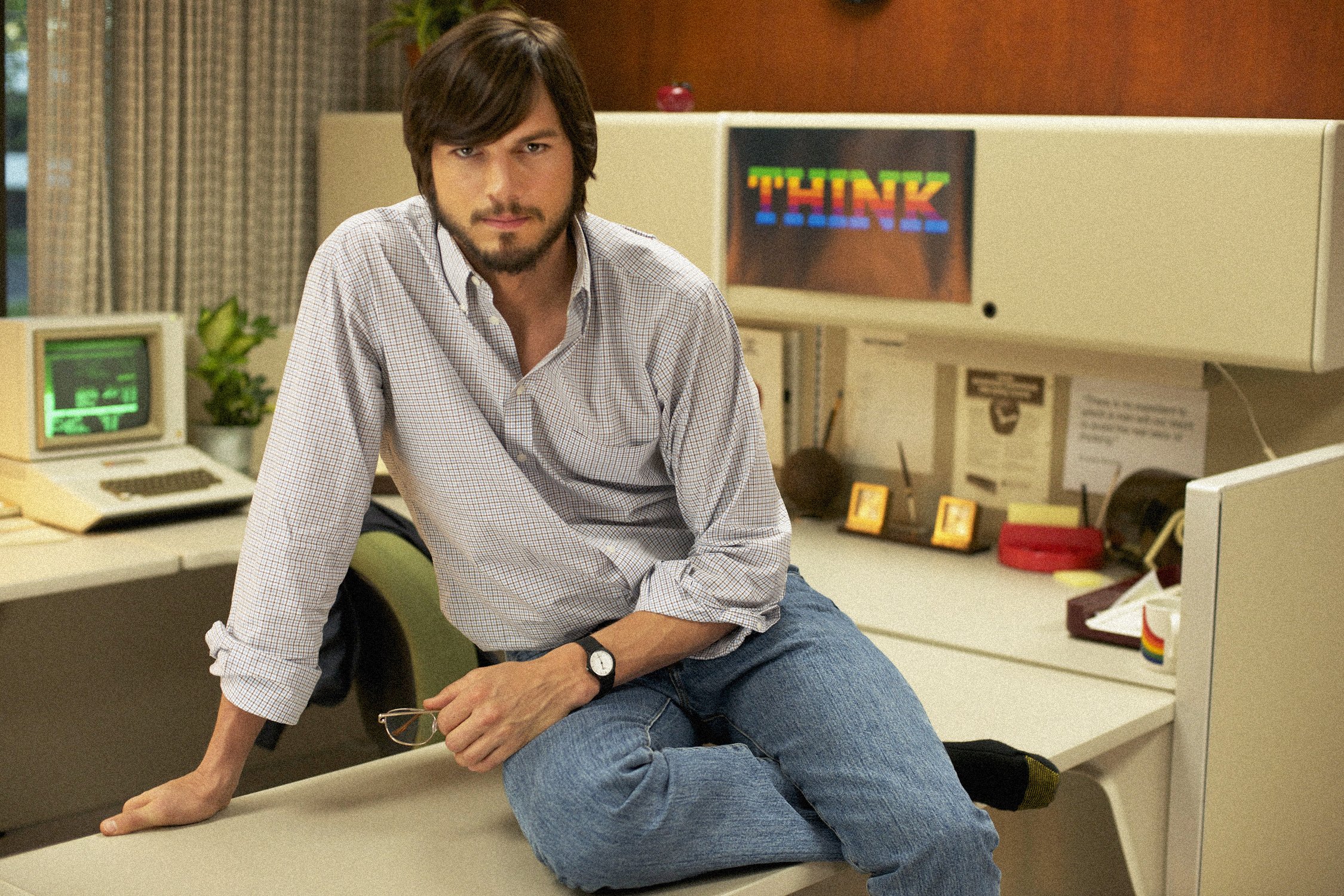
ashton-kutcher-as-steve-jobs

Even the most fascinating character, a true visionary with a transformative impact on the world and a story with one of the most wallopingly vindicating comebacks in business history, cannot always translate into a great movie.  A straight-on biopic cannot help but feel formulaic and clichéd, with the inevitable cinematic ports of call: our hero meets his then-unknown, now-legendary posse, there is a start-up montage of hard work with no resources, and when things get going our hero is accused by the people around him of neglecting them and/or abandoning the principles he once stood for. Everyone will tell him he is wrong.  He will be proven to be right.  Everyone will tell him he is arrogant.  He is, but he is also right.  There are setbacks.  There is triumph.  There are “Stars: They’re Just Like Us”-style peeks into his messy private life.  There is hero worship.  As we learned from “The Social Network,” these stories work better when they do not try to show us why someone was great or how he or she became great but instead tell us a story about a limited set of incidents that illuminate not only the life of this real person but tell us something about our own.

The good news is that just that movie about Steve Jobs is in the works, from “The Social Network’s” Aaron Sorkin. It will show us just three different moments in Jobs’ life, as three products are about to be launched.  And it will have lots of very smart dialog.  I can’t wait to see it.  In the meantime, we have this version, with Ashton Kutcher giving a very respectable performance as Steve Jobs, from his days as a college dropout still attending courses at Reed, in between sleeping around and dropping acid, to his triumphant return to Apple, eleven years after he was thrown out by the board of directors and the CEO he hired. Is it ironic or at least inconsistent that a movie about a man who insisted on “insanely great” innovation and joyfully disruptive, even seismic product development would be the subject of such an old-fashioned, traditionally structured storytelling?  Sure.  It’s like the problem of the computers and other equipment in the movie.  Though it is crucial to the storyline that we see how innovative they are; a couple of decades later they all look as old-fashioned as the rotary phones.  It is not a great or even a very good movie.  It is reporting rather than illuminating.  But it is watchable and modestly entertaining.

We learn very quickly, if clumsily, that (1) Jobs is so brilliant that a benign professor played by James Woods says he is welcome to keep going to class even though he has dropped out, (2) he is something of a user (he picks up a girl, sleeps with her, and then, when she offers him a tab of acid, tells her he is taking a second one for his girlfriend), (3) he is sad and rootless (as he and his friend and girlfriend are tripping as they lie on a blanket in the Oregon countryside, a tear slips out of his eye when he talks about being abandoned by his birth parents).  And while we’re on the subject of tears, there are a lot of damp eyes in this movie.  There may be no crying in baseball, but apparently there are a lot of tears in computers.  And (4) he does not play well with others.  He goes to work as a programmer for Atari, where he alienates everyone by being arrogant and smelling bad.

And then one day his pal Steve Wozniak (Josh Gad, in full nerd mode but with heart) shows him something cool.  He has hooked up his processor to a TV screen so that he can see the code.  Big time light bulb moment for the other Steve.  After an awkward and unimpressive demo for the Home Brew computer club, which led to his first business opportunity.  Jobs realized that there was a market for personal computers beyond the hobbyists and gearheads.  The fact that this seems stunningly obvious now is a tribute in part to his vision.  The clunkiness of the landline phones throughout the movie is another one.  Soon he created Apple with Wozniak and some friends.  Jobs set up a production facility in his parents’ garage and everyone got out their soldering irons and whatever the 1980’s equivalent of Red Bull was and went to work.

We see him rise and fall and rise again, with boardroom battles as vicious and bloodlessly violent as any scene to hit theaters this year.  Jobs is portrayed as a callous but visionary leader who tells his staff that “when you can touch the human heart, it’s limitless,” but parks in the handicapped space and tells his pregnant girlfriend, “I’m sorry you have a problem, but it’s not happening to me.”  He ferociously insists on loyalty from those around him but shows them none in return.

All of the performances are solid, despite the considerable handicap of 70’s hair.  As one of the early Apple employees he cuts out of the IPO gains, Lukas Haas is still making good use of those puppy dog eyes that go way back to “Witness.” Matthew Modine and J.K. Simmons are nicely slick as corporate bad guys.  But so much of both the personal and business story is left out that it feels empty.  The Jobs we see seems more focused on the details of the financing than the details of the product.  The man who felt abandoned by his birth parents (and later refused to see his birth father, even as Jobs was dying) disputed paternity and refused to see his daughter Lisa, but nevertheless named his biggest project after her?  He ran up huge development costs but refused to raise the price of the products to cover them and this made the shareholders the bad guy?  Why was he so ruthless in refusing stock options for the guys who were there at the beginning?  And why doesn’t the movie show that Wozniak gave them a piece of his own share?  Most important, why doesn’t the movie give us more than platitudes in showing us how Jobs got to “insanely great?”

Parents should know that this film includes smoking, drinking, marijuana and hallucinogens, strong language, a paternity dispute, and many tense confrontations.

Family discussion: What were Steve Jobs’ greatest strengths and faults? How can you work toward something that is “insanely great?”  What does it mean to say that “the system can only produce the system” and how can we transcend that?

If you like this, try: Steve Jobs by Walter Isaacson and Steve Wozniak’s iWoz: Computer Geek to Cult Icon: How I Invented the Personal Computer, Co-Founded Apple, and Had Fun Doing It

Related Tags:


Based on a true story Biography Drama DVD/Blu-Ray Pick of the Week

Elysium

Posted on August 8, 2013 at 6:01 pm

elysium posterThe best science fiction acts like a narrative Rorschach test, taking specific elements of our current condition, extrapolating into the future (usually dystopically), and allowing the audience to project our assumptions — and our fears — onto it.  “Elysium” is a smart sci-fi thriller that bundles the action and visuals we want from big-budget sci-fi with some provocative ideas about the logical consequences of the decisions we make on some of today’s most contentious issues.

The word “elysium” means a place or condition of perfect happiness.  Imagine a place of no worries, no illness, no want.  There are endless, perfectly manicured green lawns and soft breezes lightly flutter the sheers on windows that look out on exquisite landscapes.  That is home to the wealthy residents of “Elysium,” the space station.  It orbits above the now-despoiled planet earth, where the 99 percent live Hobbesian lives that are brutal, nasty, and short.  In other words, the set-up is “Wall•E” for grown-ups, without the “Hello Dolly” dance number and cruise ship atmosphere.

Max and Frey meet as children on Earth, and he promises to take her to Elysium some day.  They grow up to be Matt Damon and Alice Braga, and meet again when he mouths off to a robocop, who breaks his arm, and she is a nurse in a health care system that provides only the most basic first aid for Earth residents while Elysians have access to a kind of tanning bed technology that cures all injuries and diseases and even reverses the effects of aging.

Max is exposed to a lethal dose of radiation at the plant where he works, making more robots to wait on the residents of Elysium and enforce the brutal restrictions on Earth. A robot informs Max that he will experience catastrophic organ failure and die in five days.  The arrogant Elysian CEO in charge of the factory, John Carlyle (William Fitchner), is only concerned about whether Max will get the sheets dirty and how quickly he can be gone.

Max knows that breaking into Elysium and hacking into a med-bed is the only way he can stay alive.  And the only way for him to get there is to do a job for his old boss, Spider (Wagner Moura), capturing some data from Carlyle.  To keep Max strong, Spider’s henchmen surgically attach a cyber exo-skeletal device to his arms, spine, and skull.   He gets help from Diego Luna, a highlight as Max’s old friend from the car-stealing days.  It gives him extra power and a sort of USB plug in his brain.  And it turns out that Frey also has a desperate reason to get to Elysium.  And that the Secretary of Defense (Jodie Foster, dressed in spotless white) is in the midst of orchestrating a regime change, so the data downloaded into Max is of vital importance.  She sends a scary operative with a lot of firepower (“District 9’s” Sharlto Copley, scary good) to get Max.

As he did with “District 9,” director Neill Blomkamp adds just enough allegory to this story to give extra weight to the heart-pounding action.  Both of the worlds are thoughtfully conceived, especially the burned-out, graffiti-covered remains of Earth.  The details are evocative and compelling — a robot asking blandly whether Max is using sarcasm, Spider’s hodgepodge lair with its hobbled-together computers.  Foster’s recent performances have been disconcertingly mannered, with head-shaking to indicate the intensity of emotion.  But Damon is top-notch as Max, terrific in the action scenes and even better as we see him becoming more human.

Parents should know that this film includes constant sci-fi peril and violence with some very graphic and disturbing images, many characters injured and killed, constant strong language, drugs, drinking, and smoking.

Family discussion: What elements of this story are based on current issues and controversies?  Why did Max say no to Frey?  Why was the story about the meerkat and the hippo important?  What will happen next?

If you like this, try: “Upside/Down” and “Mad Max”

Related Tags:


Action/Adventure Drama Politics Science-Fiction

Blue Jasmine

Posted on August 1, 2013 at 6:00 pm

Two sisters. One imagines herself living a life of ease, comfort, graciousness, and elegance that does not really exist. The other is more accepting of her lower middle class life, her carnality, her limited expectations. The first sister loses everything and comes to live with the second. Woody Allen may have been inspired by Tennessee Williams’ “Streetcar Named Desire” in this modern San Francisco story of two sisters, one desperately trying to hold herself together for one more shot at a wealthy husband and the other more realistic but still holding on to some notion of romance. BlueJasmine_0

Cate Blanchett plays the self-named Jasmine, who lived in blissful — if willful — ignorance as a one-percenter, married to Hal, a wealthy businessman (Alec Baldwin). She floated from Pilates to shopping to gala to spa as he shifted funds from one shady offshore corporation to another. She would shake her impeccably coiffed head and murmur that she had no head for business and he would chuckle indulgently and pull another diamond bracelet out of his pocket.  She and her sister Ginger (Sally Hawkins) were both adopted and were never close.  But family is family, and when Hal goes to jail for Bernie Madoff-style fraud, Jasmine has no money and nowhere else to go.  We first see her on the plane from New York to San Francisco, telling the woman sitting next to her what is clearly a story she has told many times before, about her first meeting with Hal, when “Blue Moon” was playing, and about their fairy tale ending of luxury and parties.  She ignores the ugly “ever after” the way she glosses over the evident boredom of her listener, turning from annoyance to pity and then discomfort.

Blanchett, who has played Williams’ fragile Blanche on stage, is magnificent as Jasmine, a narcissistic woman who has been coddled and in denial for so long that she does not have the strength of mind or spirit to engage in an honest appraisal of her situation.  Ginger is only slightly better.  She can ask Jasmine how (and, by implication, why) someone without any money would travel first class and seems to have few illusions about the economic or emotional prospects with her rough-hewn fiancé, Chili (Bobby Cannavale).  She does not hold a grudge over the money she lost by investing with Hal or the destructive impact it had on her first marriage to Augie (Andrew Dice Clay in a nicely textured performance).  But she, too, has some illusions, and is easily taken in when she meets Al (Louis C.K.) a man who seems to have the stability and finesse that Chili does not.

Longtime Allen collaborator Santo Loquasto evokes the contrasting worlds of the two sisters with impeccably evocative production design and Sonia Grandes costumes are quite literally right on the money, with Jasmine’s gorgeous Chanels and Hermes and Ginger’s shapeless, cheap glamor.  Even the expensive bag she selects as a gift from Jasmine is superficially glittery.  The cinematography by Javier Aguirresarobe is so gorgeous it might even make Alvy Singer leave his heart in San Francisco.

But this movie is easier to admire than to like.  It has some points to make about superficiality and corruption, but there is no one to root for or care about.  The last act twist is telegraphed a third of the way in and the issues it raises are quickly abandoned.  Allen as a director is still getting better, but as a screenwriter he needs to do a few more drafts.

Parents should know that this film includes sexual references and non-explicit situations, adultery, fraud, drinking, drug use, smoking, and strong language.

Family discussion: Why is it important that the sisters were adopted? Which one made poorer choices about men? What will happen to them next?

If you like this, try: “Crimes and Misdemeanors,” another Woody Allen film about contrasting siblings confronting life choices

Related Tags:


Drama Family Issues

Cloudburst

Posted on July 29, 2013 at 8:06 am

B+
Lowest Recommended Age: Mature High Schooler
MPAA Rating: NR
Profanity: Very strong and crude language
Alcohol/ Drugs: Drinking
Violence/ Scariness: Tense and sad confrontations and loss
Diversity Issues: Age and sexual orientation diversity is a theme of the movie
Date Released to Theaters: 2013
Date Released to DVD: July 29, 2013
Amazon.com ASIN: B00CBG9SQS

Two of the all-time great actresses play a long-time couple who must find a way to cope with the indignities of aging — and the greater indignities of the way they are treated by their families and the legal system.  Oscar winners Olympia Dukakis and Brenda Fricker play a long-time couple, one losing her sight, one losing her hearing.  With the best of intentions, one’s granddaughter plans to put her in a nursing home.  The only way for them to stay together is to run away to Canada, where they can get legally married.

And so, they take to the road, where they pick up a hunky hitchhiker (newcomer Ryan Doucette).  Like the lovely “Still Mine,” also set in Canada, this is a beautifully performed story about a love that spans decades, brimming with tenderness and heartwarming devotion, and gives rare depth and dignity to characters in their 70’s.

Related Tags:


After the kids go to bed Comedy Drama DVD/Blu-Ray Pick of the Week Neglected gem Romance

Still Mine

Posted on July 18, 2013 at 6:00 pm

B+
Lowest Recommended Age: Middle School
MPAA Rating: Rated PG-13 for some thematic elements and brief sensuality/partial nudity
Profanity: Mild language
Alcohol/ Drugs: None
Violence/ Scariness: Sad themes of aging and loss
Diversity Issues: A theme of the movie
Date Released to Theaters: July 19, 2013

StillMineWhy do we spend so much time in movies watching young people fall in love? Why is the wedding so often the happy ending? “Still Mine” is a beautifully performed true-life tale of a couple who have been deeply in love for 70 years. That is a love story.

James Cromwell (“Babe”) plays Craig Morrison, a flinty, taciturn, stubbornly independent man in his 90’s who is committed to caring for his wife, Irene (the exquisitely lovely Geneviève Bujold), as she is struggling with becoming forgetful.  Their seven grown children are concerned, but Irene wants to stay at home and Craig is resolute.  He has land and he knows how to build.  When she falls down the stairs in their home, he decides he will build a new house for them on their land, something small, simple, and one-story, where he can keep her safe.

The local building authorities tell him that he is in violation of their rules.  They have no reason to believe that the structure is unsafe.  But they have regulations about the certification of lumber and various other check-list requirements that his home does not meet.  As the movie opens, he is in court, with the judge to decide whether he will go to jail for contempt, or go home to his wife.

We then go back two years to see what has led to this court appearance, in a series of sensitively understated scenes brimming with privileged moments.  It is clear that the depth tenderness between Craig and Irene is earned over a period of decades.  And it is so sweetly portrayed it will make you eager to get old.

Parents should know that this movie’s themes include aging and loss.  There is a sad death.

Family discussion:  How should families talk about end of life issues?  Do you agree with the way the Morrison’s children and grandson respond to them?  What is the best way for government authorities like the building inspectors to ensure the safety of the community but give people like Craig the freedom they need?

If you like this, try: “The Straight Story” and some of the earlier films with the immensely talented Cromwell and Bujold like “Babe,” “W,” “King of Hearts,” and “Anne of the Thousand Days”

Related Tags:


Based on a true story Drama Family Issues Movies -- format Romance The Real Story
THE MOVIE MOM® is a registered trademark of Nell Minow. Use of the mark without express consent from Nell Minow constitutes trademark infringement and unfair competition in violation of federal and state laws. All material © Nell Minow 1995-2026, all rights reserved, and no use or republication is permitted without explicit permission. This site hosts Nell Minow’s Movie Mom® archive, with material that originally appeared on Yahoo! Movies, Beliefnet, and other sources. Much of her new material can be found at Rogerebert.com, Huffington Post, and WheretoWatch. Her books include The Movie Mom’s Guide to Family Movies and 101 Must-See Movie Moments, and she can be heard each week on radio stations across the country.

Website Designed by Max LaZebnik