
Movie of the Month: Casablanca
Posted on November 2, 2012 at 8:00 am
Be sure to check out our Movie Corner Movie of the Month, Casablanca
Posted on November 2, 2012 at 8:00 am
Be sure to check out our Movie Corner Movie of the Month, Casablanca
Posted on October 25, 2012 at 6:00 pm
 Six nested stories set in the past, present, and future entwine grand themes of the conflicts between those who would oppress and those who demand freedom, those who must create and those who want to repeat what is already there, those who love and those who are afraid to love or be loved. Some in the audience will be enchanted by the grand scope of the story-telling and the intricate details of the mosaic that make up each of the story’s parts. Others will be impatient with the gimmicks and distracted by the prosthetics, wigs, and make-up. Many will grapple with the frustration of experiencing both reactions.
When they made the “Matrix” films, they were known as the Wachowski brothers, Andy and Larry. But since then, Larry has become Lana while resisting terms like “transition” as “complicity in a binary gender narrative.” That clearly fueled the commitment to age, race, and gender fluidity throughout the film. Even the most sharp-eyed cataloger of prosthetic noses and teeth will be surprised as the credits reveal the multiple roles taken by Tom Hanks, Halle Berry, Hugo Weaving (Mr. Smith in the “Matrix” films), Hugh Grant, Jim Sturgess, James Broadbent, Ben Wishaw, Keith David, Doona Bae, and others.
The oldest story, set in the early 19th century and told in the traditional style of ahistorical drama, has Sturgess as a man disturbed by the abuse of slaves in the Pacific who is being poisoned by a doctor (Hanks) he thinks is curing him. His journals become a book on a shelf in the next story, set in the 1930’s, with a musician (Wishaw) writing to the man he loves about assisting a venerated composer and working on his own composition, called “Cloud Atlas.” In the 1970’s, styled to remind us of that era’s “paranoid cinema” films like “The Parallax View” and “The China Syndrome,” an investigative reporter (Berry) gets stuck in an elevator with an elderly scientist who gives her some important information about a nuclear facility. She discovers his 40-years-old correspondence with the musician in his papers. In the present day, we see something of a shaggy dog story as a British publisher (Broadbent) goes on the run from hooligans and ends up having to escape from a “One Flew Over the Cuckoo’s Nest”-style facility.
Two stories are set in the future. The first, in what is now Korea, has a “Blade Runner-“ish society made up of consumers and “fabricants.” One of them sees a movie based on the story of the publisher’s escape (starring Hanks), which helps her understand that she must rebel against the abuses of her society. Her story becomes part of the origin myths of a post-apocalyptic society hundreds of years even farther into the future, where much of humanity has returned to an almost bronze-age level of technology and everyone speaks in a Jar-Jar Binks form of pidgin English that may have worked better on the printed page but on screen is intrusive and overdone.
As the the “Matrix” films, the more specific and concrete it gets, the less resonance it has. Its greatest message about human aspiration and inspiration and connection is in the message as medium. The scope and audacity of this undertaking, the biggest budget independent film in history, with the Wachowskis putting up their own homes to make the final budget numbers, outshines the details that never quite reach the clouds.
Parents should know that this film includes some graphic violence including murders, rape, shoot-outs, knives, arrows, suicide, brutal whipping, poison, car crashes, and a character being thrown off a balcony. Characters are in peril, injured and killed. There are dead bodies with disturbing images, some strong words including f-word and n-word, gay and heterosexual sexual references and explicit situations as well as nudity, crude sexual humor, portrayal of slavery and totalitarianism, smoking, and drug use.
Family discussion: Which of the stories was the most compelling and why? Who was the bravest character? Who learned the most?
If you like this, try: the book by David Mitchell and the “Matrix” movies
Posted on October 18, 2012 at 6:00 pm
In “Alex Cross,” Tyler Perry is called upon to: show devastating grief, show incendiary fury, make threats, throw punches, and take over a part played twice on screen by Morgan Freeman. He is not up to any of those things. Perry is a powerhouse as a writer/director/impressario and I am a fan of his unique blend of high melodrama, low humor, and true-hearted faith in God and family. But here, in a prequel to the gritty detective films “Along Came a Spider” and “Kiss the Girls,” based on the best-selling thriller series by James Patterson, Tyler is not a good fit. It opens with Tyler as Cross in run-with-a-gun mode, chasing after a bad guy, and then we see him bantering with his long-time best friend and partner (Edward Burns) and with his gorgeous wife (Carmen Ejogo). There isn’t a persuasively authentic moment in any of that. Indeed, the 6’5″ Perry’s most believable performance is when his character has to reach something from a high shelf. That feels real.

Cross is supposed to be a Sherlock Holmes-style hyper-observant detective with a degree in psychology who is also a devoted family man with a cute-cranky mother (Cecily Tyson) who is also gangbusters in chasing, shooting, and beating up bad guys, not to mention some vigilante-style rough justice. He is always right. How do we know? His best friend/partner says, “Just once I would like it if you got something wrong because this is really getting annoying.”
And the bad guy here (an unrecognizably strung-out Matthew Fox) is also something of a super-villain who has mastered every kind of weapon and technology and has an evil genius command center with marked-up maps and mechanicals pinned to the wall (how retro) and a champion mixed martial arts combatant and specialist in torture and charcoal drawings, who leaves meticulously detailed clues that are only revealed by an Al Jaffee-style Mad fold-in.
The story begins with the murder of a gorgeous and very wealthy woman with a kinky side. She explains a statue of the god of war in her bedroom: “War is a passionate undertaking of strategy and skill just like sex. So it belongs beside the bed.” She is butchered and her three bodyguards are shot and burned. That leads to a botched attempt on one of her colleagues, an arrogant German guy who does something with money that is so important he has the kind of super-security they usually reserve for places where there is actual money and not just computers people use to move it around, except in movies where we have to show how smart the villain is by having him surmount all of the obstacles. And then it all gets very personal and very, very ugly. The body count rises, including a lot of collateral damage as well as some that hit close to home. The exposition-heavy dialog is clunky (“But this building is impenetrable!” someone says as the building is being penetrated). The banter is clunkier: “I’d rather take advice from a ham sandwich.” “Love you too, it goes without saying.” And yet, he says it.
I was not a fan of the last Alex Cross film, Along Came a Spider, because of its plot holes and factual clangers. (No, the Secret Service does not protect the children of Senators and the Russian President does not live in America.) Once again, the plot becomes increasingly more preposterous when super-detective figures out that super-villain is targeting someone who is about to make a presentation to the city council. Now, in that situation I might suggest moving the meeting to a different time or place, but no, these braniacs decide to send every cop in the city to the location to lock it down. For a presentation. That must be some power-point. It goes without saying that someone claims it’s the equivalent of impenetrable and it goes without saying that our Energizer bunny of a bad guy is way ahead of them. But they say it anyway.
Parents should know that this is an R-level movie. It has very intense and graphic violence for a PG-13 with torture including severed fingers as well as brutal fighting, guns, and bombs, very sad deaths of characters including a pregnant woman, explicit sexual situations for a PG-13 including bondage and partial nudity, some language, and references to drug use and drug dealing.
Family discussion: Who was right, Dr. Cross or his mother? What makes him so aware of the revealing details all around him?
If you like this, try: Morgan Freeman’s performances as Alex Cross in “Kiss the Girls” and “Along Came a Spider”
Posted on October 11, 2012 at 6:00 pm
A-| Lowest Recommended Age: | High School |
| MPAA Rating: | Rated R for language and some violent images |
| Profanity: | Very strong language |
| Alcohol/ Drugs: | Drinking, smoking |
| Violence/ Scariness: | Scenes of mob violence, hostages, references to terrorism |
| Diversity Issues: | Ethnic, political, and cultural differences a theme of the movie |
| Date Released to Theaters: | October 12, 2012 |
| Date Released to DVD: | February 18, 2013 |
| Amazon.com ASIN: | B00AHTYGRW |
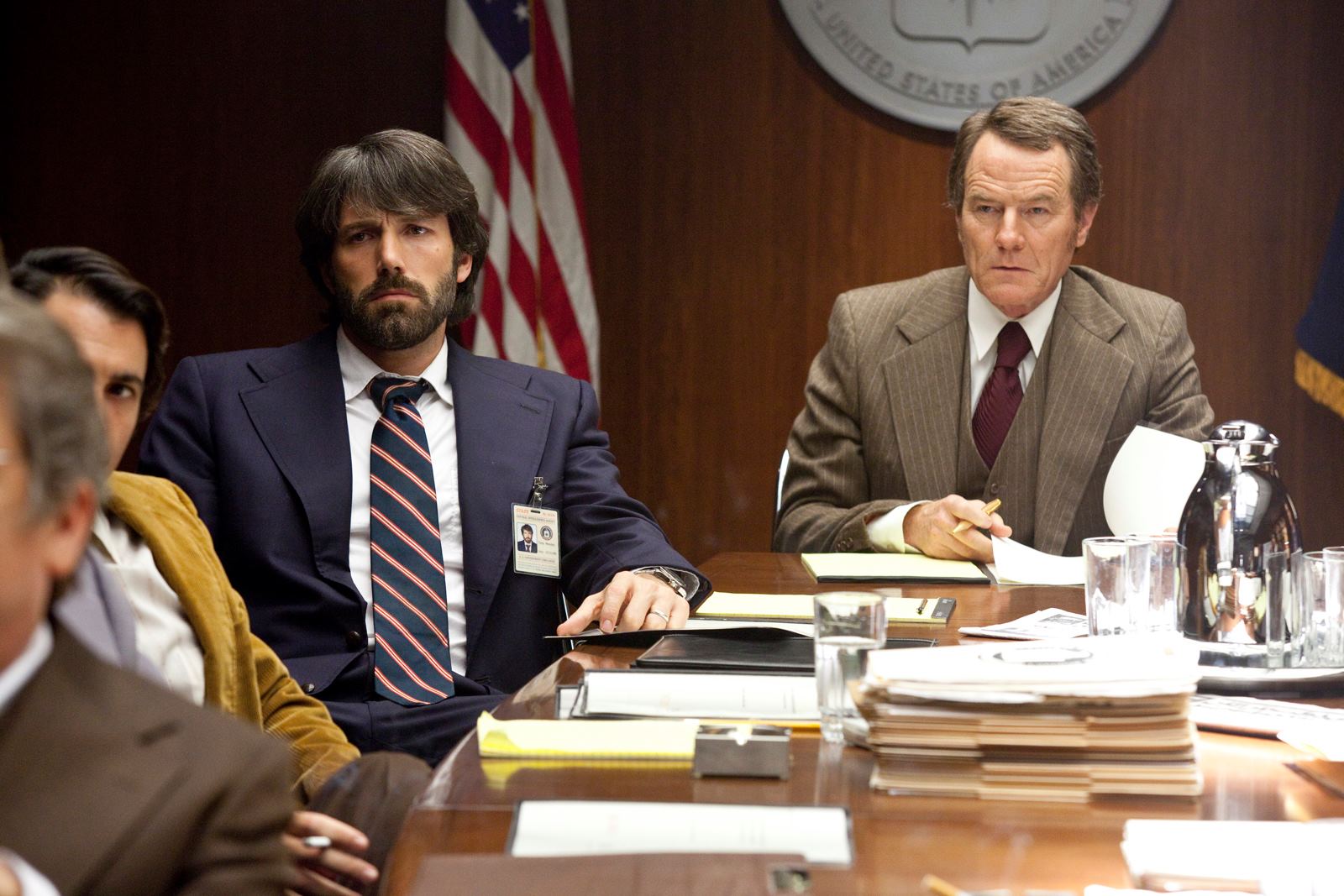 The movie within the movie, an outlandish space fantasy possibly named “Argo” for Jason’s vessel in the ancient Greek myth, may be more believable than the true and recently declassified story that surrounds it. In 1979, when American State Department employees were taken hostage in Iran, six escaped and were hidden by the Canadian ambassador. A CIA “exfiltration” expert who specializes in getting people out of difficult situations, rescued them by disguising them as members of a Canadian film crew, scouting locations for a fictitious Hollywood movie called “Argo.”
It is like an episode of the television series “Mission: Impossible” except that (1) it really happened and (2) it was much, much harder. Unlike “Mission: Impossible,” the people creating an elaborate false reality in order to fool the other side had to work with civilians. And they had to navigate a lot of bureaucratic, diplomatic, and national-security-related internal conflicts in a volatile environment with limited sharing of information. James Bond has something more valuable than a license to kill. He has a license to pretty much do whatever he wants with M ready to stand behind him. But Tony Mendez (played by director Ben Affleck) has to make a lot of literally life-or-death decisions very quickly and yet is still subject to oversight by layers of people with different priorities and points of view.
Affleck, following “The Town” and “Gone Baby Gone” (and a screenwriting Oscar for “Good Will Hunting”) is no longer one of Hollywood’s most promising new directors — he has arrived. This film works on every level. Even though we know the Americans were rescued (Canada’s embassy was given a prominent location near the White House in gratitude for their efforts), the tension is ferocious. The scenes in Hollywood, with John Goodman and a sure-to-be-nominated for a third Oscar Alan Arkin are as sharp and witty, recalling “The Producers” and “Get Shorty.” But rather than an easy way to provide contrast or comic relief, Affleck and first-time screenwriter Chris Terrio (based on an article in Wired Magazine) use those scenes to provide context, along with some tang and bite. One masterful section of the film intercuts the two stories as the Hollywood group set up shop, secure the rights to the screenplay, and put together a staged reading to get publicity to demonstrate their bona fides while the six Americans are trapped and the exfiltration mission gets underway. There are a lot of similarities — both sides deal in illusion, and not just the illusion of the sci-fi fantasy film they are pretending to make. The constant lying about the project comes naturally to Arkin’s character, an old-time Hollywood guy who has seen it all and who himself has no illusions about the integrity and loyalty of those around him. He says, “You’re worried about the Ayatollah. Try the WGA.”
Affleck locates the film in its era with hair and clothes that evoke the time period without exaggeration or ridicule, not easy to do with 70’s styles. He even used 70’s era film stock and borrowed some of the staging from movies of the era like “All the President’s Men,” and the opening titles are in a 70’s font. But the film also has some important insights about what happened and about our own time, reflected in the conflicts of three decades ago. It begins with a brief description of the events leading to the hostage crisis, emphasizing America’s support (to benefit the oil companies) of the Shah’s brutal regime, told somewhat differently than it would have been in 1979.
“You don’t have a better bad idea than this?” a State Department official asks the CIA. “This is the best bad idea we have,” is the reply from Jack O’Donnell (Bryan Cranston). They can’t fake any of the usual identities for the Americans because they are too easy to disprove. The normal reasons for foreigners to be abroad — teaching, studying, aid — are not plausible. Only something completely outrageous could be true. And it turns out that Iranians are as in love with Hollywood movies as everyone else. This one is a good reminder of why we all feel that way.
Parents should know that this film includes scenes of mob violence, hostages, references to terrorism, characters in peril, tense confrontations, alcohol, a lot of smoking, and very strong language.
Family discussion: Why did the Canadians take in the Americans? Why did Mendez defy his orders? What would you do if someone approached you the way Mendez approached the Hollywood insiders?
If you like this, try: “Charlie Wilson’s War”
Posted on September 27, 2012 at 6:00 pm
What should have been a rousing, feel-good, “inspired by a true story” film about a mother and a teacher who take on the teacher’s union and the school board to turn around a failing elementary school benefits from strong performances but suffers from a palpably skewed point of view. Maggie Gyllenhaal plays Jamie, the devoted single mother of a daughter with dyslexia who attends the John Adams elementary school in a poor Pennsylvania community. Viola Davis plays Nona, a frustrated teacher whose own son has developmental disabilities that add to the strain in her marriage.
When Jamie tries to see the school superintendent to complain about the principal’s unwillingness to help her, she can’t get in. But a sympathetic receptionist explains that there is a parental trigger law that at least in theory can help. If a school has consistently failed, parents and teachers can petition to take it over. In reality, Jamie is told, those petitions never succeed. The school board uses delays and technicalities to wear down the petitioners. But, as Jamie explains, those mothers who lift trucks to save their babies have nothing on her.
The other teachers are angry and scared when Nona joins Jamie. If the petition is successful, the teachers will no longer be part of the union. They will lose their tenure and possibly their jobs. The petition cannot be successful without the signatures of at least half of the teachers. Lifting the truck begins to seem easy by comparison.
Gyllenhaal conveys passion well but her character is too good to be true, never wavering or even slowing down despite having to hold down two jobs to support her daughter and always having to exemplify all that is committed and pure of heart while also being all kinds of spontaneous and free-spirited, knowing everything about Penguins hockey, being infinitely patient with her daughter, and rocking the skinny jeans. Davis brings great depth and warmth to Nona, but she is stuck with the “black Stepford wife” role and even Davis, one of the finest actors in film history, cannot make Nona’s big powerhouse revelation scene work.
Every parent and anyone who has ever been to school cannot help but be drawn into this underdog story about people who want to make things better for their children and are willing to take on the bad guys. But oh, this movie really overdoes it with the bad guys. There are some mentions of the important contributions made by unions, especially by Michael (the always-outstanding Oscar Isaac) as a Teach for America veteran who is one of the school’s best teachers. But those references are all to the distant past and the praise sounds as insincere Antony’s praise for Brutus. Meanwhile, the union officials are portrayed as venal and corrupt, more concerned with their own power than with the welfare of the children and willing to restort to bribes, threats, manipulation, and character assassination. The bias is evident when of them all but twirls a villain-esque mustache as he quotes a statement the late Albert Shanker, former president of the teacher’s union, never actually made about how children do not pay union dues, so his allegiance is to the teachers who do. They make “It’s a Wonderful Life’s” Mr. Potter seem like Santa Claus. There are bad teachers in schools but it is way over the top when the opening scene shows Jamie’s daughter struggling to sound out the word “story” as her teacher checks her email and shops online and some of the other kids play computer games and make fun of her.
The film has been widely criticized because it is funded by those who have an economic interest in taking over schools, for-profit companies that want to get the school contracts, and those points are valid. Those points are valid. But so is the point that seven out of ten kids at this school cannot read by the time they leave. It is fun to see Gyllenhaal and Davis dance together in the bar where Jamie works as a bartender but it would have been a lot more meaningful to have a forthright conversation about how to protect and retain good teachers and help students who do not have enough support at home. All we ever hear about from the phone book-sized petition Jamie and Nona present to the board is a number with digits mistakenly reversed that may be grounds for rejection. We never hear about the ideas for change that would be the reasons for its approval. We can all agree that schools can do better and that abuses occur when there is too little protection for teachers and administrators and when there is too much. The tough part is coming up with a way to do something about it. Nona and Jamie talk about the importance of high expectations. I had higher expectations for this film than it was willing to meet.
Parents should know that this film includes drinking, scenes in bar, mild language (“screw”), references to drunk driving and irresponsible behavior, tense confrontations, and some kissing.
Family discussion: Read about the controversy over the “parent trigger” laws advocated in the film – what are the advantages and disadvantages of outsourcing school administration? What are parents in your community doing to help teachers and students?
If you like this, try: the documentaries “Waiting for Superman” and “Small Wonders”