This looks surprisingly adorable! Part “Love Bug,” part “How to Train Your Dragon,” part “Transformers,” part “Free Willy!” It’s “Monster Trucks,” starring Lucas Till, Rob Lowe, and Danny Glover.
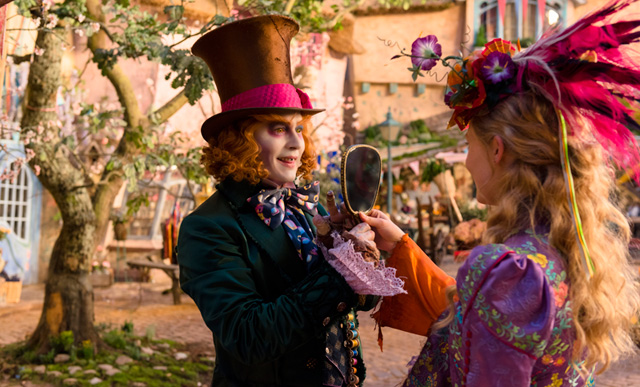
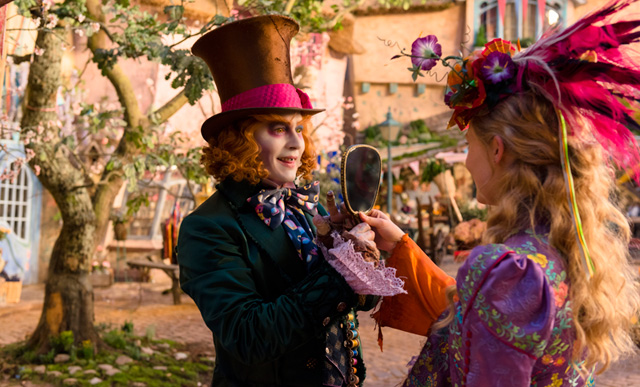
“Alice Through the Looking Glass” the movie has almost no relationship to Alice Through the Looking Glass, the book by Lewis Carroll in spirit, character, or storyline. That might possibly be all right if the spirit, character, or storyline were in any way worthwhile, but it is not. Gorgeous production design and some cool stunts do not make up for a story that begins as passable and ends as painful.
Tim Burton, who produced this one, previously gave us an “Alice in Wonderland” with an adult Alice (Mia Wasikowska) replacing the little girl of the story and spending way too much time in the above-ground “real” world as she attends a party, turns down a proposal of marriage from the odious Haimish (Leo Bill), and accepts instead the offer from his father to serve as crew on a merchant ship.
In “Looking Glass,” we first see Alice, now captain of the ship, in an exciting escape from pirates that show us her courage and love of adventure. But when the ship returns to port in London, she finds that Hamish’s father has died, leaving him in charge, and he refuses to let her go back to sea. In his home, she finds a mirror over a fireplace that is a portal back to Wonderland, led by the former caterpillar, now-butterfly (voice of of the much-missed Alan Rickman).
Having already imported the talking flowers, chess pieces, Tweedledum and Tweedledee, and the Jabberwocky from “Through the Looking Glass” into the first film, conflating the first story’s Queen of Hearts (the “Off with the head!” one) with the second story’s Red Queen (the chess one) this movie takes — but makes no use of — the first book’s characters like the Cheshire Cat and the White Rabbit, and then has a completely invented story about time travel.
This has many disagreeable aspects, but the worst is when it puts Sasha Baron Cohen as the embodiment of Time into a scene with Johnny Depp as the Mad Hatter and allows them to try to out-grotesque each other in a manner clearly intended to be charming. It is not.
Neither is the plot, which relies heavily on just the kind of treacly heartstrings-plucking backstories that Carroll would never have allowed, asking us to feel sympathy for outrageous behavior and affection for caricatures. The first film’s attempt to create a warm, devoted friendship between Alice and the Mad Hatter was rather ooky. In the sequel, we are asked to believe that she has returned to do whatever it takes to help him because they love each other so much.
To paraphrase the folks behind “Seinfeld,” in the Alice world, there should be no hugging and no apologizing — and no heartfelt professions of affection, especially when they are not in any way justified by the characters’ history with each other.
Alice is needed on the other side of the mirror because the Mad Hatter has found something that has convinced him that his family is still alive, and not killed by the Jabberwock as he had thought. Why is this so important? Is it because he misses them so? Not really. It is because he feels bad about his behavior and needs to see them again so he can be forgiven. The disconnect between the expressions of devotion and the narcissistic reality of behavior is disturbingly cynical. Alice decides the only way she can save his family is to go back in time to the Jabberwock battle, which means she has to retrieve the chronosphere from Time himself, and that leads to more time travel as she solves various not-very-mysterious mysteries and Time chases her to get it back. Not that any of it makes any sense, logically or emotionally.
The production design is imaginative and witty, but it is buried under a gormless, hyperactive mess of a film. The book is endlessly witty and imaginative and delightful with all kinds of wordplay, math puzzles, and chess references from Carroll (aka Charles Dodgson), a math professor. The movie wastes all of that opportunity. Look at the title — the movie should be about a reverse world, not a heist/time travel saga that only concludes you can’t change history. If I had the chronosphere, I’d use it to go back to the moment I sat down to watch this movie so I could go home.
Parents should know that this film has extended fantasy peril with many disturbing images, discussion of loss of parents, brief image of someone dying, and bullying.
Family discussion: If you could go back in time, what time would you pick? Why did the Hatter and the White Queen have a hard time telling their families how they felt?
Cartoon action-style peril and violence, no one hurt
Date Released to Theaters:
May 20, 2016
Date Released to DVD:
August 15, 2016
Amazon.com ASIN:
B01EK44M64
Copyright Sony Pictures 2016
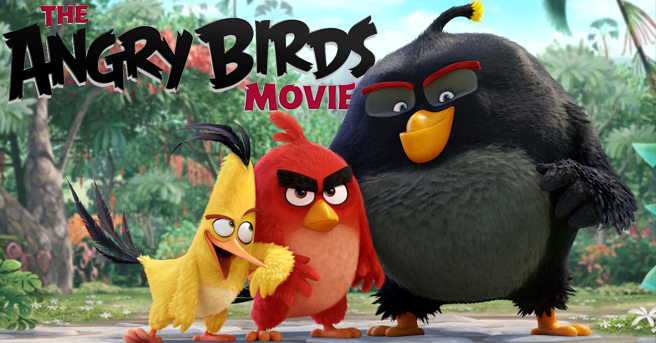
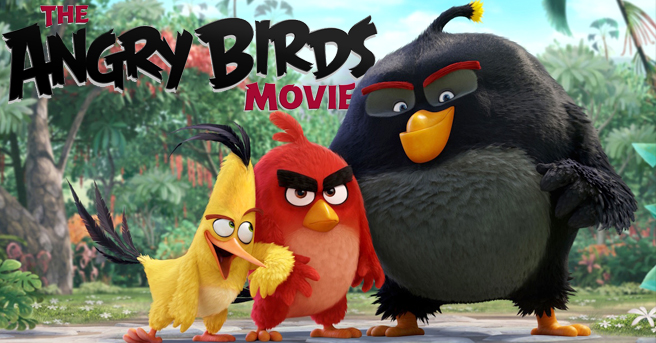
Like the wildly addictive Finnish app/game/toys that inspired it, the Angry Birds movie is colorful, with some silly humor and imaginative settings. And like the many, many attempts to make games into movies that have gone before it, this one has strong visuals, game talent, and yet never quite sustains itself as a story. It’s a rare movie for kids that endorses legitimate anger, but in these touchy times, it is peculiarly xenophobic.
Bird island is something of a flightless bird sanctuary, with no predators and a mostly happy, companionable community. Red (a perfectly cast Jason Sudeikis) is a bright red bird with Eugene Levy eyebrows, a tendency to defensiveness and snark, and a serious anger management problem.
Red is late to a “hatch-day” party he was supposed to work at as an entertainer. He insults the young bird’s parents and is accidentally standing in the wrong place when their new chick hatches, so that the baby imprints on Red instead of his parents. Red has an angry outburst leading to a court appearance presided over by Judge Peckinpah (Keegan-Michael Key), who sentences him to anger management classes conducted by the New Age-y Matilda (Maya Rudolph), where his classmates include the explosive Bomb (Danny McBride) and excitable Chuck (Josh Gad).
A ship arrives at Bird Island, carrying a cheerful pig named Leonard (Bill Hader), who oozes charm and promises friendship and merriment. He even puts on a show, in order to both pad and juice up the storyline.
Red is skeptical, but he is always skeptical. The other birds embrace their new friend, even after Red tells them Leonard has lied about coming alone. He has lied about his purpose, too. The pigs want the eggs. And…now the game part comes in: the birds need to get angry so they can get the eggs back. The whole part about foreigners/those different from us being evil and scary and wanting to eat our progeny, that’s pretty much glossed over as all in good fun, mingled with shout-outs to The Eagles (get it) and Rick Astley (because why not; it’s an easy laugh).
The birds have a possibly mythical leader, Mighty Eagle, the only bird on the island who can fly. Red, Bomb, and Chuck ascend to ME’s aerie and find that he is not as heroic as they hoped. If anyone is going to save the day, it will be the intrepid trio themselves. They have to find a way to get to the pigs’ island and get the eggs back.
It’s all bright and cheerful, but under-plotted and overproduced. Stunt-casting Oscar winner Sean Penn for a few grunts, throwing in pop songs and faux swearing to amuse the parents and bird poop humor to amuse the kids left me feeling a bit angry myself.
Parents should know that this film includes a lot of cartoon-style action and peril, with no serious injuries, some schoolyard language, and some bodily function/gross-out/crotch hit humor.
Family discussion: When is it helpful to be angry? How can you make the best use of anger?
Copyright 2016 IFC FilmsWho ever said that fairy tales were for children?
The visually striking “Tale of Tales” is based on three stories from Giambattista Basile that go back a hundred years before the Brothers Grimm. Basile, whose book was subtitled “entertainment for little ones” was the first person to write down these folk tales, including early versions of Cinderella, Rapunzel, and other classic stories. The three tales here, inspired by Basile’s stories, have fairy tale elements — wishes, magic, monsters, a princess to be won by whoever gives the right answer, a queen who will do anything to have a child. And there are lush, gorgeous, and wildly imaginative images. But these are not for children. These are straight out of the primordial ooze of the collective unconscious. These are not so much stories about enchantment as they are about desire, hubris, terror, all of the the deepest and most untamed emotions. Don’t expect anyone to live happily ever after.
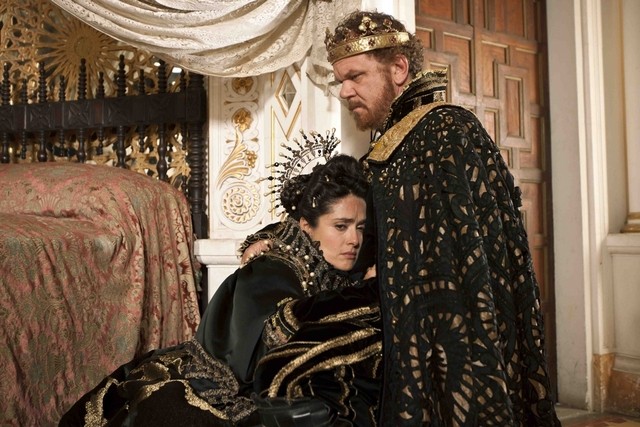
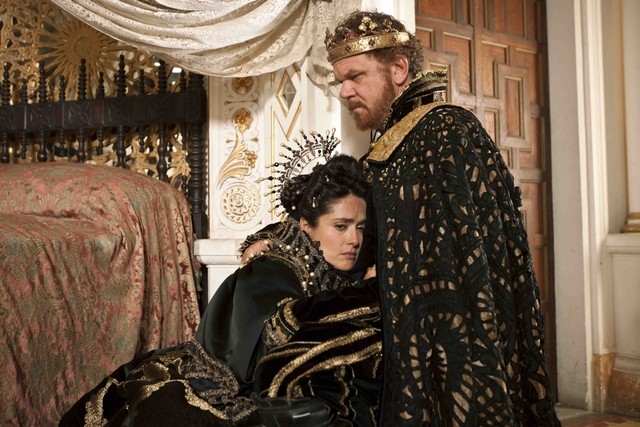
The Queen of Longtrellis (Salma Hayek) is inconsolable. She wants a child. A wizard offers her a solution. If she eats the heart of a sea monster, prepared for her by a virgin, she will become pregnant, but it will be at the cost of a life. She agrees. And her husband, the king (John C. Reilly) is killed capturing the monster. The virgin prepares the heart, and the queen devours it. She and the virgin both become pregnant and deliver identical sons.
The King of Strongcliff (Vincent Cassel) is a libertine. He hears the voice of an old woman singing (Hayley Carmichael) and, believing her to be young and beautiful, tries to get her to agree to sleep with him. She agrees, provided that they keep the lights off. But he peeks and horrified by her appearance, has her thrown out of the window.
And the King of Highhills (Toby Jones) has a beautiful and devoted daughter, Violet (Bebe Cave). She prepares a song to show her love for her father but as she performs, he is distracted by a flea on his hand, which fascinates him so much that he keeps it for a pet, feeding it and fattening it up until it is the size of a pig. When it dies, he has it skinned and offers Violet’s hand in marriage to the first one who can correctly identify the animal it came from. But the one who knows the answer is an ogre.
Each of these stories explores issues of pride, selfishness, and greed. The Queen wants more than a child; she wants all of his love. The old woman wants superficial beauty and the power it can bring and the lecherous king wants sex and a beautiful wife. A woman is consumed — literally — with jealousy. Another king can’t see the love of his daughter because he is preoccupied with his grotesque pet. Director Matteo Garrone, with his first English language film, gives the stories a hallucinatory quality with rapturous images on the brink between dream and nightmare.
Parents should know that this film includes nudity, sexual references and situations, monsters, fairy tale violence and explicit and disturbing images.
Family discussion: How do these fairy tales differ from the ones more familiar to modern audiences? How do each of these stories deal with the theme of pride?
If you like this, try: “The Brothers Grimm” and “Time Bandits”