A Monster Calls

A Monster Calls

Posted on January 5, 2017 at 5:50 pm
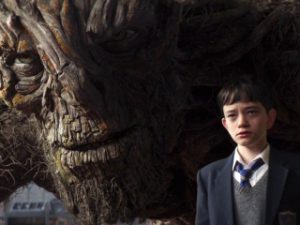
Copyright 2016 Universal

It turns out that there is something even more painful than the most devastating loss imaginable. That is the lesson of “A Monster Calls,” based on the Carnegie Medal and the Greenaway Medal award winning book by Patrick Ness, illustrated by Jim Kay, from an idea by the late human rights activist Siobhan Dowd.

It takes place in the Irish countryside. “We begin,” the movie tells us, “like so many stories, with a boy too old to be a kid and too young to be a man and a nightmare.” The boy is Conor (Lewis MacDougall), whose adored single mother (Felicity Jones) is struggling with cancer and the ravages of its treatment. While other boys are gently awakened by their parents and sent off to school with a good breakfast and a lovingly packed lunch, it is Conor who makes breakfast for his mother (there are rows of medicine bottles in the kitchen cupboard). He also does the laundry before he goes to school, where a bully threatens him. He has a frosty grandmother (Sigourney Weaver) and an affectionate but useless father (Toby Kebbell). So, he is alone with his grief, his fear, his anger, and his paints, which he must learn to use to express them all.

Let’s think for a moment about the title: “A Monster Calls.” Is that “calls” as in “pays a call,” or comes to visit? Is it “calls” as in “calls out to?” Is it “calls” as in “calls out from?”

A teacher says sympathetically, “If you ever want to talk…” Conor’s dad arrives from America, where he lives with his new wife and new baby, and he takes Conor to an amusement park. But Conor does not want to talk and he is not amused. A glimpse of the old “King Kong,” Fear and Fury bookends, and a shiver-inducing creaking noise give us a hint that a terrifying, destructive monster may be coming.

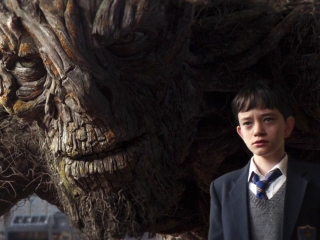
And then, yes, Conor is visited by a monster, an enormous walking yew tree with the rumbling voice of Liam Neeson. Conor may think the monster is there to protect him, but that is not exactly true. He says he is there to tell Conor three stories, and then, he says, Conor must tell him one and it must be true. The monster’s stories have a yew tree connection, as does a possible new treatment for Conor’s mother. They begin like traditional fairy tales but do not pretend that the resolutions are fair or straightforward. The fury within the stories seems to take over Conor and he finds himself becoming violent before telling his story forces him to admit what terrifies him even more than the prospect of losing his mother.

This is a complex, richly imagined film with a deep understanding, clear-eyed but compassionate. The stories it contains help us to be honest about our own.

Parents should know that this film is about a boy whose mother is dying of cancer. There are some other disturbing images and situations, including a bully and a monster.

Family discussion: Which story surprised you the most and why? Why was it important for Conor to tell his story? What monsters live inside us?

If you like this, try: the book by Patrick Ness and “Secondhand Lions”

Related Tags:


Based on a book Drama Family Issues Illness, Medicine, and Health Care Stories About Kids
Me Before You

Me Before You

Posted on June 2, 2016 at 5:21 pm

Copyright 2016 New Line Cinema
It’s all about the eyebrows. Emilia Clarke (“Game of Thrones”) has gamine-like “natural” eyebrows ideal for expressing wonder, hurt feelings, and enthusiasm, and Sam Claflin (“Hunger Games”) has circumflex-like eyebrows ideal for expressing skepticism, irony, and stoicism. All four eyebrows get an extensive workout in “Me Before You,” based on the international best-seller by JoJo Moyes about Louisa Clark (Clarke), a high-spirited, warm-hearted pixie of a girl, just laid off from her job behind the counter at a bakery, and Will Traynor (Claflin), a once-energetic, once-successful finance type from a wealthy family who is now paralyzed below the shoulders following an accident. Lou is hired by Will’s mother (the redoubtable Janet McTeer) as a “companion” for Will, a position that only exists in novels about warm-hearted young women sent to castles with names like Thornhill that have eligible but tortured men waiting to have their hearts warmed. Will has an Aussie aide who handles the icky physical stuff (Stephen Peacocke), so Lou is there to bring cheer to Will, who has no intention of being cheered. And did I mention he lives in a literal castle?

Lou’s family depends on her for money, because her father has been laid off (due, as we will find, to the financial engineering of Will’s one-time protege). And so she accepts the job with no real understanding of caring for a severely disabled person and stays in it even when he refuses to speak to her or to accept her many offers of a cup of tea. Ultimately, through a combination of ennui, frustration, and the impossibility of resisting the charm of Lou’s kindergarten teacher meets Lisa Frank and Hello Kitty-style attire, Will begins to thaw a little. The immense pressure of what he has lost inspires him to want more for her than she wants for herself, and he feels impelled to show her that, even with a castle in its midst, her little town cannot be enough for all she should want from life. Did I mention that his name is Traynor?

This is not a movie that leaves anything to the imagination. Just in case you were not sure of that, Lou’s boyfriend Patrick (one-time Neville Longbottom Matthew Lewis) is Will’s polar opposite, a fitness instructor and “motivational coach” who thinks a few more reps can solve any problem. And just in case that isn’t enough, there’s a brief encounter with the divine Joanna Lumley to spell it all out for Louisa and for us as well.

Okay, so no surprises here, especially if you’ve read the book. Bring a handkerchief, maybe two. But Clarke and Claflin have palpable chemistry, and we are no more able to resist Lou than Will is. As she takes him back out into the world, she thinks it is for him, but he knows it is for her, and we find that the real hero of the story is Will’s, well, will.

SPOILER ALERT: Some groups have raised concerns about the film’s portrayal/advocacy of assisted death, adapting the movie’s #liveboldly tagline to urge movies to portray disabled people who are active and engaged.

Parents should know that this film includes non-explicit sexual references and situation, mild language, severe injury and discussion of assisted death.

Family discussion: Should Will have changed his mind? What will Louisa do next?

If you like this, try: “Love Story” and “A Walk to Remember”

Related Tags:


Based on a book Illness, Medicine, and Health Care Romance
The Dark Horse

The Dark Horse

Posted on April 14, 2016 at 5:27 pm

B+
Lowest Recommended Age: High School
Profanity: Strong and crude language
Alcohol/ Drugs: Drinking, drugs
Violence/ Scariness: Gang related violence, domestic violence
Diversity Issues: A theme of the movie
Date Released to Theaters: April 15, 2016

Copyright Broad Green 2016
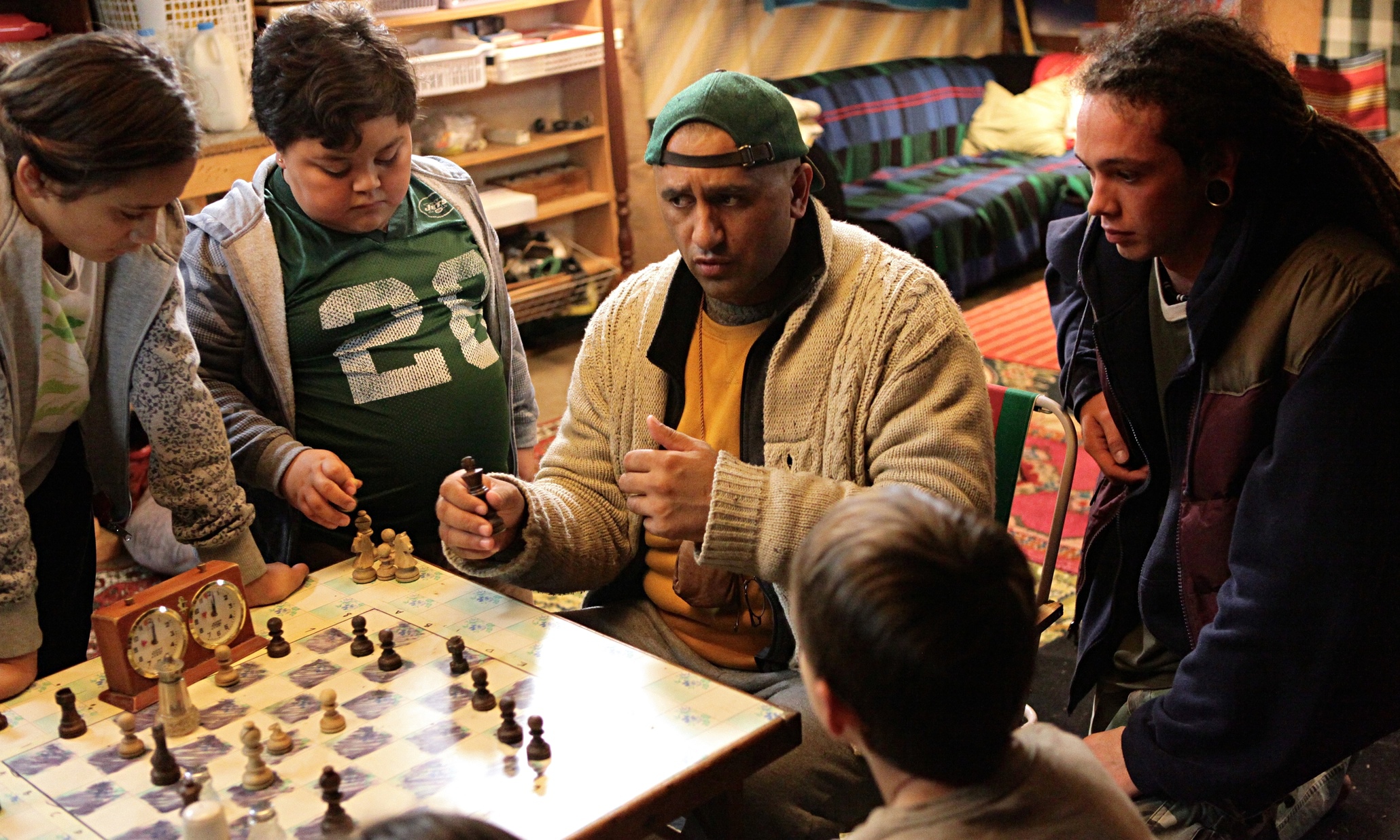
It would be so easy — and so wrong — to make this true story of a Maori chess champion who struggles with mental illness as he teaches underprivileged kids into a safe, simple, saccharine, uplifting story. But writer/director James Napier Robertson, who himself played hundreds of chess games with real-life speed chess champion Genesis Potini, trusts his story and his audience enough to give us a film that is refreshingly messy, even grungy, and therefore much more powerful.

The extraordinary actor Cliff Curtis is renowned for being able to play almost any ethnicity, one reason he was an affecting Jesus in the recent Risen. Here, though, as in “Whale Rider,” he has a chance to play the part of a person of his own ethnic heritage, the speed chess champion Genesis Potini, who had bipolar disorder. Curtis shows us that Genesis is a person first, not a group of symptoms. In a meet, wanting so much for the kids he has trained to have a chance to succeed, he cannot restrain himself from shouting encouragement, and we see how painful it is for him to feel like two people at once, the one who cannot control his impulses and the one who understands what he is putting at risk.

Robertson also gives us an honest, unflinching look at the community where Genesis has come, after being released from the mental hospital with a fistful of pills and the direction to find something to care about. The only place he has to go is the home of his brother, Ariki (Wayne Hapi), and Ariki’s son, Mana (James Rolleston of “Boy”). Ariki is a member of a gang that hangs out, gets high, commits petty and not so petty crimes, and spends a lot of time in not so petty macho posturing. He does not like having Genesis there and soon kicks him out.

Genesis sees a flier for a program that provides enrichment services for needy kids and decides that this will be the purpose that will help him maintain equilibrium. He volunteers — waking the director up in the middle of the night to offer his services, and against his better judgment, the director accepts, warning Genesis that if he shows up, he cannot let the kids down. Genesis impulsively (he does everything impulsively) tells kids who have never seen a chess game before that they will be competing at a big tournament in six weeks. Before they learn how to play, he lets each of them pick a chess man to take home as a totem, and to bring with them every day so that the set can be a team again. It makes them into a team as well. He uses the money Ariki gave him for rent to buy chess sets for the kids and he sleeps outside.

Genesis’ splintered reality and lack of impulse control may be advantages for speed chess. All of the possibilities are laid out before him but that does not make him hesitate. But chess is a game of rules and it provides a certainty, order, and mastery that Genesis and the kids he teaches can hold onto and build on. Mana has to decide whether he will follow his father or his uncle. Genesis has to try to be the man Mana and the kids need. It might get corny but for Robertson’s unaffectedly gritty settings and understanding that modest gains can be enough for checkmate.

Parents should know that this movie includes violence, child abuse, drinking, drugs, mental illness, and extreme poverty. Characters use very strong language.

Family discussion: Why was helping the children so important to Genesis? Why was having Mana in the gang so important to his father?

If you like this, try: “Searching for Bobby Fischer,” “Bobby Fischer Against the World,” and “Endgame”

Related Tags:


Based on a true story Drama Illness, Medicine, and Health Care Movies -- format
Miracles from Heaven

Miracles from Heaven

Posted on March 15, 2016 at 10:11 am

B
Lowest Recommended Age: Middle School
MPAA Rating: Rated PG for thematic material, including accident and medical issues
Profanity: None
Alcohol/ Drugs: None
Violence/ Scariness: Serious illness and peril involving children, sad death (offscreen)
Diversity Issues: Diverse characters
Date Released to Theaters: March 16, 2016
Date Released to DVD: July 11, 2016
Amazon.com ASIN: B01D1U6V58
Copyright Sony Pictures Entertainment 2016

Christy Wilson Beam’s book title says it all: Miracles from Heaven: A Little Girl and Her Amazing Story of Healing. In the book, she tells the story of her daughter Annabel, critically ill with an incurable digestive disorder, who fell thirty feet from a tree branch. Incredibly, she was not injured. And even more incredibly, possibly even miraculously, she was cured.

All of this happens in the trailer, and the movie’s biggest challenge is that the entire story is not much more than that.

A happy, loving family is catapulted into crisis when their sweet-natured daughter becomes ill. It takes a long time to get the right diagnosis, and then it takes a long time to see the only doctor who may be able to help them. And then she gets sicker and sicker and the family is under more and more pressure. And then she climbs the tree and falls. The rest, despite the best efforts of the always-appealing Jennifer Garner, mostly seems like so much padding. So, so much padding.

Just to make sure we didn’t miss the title’s reminder of where miracles come from, we are told right at the beginning what a miracle is: not explainable by natural or scientific laws. And then we meet the Beam family, as adorable as the ray of sunlight of their name, living a life somewhere between a country song and a Hallmark commercial. Everyone is beautiful, loving, patient, and trusting in God. There are sun-dappled vistas and cute animals. They have a kindly preacher, played with warmth and good humor by John Carroll Lynch.

And then Annabel (a very sweet Kylie Rogers), the middle of their three daughters, gets sick. At first, doctors reassure them that it is a minor problem like lactose intolerance, but it turns out to be a major digestive disorder that distends her stomach and makes it impossible for her to eat.

They are told that there is just one doctor in Boston who may be able to help her, but he is so busy they cannot get an appointment. Desperate, Christy (Garner) brings Annabelle to Boston, goes to the doctor’s office, and begs for a chance to see him. While they wait, they meet a kind-hearted waitress (Queen Latifah in a role that verges on uncomfortably confined to quirky comic relief) who gives them a tour of the city (more padding), until they get a call that the doctor is available. Dr. Durko (an engaging Eugenio Derbez) has a great Patch Adams-style bedside manner, but his diagnosis is a heartbreaking one. Annabel is hospitalized, and shares a room with another very sick little girl, who is comforted by Annabel’s reassurance of God’s love and protection.

And then, back at home, Annabel climbs an old dead tree and falls 30 feet inside.

The most touching and inspiring part of the film is not the “miracle” cure of a fall that somehow caused no serious injuries and rebooted the part of Annabel’s brain that was not telling her digestive system how to work. It is when Christy thinks back and realizes how many miracles the family has experienced through kindness and compassion.

Parents should know that this film is about a very sick little girl and includes scenes of illness, with a sad (offscreen) death.

Family discussion: Why did some of the women in the congregation blame Christy? What tested the family’s faith most? Which moments of kindness meant the most to the family?

If you like this, try: “Heaven is for Real”

Related Tags:


Based on a book Based on a true story DVD/Blu-Ray Pick of the Week Illness, Medicine, and Health Care Spiritual films

Trapped

Posted on March 3, 2016 at 5:19 pm

B+
Lowest Recommended Age: High School
MPAA Rating: Not rated
Profanity: None
Alcohol/ Drugs: None
Violence/ Scariness: References to violence against abortion providers
Diversity Issues: A theme of the movie
Date Released to Theaters: March 4, 2016

TRAP stands for Targeted Regulation of Abortion Providers. “Trapped” is a powerful new documentary that focuses on efforts to cut off women’s access to abortion by imposing requirements and restrictions on clinics that have no relationship to health or safety.

It could not be more timely, released the same week that the most significant challenge to Roe v. Wade was argued in the Supreme Court, just after the death of Justice Scalia makes a 4-4 split decision a possibility.

Lawyer-turned-documentarian Dawn Porter lets the people affected by these laws speak, interviewing the doctors and staff of abortion clinics to show the absurdity of the claim that the TRAP laws are based on concerns for women’s health and safety. A clinic staffer points to a requirement that “emergency lighting shall be provided in accordance with Sec. 7.9.” But there is no Sec. 7.9. Another says that they are required to spend $1100 a month on medication that has never been used but must be replaced every 30 days because it expires. Meanwhile, a protester stands outside a clinic screaming that women should be adored and cared for by men, while women who come to the clinic are berated.

We see the impact of the disinformation campaigns perpetrated by the anti-abortion forces, with clinic workers forced to provide misleading booklets and a young woman in the clinic worried that the abortion will make her sterile. It may sound reasonable to legislators who are not medical professionals to require abortion providers to have admitting privileges in the nearest hospital, but they do not understand the Catch-22: abortion is so safe that not enough patients are admitted to the hospital to retain those privileges.

And we see Alabama Supreme Court Chief Justice Roy Moore speaking at an anti-abortion event. (He has also opposed the Supreme Court’s ruling on marriage equality.)

We see a clinic staff member pray with a patient — and another one decide that “the grass is dry” and so she had better use her remote control to turn on the sprinkler that happens to be near a protester. Another staffer presents a doctor with a defiant bumper sticker: “May the fetus you save turn out to be a gay abortion provider.” We hear about 13-year-old rape victims who may be forced to bear the child of their rapists. What comes through most powerfully is their belief in supporting women in the decisions they have a right to make about what is best for them.

Related Tags:


Documentary Gender and Diversity Illness, Medicine, and Health Care Movies -- format Politics
THE MOVIE MOM® is a registered trademark of Nell Minow. Use of the mark without express consent from Nell Minow constitutes trademark infringement and unfair competition in violation of federal and state laws. All material © Nell Minow 1995-2026, all rights reserved, and no use or republication is permitted without explicit permission. This site hosts Nell Minow’s Movie Mom® archive, with material that originally appeared on Yahoo! Movies, Beliefnet, and other sources. Much of her new material can be found at Rogerebert.com, Huffington Post, and WheretoWatch. Her books include The Movie Mom’s Guide to Family Movies and 101 Must-See Movie Moments, and she can be heard each week on radio stations across the country.

Website Designed by Max LaZebnik