“Do not just a man until you have walked a mile in his shoes,” we are told, and that is the message of this understated film about a gifted pitcher who is on the autism spectrum and the minor league team coach who learns as much from him as he teaches. Dean Cain plays Murph, badly in need of a new pitcher when he gets into an accident near a farm in a remote area with no cell coverage so has to ask for help to call for a tow. He sees the farmer’s son Mickey (Luke Schroder), a sheltered young man who likes to throw apples for his pig and can throw them very fast and very hard. Mickey is on the autism spectrum and his parents have kept him on the farm all his life.
Murph wants to take Mickey to the team. Mickey’s mother supports the idea but his father does not think Mickey can function away from home. Murph promises he will take care of Mickey, and his parents allow him to try to join the team. There are a number of adjustment problems but most of the teammates are supportive. The other pitcher, though, is jealous, and as Mickey continues to do well, he is determined to stop him.
Director William Dear likes to use baseball as a backdrop for family-friendly stories with a spiritual foundation (“Angels in the Outfield,” “The Perfect Game”). There are no surprises in this one but its humility, sincerity, and decency make it watchable.
Investors can make bets by promising to buy stock at a higher or lower price than the current day’s valuation. If all goes well, they never actually have to buy the stock. They can keep buying and selling the bets with borrowed money without ever having to buy the underlying securities. But if it does not go well, the investor gets what is known as a margin call and has to come up with the cash.
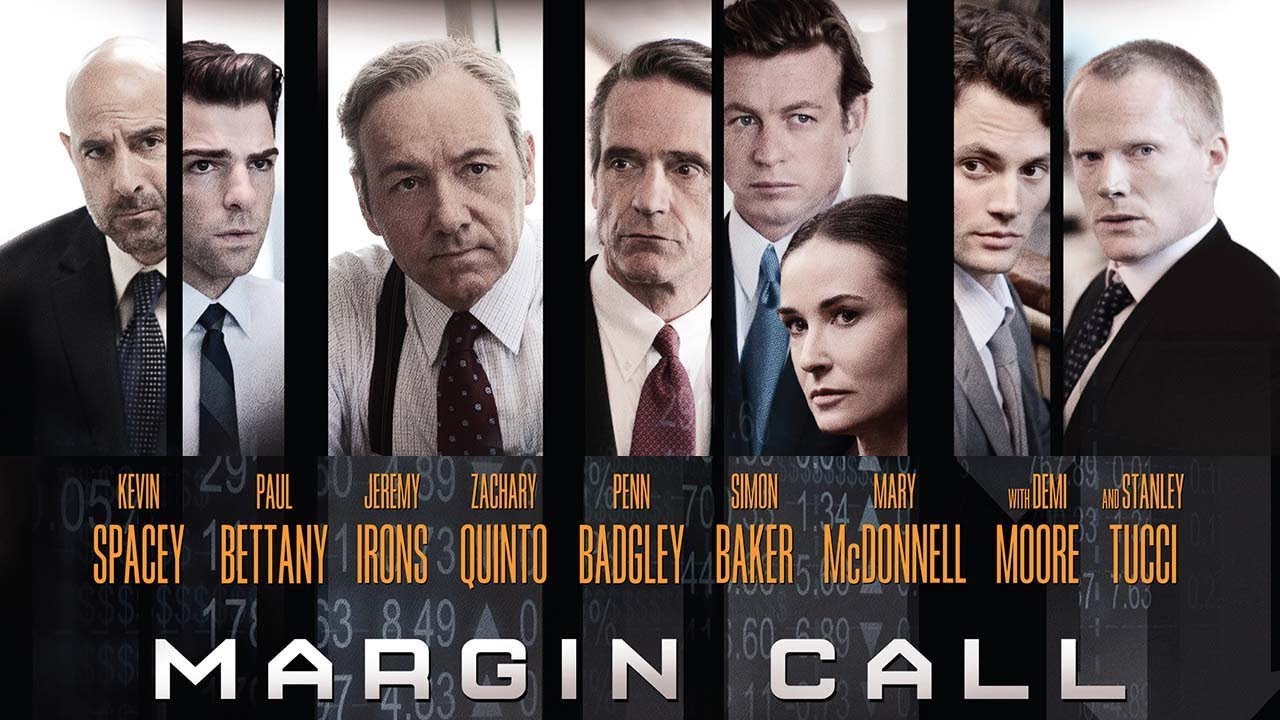
The financial meltdown of 2008 was like a margin call for America, and we will be paying off that debt for a long time. This movie, as tightly wound as a thriller, takes us through a fictionalized version of the night when it all tipped over from going well to not going well at an enormous Wall Street company, and it was time to pay the piper and a lot of others as well.
“You guys ever been through this before?” asks Will (Paul Bettany), as some serious looking people in suits start tapping people on the shoulder and saying, “I’m afraid we have to speak with you” to the people in cubicles “Best to ignore it, keep your head down, go back to work. Don’t watch.”
“The majority of this floor is being let go today,” says the serious woman in a suit. She speaks of “certain precautions that may seem punitive.” She glances down at the paperwork when she speaks of “your — 19 — years” with the (never-named) company. And then we see people carrying cardboard boxes of belongings out the front door of a shiny skyscraper, their eyes blinking in the unaccustomed sunlight.
This is nothing new, as Will’s comment informs us. It is a routine, if brutal pruning of the staff. This is a cutthroat business and periodically some throats get cut. And periodically Will has to speak to those left behind: “These were good people and they were good at their jobs, but you are better. We will not think of them again.” Back to work watching all those screens with all those numbers.
But one of the departed has left something behind. There is evident irony in the name of the division that has been gutted. It is the Risk Management group. And the 19-year veteran who has been shown the door has been working on a new analysis of the firm’s position. He turns his thumb drive over to the young colleague who has been kept on, Peter Sullivan (Zachary Quinto), a literal rocket scientist with “a PhD in propulsion,” who plugs a few holes in the formula that reveal that the firm is in their terms, “projected losses are greater than the current value of the company.” In other words, on the verge of collapse. That is when it gets interesting. Sullivan has proven that there are going to be some devastating losses. The question is who will pay for them.
The rest of the long night will be devoted to answering that question. It is like a long game of musical chairs, except that these people get to decide when to stop the music so they can get to the chairs before everyone else.
The guy at the top is John Tuld (Jeremy Irons). Given a choice between reputation and money, he has no hesitation in choosing money. He tells the head of sales, Sam Rogers (Kevin Spacey) to sell the ticking time bomb securities by assuring their clients that they are solid investments, even though Rogers points out that no one will ever trust them again. “You’re selling something you know has no value.” “We’re selling to willing buyers at fair market value so that we can survive.”
Rogers is not the only one who raises concerns, moral and financial. But writer-director J.C. Chandor lets us see when and how each of them topple, and what makes them topple, which turns out to be money. Dale repeatedly says there is nothing that can get him to go back inside the building and yet there he is, back in the building. Rogers says he will not sell these risky securities to clients because “you don’t sell anything to anybody unless they’ll come back to you for more.” But he does.
This could just as easily be set in the scuzzy world of the real-estate salesmen of “Glengarry Glen Ross” or the “leave the gun, take the cannoli” world of “The Godfather.” Chandor keeps enough of the real story to keep things vivid and meaningful but does not get mired in jargon. Crisp performances by everyone keep things taut until a surprising detour at the end. For the first time we leave the world of glass and concrete for an intensely personal moment of loss and grief. “Our talents have been used for the greater good,” one character says, reminding us that the very selection process that takes people who are capable of more tangible contributions are unable to resist the big money that pays them a many-times multiple for financial engineering over mechanical engineering. And reminding us, too, that if we let people who care only about money make the decisions they will make decisions that are only about money for them.
Rated R for language throughout, sexual content and some drug use
Profanity:
Constant very strong and crude language
Alcohol/ Drugs:
Drinking, drug use
Violence/ Scariness:
Character has cancer and the movie deals frankly with the diagnosis and treatment
Diversity Issues:
None
Date Released to Theaters:
September 30, 2011
Amazon.com ASIN:
B004QL7KKC
When Seth Rogen’s friend Will Reiser got a rare form of cancer at age 24, they bolstered their courage by imagining a movie that would be true to their experience. The movies they knew about people with cancer had characters who were (1) older, (2) transformed into saintliness and transcendence and reconciliation, and (3) by the end of the movie — dead. Reiser barely knew how to live as an independent adult. While his contemporaries were worried about dating and figuring out their careers, he was forced to deal with dire, literally life and death decisions.
Resier recovered and wrote this screenplay and Rogen co-produced and played the character based on himself. The result is a movie that captures the surreal nature of being seriously ill, the way you feel as though you appear to be on this planet but in reality you are living somewhere else, Planet Cancer, and the “normal” life around you is at the same time disconcerting and reassuring. But this is also a movie filled with hope, and humor, and inspiration. No one is transformed into saintliness or transcendence but there are lessons learned, losses borne, and hurdles overcome.
The superb Joseph Gordon-Levitt plays Adam, a 27-year-old who works for NPR. We first see him on an early morning run, stopping at a red light even though there are no cars around for miles. This is a guy who follows the rules. And then what he thinks is a backache turns out to be a rare form of cancer, a tumor on his spine, which his doctor describes as “quite fascinating.” He is still in the early stages of a relationship with Rachael (Bryce Dallas Howard), an artist. “I have a drawer? We’re getting so domestic.”
Rachael means well and even likes the idea of herself as a loyal girlfriend, but she also feels trapped by Adam’s illness. Adam’s mother (Anjelica Houston) wants to help, but that threatens Adam’s still-fragile sense of independence. Adam meets with a young grief counselor (Anna Kendrick as Katherine) who is just as new to counseling as he is to grieving.
Kyle (Rogen) is immature and squeamish, but it turns out that he is braver than he or Adam knew. What he lacks in judgment and tact he makes up for in heart and candor. When he hears that Adam’s odds are 50/50, he looks on the bright side with a metaphor drawn from his own priorities: “If you were a casino game, you’d have the best odds!” And then there’s priority number one — Kyle assures Adam that cancer is a real chick magnet.
I don’t know whether that which does not defeat you makes you stronger. But that which does not defeat you does show you how strong you are, and how strong your relationships are, too. Reiser’s insightful script and Gordon-Levitt’s sensitive performance make this one of the year’s most satisfying films.
“Citizen Kane” has topped more “all-time best” lists than any other movie and this 70th Anniversary Ultimate Collector’s Edition is a treat for passionate fans and those who still have the thrill of seeing it for the first time ahead of them.
Orson Welles was only 26 but already an accomplished writer/director with a distinguished body of work on stage and radio. He and writer Herman J. Mankiewicz wrote the script, inspired by the life of publishing titan William Randolph Hearst. Welles directed and starred in the title role of a wealthy young man who turns from idealistic newspaper owner to political candidate to bitter recluse. It is worthy of every accolade it has received and more.
This magnificent film influenced and inspired everything that came after. And the sumptuous extras that come with this anniversary edition are treasures, especially the scene-by-scene commentary by Roger Ebert, almost as entertaining and illuminating as the film itself, with insights and details of technology and artistic innovation that are mind-boggling. There’s a separate commentary by director/historian Peter Bogdanovich and interviews with editor Robert Wise (who later became a director) and co-star Ruth Warrick (who played Kane’s first wife and later went on to star in “All My Children”).