Inside Llewyn Davis

Posted on December 19, 2013 at 6:00 pm

A-
Lowest Recommended Age: Mature High Schooler
MPAA Rating: Rated R for language including some sexual references
Profanity: Strong language
Alcohol/ Drugs: Drinking, drug use and drug overdose
Violence/ Scariness: A few punches, drug overdose
Diversity Issues: None
Date Released to Theaters: December 20, 2013
Date Released to DVD: March 10, 2014
Amazon.com ASIN: B00DVZ414C

Inside-Llewyn-Davis-cat

Oscar Isaac gives the best performance of the year as the title character in the most intimate and profound movie yet from the Coen brothers.  The story is set in the New York folk music world of 1961 and the Coens insisted on filming the songs live rather than pre-recording, and one of the wonders of this film is the way that Isaac makes each song more than a musical performance — each is a part of his characterization that tells us who Davis is and where he is on a week-long journey we will see in near Sisyphian terms.  The breaths and pauses are as much a part of the performance as the notes he plays and sings.  When he is not singing, Davis reacts very little, and one of the great pleasures of this film is seeing Isaac convey immense conflict and sensitivity to us in the audience while those around him see only his superficial expressionlessness.  In one scene, a doctor offhandedly gives him surprising news about someone else.  In that one moment he says almost nothing but conveys a dozen different emotions and questions and losses.  This is the story of a man who expresses himself only through his music.  But he does not have the gifts to make him successful enough to support himself or achieve any sense of security and acceptance.

The Coens like to put their central characters under a lot of stress, and in this film Davis must deal with disappointment and anger all around him and his own sense of frustration in not being able to honor the songs that are his whole world by making them as important to others as they are to him.  Ultimately, it becomes a larger story about the way all of us struggle to find meaning and a place for ourselves.  And all of that is to the heavenly music impeccably curated by T. Bone Burnett and performed by a cast that includes Justin Timberlake, Carey Mulligan, and Broadway’s Stark Sands.  The Coens also like to create physical environments that reflect the internal pressure (the peeling wallpaper in “Barton Fink” was almost another character).  Here, the re-creation of early 60’s Greenwich Village is relatively low-key and naturalistic, but there are still cramped corridors with impossibly acute vectors to amplify Davis’ external manifestation of the grungy world that seems to have no exit.

The film’s title, “Inside Llewyn Davis,” is the also the name of a record album made by the early 1960’s folk singer played by Isaac.  We first see him singing in a Greenwich Village club, performing “Hang Me, Oh Hang Me,” a song that “was never new and never gets old.”

The folk singers of the early 60‘s thought of themselves as truly authentic in a world where suburban materialism and conformity were idealized.  A movement that presaged and in some ways helped to spark the counterculture and protest of the late 60’s was, of course, inherently inauthentic itself.  Folk music is beautiful wherever it is sung, even in the kind of homogenized, commercial versions looked down on by Davis (and gently mocked in “A Mighty Wind”).  But what makes it authentic is that it is music sung by folk in their community, not by professional musicians in a New York club.  The essence of the struggle any artist — or any person — faces between integrity and selling out is explicit here.  Davis criticizes his friend and sometime lover as “careerist” for trying to get ahead in the music business.  But he himself makes a trip to an influential producer to see if he can get better bookings.  And as authentic as Davis may think he is, he is contemptuous the performances by a soldier and a woman from the country, both of whom arguably have a better claim to “authenticity” than he does.

Like all Coen brothers anti-heroes, Davis is a man under pressure.  He has nowhere to live, and sleeps on couches he scrounges from friends.  He seems to have no sense of gratitude.  He shows some sense of responsibility.  He spends the night at the home of a benign Columbia professor who loves his music, stopping to play a cut from the album he made with his former partner (Isaac sings with Marcus Mumford).  Then, when he is leaving, the professor’s marmelade cat slips out the apartment door just as it swings shut and locks behind him.  Davis scoops up the cat and takes him on the subway, calling the professor’s office to let him know the cat is safe.  He then drops the cat off at another apartment he often uses as a place to stay, the home of singing duo Jim (Justin Timberlake) and Jean (Isaac’s “Drive” wife, Carey Mulligan), where he finds out that Jean is (1) pregnant and (2) furious because it might be his.  He again responds responsibly, if not graciously.  And when Jim (of course not knowing anything about his relationship to Jean) arranges for Davis to get a quick gig as a session musician for a silly but irresistible little novelty ditty called “Please Mr. Kennedy,” he gives it his best.

We follow Davis over the course of a week, one frustrating encounter after another, with Jean, with the head of the tiny record label that produced his last record, a doctor who performs abortions, his silent father in a nursing home, his suburban sister, on a long ride to Chicago with a jazz musician (Coen brothers regular John Goodman) and his near-silent driver (Garrett Hedlund), a nerve-wracking audition with an important producer (F. Murray Abraham).  In each of them, Davis is subdued. He has feelings, but he expresses them in his music.  There is something in these ancient songs about death, betrayal, and injustice that touches his heart. Singing them is his deepest connection to himself.  “Just exist?” he asks his sister, when she suggests he give up folk music.  But even when he wants to give up, he can’t.

Davis knows that things seem hopeless for him.  He tries to slide his box of remaindered LPs under a table only to find an almost-identical box of another singer’s records there already.  He looks out of the car window at a highway exit that he and we know could lead to an important chance at connection and meaning.  We see around Davis what he cannot.  We see him make a decision as he leaves the recording studio that suits his purposes at the moment but that we know he will be bitter about forever. A young, tousled-hair singer goes on at the club and we know he will transform the world in a way Davis can not.  But in a very real and very satisfying way, the Coens and Isaac have reclaimed him for us with their own story that was never new, and never gets old.

Parents should know that this film includes strong language, a fistfight, references to sex, adultery, abortion, and suicide, drinking, smoking, and drug use and overdose.

Family discussion:  Why was it so hard for Llewyn to succeed?  What do we learn about him from the decision not to go to Akron?  From his heckling of another performer?

If you like this, try:  “Don’t Look Back” and “A Mighty Wind” — and the Showtime concert featuring the music from the film, “Another Day, Another Time”

Related Tags:


Drama DVD/Blu-Ray Pick of the Week Inspired by a true story Musical

Phantom

Posted on February 28, 2013 at 6:00 pm

C
Lowest Recommended Age: High School
MPAA Rating: Rated R for violence
Profanity: Mild language
Alcohol/ Drugs: Drinking, drinking game, smoking
Violence/ Scariness: Extended violence, characters injured and killed, suicide
Diversity Issues: Cultural differences
Date Released to Theaters: March 1, 2013
Amazon.com ASIN: B00B635CPI

Submarine movies are immediately gripping because they are powerful microcosms that amplify conflict.  A small group of people in very close quarters, highly trained and with an explicit mission are then completely disconnected from the rest of the world.  When problems arise, they have to decide what to do with very limited information and no access to authority outside the ship.  Great drama, when it works.  This time, though, not so much.

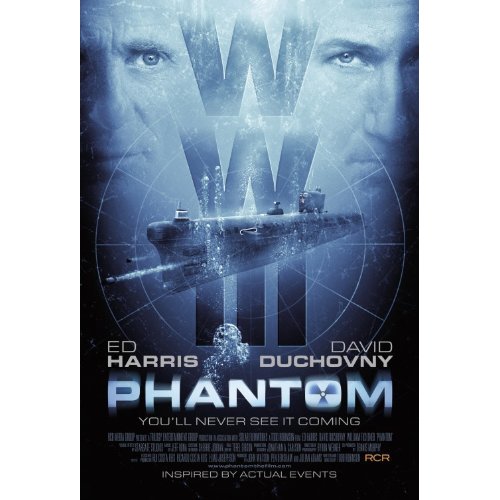
Theoretically “inspired by true events” but more like “a massive flight of fantasy and speculation slightly tied to one possible thing that might have happened,” this submarine story begins with a promising twist.  American actors play members of the Soviet navy during the Cold War.  We might expect Ed Harris, William Fitchtner, and David Duchovny to be the Americans fighting the Soviets.  It takes a few moments to get used to the idea that we are rooting for the guys in the striped shirts pushing the buttons with Cyrillic labels, or at least some of them.

Ed Harris plays Demi, a captain with a dark past (yes, we’ll find out what that’s about) who gets unexpected orders to ship out on a secret mission, his last, on a sub that makes the assignment somehow even more meaningful and ironic (yes, we’ll find out that, too).  It is the sub’s last mission, too, before it will be sold to the Chinese.

Because it comes up so suddenly, he gets a new crew, along with two passengers operating under some higher authority but not revealing very much about what they are doing.  The leader is Bruni (Duchovny), whose arrogance seems to outweigh Demi’s air of resignation.

Demi is still anguished about a mistake made early in his career and the sense that only his father’s high rank and prestige kept him from being discharged dishonorably.  When he discovers that Bruni’s plans would put the entire world at risk, he has to become the leader he once dreamed of being.

Writer/director Todd Robinson clearly cares passionately about the material but he often loses track of the narrative.  There are many scenes of people racing and chasing down narrow corridors and men staring and analog instrumentation.  There are so many shifting power plays that it is difficult to keep track, and the story escalates so preposterously that it is difficult to care.

Parents should know that this is an intense Cold War story that deals with issues of nuclear war and includes extended sequences of peril and violence, with many characters injured and killed.

Family discussion: How should Demi decide which orders to follow?  Listen to and discuss the “This American Life” story about the real-life notes provided to British officers in nuclear submarines to be opened in case of catastrophe.  What should the note say?

If you like this, try: “Crimson Tide,” “The Hunt for Red October,” and “K-19: The Widowmaker”

Related Tags:


Drama Epic/Historical Inspired by a true story Movies -- format Thriller

Snitch

Posted on February 21, 2013 at 6:00 pm

“Snitch” tries to be three things at once, but it doesn’t do any of them very well.

First, it wants to be a drama about fathers and sons.  John Matthews (Dwayne “The Rock” Johnson) is a good man who who risks everything, even his own life and the lives of his family, to save his teenaged son from a ten-year prison sentence.  John owns a construction company that is solid but struggling a bit because of the economy.  His son is Jason (Rafi Gavron), who lives with his mother, John’s first wife (Melina Kanakaredes), and uses her last name because he is angry at his father for leaving them.  Jason makes a foolish mistake and agrees to accept a shipment of some pills from a friend.  It is a trap.

Three of the key characters in the story make big sacrifices to help their sons, but the theme is heavy-handed and the dialog so clunky it feels like an after-school special.

Second, it wants to be an action film, because John finds that the only way to get Jason out of prison in less than ten years is to deliver an important arrest to the federal prosecutor.  Jason refuses to entrap any of his friends (as he was entrapped by the friend who sent him the drugs), even to reduce his sentence.  So, John decides to go undercover in a very high risk sting operation involving criminals at the top of an international drug cartel.  He gets badly beat up the first time he tries to make a connection to a drug dealer.  But with the help of an employee who is now determined to go straight after two prison terms for narcotics distribution, he is introduced to Malik (Michael Williamson), a typical movie drug dealer — black, gangsta, and living in a house with almost no furniture and loud rap music.  John has no street cred whatsoever.  But he does have big semis and a legitimate business to give him good cover for transporting big, heavy bags in them.  And even the suspicious Malik understands that the economy is lousy, and is persuaded that a law-abiding citizen like John could be desperate enough to fill some of those cement bags with cocaine.

So there are some shoot-outs and chases, but they are poorly staged and uninvolving.  So as much as the movie tries to make us believe he is just a good guy from the suburbs who does not know anything about guns and criminals, this is The Rock.  We never feel the sense of peril that would create some tension, and we miss the expected sense of satisfaction when no cans of whup-ass are opened.

Third, the movie tries to be an issue film, taking on the unintended consequences of the mandatory minimum sentences legislation that was supposed to reduce the unfairness in assigning penalties for drug-related offenses and get tough on drugs but instead created a whole new level of unfairness and got tough only on low-level users.  When judges no longer have discretion to assign prison terms based on individual circumstances, the only mitigating factors are the defendants’ ability and willingness to turn over bigger fish.  Susan Sarandon, once again stuck in a role far beneath her, plays the ambitious US Attorney and political candidate who is so over-the-top that it undermines the institutional pervasiveness of the problem the filmmakers are trying to convey.  They do more to make their point with a credit-sequence note about the impact of mandatory minimums than they accomplish through the film.  And the recent documentary “The House I Live In” addresses the issue far more compellingly.

It’s a triple disappointment.  But most of all, it is just dull.

Parents should know that this film includes characters are drug dealers, drinking, smoking, drug use, violence including knives, fights, shoot-outs, and chases with characters injured and killed, and some strong language.

Family discussion: How did being a father of a son change the decisions made by three characters in the movie?  Why did John say his son taught him about character and integrity?  Do mandatory minimum sentencing laws do what they were intended to do?

If you like this, try: “The House I Live in” and “Narc”

Related Tags:


Action/Adventure Crime Drama Inspired by a true story

Magic Mike

Posted on June 28, 2012 at 6:00 pm

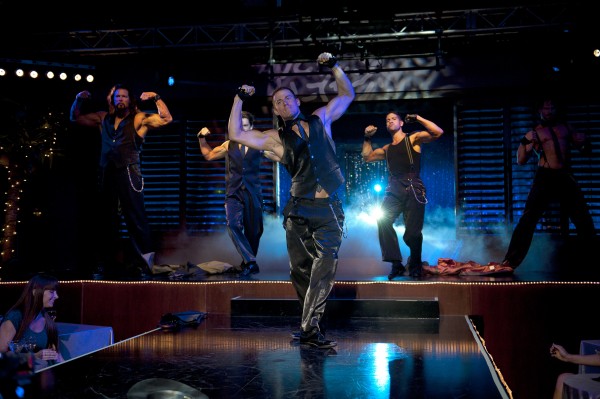
You might expect a movie about strippers to be either a glossy Hollywood fantasy or a gritty, sour, documentary.  The surprise of “Magic Mike” is that it avoids both extremes with an appealing naturalness and intimacy that softens but does not glamorize its setting.  

It is inspired by the experiences of co-producer and star Channing Tatum as an exotic dancer before he broke through as an unexpectedly versatile actor (“Step Up,” “G.I. Joe,” “Dear John,” “21 Jump Street”). Equally versatile director Stephen Soderburgh (“Traffic,” “Erin Brockovich,” “Sex, Lies, and Videotape,” “Oceans 11”) gently bumps the story a couple of degrees away from the sordid to keep things fun and even romantic.  The big musical numbers are grander and more elaborate than anything you might actually see in a small Tampa club catering to sorority girls and bachelorette parties.  But even when it gets debauched and dangerous, it is still kind of sweet.  It has a bit of the sense of discovery of Robert Altman’s “The Company.”  Plus, those guys have some moves.  The dance numbers are a blast, witty, sexy, and very wooo-worthy.

Tatum plays Mike, a would-be entrepreneur who does a little of this and that (and wears very little of this and even less of that) as he tries to straighten out his financial situation so that he can pursue his dream of designing furniture.  He meets a young college drop-out named Adam (Alex Pettyfer), and introduces him to the world of exotic dancing, from trolling bars to entice girls to come to the show to turning himself into the fantasy lover they love to be scandalized by.  The owner is Dallas (Matthew McConaughey), who has promised Mike he will open up a big club in Miami and make Mike his partner.  (Drinking game: take a shot every time McConaughey says “all right.”)

Adam lives with his sister Brooke, played by the very appealing Cody Horn, who has a wonderful easy chemistry with Tatum.  So there is a classic structure, with Mike in the center between the hardened and cynical Dallas and the naive kid in a candy store Adam, drawn to the dream of a different life with Brooke.  What takes this out of the category of fluff is the way the story is unaffectedly located in the reality of the economic struggles of the area and our time.  Mike tries to persuade a bank loan officer to give him some money, shoving stacks of bills across her desk and not quite understanding that even though he is still selling, this transaction differs from the easy and sleazy environments he frequents.  But she sees who he is.  So does Brooke, and that helps him to see himself beyond the breakaway pants.

(more…)

Related Tags:


Date movie Drama Inspired by a true story Musical Romance

Remake of “Steel Magnolias” with Queen Latifah and Phylicia Rashad

Posted on March 23, 2012 at 3:45 pm

I was thrilled to hear that Lifetime is working on a remake of “Steel Magnolias” with Queen Latifah as M’Lynn (the part played in the movie by Sally Field), Phylicia Rashad as Clairee (played in the movie by Olympia Dukakis), Jill Scott as beauty salon owner Truvy (played in the movie by Dolly Parton) and Alfre Woodard as the irascible Ouiser (played in the movie by Shirley MacLaine).  Rashad’s daughter Condola will play Shelby, a character inspired by the playwright’s sister, who died of complications from diabetes but who would “rather have 30 minutes of wonderful than a lifetime full of of nothing.”   This is a dream team of performers and I can’t wait to see what they do with this juicy story.

Related Tags:


Based on a play Inspired by a true story Television
THE MOVIE MOM® is a registered trademark of Nell Minow. Use of the mark without express consent from Nell Minow constitutes trademark infringement and unfair competition in violation of federal and state laws. All material © Nell Minow 1995-2026, all rights reserved, and no use or republication is permitted without explicit permission. This site hosts Nell Minow’s Movie Mom® archive, with material that originally appeared on Yahoo! Movies, Beliefnet, and other sources. Much of her new material can be found at Rogerebert.com, Huffington Post, and WheretoWatch. Her books include The Movie Mom’s Guide to Family Movies and 101 Must-See Movie Moments, and she can be heard each week on radio stations across the country.

Website Designed by Max LaZebnik