The minions are back! Universal Pictures Home Entertainment has just released a Minions mini-movies online in celebration of the Minions release on Digital HD on November 24 and Blu-ray, DVD and On Demand December 8.
The new mini-movie features Stuart, Kevin and Bob as they battle it out in the ultimate “Competition.”
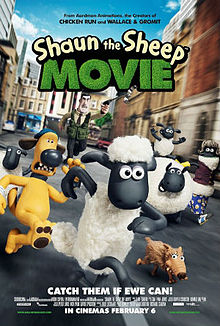
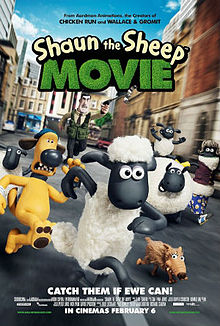
Interview: “Shaun the Sheep” Co-Writer/Director Richard Starzak
Posted on November 23, 2015 at 3:51 pm
Copyright 2015 Lionsgate
Richard Starzak and Mark Burton wrote and directed the adorable “Shaun the Sheep,” and it was a lot of fun to talk to him about making a stop-motion animation movie with no words. The DVD/Blu-Ray, which will be available November 24, 2015, has a behind-the-scenes featurette showing Starzak and Burton acting out some of the movements for the animators “to get the timing right for comedy” and working with actor Justin Fletcher on recording some of the non-verbal sounds. The idea of having the mouths of the sheep go off to the side of their snouts came from one of the storyboard artists “just to indicate that the character was smiling and we thought it was funny so we kept it there. Some people think it looks very strange and some people kind of don’t worry about it.”
The vehicles in the film are as individual as the human and animal characters. “We tried to give everything a bit of personality.”
It is a painstaking, very slow process to move each of the characters very slightly, take a picture, and then move it again. “We aim for about two seconds per animator a day so in a week we’re expected to do about ten seconds on average. That’s times sixteen animators so it would be two or three minutes of animation during the week…We use mainly the live action video to time how long we need for any particular shot. It’s a bit of jigsaw puzzle. You have to fit the film into a certain amount of time but it’s kind of trial and error. We shoot and then we might adjust them after we have shot them, we might take the odd frame out here and there, we’ll double up the odd frame so it is constantly being reassessed. I suppose the film ended up a few minutes longer than we intended but that’s fine; the timing was worthwhile so we were happy with that.”
Working without dialogue was liberating. “Strangely, yes, it makes life in some ways more difficult but also really focuses you on the story. We kind of have a lot of evidence particularly when children watch the film, they really concentrate on the film as they do on the television episodes because it requires all the attention but they get more immersed in it as a result. So I found it very liberating because it’s a very pure way of making a film. It’s very cinematic. I can’t wait to make another one really, I love the idea of not using dialogue.”
One of the challenges is directing the voice talent on recording the various sounds that the characters make. “They are noises but they are still very crucial to get the right tone so it’s a question of the voice talent that we use actually understanding and getting the tone right so they can watch and understand how to enhance and how to make any shot or movement more understandable. It’s a lot of trial and error. And it’s very strange standing there saying, ‘Can you put a little more despair into that squeak?’ or ‘Can you make that squeak slightly lighter?'” It’s a process but we get there in the end. We put up the storyboards against a temporary track of grunts and squeaks and then we invite the voice artist to lay down some sounds for us and after the process is finished we refine them and we get them in again to see if they can improve on what we’ve already got.”
Starzak was influenced by silent film masters like Buster Keaton and Jacques Tati. “When I first started the series I always had Buster Keaton in mind because there is not a lot that you can do with Shaun’s face. He has just got eyes and occasionally a mouth but there’s not a lot to express with so I’ve got a picture of Buster Keaton on the door on the way into the studio to remind people what we’re trying to do. We watched a lot of funny comedies. Jacques Tati films are very clever in including a lot of ideas in the same shot and playing out the shots obviously with sounds but no dialogue which is kind of what we were aiming for.”
The most complicated scene in the film takes place in a restaurant, where the sheep are disguised as humans. “It’s almost a comedy of manners. We had to stage four characters sitting around the table then there was another table with two characters plus there was the waitress and the maître d’ and everything was quite complicated. The most fun thing to do was the hospital scene.”
Seth Rogen. Not very surprising guest stars. Many mind-altering substances. Many bodily fluids and functions. Many bad choices. No ability to allow women to be funny, even with some of the best comic actresses of our time in the cast. Haven’t we been here before?
That’s the question the characters in this film are asking, too. Isaac (Rogen), Chris (Anthony Mackie), and Ethan (Joseph Gordon-Levitt) are friends who get together each year on Christmas Eve for a series of traditions, from visiting the tree at Rockefeller Center to a karaoke bar and a toy store to play on the giant piano keyboard from “Big.” Plus donning ceremonial holiday sweaters and getting wasted. Ethan’s parents were killed just before Christmas by a drunk driver 14 years ago, and Isaac and Chris promised him they would be his family for the holidays. More than a decade later, they’ve agreed this will be the last time. Chris is getting to be a big time athletic star in the NFL, and that means endorsement money and extending his personal brand via social media. He’s a spokesman for Red Bull, which has provided a limo for the evening. And he is hiding the secret of his recent jump in performance.
Isaac is married to Betsy (criminally underused Jillian Bell), and they are about to have a baby. She is refreshingly on board with his going out for a wild night with the boys that she gives him an early Christmas gift — a box of drugs, a sort of Whitman’s Sampler with everything from ‘shrooms to Molly, with some weed and cocaine thrown in for good measure (though, as Isaac points out with a tolerant chuckle, she does not know enough to get the proportions right). Ethan is drifting professionally and personally, never following through on his music and mourning a recent breakup with Diana (criminally underused Lizzy Caplan) because he could not commit to meeting her parents or moving in together.
Many years before, on one of their Christmas eve outings, they heard about a legendary party. I mean a PARTY. I mean THE PARTY, Platonic perfection of party-dom. It has always been their fondest wish to be there. Ethan, working as a coat check elf (his elf face really is very impressive), finds three tickets to the party in a guest’s coat pocket, steals them, and walks out. The party location won’t be announced until 10, so the trio has a few hours for their traditional activities, and plan to limo over to THE PARTY to cap off the evening.
This means encounters with old friends (Diana and her friend, played by the criminally underused Mindy Kaling, plus Michael Shannon as their weed dealer back in high school, Mr. Green), and odd substances (Rogen is actually quite funny as someone going through many different effects from many different drugs). There are cheap jokes about other Christmas movies and changes in technology over the past 14 years. A pay phone. A flashback with people amazed that an iPod can like hold “like 100 songs!” A revisit to Goldeneye on Nintendo 64 at Chris’ mother’s apartment.
There are some new friends, too. “Broad City’s” Ilana Glazer is a Christmas-hating fan who has sex with Chris in a club bathroom and then turns out to be Grinch-y. Various items and people are lost and must be searched for. Isaac’s bad trip is long, strange, and barf-y. And then there is a party with some not-so-surprising guest stars and some even less surprising Christmas-y confessions, apologies, and reconciliations.
“It’s hard to stay friends when you’re older,” Isaac says. It’s also hard to translate “Superbad”-style humor into something for actors in their 30’s. It should not be so hard to find a role for female characters that goes beyond infinite understanding and adoration. There are some enjoyably silly laughs here, and not all of them are in the “oh, no, you didn’t” category. There is a sense of groping toward something more — director Jonathan Levine worked with Rogen and Gordon-Levitt in the excellent fact-based “50/50,” and there are flickers that indicate a wish for something behind drug and barf jokes. One of my Christmas wishes is that the people making this movie learn something from the characters they put on the screen and give us something better next time.
Parents should know that this film is an extremely raunchy comedy with drinking, extensive and varied drug use, constant strong and crude language, some violence, explicit sexual references and situations, and very graphic nudity.
Family discussion: How do you decide which traditions to continue and which to give up? What did Mr. Green teach Ethan, Isaac, and Chris? Is it hard to stay friends as you get older?
If you like this, try: “The Hangover,” “Pineapple Express,” and “Ted”
Rated PG-13 for intense sequences of violence and action, and for some thematic material
Profanity:
Some mild language
Alcohol/ Drugs:
Social drinking
Violence/ Scariness:
Constant and intense peril and violence, guns, explosions, arrows, mines, zombie-like creatures, many adult and child characters injured and killed
Diversity Issues:
Diverse characters
Date Released to Theaters:
November 20, 2015
Date Released to DVD:
March 21, 2016
Amazon.com ASIN:
B0189HKE5Q
Copyright Lionsgate 2015
Can we all just agree that from now on we’ll try to keep it to one book/one movie? This final entry in the Hunger Games series will give the fans what they’ve been waiting for. It’s faithful to the book and it’s perfectly fine. But part 4 is not as good as part 3 and I am not persuaded that it needed to be a separate film.
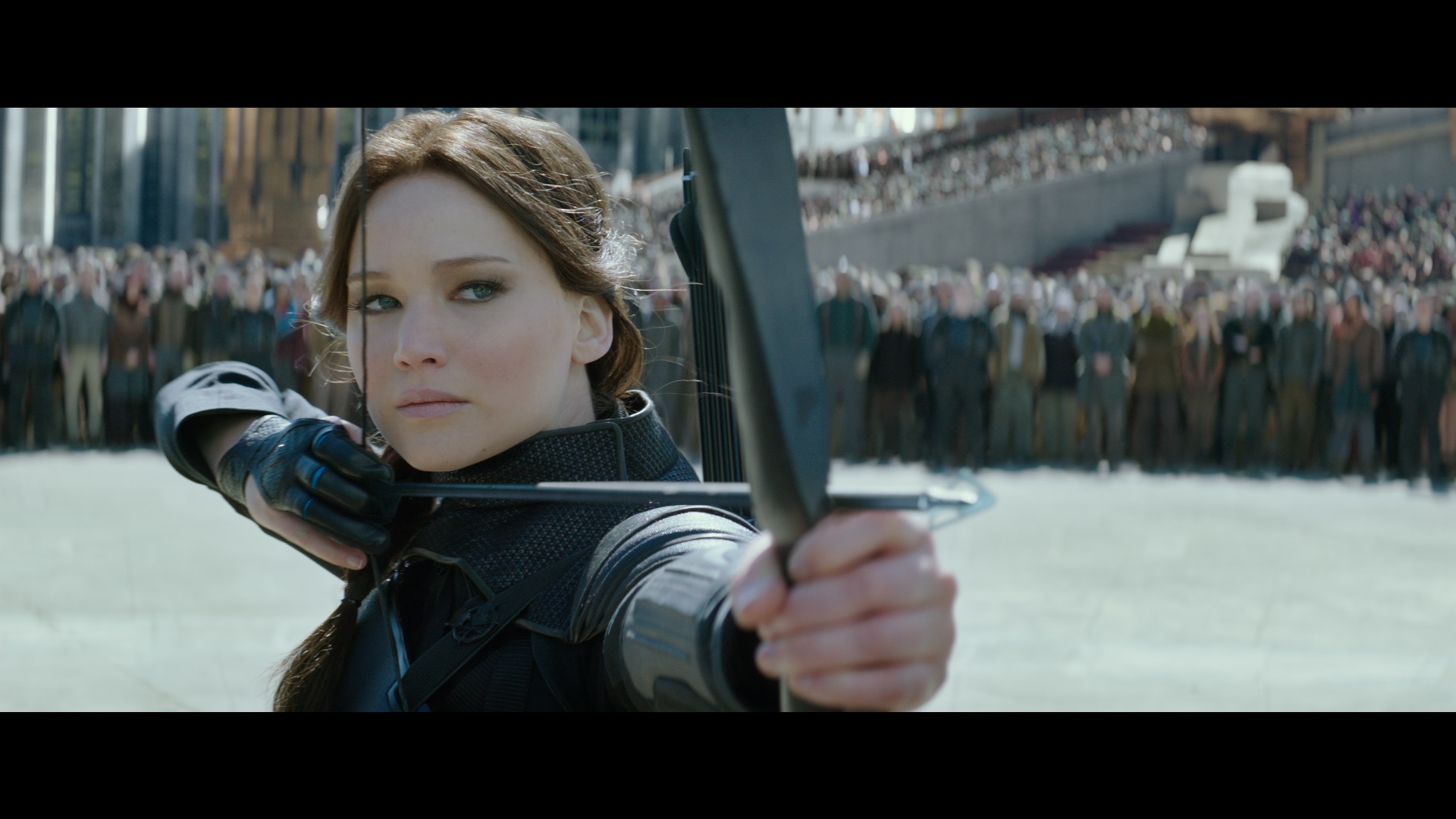
Jennifer Lawrence is still very much the Girl on Fire and still the heart and soul of the entire series as Katniss Everdeen, whose archery skills, heart, and integrity inspire a rebellion.
Those qualities also make her a double target, wanted by both of the opposing forces. Dictator President Snow (Donald Sutherland) wants to get rid of her. But the leader of the rebel group, President Alma Coin, wants to use her for propaganda purposes. As soon as Katniss recovers from the injuries she suffered in part 3, she is back in the field, not so much to fight as to appear to fight, with a camera crew following along.
Also at the end of part 3 we saw that Peeta (Josh Hutcherson), who was tortured by Snow’s “Peacekeepers,” is now convinced that it is Katniss who is the enemy. Even the gentle Prim Everdeen (Willow Shields) cannot reach him.
Katniss is deeply conflicted. She has pretended to be in love with Peeta to win the Games and is so disconnected from her feelings she has no idea whether she loves him or not, or, if she is, if he will ever be himself again. Her old friend Gale is in love with her and she does not know how to respond to him, either. While she is passionately committed to bringing down President Snow, she is not willing to go along with the tactics President Coin believes are necessary. She finds it hard to trust anyone, even herself. The abrasive Johanna Mason (Jenna Malone, a refreshing break from the earnest doggedness of just about everyone else) reminds her that some people say what they mean.
All Katniss is certain of is that President Snow must die and she wants to be the one who kills him. So she and a group of rebel soldiers (don’t get too attached — they’re mostly red shirts) set off with one map showing where the mines and traps have been laid out and, for each of them, a capsule of poison to kill themselves in case of capture.
The middle section of the film is more FPS video game than story as the group faces one diabolical threat after another and it becomes numbing, even comedic as we go from guns and traps to a toxic inky flood and then some zombie-esque creatures, as though it is not just President Snow but author Suzanne Collins who wants to make sure no possible destructive force is overlooked.
There is a brief respite at the home of Tigris (a slinky and imposing Eugenie Bonderant, a woman who has been surgically modified to resemble a jungle cat. Like “Ender’s Game,” another story with very young heroes, the climax does not come where you think, in a manner that allows Katniss to evade genuine resolution of the moral quandaries of ends and means.
Director Francis Lawrence (no relation to Jennifer) has steered this big, unwieldy ship of a story safely into harbor. If he erred on the side of satisfying the books’ fans over those who might come to the story first on screen, that is understandable. But it means that at least half of the relief at having it resolved will be that no one is planning a part 5.
Parents should know that this film includes intense, extended, and sometimes graphic peril and violence with many adult and child characters injured and killed, as well as references to torture, guns, explosions, murder, chase scenes, themes of dystopia and tyranny.
Family discussion: Could the rebels have won without Coin’s decision? Was it worth it? Why are Snow’s forces called Peacekeepers?
If you like this, try: the other films in the series and the books by Suzanne Collins
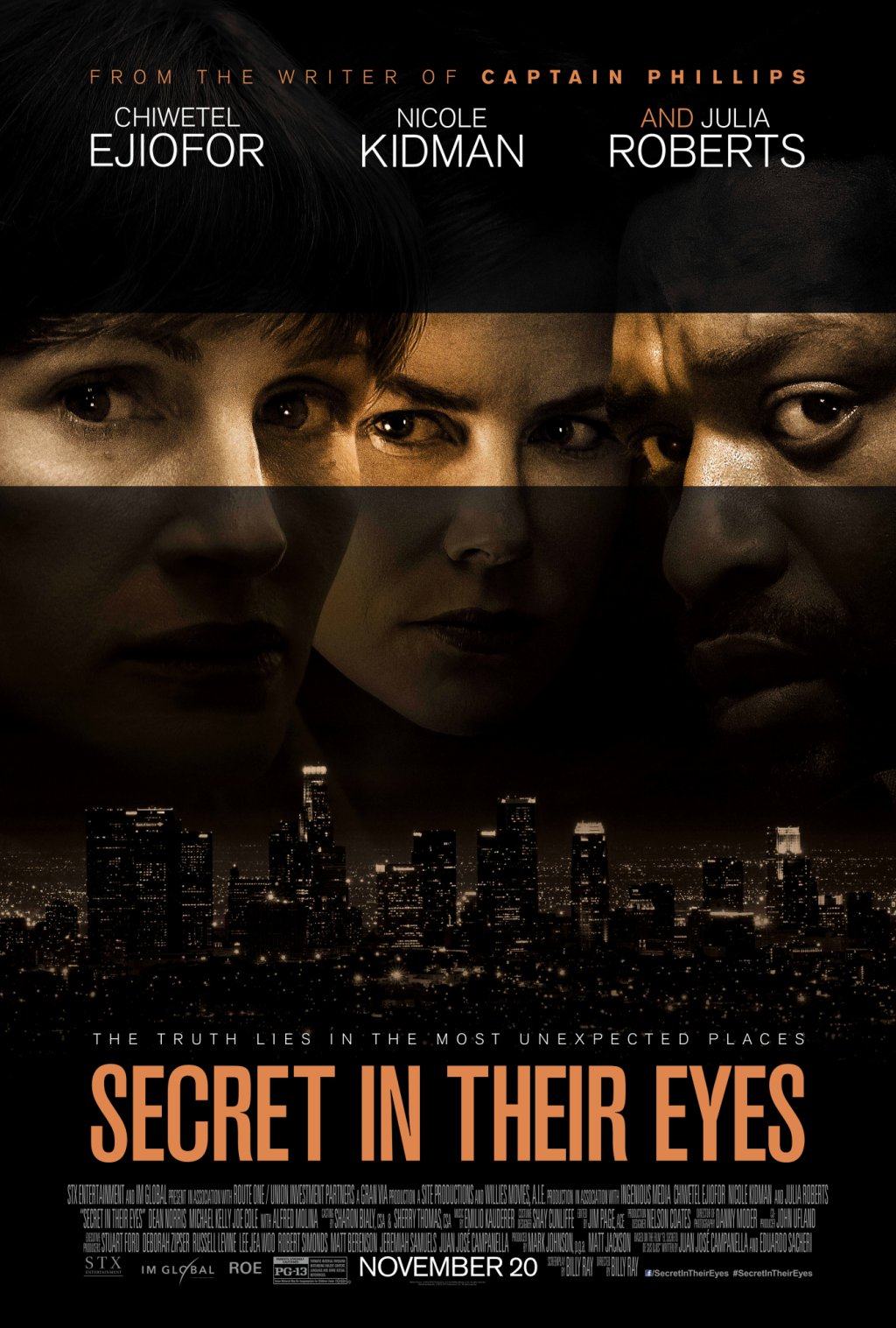
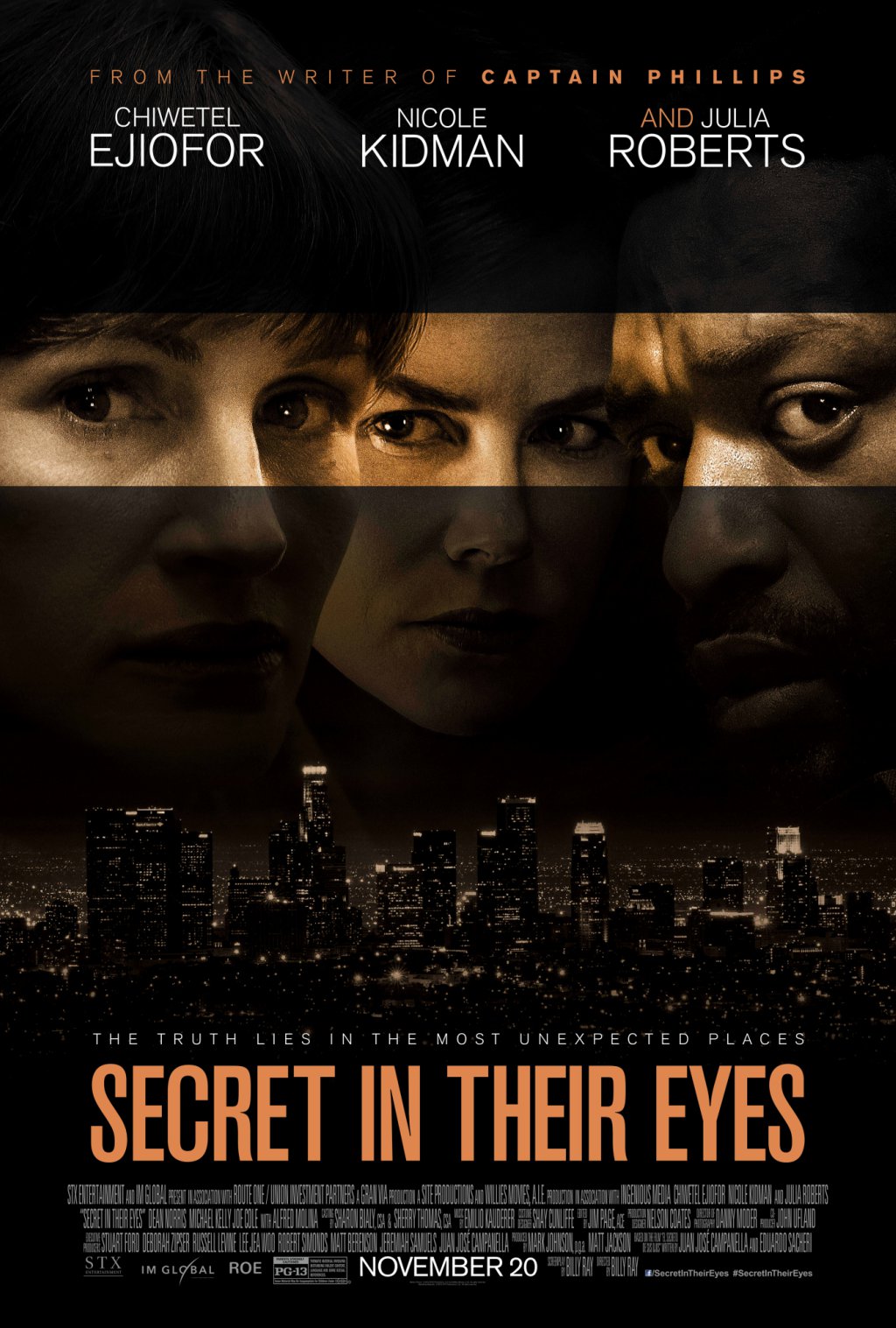
A girl is murdered. That girl, that crime and the man who did it are seen very differently by different people, all of whom are in law enforcement and all who have sworn to devote their professional lives to justice in this dark thriller based on an Oscar-winning Argentinian film (“The Secret in Their Eyes“). Just as that film used a long-unsolved murder to explore the shifts of politics and culture over the decades, this version, from writer-director Billy Ray, sets the murder in the frantic realigning of priorities following the terrorist attacks of 9/11. For those who loved her, justice for the death of the girl is all that matters. For those working on anti-terrorism, though, the suspect may be of more use out in the world as an informant than in prison as a murderer.
The story takes us back and forth between the present day and the time of the murder, in 2001. Claire (Nicole Kidman) is a District Attorney and Ray (Chiwetel Ejiofor) is an investigator newly assigned to the FBI’s anti-terrorism division. There is an immediate charged connection between them, though Claire is more reserved. Ray works with Jess (Julia Roberts), who teases him about his evident interest in Claire.
Then there is the report of a death, a body in a dumpster. Ray and Jess arrive, alert, professional, but detached, snapping on their blue latex gloves and talking about a possible connection to their work because the body was found near the mosque they are investigating.
And then Ray sees the girl and has to tell Jess that everything she cared about in the world has been destroyed. The shot of Roberts’ face as she has to go from thinking she has been called to see a body to understanding that it, that she is the one particular individual who means the most to her, “the thing,” she says, “that made me me,” is shattering to see. For the rest of the film, the radiant presence we know so well is haggard, numb, broken.
In the present day, the murder has not been solved. Because the suspect was an informant from a mosque that could have been harboring terrorists, the case against him was not pursued, and he has disappeared. But Ray has never stopped looking for him. He went through 1906 photos a night, searching every white male in the FBI’s system, for 13 years. He thinks he has found him.
More successful in mood than plot, Ray uses this story to meditate on loss, hopelessness, and the gulf between law and justice. Each of the characters wants something different from this investigation. Jess wants what she thinks of as justice but what looks more like revenge. “Death penalty would be too good for him,” she says. Ray feels somehow responsible, because he could have been with Jess’ daughter the morning she was killed. Claire wants the law to be enforced. And she still feels a connection to Ray. As for the suspect — in his own way, he is as controlled by his obsessions as the others.
Parents should know that this film includes a brutal rape and murder (off-screen) and some violence, with some peril and some injuries and abuse. There is some strong language.
Family discussion: Do you agree with Morales’ decision on how to treat Marzin? Should Ray have told Claire how he felt?
If you like this, try: the original film, “The Secret in Their Eyes” and Ray’s earlier films, “Shattered Glass” and “Breach”