
Freeheld

Freeheld

Posted on October 8, 2015 at 5:50 pm
Copyright Lionsgate 2015

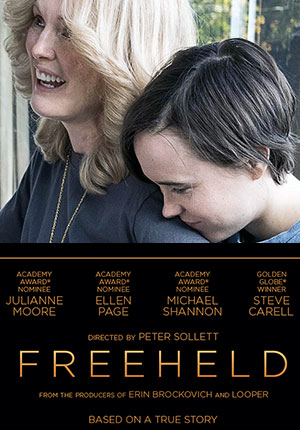
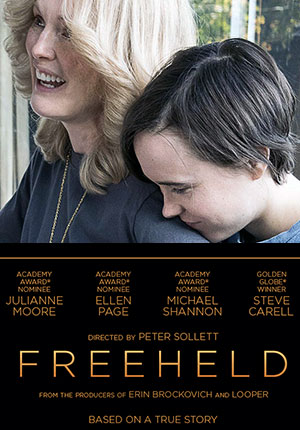
Laurel Hester (Julianne Moore), a 23-year veteran of the police force, learns that she has terminal cancer. And then she learns something even more devastating — that her registered domestic partner, Stacie Andree (Ellen Page) is not eligible for the pension benefits that she would be entitled to if they had been a heterosexual married couple.

It is hard to believe that was only ten years ago. But in 2006, marriage equality seemed very far in the future. And that was not Laurel Hester’s concern. As shown in the Oscar-winning documentary short, also called “Freeheld,” she did not want her fight for death benefits to be used to promote marriage equality. Hester was a very private person who did not even tell her longtime detective partner (Michael Shannon) that she was gay. She just wanted what she believed she had earned, and she wanted the woman she loved to be able to stay in the home they created together.

The term “Freehold,” by the way, is unique to New Jersey, and it goes back to the state’s earliest history. New Jersey’s first constitution, written in 1776, declared a county representative must be worth “fifty pounds proclamation money, clear estate in the same and have resided in the county in which they claim a vote for twelve months immediately preceding the election.” “Clear estate” means owning a property outright, and is also called a “freehold,” so only those who owned land could vote or be elected to office. While that restriction no longer applies, the position most localities call “representative,” “supervisor,” or “councilman” is referred to in New Jersey as “Freehold.” In the case of this movie, “freeheld” refers to the property shared by Hester and Andree and their love for each other as well.

There are really two stories here, both familiar to moviegoers, but not combined in this way. There is the story of the fight for justice against the barriers of bureaucracy, bigotry, and bullies. And there is the story of a reserved loner opening up to love. The combination is at times uneasy. The love story is the stronger part of the film, but gets less attention. Moore is superb as Hester, with her Farrah Fawcett hair wings, utter dedication to her job, and resolve built up into isolation after more than two decades of mostly good-natured but sexist and homophobic humor from her fellow cops. She crosses state lines to play in on a lesbian volleyball team in Pennsylvania so no one in New Jersey will see her.

And then she meets Stacie, tiny, much younger, but confident in who she is and who she loves. The scene where Andree proves herself to the manager of a car repair shop is a highlight. And so is their date, where we see Hester’s conflicting feelings. She is very attracted to Andree, she cannot quite believe Andree is attracted to her, she wants love in her life, she does not want to be exposed or vulnerable. When the two of them walk away from the bar to talk quietly, they are approached by thugs, and Hester pulls out her gun and identifies herself as a police officer. It is, in a way, a supremely romantic gesture. Later, she introduces Andree as her “roommate” and barks at her for answering the phone. But when she gets sick, she understands quickly what her priorities need to be.

She remains clear, even after Steven Goldstein (Steve Carell), a flamboyant activist for gay rights, shows up. Hester reluctantly allows him to create some political theater to support her cause. There is a loophole in the law. Domestic partners of state employees are covered, but local Freeholders decide whether city and county-level employees will qualify. Hester’s Freeholders have already turned her down and she does not have much time.

As often happens in re-telling a recent true story, the movie trips over the proportions in trying to get the facts straight. The interactions between the various Freeholders, including Josh Charles as the most inclined to support Hester’s rights, are no more interesting than municipal-level politics usually are. But the deep love between Hester and Andree and their quiet insistence on simple justice give the story sincerity, sweetness, and conviction.

Parents should know that this film includes very sad scenes of a terminal cancer patient, and death, themes of LGBTQ rights including homophobic and bigoted characters, some sexual references and situations, some strong language, smoking, drinking, and some law enforcement-related violence.

Family discussion: Why did Laurel insist that she was not an advocate of marriage equality? Should she have told her partner the truth?

If you like this, try: the Oscar-winning documentary that inspired the film

Related Tags:


Based on a true story GLBTQ and Diversity

Exclusive Clip: Romantic Comedy “You Cast a Spell on Me”

Posted on October 8, 2015 at 4:26 pm

We are delighted to premiere an exclusive clip from the bewitching romantic comedy “You Cast A Spell On Me,” starring Ryan McPartlin (“Chuck”) and Nikki Deloach (“Awkward”), now available on Digital HD and On Demand.

Related Tags:


Fantasy Romance Trailers, Previews, and Clips

Interview: Bryan Carberry and J. Clay Tweel on the Documentary “Finders Keepers”

Posted on October 7, 2015 at 3:30 pm

Bryan Carberry and J. Clay Tweel have made some of my favorite documentaries, including “King of Kong” and “Make Believe,” bringing us into worlds that at first seem exotic and downright weird and seamlessly making us feel a part of small fringe communities like competitive video gamers still in cutthroat battles via the near-antique “Donkey Kong” or teenage magicians. Their latest is Finders Keepers, the story of one of the most improbable lawsuits ever filed — over ownership of a severed leg. John, the man whose leg it was wants it back from Shannon, the man who accidentally and unknowingly bought it in the disposition of storage facility contents seized for nonpayment and wants to keep it because he thinks it is his ticket to fame and fortune. I spoke to Carberry and Tweel about finding the funding for the film via Kickstarter and normalizing a story that seems at first to be outlandish and grotesque.

Co-producer Ed Cunningham first started covering the story. Carberry explained, “Initially Ed was coming off King of Kong in 2007 and looking for his next thing so this was kind of like his baby for awhile. He went out of his pocket for a bit flying out there with his little handycam. After a couple of years there wasn’t really much funding behind this and I came across Ed’s footage and we thought, ‘Okay, this needs to happen.’ It’s amazing by then crowdfunding came along and we got the Kickstarter together for eighty thousand dollars. That paved the way. It got us go out and shoot the bulk of the story and get into the edit room.”

They talked about creating sympathy and even identification with the characters. Tweel said, “We try to structure our documentaries in the same way that a lot of narrative fictional films are structured, kind of like a screenwriting type of format and so in doing that we are trying to tell the most universal story possible, whether it’s about arcade video game players or teenage magicians or two guys fighting over a leg. We’re constantly in search of the underlying truth in the ways in which our audience can connect with these people. And so really we struck gold here not just because John and Shannon are funny and quirky but they are also very vulnerable and honest and so are their family members. And so we were able to get to the kind of deeper levels to the story that you can relate with, like you can relate with a sister who has a drug addict as a brother and she is trying to protect him but also he’s hurting her. We felt like the parallel stories of these guys kind of mirror each other in so many different ways and that was something Bryan and I were very much interested in exploring.”

Ed Cunningham was the one who first made the people in the film feel comfortable talking very candidly in front of a camera. Tweel said, “Basically, he just laid everything out on the line. A) He was able to give them “King of Kong” and say, ‘This is the treatment we give. This is just a fair account. We’re not going to be playing this up or anything.’ But once you have a camera pointing at someone for long enough, they are just describing it like you’re a friend on the block or something. It’s completely natural for them because they’re with it they’ve been with it for so long so when they are talking without grinning or whatever about them hanging the leg in a tree in the front yard or something it’s because that’s their life. It’s not strange to them. And after working with them for a couple years it wasn’t strange to us either. The first time we screened at Sundance for the people we couldn’t believe the laugh it was getting because it had become incredibly normal for us having worked with it every day.” It also helped that Cunningham and Carberry were both born in Virginia, so the people in the movie did not think of them as Northerners trying to make fun of the hicks in the South.

One of the most fascinating elements of the film is that the documentary itself contrasts with at least three different “reality” television shows that became involved, including Judge Mathis, who finally resolved the dispute and sent John to rehab. So this is a documentary that includes the impact of a more heightened version of what they do. Carberry said, “I think that the reality TV version of the story is they are coming at it from a different angle and they are not there to give more of the context behind the story that we are. So we as much as possible like to let people talk themselves and let things kind of happen organically where reality TV is more operating on machine, a little bit like they have schedule and they’re cranking up shows. We’re just trying to show how that affects our characters.” “They are more hands on and we are hands off,” added Tweel.

Related Tags:


Directors Documentary Interview

List: Movies about Peter Pan

Posted on October 7, 2015 at 8:00 am

James M. Barrie’s play “Peter Pan” premiered in 1904 and the story of the boy who wouldn’t grow up is still one of the best-loved of all time. This week the prequel “Pan” opens up in theaters, with Hugh Jackman, Rooney Mara as Tiger Lily, and Garrett Hedlund as the young not-yet-captain Hook. And there’s a hit musical on Broadway called “Finding Neverland,” based on the Johnny Depp movie that was based on Barrie’s life, and the friendship with some children that inspired his most famous story.

https://www.youtube.com/watch?v=1jsR7_EqQSs

There was also a theatrical Peter Pan prequel on Broadway called “Peter and the Starcatcher.”

There was a silent film version in 1924.

https://www.youtube.com/watch?v=DdnZUszqGOY

A generation of baby boomers adored the Mary Martin musical version.

The Disney movie was the first to have the title role played by a boy.

https://www.youtube.com/watch?v=zf00mEe9EOs

The theatrical version was remade with Cathy Rigby and Sandy Duncan. Here Duncan is introduced by Mary Martin.

Rigby played the part longer than anyone else, more than 30 years.

Steven Spielberg made a sequel called “Hook,” starring Robin Williams with Julia Roberts as Tinkerbell.

The PJ Hogan-directed version had Jason Isaacs as Captain Hook.

And Allison Williams starred in the live telecast last Thanksgiving.

Related Tags:


Based on a book Based on a play Fantasy Lists
THE MOVIE MOM® is a registered trademark of Nell Minow. Use of the mark without express consent from Nell Minow constitutes trademark infringement and unfair competition in violation of federal and state laws. All material © Nell Minow 1995-2026, all rights reserved, and no use or republication is permitted without explicit permission. This site hosts Nell Minow’s Movie Mom® archive, with material that originally appeared on Yahoo! Movies, Beliefnet, and other sources. Much of her new material can be found at Rogerebert.com, Huffington Post, and WheretoWatch. Her books include The Movie Mom’s Guide to Family Movies and 101 Must-See Movie Moments, and she can be heard each week on radio stations across the country.

Website Designed by Max LaZebnik