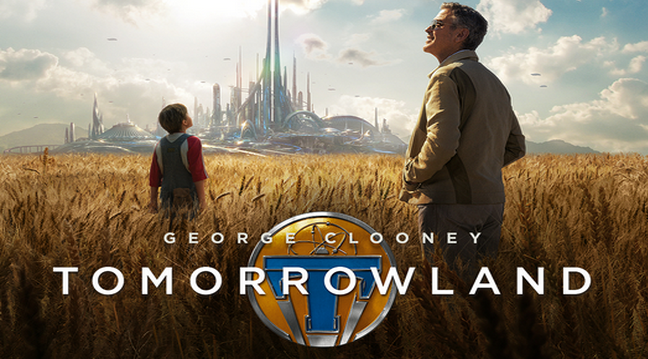
It begins with an argument. Frank (George Clooney) is trying to tell us the story. But he is repeatedly interrupted by someone we will learn is Casey (Britt Robertson). “Try to be a little more upbeat,” she urges him. The only way he can do that is to go back to when he last felt upbeat, as a child in 1964, when he brought his not-quite-working-yet invention to the New York World’s Fair to submit it in competition. The judge (Hugh Laurie) rejected it, but a young girl who was watching them follows Frank, hands him a pin, and tells him to follow her without being noticed. She is Athena, played with saucer-eyed charm by Raffey Cassidy. That leads him to the “It’s a Small World” ride, which had its premiere at the 1964 World’s Fair, but in this version of the ride, there is a portal to a fabulous Oz-like city of the future.
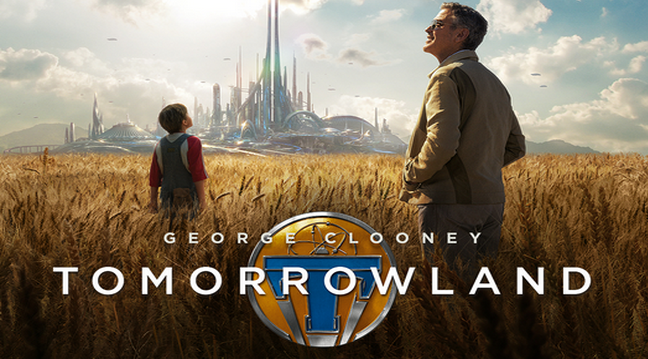
We then meet Casey in the present day, where she is engaging in a little breaking and entering at a NASA facility in Cape Canaveral, trying to stop the machines that are tearing it down. Her father (a warm and wonderfully natural Tim McGraw) is a NASA engineer who has been laid off as his entire program is shutting down. Casey is caught and arrested, and when she is being released, among her things is the same pin. And when she touches it, she is transported to a wheat field with that same city in the distance. The shot is an homage to the iconic image of the Emerald City from the poppy field. She wants to get back there. She feels that she needs to get back there. And so she tries to track down the pin, which takes her to a store filled with sci-fi artifacts run by Kathryn Hahn and Keegan-Michael Key, who manage to be both very funny and surprisingly menacing. The store is called Blast from the Past, a name that turns out to be quite literal when some guys dressed in black with scary grins and big guns show up.
Athena arrives, looking not a day older than in 1964, and takes Casey to see Frank, now a grumpy recluse with a grizzly gray beard stubble and a holographic dog. When the guys in black show up, they are held back by Frank’s elaborate system of booby traps long enough for Frank, Casey, and Athena to escape. Eventually they make it back to Tomorrowland, which looks quite different from the pristine and joyful version Casey first saw.
There are some magical moments, but also some choices so poor they suggest last-minute panic re-cutting. That last scene with Clooney and Cassidy is weird and creepy, even more so because it is intended to be touching. But in much of the film, co-writer/director Brad Bird, working with “Lost’s” Damon Lindelof, combines some of the themes from his earlier films, “The Iron Giant,” “The Incredibles,” “Ratatouille,” and even “Mission Impossible: Ghost Protocol,” so that the story’s superbly staged action sequences and gorgeously imagined settings underlie ideas about creativity, optimism, and the power of ideas and imagination. It is all in the tradition and the spirit of the man behind the theme park area that inspired the film.
Early on, Casey tells her dispirited father, who describes himself as “a NASA engineer without a launch,” the Cherokee story he used to tell her. Two wolves are fighting. One represents darkness and despair. One represents light and hope. Which one will win? The one that you feed. It is clear that Bird wants us to feed the wolf of light and hope, and this film gives that wolf some real nourishment.
Parents should know that this film includes sci-fi/action/fantasy peril and violence including weapons, characters injured and killed, themes of dystopia and destruction, and some mild language (hell, damn).
Family discussion: What made Casey special? What invention would you like to create to make a better future? Would you like to have a friend like Athena?
If you like this, try: Disney classics from the original Tomorrowland era like “Escape from Witch Mountain” and “Swiss Family Robinson”
Rated PG-13 for sexual material, drug use and brief strong language
Profanity:
Strong language
Alcohol/ Drugs:
Drinking, marijuana
Violence/ Scariness:
Some mild peril, sad death
Diversity Issues:
None
Date Released to Theaters:
May 22, 2015
Copyright 2015 Bleeker Street
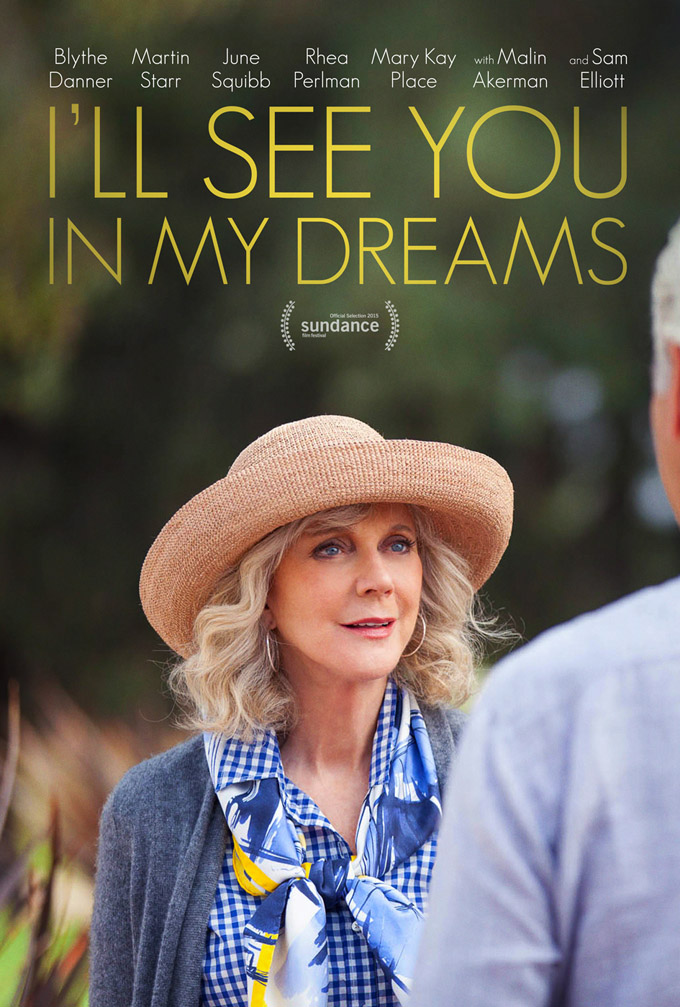
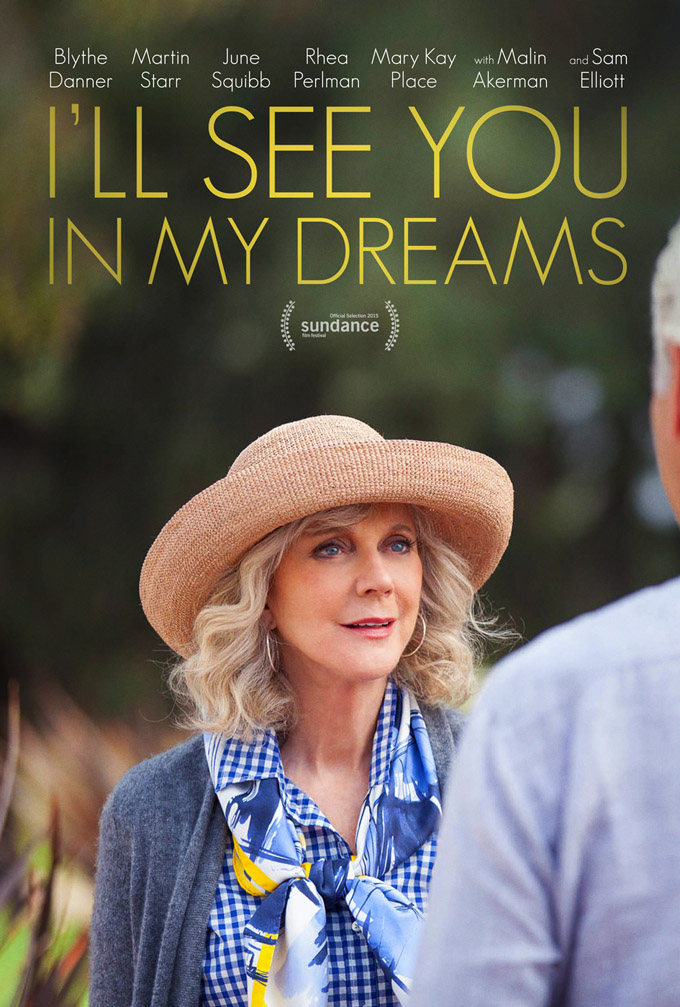
Blythe Danner gives a performance of exquisite sensitivity in “I’ll See You in My Dreams,” the story of a lonely widow. She plays Carol, a singer-turned teacher who retired 20 years ago after her husband died. Her friends in a nearby retirement community urge her to join them but she prefers to stay in her home, her primary companions her dog and her glass of white wine.
The movie begins by taking us through a day we surmise is just like hundreds of others. She plays cards with friends, she plays golf, she feeds the dog, she sips wine and watches television. She keeps busy and she is not unhappy. She has plans, and she has fun, but she does not have much of a sense of purpose. When a rat invades her home, it is unsettling. She asks her new pool cleaner for help.
His name is Lloyd (Martin Starr), and he is lost in a way that makes her feel able to talk to him. Her feelings toward him are not maternal or romantic. But he is smart, and funny and self-deprecating and he was willing to help her with the rat. And he is newly back in town and living with his parents, so he can use a friend, too. When he tells her about going to do karaoke, she agrees to go with him.
A speed dating event with her friends is a hilarious disaster, but that may make an overture from a handsome stranger named Bill (Sam Elliott) seem more appealing. Writer/director Brett Haley has a good sense for the way people who have no time for trivialities get to the point with each other, wasting little time on getting-to-know-you trivialities. Carol’s conversations with Lloyd and Bill are direct without being intrusive, and especially without being judgmental. When she is with her friends, there are easy exchanges that reflect the kind of connection based on the shared experience of being an older woman. A scene where they all get high on one friend’s medical marijuana is completely charming.
It is almost beyond belief that this is Danner’s first romantic lead in a film. She is breathtaking. Haley wisely just leaves the camera on her beautiful face as she sits with her beloved dog while he slowly stops breathing in the vet’s office. Her grief is devastating. Her devotion is deeply moving. Her performance of “Cry Me a River” in karaoke is also magnificent. The incandescence she brings to the story of a woman who is still struggling for connection makes this one of the most touching performances of the year.
Parents should know that this movie has strong language, drinking and drugs, sexual references and situations, and a sad death.
Family discussion: What do we learn about Carol from the karaoke scenes? Why did she become friends with Lloyd? How is dating different for older people than for younger people?
If you like this, try: “The Best Exotic Marigold Hotel” and its sequel
Friar’s Club Documentary — Tonight on WNET and Online
Posted on May 21, 2015 at 8:00 am
Tonight on New York PBS station WNET, “Treasures of New York: Friars Club” will explore the rich history of the exclusive private club through never-before-seen footage of Frairs roasts and interviews with some of the club’s most prominent members. Larry King, Joy Behar, Lisa Lampanelli, Susie Essman, Jerry Lewis, Jeffrey Ross and Mark Simone are among those interviewed. The Friars Club is best known for its outrageously insulting (and extremely dirty) roasts, but it is also the home territory for superstar performers, including the greatest comedians of the last century, from the vaudeville era to the YouTube era.
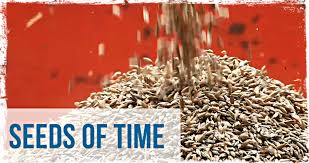
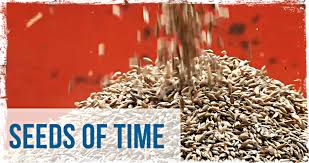
Seeds of Time is a documentary that seems like a terrifying science fiction story. It is about the efforts of Cary Fowler, funded by Bill Gates, to find, preserve, and store seeds from plants necessary for all life forms on the planet, as over 90 percent of the plant species we use for food have become extinct in the last century. For the best and worst reasons, most of our food now comes from modified plants (and the animals who eat them), created to be more efficient to grow and ship — and to be able to be patented and thus a better investment for agribusiness.
Seeds of Time is in some theaters now, and anyone can bring a screening to any community via Theatrical On Demand film distribution service Gathr®, which is free if it “tips,” meaning enough tickets are reserved.
I spoke to director Sandy McLeod about the film.
How did you come to this project?
I had been sent an article that was in the New Yorker by two friends and I was reading it one morning at breakfast. My husband was on the speaker phone and I’m reading about Cary Fowler and I hear my husband talking to a guy named Cary on the phone and I don’t really think much it. But I read a line in the article that says Cary Fowler was given $30 million to collect the seeds through the Gates Foundation and I hear my husband ask this person on the phone. How much were you given by the Gates Foundation? And I hear the person on the other end say “$30 million.” And when my husband hang up the phone I said, “Was that Cary Fowler by any chance?” and he said, “Yeah, how did you know?” So I ask my husband if he could introduce me to Cary and that summer I read Cary’s book which is called Shattering: Food, Politics, and the Loss of Genetic Diversity/. I realized that there are so many things in that book that I had no clue about even though at I’m a foodie and I know quite a lot about food, and it is of fundamental to having an intelligent conversation about the status of the food system today. And so I went to Memphis and I interviewed Cary and he really blew my mind. I realized that if this was something that people really need to know about in order to have an intelligent conversation about food and that I was going to learn along with my audience. So I felt like I was a good guinea pig for them.
The extinction statistics are staggering. How do you respond to people who say, “Well, that’s Darwinism. It’s just natural selection, right?”
It’s not in this case because we actually domesticated those plants and we ate those plants and we had tremendous diversity and a lot of different kinds of fruit and vegetables that we no longer have. In fact 93% of all the fruit and vegetables that were in the United States in the last 80 years has gone extinct. So that is huge, that’s a tremendous number and with agriculture now facing so many difficulties including limited lands, limited water, low availability of fertilizers, population expansion, and now climate change, having lost that diversity means that there are less tricks in the tool bag to let genetics be able to give to the farmers to work with to have a radish that’s going to survive, to have heat tolerance or drought resistance or all the things that farmers are starting to feel in terms of what’s happening with the climate. So that loss would have continued if Cary hadn’t done what he did. It’s an ongoing battle. Seed banks are still becoming extinct and if they’re not backed up, those seeds will go with them.
The scenes in the seed storage facility between Norway and the North Pole were like something out of a James Bond movie. What was it like to film there?
Well, it was very cold there. It was 50 below and 30 below in the vault. and I didn’t fully appreciate what that would mean. I have a lot of cold weather gear because I’ve shot in a lot of strange places, very cold places but I’ve never really been in any place like that. It’s very other wordly. It’s ironic that we store all those seeds up there because nothing could ever really grow up there. There’s a very short season where it’s day all the time and then the rest of the year starts again and it is very, very cold. And in my exuberance as soon as I go there I wanted to go to the seed vault and I jumped out of the car and ran up the hill and found a shot that I wanted to get and I very quickly realized that my nose hurt. I didn’t have anything on my face. You have to cover everything up. You can’t really run around in those kinds of temperatures. And it was funny because when we went into the seed vault which is 30 below it actually felt really warm to me. If you decide you’re going to shoot outdoors you have to stay outdoors all day because once you bring the cameras in they have to go through a thawing process and the lenses fog up. But we were lucky in a way that we’re in a modern enough time where we weren’t shooting film, because the film can break under those conditions. Also, it’s a really expensive of place to be. All the food that’s there has to be brought in and hotels are really expensive there so we couldn’t really stay there very long but we ran around as much as we could, while we could.
Your opening shot is so beautiful. It really invites you into the film even though it’s going to be a scary and disturbing stories. So tell me a little bit about the cinematography.
I come from a feature film background. I used to do continuity on feature films and I’ve worked with a lot of great cinematographers. And so I’ve learned what good lighting looks like and how to frame the shot. One of the biggest problems I had on this film was that I couldn’t have the same cinematographer with me all the time. I worked with lots of different people, so I had to keep trying to keep the look unified. It was really challenging but so far most people don’t seem to notice that. And because it’s about seeds, first of all I wanted people to see how beautiful seeds can really be because they’re so tiny we don’t really look at them. These two guys in London did a beautiful book of photography on seeds and I had seen it and they let me use some of those images in the film. They’re amazing when you look at them and, they are beautifully engineered, they have incredible subtlety and nuance and diversity. So finding things like that to shoot was really, really fun and we went to a lot of great locations. Peru is a beautiful country and the Peruvian farmers are incredibly beautiful people. They dress up in their indigenous gear and they look phenomenal in the film. And we were shooting in the Sacred Valley, which is a very lush mountainous part of Peru and which is incredibly photogenic. We were lucky and the film lends itself to lots of lush imagery.
How has working on the film changed the way that you shop?
I eat a lot more fruits and vegetables now than I ever had and I really look for things that were unusual. I’m interested in tasting new things. I’ve always been pretty healthy eater, except probably when I was in my teens. But I appreciate diversity in the supermarket now more than I ever have and I also appreciate what the farmer does more than I ever have. I really do appreciate actually having a relationship with someone that I know who’s growing my food.
It’s something really…that feels really connected to me and I like knowing what can grow seasonally where I lived and when it becomes available. Even though I live in the city, I live in a loft so I do grow some herbs on my fire escape. At least I can participate in that way and know what’s sort of growing around me. I think it’s healthier to do that.
How do you think of the people who were in their 20s today see these issue different than the last generation?
I have godsons in their 20s, and they are really much more interested in the land and their food, than I was when I was their age. Even though I was interested in it I was, I mean, I would go to the health food store and that sort of thing. One of them is taking a permaculture in class now. One of them has to come a really good chef and is interested in this new ideas of more nutrition per acre and how acre and how do you that instead of being so concerned about yield per acre. So I think that they are more aware because they see the issues that they’re about to confront. There are economic issues, though, too. I mean the whole farmers market phenomenon and I know that’s a certain…it has a certain…I know that Walmart is sourcing a lot more food locally and trying to make organic food more readily available. We need to have more democracy in our food. Consumers can help drive that. I know a lot of the big companies are trying to make healthier products now they see that they sell and that people are making a lot of money on this stuff. So I don’t think most people realize how powerful their dollars are and they can cast a vote on the food that they want by not buying what they don’t want to eat. And I know that their people who don’t know we have that choice because they’re in a hurry and they don’t have time to think about it. I think we should be responsible about what we do because it definitely influences the powers that be. They’re in the business of selling things and if they can’t sell them they’re not going to make them. So we can help drive that.

 /. I realized that there are so many things in that book that I had no clue about even though at I’m a foodie and I know quite a lot about food, and it is of fundamental to having an intelligent conversation about the status of the food system today. And so I went to Memphis and I interviewed Cary and he really blew my mind. I realized that if this was something that people really need to know about in order to have an intelligent conversation about food and that I was going to learn along with my audience. So I felt like I was a good guinea pig for them.