Neighbors

Posted on May 8, 2014 at 6:00 pm

neighbors-posterI admit it.  My always-thin ability to finds humor in movies about irresponsible jerks who won’t grow up has long since evaporated, and if I ever found irresponsibility entertaining, I can no longer remember why.  Though I suspect this development has something to do with an overdose of the Apatow atelier, including Seth Rogen and writer/director Nicholas Stoller (The Five-Year Engagement).  I keep remembering Mae West’s answer when she was asked what advice she had for the youth of America.

“Grow up.”

“Neighbors,” which Rogen has described as a loose sequel to arrested development comedy “Knocked Up,” is the story of Mac (Rogen) and Kelly (Rose Byrne), a couple with a new baby who are not ready to cross the line into being grown-ups.  They love each other and they love the baby, but cannot quite relinquish the notion of themselves as primal in the world of what is cool and happening.  When a friend calls to invite them out to a club, they decide the thing to do is pack up all the baby gear and bring him along.  “Baby’s first rave!” they exclaim.  Then, because being a parent is so exhausting, they fall asleep.  Funny!

Not.

Just to hammer the final nail in the “you’re old and boring now” coffin, who should move in next door but a fraternity, led by Teddy (Zac Efron), who, Mac admits with admiration as well as envy, is so handsome and buff that he looks like he was designed by gay men in a laboratory.  Mac and Kelly convene on how to best introduce themselves to their new neighbors in a manner that shows that they are totally cool and yet conveys that it would be super-nice if the guys could just keep the noise down as there is a baby next door.  A few rehearsals to make sure they have the coolness down (not too much of self-deprecatory head shake), and they go over, immediately showing themselves to be idiots by joining in the frat’s housewarming party and getting very, very high.

Mac promises Teddy that if they have any problems they will go straight to him and not call the police.  Then, after his baby picks up a condom from their lawn, he calls the police, anonymously, he thinks, until the cop reminds him that they have caller ID.  Teddy, feeling betrayed, declares all-out war.   Mac and Kelly, unwisely, decide to escalate.

There are some funny moments, especially a Robert DeNiro-themed frat party.  But they get lost in a tidal wave of stupid humor like an extended sequence with the frat members raising money by selling dildoes modeled on their own…members. Did you think you could avoid a joke about getting stuck in the mold?  Sorry.  Really sorry.

Rogen does the same thing he does in every other movie.  Byrne is, as always, beautiful, on target, and delightfully game for whatever. It’s nice to see a female character in one of these boys’ club movies who is not relegated to telling everyone to grow up.  Efron and Dave Franco as his sidekick deserve better.  So do we.

Parents should know that this movie is exceptionally raunchy, with very explicit sexual references and situations and nudity and many crude jokes.  Characters use very strong language, drink, and use drugs and there is comic violence.

Family discussion: Why did Mac and Kelly want the frat to think they were cool?  Why didn’t Pete tell Teddy the truth?  What will Teddy do next?

If you like this, try: “The 40 Year Old Virgin” and “Knocked Up”

Related Tags:


Comedy

Belle: The Real Story

Posted on May 8, 2014 at 8:00 am

belle portrait“Belle,” expanding to theaters across the country tomorrow, is based on the real-life 18th century story of Dido Elizabeth Belle, the illegitimate daughter of a titled British Naval officer (played in the film by Matthew Goode of “A Good Wife”) and a slave from the West Indies. Her father brings her to live with his uncle, the British equivalent of the Chief Justice of the Supreme Court. In the film, directed by a British woman of African heritage, Amma Asante, the themes of gender, money, class, and race are explored with sensitivity and insight reflecting some of what we have learned in the nearly 400 years since Belle appeared in a famous portrait with her cousin.

There was a real Belle, and as in the film she was known to her family as Dido, born around 1761.  She lived with her great-uncle, the Earl of Mansfield.  He and his wife and unmarried sister raised her with her cousin, Lady Elizabeth Murray.  The girls were around the same age, as shown in the portrait, and raised as sisters.  Dido was, as shown in the movie, loved by her family but was subjected to restrictions based not just on her race but on her illegitimacy.  A contemporary report from a visitor to the home suggested that she was more of a companion to her cousin than an equal.  She had some responsibilities over housekeeping, but so did her unmarried aunt.  A fascinating historical account noted that she served as a kind of secretary to her great-uncle, which suggests that she had a level of respect for her intellectual ability that was unusual for people of her race and gender at the time.

The move toward abolition of slavery in Great Britain is as gripping and complex a story as the movement in the United States.  There were two big differences.  First, since slavery was offshore and unseen by most citizens, it was more difficult to make its fundamental immorality clear to the population.  Once it was made clear, it led to the first ever populist political movement.  This story is very well told in the film “Amazing Grace.”  Second, the abolition of slavery was accomplished in 1833, decades earlier than in the United States, and without armed conflict.

One reason for that was a crucial decision made by the courts in England in 1772, a decision by none other than Belle’s great-uncle, Lord Mansfield.  While the facts of that case are very different from those described in the film, the decision was the first acknowledgement by the court of the inherent offensiveness of slavery and was an important precedent for framing the arguments over slavery that followed.  We will never know whether Belle influenced her great-uncle explicitly or by the example of her intelligence and character, as the movie has it.  But it is fair to wonder whether he would have ruled differently had he not had the unquestioned affection for Belle that has been documented.

For more about Belle, read this scholarly article by Henry Louis Gates and Belle: The Slave Daughter and the Lord Chief Justice.

Related Tags:


Race and Diversity The Real Story

Contest: Win a DVD of “The Story of the Jews”

Posted on May 5, 2014 at 12:20 pm

I am delighted to have five copies of the outstanding PBS series The Story of the Jews with Simon Schama to give away.  The DVD is being released tomorrow from PBS Distribution, and it is also available on digital download.

https://www.youtube.com/watch?v=CjoH6oP3D2Y

Prize-winning author of 15 books and Emmy Award-winner Simon Schama brings to life Jewish history and experience in a new five-part documentary series follows Schama as he travels from Russia and the Ukraine to Egypt, Israel and Spain, exploring the imprint that Jewish culture has made on the world and the drama of suffering, resilience and rebirth that has gone with it.

The series is, at the same time, a personal journey for Schama, who has been immersed in Jewish history since his postwar childhood; a meditation on its dramatic trajectory; and a macro-history of a people whose mark on the world has been out of all proportion to its modest numbers.SJSS600

“If you were to remove from our collective history,” said Schama, “the contribution Jews have made to human culture, our world would be almost unrecognizable. There would be no monotheism, no written Bible, and our sense of modernity would be completely different. So the history of the Jews is everyone’s history too and what I hope people will take away from the series is that sense of connection: a weave of cultural strands over the millennia, some brilliant, some dark, but resolving into a fabric of thrilling, sometimes tragic, often exalted creativity.”

The series draws on primary sources that include the Elephantine papyri, a collection of 5th-century BC manuscripts illuminating the life of a town of Jewish soldiers and their families in ancient Egypt; the astonishing trove of documents – the Cairo Geniza – recording the world of the medieval Jews of the Mediterranean and Near East; the records of disputations between Christians and Jews in Spain; correspondence between the leader of the Arab revolt during World War I, Emir Feisal, and the leader of the Zionist movement, Chaim Weizmann.

Schama talks about the turning points of the drama with living witnesses like Aviva Rahamim, who, as a 14-year-old, walked across the Sudanese desert to try and reach Israel; Yakub Odeh, the Palestinian whose village was destroyed in the war of 1948; and Levana Shamir, whose family members were imprisoned in Egypt at the same time. He debates the meaning of new archaeological discoveries of the Biblical period with Yosef Garfinkel of the Hebrew University; the Dead Sea Scrolls with their chief curator Pnina Shor; the character of the Talmud with Leon Wieseltier, literary editor of the New Republic; the photographic record of Israel’s history with Micha Bar Am; German cultural treasures from Enlightenment Germany and the music of Felix Mendelssohn with the critic Norman Lebrecht.

The series, first broadcast in the United Kingdom on BBC in fall 2013, was acclaimed in the British press as “an astonishing achievement, a TV landmark, idiosyncratic, accessible but always authoritative.”  It includes new archaeological research that is transforming our understanding of the earliest world of the Jews, and highlights evidence from the visual arts — synagogue mosaics, spectacularly illustrated Bibles, the brilliantly colorful decoration of synagogues (contrary to impressions of a monochrome religion), as well as the glorious music that carried Jewish traditions through the centuries.

Whether he’s amid the stones of 11th-century Judea, the exuberantly decorated cemeteries of Ukrainian hasidic rabbis, the parlors of Moses Mendelssohn’s Berlin or the streets of immigrant New York, Schama brings together memory and actuality, past and present, sorrows and celebrations, vindications and challenges and makes felt the beating pulse of an epic of endurance that has been like no other – a story that belongs to everyone.

To enter the contest, send an email to moviemom@moviemom.com with “Story of the Jews” in the subject line and tell me your favorite Jewish author, performer, musician, or holiday.  Don’t forget your address!  (US addresses only.)  I will pick a winner at random on May 14.  Good luck and mazel tov!


Related Tags:


Contests and Giveaways Documentary Spiritual films

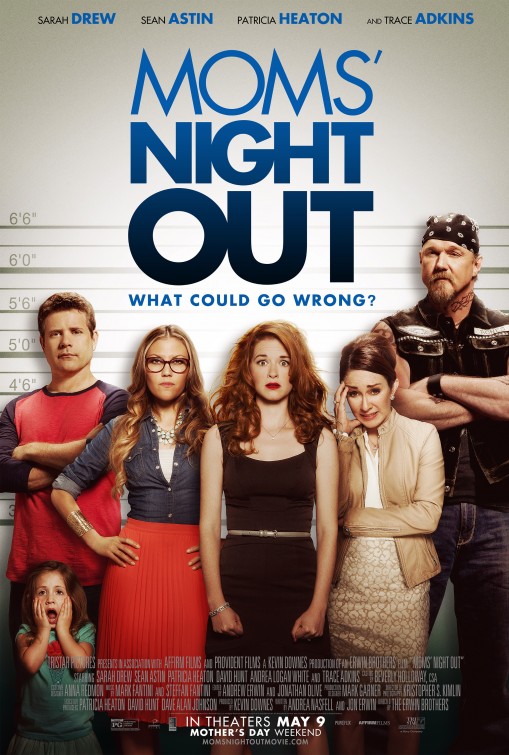
Moms’ Night Out

Posted on May 4, 2014 at 9:48 pm

B+
Lowest Recommended Age: 4th - 6th Grades
MPAA Rating: Rated PG for mild thematic elements and some action
Profanity: Mild language
Alcohol/ Drugs: Some drinking, references to substance abuse
Violence/ Scariness: Characters in peril, mostly comic, taser, tattoo parlor
Diversity Issues: Diverse characters
Date Released to Theaters: May 9, 2014
Date Released to DVD: September 1, 2014
Amazon.com ASIN: B00KO6EC4A
© 2014 AFFIRM Films/Sony Pictures Entertainment & Provident Films, LLC. All Rights Reserved.

It may feel like a kinder, gentler, sweeter version of “Adventures in Babysitting” or “The Hangover,” but this charming story manages to avoid getting syrupy, even when everyone settles down in the midst of chaos for a little talk about God’s love. It helps that the conversation is with a scary-looking tattooed biker type played by country star Trace Adkins. It is a very funny movie with an exceptionally likeable cast and a warm-hearted, surprisingly touching tribute to moms and their families, as endearing as a Mother’s Day Card made from a paper plate covered with smeared finger paint and glittery macaroni.

Three moms are just hoping for a night away from cranky toddlers, crankier teenagers, and the perpetual chaos of parenthood, only to stumble into an even greater chaos that (spoiler alert) teaches everyone some important lessons about what really matters. Allyson (adorable Sarah Drew of “Grey’s Anatomy”), is a “clean freak” fighting a losing battle against the most powerful mess generators ever known, young children.  She thinks it would feel comforting to be locked away in a bare white room in a straight jacket. The result: Allyson feels like “the Bruce Banner of stay-at-home moms,” literally tackling a child about to put his finger in his mouth because she is worried about salmonella.  Danger seems to lurk around every corner.  Panic never subsides.

Allyson has a devoted, sympathetic husband (Sean Astin as Sean), but that only makes her feel that she is failing him, too.  Plus the readers of her mommy blog have dropped from four to three. Allyson looks up to Sondra (a nicely wry but heartfelt Patricia Heaton), her preacher’s wife, and thinks of her as “my Oprah, my Dr. Phil, my Gandalf.”  And her closest friend is Izzy (Andrea Logan White).  She has not quite figured out a way to tell her husband, who is very insecure about taking care of their twins, that another baby is on the way.

All three moms are in desperate need of some grown-up time, in grown-up clothes, eating food they did not cook and won’t have to clean up after, with purses emptied out of sippy cups and disinfectant wipes.  So, they make plans for an all-too-rare girls’ night out, get all dressed up, and head out for a very fancy restaurant.

Unfortunately, they never get past the snooty hostess (the always-great Anjelah Johnson-Reyes of “Bon Qui Qui”).  Instead, they find themselves caught up in a vortex that includes a missing car and a missing baby (the child of Sean’s sister), with trips to the emergency room and the police station, a tattoo parlor and cosmic bowling. Adkins has a nice scene as a tattooed biker with some surprisingly good advice. Every mom will relate to Allyson’s “pyramid of co-dependency” and the particular bleakness of feeling that you are living your dream and still cannot feel happy about it.  And to the mantra of the airplane directions for use of oxygen: If you are travelling with a child or someone who requires assistance, secure your mask on first, and then assist the other person.  And to “finding the meaning, joy, and purpose in all the craziness.”

Parents should know that the movie includes some peril (no one badly hurt), minor injuries, a character who gets tased, and references to alcoholism.

Family discussion: Why was it hard for Allyson to feel like she was doing a good job?  How do you find purpose in the craziness?

If you like this, try: “Adventures in Babysitting” and “Ramona and Beezus”

Related Tags:


Comedy DVD/Blu-Ray Pick of the Week Family Issues Spiritual films

Decoding Annie Parker

Posted on May 1, 2014 at 6:00 pm

B+
Lowest Recommended Age: Mature High Schooler
MPAA Rating: Rated R for language and some sexual content
Profanity: Very strong language, sexual references
Alcohol/ Drugs: Drinking
Violence/ Scariness: Serious illness with disturbing scenes of symptoms and treatment, very sad deaths
Diversity Issues: None
Date Released to Theaters: May 2, 2014
Rashida Jones and Samantha Morton in Decoding Annie Parker (courtesy of Dorado Media)

This is the true story of two women who share a goal but meet just once, for a few moments.  Oscar winner Helen Hunt plays scientist Dr. Mary-Claire King, whose pioneering research led to one of the most significant medical discoveries of the 2oth century, the BRCA1 genetic marker for early onset breast cancer.  And Samantha Morton plays Annie Parker, a young woman who lost her mother and sister to breast cancer and then, when she was diagnosed with it herself, became dedicated to learning everything she could about the disease.  An outstanding cast, a likeable narrator, and a thoughtful script co-authored by director Steven Bernstein take this out of the easy tears of the disease-of-the-week TV movie category.  It is an absorbing drama with a lot of respect for its characters and a welcome sense of humor.  “My life was a comedy,” a quote from the real Annie says as the movie begins.  “I just had to learn to laugh.”

Annie’s mother died of breast cancer when she was a child, and Annie and her sister (Marley Shelton as an adult) superstitiously believe — or pretend to believe — that Death sleeps in a locked room on the top floor of their house, and that their mother make the mistake of awakening it.  Their father dies when Annie is still in her teens, and we see her at the first of three funerals in the film, with fatuous remarks from the people attending and a skeezy funeral home employee hitting on her.  “A lot of women can’t be cool and in mourning at the same time, but you pull it off.”

A little lost, and overcome with ardor for her musician/pool cleaner boyfriend Paul (“Breaking Bad’s” Aaron Paul in a series of 70’s and 80’s hairdos that are both horribly ugly and fake-looking), Annie gets married.  They live in the house she grew up in and very soon they have a baby.  And then, the last member of her family, her sister Joan, gets breast cancer and dies, funeral number two, same fatuous remarks and skeezy guy.

And then Annie gets a lump in her breast.  It is cancer.  She has a radical mastectomy and removal of most of her lymph nodes under one arm, followed by chemotherapy.  She becomes determined to learn as much as she can about the disease, even building models of cancer and DNA.  And she becomes a warrior against cancer, checking her breasts and insisting everyone else check, too.  She even offers to check her husband for testicular cancer during an intimate moment.

Meanwhile, Dr. King is insisting that there is a genetic link and working to find it, despite a lack of support.  She is told it will take ten years for the computers available to her to analyze the data she is collecting from women who are in families with multiple cases of breast cancer.  But Bernstein wisely makes Annie Parker, rather than Dr. King, the focus of the film.  This adds warmth and drama to a story that would otherwise be a lot of people in lab coats getting turned down for grants and crunching data.  Parker makes an engaging guide to the years of struggle faced by both women, with a wry sense of humor and a steeliness of resolve that, endearingly, is as much a surprise to her as it is to everyone around her.  She is very funny quacking (really!) to get the attention of a bored doctor’s office receptionist (Rashida Jones), who later becomes her close friend and ally.  Morton is superb, showing us Parker’s vulnerability as well as her courage, and making us understand the scope and the human dimension of Dr. King’s work.  When they finally meet we see how in an important way they kept each other going.

Parent should know that this film has themes of cancer, illness, and loss, with sad deaths and some disturbing scenes of symptoms and treatment, sexual references and brief explicit situations, adultery, some very strong language, and drinking.

Family discussion: Why did Paul and Annie have such different reactions to illness? How did humor help Annie stay courageous? Read up on Dr. King and her opposition to patenting gene sequences.

If you like this, try: “50/50,” “Wit,” and “God Said Ha!”

Related Tags:


Based on a true story Drama Movies -- format
THE MOVIE MOM® is a registered trademark of Nell Minow. Use of the mark without express consent from Nell Minow constitutes trademark infringement and unfair competition in violation of federal and state laws. All material © Nell Minow 1995-2026, all rights reserved, and no use or republication is permitted without explicit permission. This site hosts Nell Minow’s Movie Mom® archive, with material that originally appeared on Yahoo! Movies, Beliefnet, and other sources. Much of her new material can be found at Rogerebert.com, Huffington Post, and WheretoWatch. Her books include The Movie Mom’s Guide to Family Movies and 101 Must-See Movie Moments, and she can be heard each week on radio stations across the country.

Website Designed by Max LaZebnik