The Counselor

Posted on October 24, 2013 at 6:00 pm

B-
Lowest Recommended Age: Adult
MPAA Rating: Rated R for graphic violence, some grisly images, strong sexual content and language
Profanity: Very strong, explicit, and crude language
Alcohol/ Drugs: Drugs and drug dealers, drinking
Violence/ Scariness: Very graphic and disturbing violence with characters injured and murdered, decapitations, guns, sexual violence
Diversity Issues: Diverse characters
Date Released to Theaters: October 25, 2013

the-counselor-posterCormac McCarthy’s spare, bleak, and very literary prose has made for some compelling cinema, most effectively in No Country for Old Men and The Road and the adaption of his play for an HBO movie, The Sunset Limited.  In his first original screenplay, he shows his flair for dialog that is half gangster, half poetry, but he is still more writer than visual story-teller.  He needs to learn to trust the audience.  If you show something, you don’t have to tell it, and you certainly don’t have to tell it more than once.  Some good ideas and some gorgeous talk get lost in an awkward, over-the-top, you’ve got to be kidding me mess.  Other writers are better at adapting his ideas for film than he is.

Michael Fassbender plays the title character, a handsome lawyer with a lot of low-life clients and a gorgeous girlfriend (Penélope Cruz) who adores him.  What he does not have is a name.  We never hear him called anything but “counselor.”  He does have — a very bad combination — a plan to get a lot of money very quickly, some friends and clients involved with some very bad people, and a wildly unrealistic notion that he can veer off of that path of what’s legal just one time and then get right back on.  If you have any confusion about what happens next, check your ancient Greek dramas with the hashtag #hubris.  Or, just listen to the loving description of a method of killing people from Reiner (Javier Bardem) that involves a wire noose that tightens inexorably around the neck.  METAPHOR ALERT.  Don’t even get me started on the diamond seller the counselor visits to buy an engagement ring, the one who explains that in the world of diamonds, what we look at are the imperfections, sells him a cautionary stone, and tells the counselor, “We will not be diminished by the brevity of our lives.”

Renier also has a girlfriend named Malkina (Cameron Diaz) who not only MORE METAPHORS COMING loves to watch her pet cheetahs chase and devour jackrabbits but has cheetah-themed tattoos and eye make-up, a gold tooth, and an amber ring the size of a cheese sandwich. She also brings new meaning to the term “auto-erotica” in a crazynutsy scene narrated by Bardem that is literally over-the-top.  Note: Diaz is very limber and has lovely long legs.  “I asked her whether she had ever done anything like that before and she said she had done everything before,” Renier says, a little dazed.  Also, the drug smuggling involves trucks carrying human waste and occasionally a dead human body.  On the side, it says, “We pump it all!”  Is it just me, or is that a METAPHOR, too?  Did I mention Renier lives in a glass house?

Ridley Scott’s direction, the cinematography by Dariusz Wolski, and outstanding performances keep the movie watchable, even when it isn’t working, until the literary pretentiousness overcomes it with a series of speeches near the end that tip the scales from poetic, and ironic to purplish and self-parodying.  In small roles, Rosie Perez, Rubén Blades, and Natalie Dormer create vivid characters who evoke the work the counselor thought he could keep himself apart from and does not realize he has already been changed by.  “If you think that, Counselor, that you can live in this world and not be a part of it, you are wrong,” Renier tells him.

McCarthy knows this is a world where the problem that brings you down is one that in normal world would be quickly explained and quickly forgiven.  These people do not believe in explanations.  “They’re a pragmatic lot.  They don’t believe in coincidences. They’ve heard of them.  They’ve just never seen one.”  There are no second chances.  And then, as Renier explains, “it’s not that you’re going down.  It’s about what you’re taking down with you.”

I enjoyed the elliptical epigrams tossed around by the characters, especially Brad Pitt’s cowboy, a loner who has a bit more perspective than the others.  “How bad a problem?” the counselor asks the cowboy.  “I’d say pretty bad.  Then multiply it by ten,” he answers.   These are people who expect they are being listened to by law enforcement, so it makes sense that they would corkscrew their communications.  And it was fun to see the actors having fun with their roles, especially Diaz, with her asymmetric hair, cut to a point that looks like it could etch metal, swanning into a church to try out this confession idea she had heard about.  With all the flamboyance, though, the movie’s best moments are the quiet ones.  Everything ends up turning on a decision that was not really a mistake.  And the most terrifying moments are not the ones with spurting blood or automatic weapons.  They are a quiet phone call and a simple, “Hola!”

Parents should know that this film is an extremely violent crime drama with very disturbing and graphic images including decapitation. Many characters injured and brutally killed.  It includes guns, crashes, drug dealing, drinking, smoking, very explicit sexual references and situations, and very strong and crude language.

Family discussion: Who suffered the most? Why do we never learn the counselor’s name?
If you like this, try: “No Country for Old Men” and “The Lincoln Lawyer” and the books of Cormac McCarthy and James M. Cain
Related Tags:


Crime Drama Movies -- format Thriller

Tonight Only: Merrily We Roll Along from Sondheim/Furth/Kaufman/Hart

Posted on October 23, 2013 at 8:00 am

Tonight only — Fathom will make the legendary musical “Merrily We Roll Along” available in theaters across the country.

Set over three decades in the entertainment business, the story charts the relationship between three friends Franklin, Mary and Charley. Travelling backwards in time, this powerful and moving story features some of Sondheim’s most beautiful songs including “Good Thing Going” and “Not a Day Goes By.” As an extra treat, cinema audiences will be treated to an exclusive backstage experience with cast interviews and more.

It began as a rare flop for George S. Kaufman and Moss Hart, the writing team behind many of the biggest box office successes of the middle 20th century, including “You Can’t Take It With You” (which became an Oscar-winning movie) and “The Man Who Came to Dinner.”  It was innovative because it presented the story in reverse order.  In the first scene, the characters are established show business figures, though not very happy.  Each succeeding scene takes us back in time as we see the characters make compromises and lose their innocence, until the final moments, when we see them as seniors graduating from college, filled with optimistic dreams.

In 1981, writer/actor George Furth and composer/lyricist Stephen Sondheim adapted it into a musical and again it was a financial failure, unlike their other collaboration, “Company.”  But it has been amended and revived to great success and this highly acclaimed London production should be very satisfying.

Related Tags:


Based on a play Musical

Four Chaplains — New on SpiritClips

Posted on October 21, 2013 at 8:00 am

SpiritClips, a wonderful online resources for uplifting films, is premiering “Four Chaplains,” based on a true story of extraordinary heroism and sacrifice. In 1943, four Army chaplains of different faiths banded together to save military and civilian personnel aboard the sinking troop ship USAT Dorchester. In a time of crisis, these “Immortal Chaplains” demonstrated the common foundation of their religions: they gave selflessly to aid and comfort the men around them, giving up their lifejackets and sacrificing themselves so that others could live. They were Lt. George L. Fox, Methodist; Lt. Alexander D. Goode, Jewish; Lt. John P. Washington, Roman Catholic; and Lt. Clark V. Poling, Dutch Reformed.

“Four Chaplains” is the SpiritClips directorial debut of James Hernandez, who also edited the documentaries “Excelsior” and “Flight of Honor.” The story appealed to James because he was raised around many religions and grew to appreciate their common values. In directing “Four Chaplains,” James strove to convey the chaos of that night and the fear and panic the men felt as the boat was sinking. With careful research and materials from The Four Chaplains Memorial Foundation in Philadelphia, James pays tribute to these heroes.


Related Tags:


Internet, Gaming, Podcasts, and Apps Spiritual films

12 Years a Slave

Posted on October 17, 2013 at 6:15 pm

A-
Lowest Recommended Age: Mature High Schooler
MPAA Rating: Rated R for violence/cruelty, some nudity and brief sexuality
Profanity: Constant use of racial epithets, sexual references
Alcohol/ Drugs: Drinking and drunkenness
Violence/ Scariness: Intense and disturbing violence including rape, murder, whipping, and abuse, disturbing and graphic images
Diversity Issues: A theme of the movie
Date Released to Theaters: October 18, 2013
Date Released to DVD: March 3, 2014
Amazon.com ASIN: B00G4Q3NDA

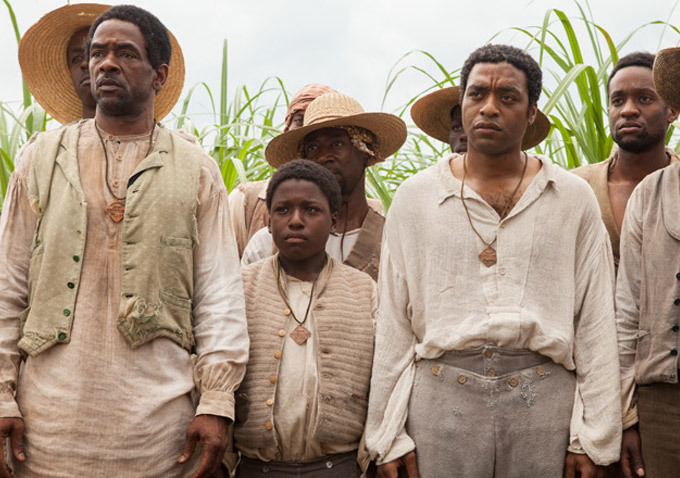
12-years-a-slave-2Watching “12 Years a Slave” is a shattering experience. It shatters any remaining illusions of gracious, chivalrous, Southern plantation life in the pre-Civil War era.  They were based on the late 19th century myth-making from the children of slave-owners in a toxic effort to disguise the reality that the South was fighting to preserve a system of virulent racism fueled by the economics of plantation life. It shatters cherished notions of the first principles underlying the founding of this country.  The man who wrote the revolutionary words that “all men are created equal” was a part of this atrocity. It shatters all previous depictions of slavery.  By comparison they seem cartoonish and fraudulent, from “Gone With the Wind” to “Django Unchained,” more about the time they were made than the time they depicted. And, like all great films, it shatters our previous notions of what was possible on screen, with performances so vivid and compelling they seem to break through every boundary, between us and them, between then and now, between actor and audience. In one audacious moment, Solomon Northrup (Chiwetel Ejiofor), a free man sold into slavery, looks into the distance, eyes filled with ineffable suffering and loss, and then turns to face us, looking into the eyes of those who are looking at him, bringing us further into his world.

This is different because it is a rare story of pre-Civil War South told from a black person’s point of view. It is based on Northrup’s book, written after he returned to his family.  It is the story of slavery from a man who experienced it, and who knew what it was like to live as a black man who was not just free but better educated and more successful than most people of any race in his community. In that sense, it is a story told from inside the system of our country’s greatest shame.  In another sense, it is presented by outsiders, director Steve McQueen (British) and stars Ejiofor (the British son of Nigerian immigrants) and Lupita Nyong’o (born in Mexico, raised in Kenya, educated in the US).  They tell us Northrup’s story — and ours — without being tied to the way we prefer to tell ourselves what our history is and means.

Northrup is a successful musician, happily married with two adored children and respected by both white and black members of his community in New York State.  He accepts a job playing with some circus performers (Scoot McNairy and “SNL’s” Taran Killem) in Washington, D.C., where slavery is legal.  They drug him and sell him to a slave dealer (Paul Giamatti).  Without his papers, he cannot prove he is a free man.  Soon he is renamed Pratt and transported to Louisiana, where he is sold first to a comparatively benevolent man (Benedict Cumberbatch), but then, when he gets into a fight with the overseer (an oily Paul Dano), he is re-sold to a brutal man who prides himself on being an n-word-breaker (Michael Fassbender).  Northrup loses more than his family, his liberty, his name, and his freedom.  He loses his very self; he is told early on that if the white people know he can read and write, it will create more trouble for him.  Indeed, when he tries to be helpful by suggesting a better system for transporting the crop, he earns the gratitude of his master but incurs the jealousy of the white boss.  The only way to survive is to pretend to be the sub-human the owners need them to be to continue to hold onto their bigotry.

This movie makes clear the poisonous, psychotic twisted mind that can accept or even justify the idea that one person can buy and sell another.  Over and over, we see the slaveholders at the same time acknowledging and denying the humanity of the people they think they own.  A female slave sobs because her children have been sold and she will never see them again.  The woman of the plantation, briefly sympathetic, says, “Poor woman.”  But then, immediately after, “Your children will soon be forgotten.”  Slaves are included in family worship services (though not seated with the family).  But their souls are never acknowledged; they are categorized as livestock.

There are terrible beatings.  There is torture and rape.  Slave children run and play, laughing, ignoring the man who is almost choking to death as punishment. There are property identification chains slaves must wear if they go off the property, like something between a hall pass and a dog tag.  There is a slave who has made her peace with what she has done to get better treatment — and with what she now does to other slaves.

Instead of the lush orchestral score usually underlying period films or the melancholy flute and drum usually heard in Civil War films, Hans Zimmer has created spare, edgy music that is bleak without being maudlin.  McQueen’s approach is sure and direct and the script by John Ridley is ably structured and thoughtful.  Nyong’o’s gives performance of exquisite grace and heart-wrenching dignity.  But the center of the story is Northrup.  Ejiofor is sure to get an Oscar nomination for a performance of unparalleled depth and eloquence.

Parents should know that this film includes very graphic and disturbing images of slavery, with rape, murder, and abuse, brutal whipping and atrocities, nudity, sexual references and situations, constant racial epithets, drinking and drunkenness.

Family discussion: What was the significance of the early scene in Mr. Parker’s store?  How does this story differ from other movie depictions of the pre-Civil War South?  Why did Northrup join in the singing of “Roll, Jordan, Roll?”

If you like this, try: book by Solomon Northrup, “Amistad,” American Experience: The Abolitionists, and Roots

Related Tags:


Based on a book Based on a true story Drama DVD/Blu-Ray Pick of the Week Epic/Historical

The Fifth Estate

Posted on October 17, 2013 at 6:05 pm

B
Lowest Recommended Age: High School
MPAA Rating: Rated R for language and some violence
Profanity: Very strong language
Alcohol/ Drugs: Drinking
Violence/ Scariness: Some violence including murder of two people and footage of military killings
Diversity Issues: None
Date Released to Theaters: October 18, 2013
Amazon.com ASIN: B00BEIYRYM

the-fifth-estateIn late medieval times, when people first began to divide each other into groups defined by status and power, they began to speak of a “first estate” (the clergy), a “second estate” (the nobility, which also at the time meant the government), and a “third estate” (the common people.  Later, the “fourth estate” was added to describe journalists and what today we call news media.  Julian Assange, the Australian teenage hacker turned founder of Wikileaks is singular, unprecedented, gui generis.  He collects masses of “secret” data and publishes it without editing, digesting, analysing, or redacting any of it.  And so, this movie, with Benedict Cumberbatch as the white-haired Assange, is called “The Fifth Estate.”

This movie, from director Bill Condon (“Kinsey,” “Dreamgirls”), and based on a book by Assange’s now-estranged former partner Daniel Berg (played in the film by “Rush’s” Daniel Brühl) at times feels as though it is un-digested and un-analyzed.  As a government official forced to resign due to some of the disclosures says near the end of the film, “I don’t know which of us history’s going to judge more harshly.”  I would advise anyone interested in Wikileaks to begin with the documentary, “We Steal Secrets: The Wikileaks Story,” directed by Alex Gibney.

Assange says that he has two goals for what he calls “a whole new form of social justice.”  He says he wants transparency for institutions and privacy for individuals.  The problem, or, at least, one problem is that institutions are made up of individuals.  And so, when one of Wikileaks’ early scoops is a list of British members of the far right “National Party,” it does not bother him that the members’ contact information is disclosed.  Assange is an absolutist.  He refuses to edit or redact (remove identifying information from) any of the documents he publishes.  “Editing reflects bias,” he says.  He is also something of a monomaniac and a megalomaniac, at least in the view of his one-time colleague.  According to this film, he grew up in an odd Australian cult called “The Family,” with severe beatings, and has been diagnosed as being on the autism spectrum.  He is very protective of his own privacy as he exposes the secrets of others.  And, as they say, just because you’re paranoid does not mean they’re not really out to get you.  Once Assange starts exposing the secrets of the wealthy and powerful, they start coming after him, and the thing about being wealthy and powerful is that they have the resources to inflict a lot of harm.  Two of his sources are murdered.

Condon does his best to minimize the scenes of people staring intently into monitors while they bang on the keyboards.  He has some nice visualizations to evoke the experiences, some fantastic, some just the rocky topography of Iceland, one of many places Assange hid.  And he takes a balanced approach.  Everyone would agree with some of what Assange has uncovered.  And everyone would object — even be horrified — by something he has done.  Both sides quote Orwell.  Big Brother is watching.  Like “The Social Network,” the movie focuses on the rise and fall of the friendship and partnership more than the impact of the product they were working on.  In this case, that is in part because we don’t know what that impact will be.  But in this case, we do know that the impact is transformational.  This is not some Facebook advertiser using an algorithm on your status posts to figure out what to sell you.  This is a 22-year-old destroying the confidentiality that allows candid conversations between diplomats, including information about the foreign nationals who are giving them information.

Assange explains early in this film that the program he has developed to protect the identity of the providers of leaked documents is to drown them in false and phony data.  He can say that editing reflects bias, but in the case of terabytes of information dumped in undigested and unredacted form, the data dump can be just as distorting.  Like the journalists Assange worked with on the Bradley Manning material, this film tries to put some shape and perspective on a story that is still too big and too new to frame as a definitive narrative.  But it is an absorbing story and as good an assessment as we can get for now.

Parents should know that this film has very strong language, violence including shooting and wartime scenes with some disturbing images.

Family discussion:  What is the answer to the State Department official’s question about whose side history will be on?  Who should decide what gets released?  If Wikileaks makes other organizations accountable, who makes Wikileaks accountable?  Do you agree with the two things Assange says you need to have to succeed?

If you like this, try: the documentary “We Steal Secrets: The Story of Wikileaks,” read up on the most recent leaker, Edward Snowden, and take a look at the Wikileaks page

Related Tags:


Based on a true story Drama Movies -- format Politics
THE MOVIE MOM® is a registered trademark of Nell Minow. Use of the mark without express consent from Nell Minow constitutes trademark infringement and unfair competition in violation of federal and state laws. All material © Nell Minow 1995-2026, all rights reserved, and no use or republication is permitted without explicit permission. This site hosts Nell Minow’s Movie Mom® archive, with material that originally appeared on Yahoo! Movies, Beliefnet, and other sources. Much of her new material can be found at Rogerebert.com, Huffington Post, and WheretoWatch. Her books include The Movie Mom’s Guide to Family Movies and 101 Must-See Movie Moments, and she can be heard each week on radio stations across the country.

Website Designed by Max LaZebnik