
The First Presidents on Film
Posted on November 6, 2012 at 3:59 pm
As soon as movies were invented, Presidents started appearing on screen. I love to watch these early films of the men we learn about in history books.
Posted on November 6, 2012 at 3:59 pm
As soon as movies were invented, Presidents started appearing on screen. I love to watch these early films of the men we learn about in history books.
Posted on November 3, 2012 at 3:59 pm
 The Mark
But Turner is not carrying the chip. It has been implanted in his arm. It is worthless unless he is alive. Pike and Cooper are utterly ruthless but both have to find a way to fight each other without crashing the plane or killing Turner. And then, somehow, some of the people on the plane just disappear, without their clothes and jewelry. Everyone else is left behind.
Turner has lost his faith in just about everything, except perhaps for a lovely flight attendant named Dao (Sonia Couling). But the brutality and corruption he sees in Cooper and Pike and the goodness he sees in Deo awaken the hero in him.
I have one copy to give away. Send me an email at moviemom@moviemom.com with “Mark” in the subject line and don’t forget to include your address (US addresses only). I’ll pick a winner at random on November 7.
Posted on November 2, 2012 at 8:00 am
Be sure to check out our Movie Corner Movie of the Month, Casablanca
Posted on November 1, 2012 at 6:00 pm
B+| Lowest Recommended Age: | Kindergarten - 3rd Grade |
| MPAA Rating: | Rated PG for some rude humor and mild action/violence |
| Profanity: | Some schoolyard language |
| Alcohol/ Drugs: | None |
| Violence/ Scariness: | Cartoon-style action violence and peril, guns, explosions |
| Diversity Issues: | Strong female and disabled character |
| Date Released to Theaters: | November 2, 2012 |
| Date Released to DVD: | March 4, 2013 |
| Amazon.com ASIN: | B00A7OIXW6 |
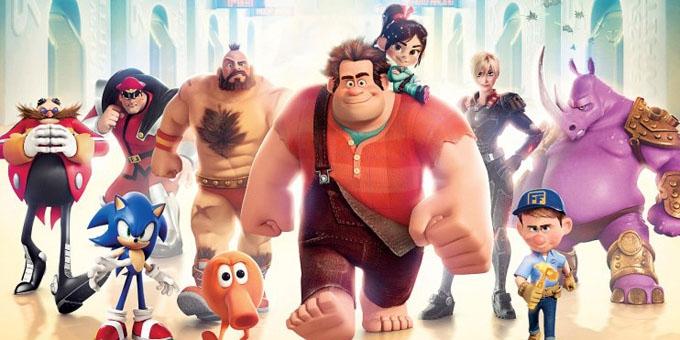 No one wants to be the bad guy anymore. In “Despicable Me,” Gru’s delightfully dastardly plans were no match for the overpowering adorableness of three little girls. “Megamind” found that being the bad guy was no fun after he vanquished the hero. Even the sharks in “Finding Nemo” became vegetarians, with support group meetings to chant, “Fish are friends, not food.”
And now there’s Ralph (John C. Reilly), having something of an existential crisis. Back in the 80’s era of arcade video games, before people had home computers and game stations and televisions that were part computer and part game station to play on, if you wanted to play a game you had to go to an arcade and get a roll of quarters. The primitive 8-bit games had a charm of their own, in part from the novelty of games on a screen instead of being based on mechanical balls and levers, and in part because their very simplicity left a lot of room for the player to fill in the details from his or her own imagination. The brilliant documentary The King of Kong: A Fistful of Quarters
This is a marvelous environment for a story, whether you grew up with these games and recognize the in-jokes or haven’t played a game since Pong and Tetris, even those who do not know a Wii from a Playstation. Wreck-It Ralph is so persuasively authentic it seems to be entirely at home with what has been referred to as “the Roger Rabbit of video games.” Ralph keeps knocking down the building inhabited by the Webelo-like residents of Niceville, and the relentlessly cheerful Fixit Felix, Jr. (“30 Rock’s” Jack McBrayer), with the help of the quarter-loading player, rebuilds so fast that Ralph gets thrown off the roof of the building and everyone in Niceville has a party. Ralph doesn’t break things to be mean. It’s just his job. It’s in his code. He feels that he is as much a part of the game as Frank and the building inhabitants. Ralph shares his conflicts with an adorable villain support group (love the zombie with axes attached to his hands). But he wants more.
Ralph is just lonely. He wants to go to the party. He wants to make friends. He wants people to like him. But just as he is coded to break things, the Niceville residents are coded to be scared of him. Just to get rid of him, one of them tells him that if he can win a hero’s medal, he can be their friend. So Ralph leaves his game to find a place where he can be a hero.
Ralph visits an intense and violent military game called Hero’s Duty with a tough female commanding officer named Calhoun (Jane Lynch). She is “programmed with the most tragic backstory ever” and probably inspired by video game voice star Jennifer Hale, the combination Meryl Streep and Angelina Jolie of the video game world. Everything seems to go according to plan until he somehow ends up in Sugar Rush, a game for children that looks like NASCAR if it was designed by Katy Perry. Adorable little children race cars made out of candy and cookies.
Maybe not so adorable. Just as Ralph is not so bad, the cute little kids of Sugar Rush are not so sweet. He is annoyed by Vanellope (Sara Silverman), a bratty little girl, but then joins forces with her to help her build a race car. And then he meets the “heroes” of Sugar Rush and finds that the line between good guy and bad guy is not what he thought it was.
The witty and vibrant worlds are gorgeously imagined (and of course now available in game form themselves), with a satisfying balance of heart and humor. The story nimbly mixes existential questions of identity, purpose, and destiny with a sweet friendship and knowing humor about the world of games and gamers and even some Joseph Schumpeter-style creative destruction. I loved the Mentos jokes and the detour to the car-building site. And I loved the constant playing with almost Pirandello-esque notions of the way we create our worlds and the assumptions that underly them.
Parents should know that this movie includes video game violence with guns and explosions, some mildly disturbing images, characters in peril, and some potty humor.
Family discussion: How do you know what is “in your code” and what you can change? Can a bad guy become a hero? What did Ralph learn from Vanellope? Why did Vanellope love her car?
If you like this, try: Two more movies with bad guy-good guys, “Despicable Me” and “Megamind,” as well as “King of Kong,” the brilliant documentary about a video game competition.
Posted on November 1, 2012 at 8:00 am
After documentary filmmaker Arnon Goldfinger’s grandmother died at age 97 in Israel, he brought a film crew to her apartment where she and his grandfather lived from the time they immigrated to what was then called Palestine just before World War II. He was fascinated by their home, which seventy years later looked as though it had been transplanted from their birthplace in Germany. The books on the shelves were in German. They always spoke German in their home. Most of their lives were lived in Israel, but they lived as though they were still in Berlin.
Goldfinger thought he would learn something about his grandparents as the family sorted through their belongings. But he could never have imagined what he would find or where it would take him. His grandmother had saved issues of one of the most virulently anti-Semitic newspapers distributed in Nazi Germany. This discovery led to a journey that illuminated one of the strangest friendships imaginable, represented by an artifact that is almost unthinkable — a coin with a Jewish star on one side and a Nazi swastika on the other. The movie also focuses on the strain this inquiry put on Goldfinger’s relationship with his mother, who was almost as passionate about not finding out the answers to his questions as Goldfinger was about seeking them.
I spoke to Goldfinger when he was in Washington, D.C. to show the film, which opens tomorrow.
What did you think you were going to film?
To be honest, I just wanted to be there with the camera and document the world I knew was going to disappear very quickly. I thought it would be an even quicker process. I knew this flat all my life and I had an ambivalent feeling toward it. On the one hand, I had an attraction to this world, to this culture, to those books, to the secrets, the mystery. On the other hand, as an Israeli it was so foreign, so German, so connected to the tragic happenings in the Holocaust. It was only later I had an idea to make a film, but even then the idea was just something very short. People would ask, “What can you learn about someone from what they leave behind?” This shows you can learn a lot.
What does your mother think about the movie?
I was very afraid of course. Our relationship was close before and if it would stay like that, it would be fine. But I was surprised. It brought us closer. She was very supportive of the film. After the first screening, when she first saw it, she said she saw it was important for her, too. When her friends saw the film, they said to her, “We didn’t know, either. We didn’t ask.” She felt that she was not alone.
Why was your mother reluctant to know more?
She was really raised in a German house. I remember as a kid, hearing her argue with her parents in German. But when she went out of the flat, she was in Tel Aviv, the Mediterranean combined with bohemian, a place of vibrance. She lived two lives. But like all of the people of her age, she wanted to leave the past behind her, as you see when you look at her flat, not even any dust from the past. Your house is the place you want to live in. And she wanted to live with with barriers to all the historical items. Before I made the film I thought it was her character. But now I understand it’s a barrier from all the pain and sorrow.

You met with Edda, the daughter of the Nazi couple who were your grandparents’ friends. Tell me something about your impressions.
They were lovely people, very friendly, welcoming, warm. That made it harder. If they were nasty it would have been easier for me. During my research I would think, “Maybe it’s not possible, maybe it’s not right” that this friendship existed between my grandparents and the Nazis. If I called someone out of the blue and said “My grandparents knew your parents, I would not recognize one name.” But the way she recognized it so immediately, the way she knew and was so glad to hear from me in such an open way and with such memories — I don’t remember even one gift my parents’ friends gave me — but for her, she remembered so much.
What about her father, the man who was your grandparents’ friend while having an important role in the Nazi party?
I found much more about him than what is in the film. It was important to say that he did not live the Nazi party. He was involved in anti-Semitic propaganda. But he wanted to stay in contact with Jews. I found all kinds of other things about him, nothing that would change your mind, no smoking gun, but you could ask yourself, “Did he have an alternative?” The way to describe what happened was this. Nobody knew what Hitler wanted, but everybody knew if they did something Hitler did not want, it’s the end. It was a classic regime of terror. There’s a book called Alone in Berlin
One of the most shocking moments for me was when Edda told me that she knew my family had lost someone in the concentration camps. She did not have the details right. She thought it was my grandfather’s mother, not my grandmother’s mother. She’s a little mistaken with the details but it shows that she and therefore her parents knew some of what happened. That means my grandparents were sitting over there in the garden where we were, discussing the death of someone from their family with a man who was a Nazi. Did they ask him if he received their letter asking for help? Did he tell them he could not help them? There were a lot of lies over there.
My favorite character in the movie was your grandmother’s friend. What a beautiful face. I felt I knew your grandmother by seeing her friend.
She was my grandmother’s closest friend and like an aunt to me. When I first approached her, she did not want to be filmed. She was the only one, and I could not understand why. It took me almost a year to persuade her. But she said, “I will give you half an hour, but you come alone.” I told her I had to bring a cameraman and a sound man, and she said, “No, no, no.” In the end, it was only me and the cameraman. I figured she would see it is not threatening and she would let me stay longer. The cameraman said, “Be careful. Remember who you are dealing with. Ask the questions you want in the beginning not as usual at the end.” After 32 minutes she told me it is enough. Three months later she passed away. Her daughter was so happy that I captured her in her beauty. There’s such elegance in those characters.
Why did your grandmother keep the Der Angriff
There was something emotional about it, a memory from a very, very important event in their life. The idea was to keep an eye on the Nazi and push him to include more Zionist material in his story. There may be a possibility my grandfather even edited the article. It was something very vivid at the time and maybe she forgot about it. She never opened it again. Maybe she forgot about it.
What are you going to do with them?
I think maybe give them to the Zionist archive in Jerusalem or to Yad Vashem.
Why does this movie touch people so deeply?
The film is telling an amazing story about a Nazi and a Jew, but really it is a movie about family, what you know about your family, what you want to know, what you can know. Those questions anyone can identify with, especially in America, a place of immigrants. Some people who see the movie tell me, “I want to ask my parents more about our history.” And some say, “I need to get rid of a lot of the things in my house!”