“That Guy” — Showtime’s Documentary About Character Actors

Posted on October 13, 2012 at 3:59 pm

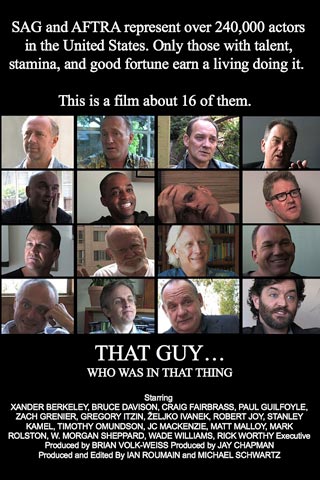
I have a special affection for character actors.  They have to create a character and move the story forward without having the luxury of time and the audience’s primary attention, and they have to do it without overshadowing the star.  So I was delighted to see Showtime’s tribute to character actors, a documentary called, “That Guy….Who Was in That Thing.”  Candid interviews with actors who all look familiar but not instantly recognizable, who might be mistaken for someone you went to school with or once saw at a family reunion cover touchy subjects like auditions, being a guest star on a show where the stars do not think it is worthwhile even to introduce themselves, going for months without a job, family and financial stress, being stuck with a lot of technical talk or exposition, and the pure joy of having the opportunity to perform.  It’s On Demand through November 13 and well worth a look.

Related Tags:


Actors Documentary Television

Interview: Matthew Heineman of the Health Care Documentary, “Escape Fire”

Posted on October 11, 2012 at 6:56 pm

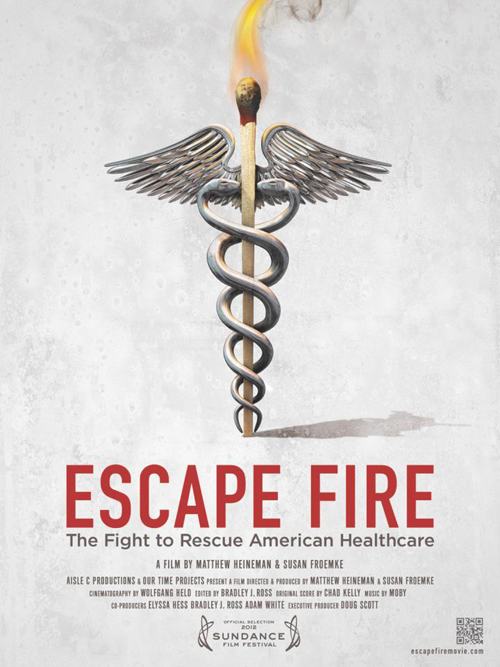
“Escape Fire” is a new documentary about what does not work in our system for preventing and treating illness, and what some people are doing to make it better.  I spoke to Matthew Heineman, co-director and co-producer of the film.

Tell me about the reactions you have been getting from people who see this film.

I think one of the most inspiring things for us is to really see what happens when a local community screens the film. Just two weeks ago we screened the film at 62 medical schools across the country, all on one night.  There is an outpouring of optimism, that this is a problem that we can fix, a problem that we don’t have to wait, necessarily, for someone to come in from Washington, that change can really happen on the local level, sort of doctor-by-doctor community, system-by-system, and that’s how change can happen quickly.  One of the real goals of the film is to transform how our country views health and habit.  Medical school is the future, so their response is important.  We also screened last week at the Pentagon, hosted by the U.S. Army Surgeon General, and have sort of a room full of leadership generals and medical leadership at the Pentagon. And again, they recognize this problem that they have with over-medication, recognize that the status quo’s not working, and the Surgeon General said herself that she really thinks that this film can help change the culture of medicine in the army to begin with, but hopefully with the military at large. So it’s pretty amazing, we’re already seeing impact happening.

A big light-bulb moment for me comes fairly early in the film when somebody says, “We don’t have a healthcare system, we have a disease-management system.”
We did 6-8 months of research on the topic and almost everyone was saying that.  It’s a system that profits from sickness, not on health. 75% of healthcare costs go to preventable diseases, so how did this system come to be? Why did it not want to change? We wanted to try and find people out there who are trying to change it. Just to quickly mention one thing I didn’t say about your first question,

It seems to be that the problem which you touch on in the last part of the film, the inevitable corruption of corporate money and politics, is the real insoluble problem.  You can have the good will in the world and you can have all the data in the world, but when people are getting paid hundreds of millions of dollars under the current system, it’s very hard to get them to change it.

There’s no question about that.  As Andrew Weil says in our film, there’s rivers of money flowing to very few pockets, and the owners of those pockets don’t want to see anything changed.  I think what’s different now, and one of the reasons why we made the film is that things can’t get any worse.  We’re spending 2.7 trillion dollars a year on healthcare. That’s just a number, but when it comes down to individual companies or healthcare systems or cities or towns or small businesses or individual people, it’s bankrupting us. So, we’re being forced to change, we’re being forced to adapt, because what’s happening now is unsustainable.  We see that with the military in our film, we see that with Safeway Corporation in our film, we see that at the Cleveland clinic, that these major institutions are being forced to change, and so I think, yes, the system is making a lot of money out of the way things are, but many of the players in the system recognize how unsustainable it is and thus are being forced to change.

Your movie makes the case that when you spend more money it doesn’t necessarily correlate to better outcomes.

That was one of the most eye opening things for us.  In America we have this fascination with faster, bigger, better, now; we want the quick fix. We want that pill, we want that procedure, we view healthcare as something that somebody gives to us or does to us or something that we put in our throat, and I don’t think we really recognize that more isn’t necessarily better when it comes to healthcare, that more can often hurt us, that there’s this term called ‘over-treatment.”  We reward for quantity and not for quality. Doctors, we pay for the diabetics to get their foot amputated when they’re 60, but we don’t pay for simple nutritional counseling when they’re 20, 30 or 40 to prevent that from happening in the first place. It’s just a perverse system.

What got you interested in this as an issue?

We started the film three years ago just as the healthcare debate was heating up, and I think like many Americans we were just confused by the traditional media coverage of the topic, I mean, it was so hyperbolic and so confusing; healthcare was really dividing our country. So, I think we really wanted to try to understand, systemically, how it was broken, why it was broken, but also highlight people out there who were trying to fix it.  So many films like this are just polemics, that you walk out of there, head hanging low and just hopeless, and I think we knew from day one that we didn’t want to do that. We also knew from day one that we wanted to have real, powerful human narratives that would provoke audiences to want to keep watching.

What can a movie do that an op-ed or book or politician could not do?

I’m obviously biased; I’m a film-maker. I think documentary film has the power to really bring an issue that to life, with real human stories in a way that facts or articles or tweets don’t or can’t.  What we really tried to do was make a film that would not only move you intellectually but move you viscerally.  We look at healthcare through a number of different lessons and through a number of different characters that I think almost anyone in American can identify with, at least one, two, three or all of our characters in this film and say, “I know somebody like that,” “that’s sort of like me.”  It is just the power of film to associate at a more visceral level with an issue. I think that’s what documentary has the power to do.

Why did you choose to name the film after a technique for stopping a forest fire by setting a small controlled “escape fire?”

Escape fire is a metaphor between our healthcare system and a forest fire from 1949 that happened in Mann Gulch, Montana.  The fire fighters were filled with hubris, with the latest and greatest technology, they thought they’d have it beat by 10 o’clock the next morning—then the wind shifted directions and they found themselves running down this hill for dear life.  The foreman, the leader of this group, came up with this ingenious idea on the spot, where he lit a match and he burned the area around him to consume the fuel, so that when the fire came over to them, he’d be safe in what is now known as an “Escape Fire.”  He called to allow his fellow smoke-jumpers to join him, but nobody listened, and they kept running up the hill.  They all died, but he survived, basically, unharmed. And I think it’s a really powerful metaphor because it shows that the status quo is so strong, especially in healthcare, it’s so easy to keep doing what we’re doing, and we’re making a lot of money continuing to do what we’re doing, but we really need to look outside the box and think outside the box to come up with an escape fire for our system.  Otherwise we’re doomed.

 

Related Tags:


Directors Documentary Interview

Here Comes the Boom

Posted on October 11, 2012 at 6:00 pm

Kevin James is so gosh-darned likable that he can make up for a lot of sub-par material, but not even he can make this tiresome effort work.  James co-wrote the story, an attempted feel-good saga of a lost-mojo high school science teacher who finds his passion when the school’s music budget is cut and he decides to raise the money to save it by losing a series of mixed martial arts fights, inspiring everyone around him and winning the love of the school nurse.  But the movie itself comes nowhere near mojo.  It taps out right from the start and the promised Boom never arrives.

James plays Scott, who is as unenthusiastic about his students as the texting teacher in the recent “Won’t Back Down.”  He does not do much other than hit on School Nurse Flores (Selma Hayek), who has as little interest in him as he as in his job, his self-respect, or his future.  But he takes pity on the sweet-natured music teacher Marty Streb (Henry Winkler), who loves teaching, because budget cuts eliminate the music program just as Marty’s wife, defying the odds, becomes pregnant in her late 40’s.  Scott promises to help.  He takes on another job, teaching immigrants how to pass their citizenship tests, which leads to a painful scene of condescending ethnic humor.  People from other countries don’t speak good English!  Alert the media!

One of those students is Niko (real-life MMA star Bas Rutten, a James regular), an exercise instructor and MMA coach.  Scott finds out how much money can be made by losing MMA matches and decides that since he was a college wrestler, he is “good enough to lose.”  Cue the training montage and the beat-down montage.  And a limply staged and random food fight.  And the mojo montage, as everyone is inspired by this very uninspiring underdog story.  They could have included a montage of me looking at my watch.  It would last as long and be almost as exciting.

I did enjoy the use of Neil Diamond as Scott’s entrance music and Ruten has some rough charm.  But Scott’s attempts to make a connection between stagnant cells and the dispiriting state of schools where teachers “can’t speed up the good ones or slow down for the other ones” falls flat because the film’s own lack of energy feels pretty stagnant itself. Boom, you say?  More like a sigh.

Parents should know that this film has extended and sometimes intense “action-style” mixed martial arts violence, with no blood or graphic injuries except a dislocated shoulder but a lot of beating up and getting beaten up. It also has some language, some crude humor (barfing, crotch hit, jokes about fertility of an older woman and about cross-dressing), an AA meeting, and some ethnic humor.

Family discussion: What does “good enough to lose” mean? How did Scott’s experiences as a fighter change the way he thought about teaching? How can someone be jealous of someone else’s passion?

If you like this, try: Kevin James’ “Paul Blart: Mall Cop” or a more dramatic film about MMA fighters, “Warrior”

Related Tags:


Comedy High School Romance Sports

Argo

Posted on October 11, 2012 at 6:00 pm

A-
Lowest Recommended Age: High School
MPAA Rating: Rated R for language and some violent images
Profanity: Very strong language
Alcohol/ Drugs: Drinking, smoking
Violence/ Scariness: Scenes of mob violence, hostages, references to terrorism
Diversity Issues: Ethnic, political, and cultural differences a theme of the movie
Date Released to Theaters: October 12, 2012
Date Released to DVD: February 18, 2013
Amazon.com ASIN: B00AHTYGRW

The movie within the movie, an outlandish space fantasy possibly named “Argo” for Jason’s vessel in the ancient Greek myth, may be more believable than the true and recently declassified story that surrounds it.  In 1979, when American State Department employees were taken hostage in Iran, six escaped and were hidden by the Canadian ambassador.  A CIA “exfiltration” expert who specializes in getting people out of difficult situations, rescued them by disguising them as members of a Canadian film crew, scouting locations for a fictitious Hollywood movie called “Argo.”

It is like an episode of the television series “Mission: Impossible” except that (1) it really happened and (2) it was much, much harder.  Unlike “Mission: Impossible,” the people creating an elaborate false reality in order to fool the other side had to work with civilians.  And they had to navigate a lot of bureaucratic, diplomatic, and national-security-related internal conflicts in a volatile environment with limited sharing of information.  James Bond has something more valuable than a license to kill.  He has a license to pretty much do whatever he wants with M ready to stand behind him.  But Tony Mendez (played by director Ben Affleck) has to make a lot of literally life-or-death decisions very quickly and yet is still subject to oversight by layers of people with different priorities and points of view.

Affleck, following “The Town” and “Gone Baby Gone” (and a screenwriting Oscar for “Good Will Hunting”) is no longer one of Hollywood’s most promising new directors — he has arrived.  This film works on every level.  Even though we know the Americans were rescued (Canada’s embassy was given a prominent location near the White House in gratitude for their efforts), the tension is ferocious.  The scenes in Hollywood, with John Goodman and a sure-to-be-nominated for a third Oscar Alan Arkin are as sharp and witty, recalling “The Producers” and “Get Shorty.”  But rather than an easy way to provide contrast or comic relief, Affleck and first-time screenwriter Chris Terrio (based on an article in Wired Magazine) use those scenes to provide context, along with some tang and bite.  One masterful section of the film intercuts the two stories as the Hollywood group set up shop, secure the rights to the screenplay, and put together a staged reading to get publicity to demonstrate their bona fides while the six Americans are trapped and the exfiltration mission gets underway.  There are a lot of similarities — both sides deal in illusion, and not just the illusion of the sci-fi fantasy film they are pretending to make.  The constant lying about the project comes naturally to Arkin’s character, an old-time Hollywood guy who has seen it all and who himself has no illusions about the integrity and loyalty of those around him.  He says, “You’re worried about the Ayatollah.  Try the WGA.”

Affleck locates the film in its era with hair and clothes that evoke the time period without exaggeration or ridicule, not easy to do with 70’s styles.  He even used 70’s era film stock and borrowed some of the staging from movies of the era like “All the President’s Men,” and the opening titles are in a 70’s font.  But the film also has some important insights about what happened and about our own time, reflected in the conflicts of three decades ago.  It begins with a brief description of the events leading to the hostage crisis, emphasizing America’s support (to benefit the oil companies) of the Shah’s brutal regime, told somewhat differently than it would have been in 1979.

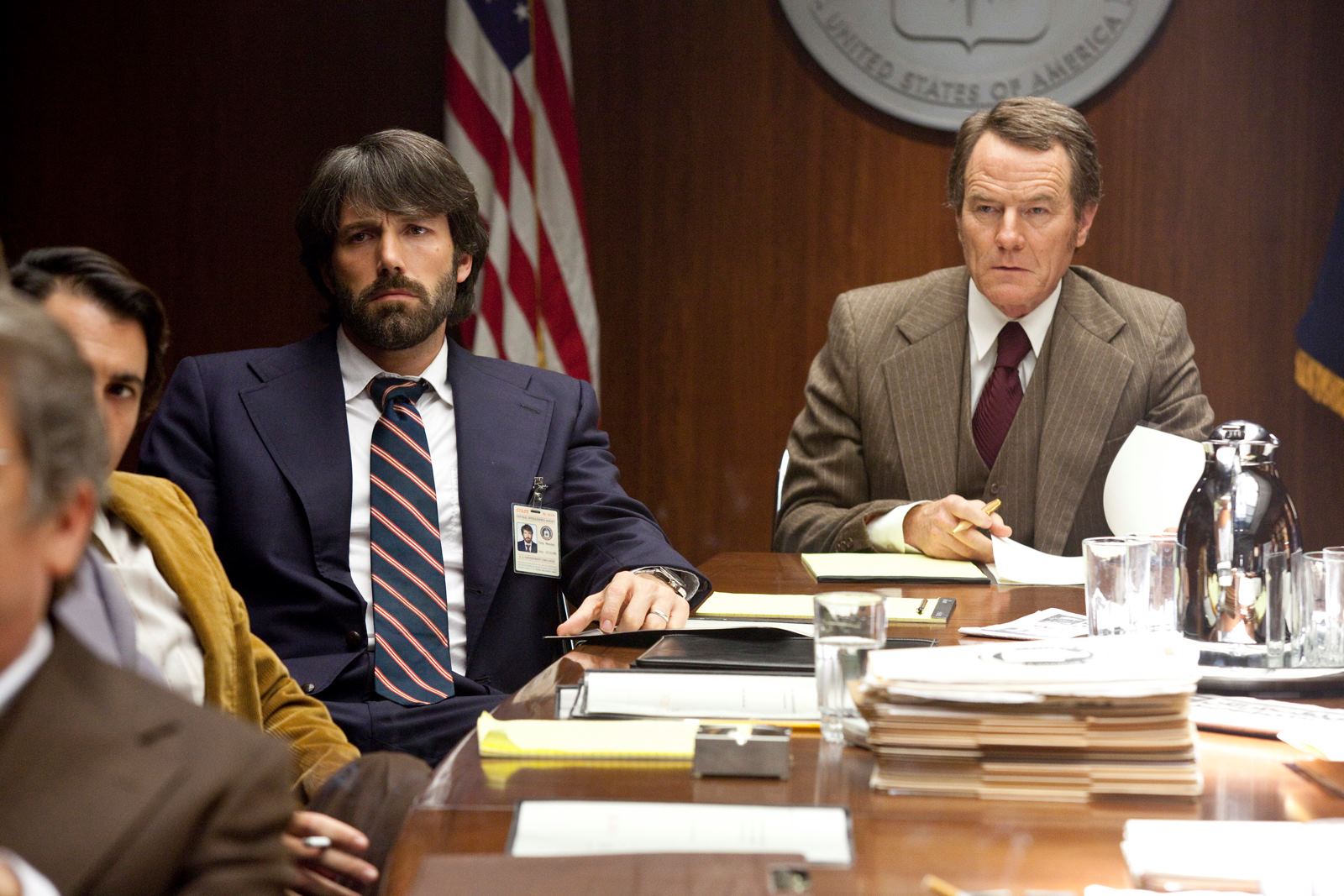
“You don’t have a better bad idea than this?” a State Department official asks the CIA.  “This is the best bad idea we have,” is the reply from Jack O’Donnell (Bryan Cranston).  They can’t fake any of the usual identities for the Americans because they are too easy to disprove.  The normal reasons for foreigners to be abroad — teaching, studying, aid — are not plausible.  Only something completely outrageous could be true.  And it turns out that Iranians are as in love with Hollywood movies as everyone else.  This one is a good reminder of why we all feel that way.

Parents should know that this film includes scenes of mob violence, hostages, references to terrorism, characters in peril, tense confrontations, alcohol, a lot of smoking, and very strong language.

Family discussion: Why did the Canadians take in the Americans?  Why did Mendez defy his orders?  What would you do if someone approached you the way Mendez approached the Hollywood insiders?

If you like this, try: “Charlie Wilson’s War”


Related Tags:


Based on a true story Drama DVD/Blu-Ray Pick of the Week Politics Spies

Argo: The Real Story of the Crazy CIA Caper to Rescue Six Americans in Iran

Posted on October 8, 2012 at 8:00 am

The employees of the US embassy in Iran were taken hostage in 1979, but six escaped and were hidden by the Canadian ambassador and his wife.  A CIA “exfiltration” expert worked with the Canadian government and some Hollywood talent to create fake identities as members of a Canadian film crew scouting locations for the six Americans.  The story was classified for many years (the CIA agent even had to give back his medal), but it is now public.  This week, Ben Affleck directs and stars in “Argo,” based on the rescue mission.  Affleck and the real-life former spook, Tony Mendez, were interviewed by Entertainment Weekly.

“I’ve spent my whole life trying to be boring,” Mendez said. “As an operative, you don’t want to be caught on camera.  And here I am watching Ben on a big screen saying, ‘My name is Tony Mendez.’  That really is weird….The movie is so well-done that I felt exactly like I was back there.”  You can catch the “boring” Mendez in the movie if you look carefully.

The story first came to light in a Wired Magazine article in 2007.  As the movie acknowledges in its conclusion, there were some dramatic liberties taken with the facts.  But the most outlandish aspects of the story really happened.  Mendez had worked with Hollywood experts before on make-up and disguises, so he had some contacts.  Mendez, using the name Kevin Harkin, really did set up a film production company that could credibly be scouting locations for a wild sci-fi/fantasy film.

In just four days, Mendez, Chambers, and Sidell created a fake Hollywood production company. They designed business cards and concocted identities for the six members of the location-scouting party, including all their former credits. The production company’s offices would be set up in a suite at Sunset Gower Studios on what was formerly the Columbia lot, in a space vacated by Michael Douglas after he finished The China Syndrome.

All they needed now was a film — and Chambers had the perfect script. Months before, he had received a call from a would-be producer named Barry Geller. Geller had purchased the rights to Roger Zelazny’s science fiction novel, Lord of Light, written his own treatment, raised a few million dollars in starting capital from wealthy investors, and hired Jack Kirby, the famous comic book artist who cocreated X-Men, to do concept drawings. Along the way, Geller imagined a Colorado theme park based on Kirby’s set designs that would be called Science Fiction Land; it would include a 300-foot-tall Ferris wheel, voice-operated mag-lev cars, a “planetary control room” staffed by robots, and a heated dome almost twice as tall as the Empire State Building. Geller had announced his grand plan in November at a press conference attended by Jack Kirby, former football star and prospective cast member Rosey Grier, and several people dressed like visitors from the future. Shortly thereafter, Geller’s second-in-command was arrested for embezzling production funds, and the Lord of Light film project evaporated.

Since Chambers had been hired by Geller to do makeup for the film, he still had the script and drawings at his house. The story, a tale of Hindu-inspired mystical science fiction, took place on a colonized planet. Iran’s landscape could provide many of the rugged settings required by the script. A famous underground bazaar in Tehran even matched one of the necessary locations. “This is perfect,” Mendez said. He removed the cover and gave the script a new name, Argo — like the vessel used by Jason on his daring voyage across the world to retrieve the Golden Fleece.

The new production company outfitted its office with phone lines, typewriters, film posters and canisters, and a sign on the door: studio six productions, named for the six Americans awaiting rescue. Sidell read the script and sketched out a schedule for a month’s worth of shooting. Mendez and Chambers designed a full-page ad for the film and bought space in Variety and The Hollywood Reporter. The night before Mendez returned to Washington, Studio Six threw a small party at the Brown Derby, where they toasted their “production” and Mendez grabbed some matchbooks as additional props to boost his Hollywood bona fides. Shortly thereafter, the Argo ads appeared, announcing that principal photography would commence in March. The film’s title was rendered in distressed lettering against a black background. Next to it was a bullet hole. Below it was the tagline “A Cosmic Conflagration.”

New Yorkers can see some of the actual artifacts from what was called “The Canadian Caper” on display at Discovery Times Square, including the script for the fake movie.  One of the State Department officials who was rescued wrote about what the movie gets right and wrong in Slate.  My favorite footnote: in an interview with Joshuah Bearman, the reporter who wrote the first story about the declassified details, he says that the fake “Studio 6” production company set up by Mendez and named for the six Americans they were trying to rescue actually received 26 scripts, including one from Steven Spielberg!

Related Tags:


Spies The Real Story
THE MOVIE MOM® is a registered trademark of Nell Minow. Use of the mark without express consent from Nell Minow constitutes trademark infringement and unfair competition in violation of federal and state laws. All material © Nell Minow 1995-2026, all rights reserved, and no use or republication is permitted without explicit permission. This site hosts Nell Minow’s Movie Mom® archive, with material that originally appeared on Yahoo! Movies, Beliefnet, and other sources. Much of her new material can be found at Rogerebert.com, Huffington Post, and WheretoWatch. Her books include The Movie Mom’s Guide to Family Movies and 101 Must-See Movie Moments, and she can be heard each week on radio stations across the country.

Website Designed by Max LaZebnik