Lawless

Posted on August 30, 2012 at 6:00 pm

Musician Nick Cave and director John Hillcoat are Australians who are drawn to bleak internal and external landscapes.  They worked together on “The Proposition,” a western-style and very violent crime story about brothers.  “Lawless” is another crime story about brothers, again very violent and, like “The Proposition,” with a bleak setting and compromised characters.  This one is a true story, based on Matt Bondurant‘s book about his Prohibition-era grandfather and great uncles, who were ran illegal hooch in Franklin County, Virginia, described by writer Sherwood Anderson as “the wettest county in the world.”

“There’s a feeling around these parts that these Bondurants is indestructible,” one character says.  Forrest Bondurant (a quietly powerful Tom Hardy) came back from WWI without injury and the community almost believes the legend that he cannot be stopped.  That’s good for business; you might even say it is their brand.  But just as in legitimate enterprise, the success of a local operation selling moonshine in mason jars attracts the interest of the competition.  The big bootlegging organization out of Chicago is thinking about what one might call a very hostile takeover.  The Bondurants have a good relationship with the local sheriff, who is happy looking the other way for a small piece of the action.  But a federal agent named Charlie Rakes (an oily and twisted Guy Pearce) arrives and for him it is not about law, morality, or directions from his superiors.  It is about power.  The Bondurants are not afraid of him and that is why he wants to destroy them.  Pearce, in gloves and slicked-down hair parted in the middle, is one of the best villains of the year.

Forrest is the leader and he has an unspoken understanding with his brother Howard (Jason Clarke).  Indeed, a lot that goes on here is unspoken.  The youngest brother, Jack (Shia LeBoeuf) wants to prove himself to his older brothers.  And he wants to prove something to a pretty churchgoing girl named Bertha (Mia Wasikowska).  Brash and flashier than his brothers, he has the nerve to try to make a deal with machine gun-toting Chicago hood Floyd Banner (Gary Oldman) and the entrepreneurial instinct to improve and expand production and delivery.  When he sees a brutal gangland slaying, his only thought is to grab a souvenir shell case.  He will have a Michael Corleone moment when the violence gets closer to home.   “It is not the violence that sets men apart,” Forrest says.  “It is the distance he is prepared to go.”  The Bondurants do not give up.  It is not about the money.  It is about defending their home and their right to make their own choices.

Maggie (Jessica Chastain) shows up out of the blue one day, offering her manicured hand to Forrest’s rough one and offering to work for the brothers.  “The city can grind a girl down,” she tells Forrest.  “Gets to a point where you start looking for somewhere quiet.”

Franklin County is far from quiet.  But the noise Maggie wanted to escape was the cacophony of heartlessness she was surrounded by in the city.  Everyone in this story is breaking the de jure law, but Maggie knows that the Bondurants have a core of integrity and loyalty that she can count on.  And she will show that she can be counted on as well.

Strong performances and an evocative sense of time and place anchor the film and the unexpected tenderness of the romantic interludes balances the brutality.  A coda provides perspective that just because someone is willing to go the distance does not mean he cannot come back home.

Parents should know that this is the true story of moonshiners during Prohibition, so the good guys are law-breakers and the police are corrupt.  The movie includes extremely graphic violence with characters tortured, injured, sexually abused, and killed, strong language including a racial slur and segregation, sexual situations including prostitution, female nudity, and alcohol and smoking.

Family discussion:  How were the brothers alike and how were they different?  The script was written by musician Nick Cave – how does the music help tell the story?

If you like this, try: Lawless: A Novel Based on a True Story by the real-life grandson of the youngest Bondurant brother

Related Tags:


Based on a book Based on a true story Crime Drama Romance

“Possession” and the Tradition of Jewish Horror Films

Posted on August 30, 2012 at 3:49 pm

The new horror film “Possession” is a kind of Jewish version of “The Exorcist,” the story of a little girl who is possessed by an evil spirit.  Like “The Exorcist,” it was inspired by a true story, and focuses on non-religious people who must bring in a member of the clergy to remove the evil spirit.  “The Possession” includes a performance from reggae star and real-life Orthodox Jew Matisyahu.

The movie did not screen for critics and it is opening at the end of August, two reliable indicators that it is not very good.  Tablet Magazine has a thoughtful article by J. Hoberman about how it fits into the genre of Jewish-themed horror films.

In The Possession, Matisyahu’s game performance does offer a measure of authenticity—less in Jewish than in film-historical terms. The representation of traditional Jews as exotic, uncanny others puts The Possession in the tradition of early German horror films like The Golem (1920), in which Rabbi Loew of Prague creates an ur-Frankenstein’s monster, andNosferatu (1922), in which a vampire emigrates from deepest Carpathia to Bremen, Germany. Of course, the vampire in Nosferatu isn’t explicitly Jewish, he’s more like an anti-Semitic nightmare—a lascivious, blood-sucking extravagantly hook-nosed Eastern foreigner who arrives in Germany with a plague of rats.

Indeed, 18 years later, the Nazis would characterize their anti-Semitic propaganda as something akin to horror films. In 1940, Fritz Hippler promoted his loathsome Der Ewige Jude, largely filmed in occupied Poland, as “an absolute symphony of horror and disgust,” including an “absolutely truthful” documentary of Jewish ritual slaughter “so awful” as to be inappropriate viewing for Aryan women and children. (Among other “Jewish performances,” the movie included a clip of Peter Lorre—a Jewish refugee—playing the child-murderer in Fritz Lang’s M.)

A few Jewish films produced at Universal (the Hollywood studio most identified with the horror genre) by Central European Jewish émigrés did attempt to answer the Nazi Jewish horror genre. Most notable among these was The Black Cat (1934), Edgar G. Ulmer’s supremely perverse vehicle for Universal’s top stars Bela Lugosi and Boris Karloff, released some 15 months after Hitler came to power in Germany. Taking only its title from Edgar Allen Poe, Ulmer’s movie marooned a naïve pair of American honeymooners in Europe’s heart of darkness, where they became unwitting pawns in the death struggle between a hysterical Hungarian psychiatrist (Lugosi) and a proto-Nazi, Satan-worshipping Austrian architect (Karloff) who has built his steel-and-glass deco castle on the site of World War I’s bloodiest battlefield. Despite trafficking in incest, necrophilia, human sacrifice, and sadism—not to mention a black mass with a stylized crooked cross—The Black Cat somehow got past the Production Code to become Universal’s highest-grossing release of 1934. (Then, in a career move without Hollywood precedent, Ulmer relocated to New York to make Yiddish and Ukrainian “ethnic” movies on budgets that sometimes failed to break five figures.)

In the Jewish Daily Forward, Hannah Brown writes about Jewish demons in movies.

Paddy Chayefsky used the dybbuk theme in his 1959 play, “The Tenth Man,” in which a young girl at a Long Island synagogue is possessed by the spirit of a woman wronged years earlier by a man in the minyan; the play was filmed for German television in 1965. The Coen brothers opened their 2009 film, “A Serious Man,” with a Yiddish prologue about a dybbuk that served as a metaphor for the moral dilemma faced by the beleaguered protagonist. And the dybbuk plot was certainly familiar to Yiddish theater- and movie-goers who saw S. Ansky’s play “The Dybbuk,” which was made into a movie in Poland in 1937. Ansky wrote his play between 1912 and 1917, after he took a journey through Eastern Europe to research local folklore and was inspired by tales of possession and exorcism.

Hoberman talks about the influence of Jews and anti-Semites in horror films from the Wolf Man to David Cronenberg.  I think his most important point is that in “The Exorcist,” we are supposed to see the priests as flawed but heroic, while the Jewish clergy in “Possession” are portrayed as strange and foreign.  That insight is more disturbing insight than any creepy special effects in the movie.

The Exorcist not only terrified the world at large but had a deep and sustained meaning for Catholics, observant or lapsed. A shock closer notwithstanding, Possession is highly unlikely to make a comparable impression on Jews. By objectifying Jews as exotic others rather than presenting them as subjects, the Raimi production eliminates the precise element that would have been most powerful for a Jewish audience: We are possessed by our dybbuk, however you want to allegorize it. Clyde’s anxiety and the tension within his broken home would have been immeasurably heightened if his family were confronted with a repressed aspect of their own past. The movie would have been stronger still if that were a shared heritage—Jews haunted by a lost tradition or the burden of Jewish history.


Related Tags:


Critics Horror Understanding Media and Pop Culture

Back to School Movie Quiz

Posted on August 27, 2012 at 3:58 pm

As you get your school supplies ready and finish up those last assignments on the summer reading list, see if you can answer these questions about movies set in school.

1.  A tough cop goes undercover as a kindergarten teacher.

2. This classic based on a true story is about an English woman who travels to the other side of the world to teach the many children of a king.

3. It’s Saturday, but these five kids have to spend the day in the library for detention.

4. In this touching documentary, a community with very few minorities finds an especially compelling way to teach their children about the Holocaust.

5. A book by Roald Dahl is the basis for this movie about a girl from an awful family who is befriended by a kind-hearted teacher.

6. A musician pretends to be a substitute teacher to make money and ends up turning his class into a rock group.

7. In this body-switching classic, a mother finds out what her daughter’s life is like when she has to spend a day in her daughter’s classes.

8. Undercover cops pretend to be high school students to catch drug dealers in this movie based on a television series.

9. A high school drama teacher decides his class should put on musical sequel to “Hamlet.”

10. Four high school girls form a witches’ coven and get revenge on the classmates who were mean to them.


Related Tags:


Quiz School

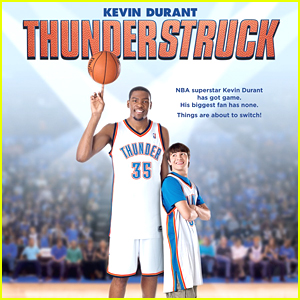
Thunderstruck

Posted on August 23, 2012 at 6:00 pm

C
Lowest Recommended Age: Kindergarten - 3rd Grade
MPAA Rating: Rated PG for mild language and rude humor
Profanity: Some schoolyard language ("sucks," "crap")
Alcohol/ Drugs: None
Violence/ Scariness: None
Diversity Issues: Diverse characters
Date Released to Theaters: August 24, 2012

This “Freaky Friday” with basketball keeps throwing airballs.

It’s the story of Brian (Taylor Gray) a sixteen-year-old kid who wishes he could have the skills of Olympic gold medalist and NBA star Kevin Durant playing himself, not very convincingly but with an engaging low-key unpretentiousness.

A magical basketball (don’t bother trying to figure it out; the movie doesn’t) switches their abilities.  Suddenly Brian can’t miss and KD can’t even make a free throw.  Brian goes from being the subject of jeers and humiliation in the school cafeteria to being a big man on campus, with the entire student body wearing shirts in his honor.  And to the dismay of his agent (Brandon T. Jackson) and the poor director moaning “take 47” as they try to film a commercial for KD’s new shoes, KD can’t get out of his slump.

http://www.youtube.com/watch?v=j0wiLTsDqag

Brian first meets KD at half-time, when he has just been given the chance to do a free throw for a big prize.  Instead of hitting the basket, he hit the mascot.  “I wish I had your talent,” Brian says.  “I wish you did, too,” KD tells him, but then says that it is hard work that matters more than talent.  That is a good message for kids but the entire premise of the movie is the opposite.  Both Brian and KD work very hard but it makes no difference in either case.  This is typical of the carelessness of the script.  Even the good guy characters are self-centered and without any interest in learning anything new.  The coaches (Jim Belushi and his son, Robert) have no understanding of the game’s skills or strategy and no interest in the team other than winning.  “Don’t suck!” is their charming mantra.  When it comes time for the big pep talk before the championship game, the best they can do is recite some lines from “Hoosiers.”  Plagiarism and insincerity — a nice lesson for the kids, both those on the team and those who are watching.

Parents should know that this movie has some schoolyard language (“it sucks,” “crap”), crotch hits, brief potty humor, and some bullying.

Family discussion:  Why did Kevin and his agent react differently when Kevin lost his talent?  Why did Brian become thoughtless and hurt his friends’ feelings?  If you could have someone’s talent, who would you pick?

If you like this, try: “Like Mike” and “Rookie of the Year”

Related Tags:


Comedy Fantasy Movies -- format School Sports Stories About Kids

Premium Rush

Posted on August 23, 2012 at 6:00 pm

He’s a Manhattan bicycle messenger and his name is Wilee, like the coyote.  But Wilee (the always-brilliant Joseph Gordon-Levitt) is more like the road runner in this story.  He has an envelope to deliver, and Bobby (Michael Shannon) wants to stop him.  This nifty little thriller does not need much more than that to hold our attention.  And yes, it delivers.

Director and co-writer David Koepp (writer of “Spider-Man,” “Panic Room,” and “Jurassic Park”), like his hero, pares everything down to the essentials, and that means removing the brakes.  Wilee explains that his bike has no gears and no brakes.  It cannot coast, so the pedals never stop turning.  “People risk their lives for 80 bucks on a good day,” he tells us.  But he loves the freedom, the adrenalin, the constant recalibrating as he swerves in and out of traffic and tries to stay safe in a city were “door” is a verb and getting “doored” (slamming into an opening car door) can cause major injuries.

Just as Wilee is constantly juggling and recalibrating his options as he determines his strategy for getting to his destination as quickly and as safely as possible, with the priority on speed.  Koepp takes us inside Wilee’s head as he looks down different paths and calculates what the outcome will be for each one.  He applies the same sort of calculus to the rest of his life.  He graduated from law school but never took the bar because he cannot see himself wearing a suit to an office, at least not now.  He cares about his girlfriend, Vanessa (Dania Ramirez), but he cannot plan far enough into the future to manage to get to her graduation.  He likes being in the moment.  He does not like anything that reminds him of the other life beyond the urgency of making the deadline.  He loves being a part of the few, the proud, the bike messengers — in a world of email and FedEx, there are still some things that have to be carried in person — but he is feeling increasingly competitive with Manny (Wole Parks), who seems to be chasing Wilee on the streets and Vanessa after hours.

Nobody gets mad better than Michael Shannon.  I do not want to give away too much about what he is trying to do and why, so I will just say that he is great as a volatile man cracking under extreme pressure.   Like Wilee, he looks from side to side to evaluate his options and is still just about able to continue to appear normal when he needs to.  Koepp keeps the gears moving like a Swiss watch, hitting rewind to show us how the characters got to where they are but keeping the pacing tight, with just the right touches of comedy, romance, and plot for a nicely satisfying little late-summer treat.

Note: Be sure to stay for the credits to see a clip showing Gordon-Levitt’s real-life on-set accident, which required 31 stitches on his arm.

Parents should know that this film includes extended peril and some violence including bicycle accident and a gun, characters injured and killed, and some strong language (one f-word).

Family discussion:  Why did Wilee prefer being a messenger to being a lawyer?  What does his name tell us about him?  What did the movie gain from being told out of order?

If you like this, try: “Quicksilver” with Kevin Bacon, “Cellular,” and “The Transporter”


Related Tags:


Action/Adventure Crime Thriller
THE MOVIE MOM® is a registered trademark of Nell Minow. Use of the mark without express consent from Nell Minow constitutes trademark infringement and unfair competition in violation of federal and state laws. All material © Nell Minow 1995-2026, all rights reserved, and no use or republication is permitted without explicit permission. This site hosts Nell Minow’s Movie Mom® archive, with material that originally appeared on Yahoo! Movies, Beliefnet, and other sources. Much of her new material can be found at Rogerebert.com, Huffington Post, and WheretoWatch. Her books include The Movie Mom’s Guide to Family Movies and 101 Must-See Movie Moments, and she can be heard each week on radio stations across the country.

Website Designed by Max LaZebnik