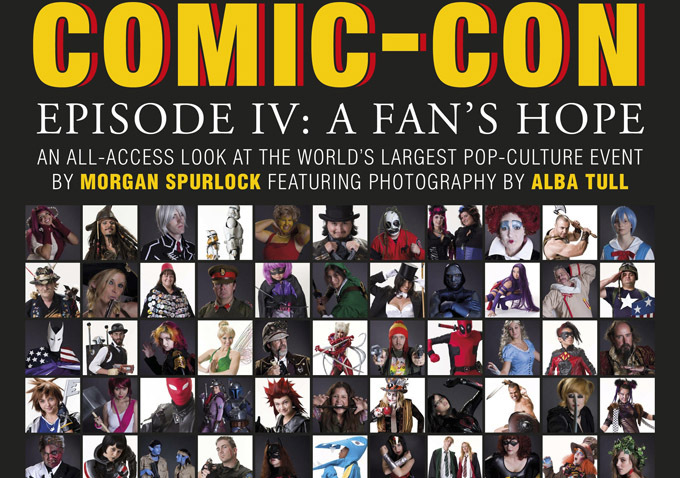
Comic-Con Episode IV: A Fan’s Hope

Posted on April 9, 2012 at 3:36 pm

B+
Lowest Recommended Age: High School
MPAA Rating: Rated PG-13 for some sex and drug references, language, and brief horror images
Profanity: Some strong language and some bleeps
Alcohol/ Drugs: Drug references
Violence/ Scariness: Some images of horror in comic books and other media

There’s an old joke about a woman who goes to a therapist.  “Why are you here?” he asks.  “My family wants me to come because I love pancakes,” she answers.  “Well,” he says reassuringly, “that’s perfectly normal!  I love pancakes, too.”  “Really?” she responds happily.  “You must come over to my house.  I have trunks full of them!”

While many people may tell you that they are fans of “Star Trek” or “Star Wars” or “The Big Bang Theory” or an obscure Marvel comic hero named Red Raven, there are the super-fans who go way past buying the box set DVDs and encasing their comic collection in mylar.  They fill rooms with collections of mint condition action figures.  They spend a year meticulously creating animatronic costumes for characters from a video game.  They propose to their girlfriends with a “Lord of the Rings”-styled engagement ring, in front of 6000 fans at a Kevin Smith panel.  And this is their movie, opening in selected cities and available everywhere via Video On Demand.

Morgan Spurlock, who made himself the star of documentaries that were very critical of big business and corporate brainwashing (“Super Size Me,” “Pom Wonderful Presents The Greatest Movie Ever Sold”), stays off camera in this kinder, gentler tribute to the the consumers who find hope, inspiration, and home in their passion for superheroes, zombies, cartoon characters, games, comic books, and the rest of what the people behind San Diego Comic-Con call the lively arts.  The fans are pretty lively, too, as Spurlock shows, following five attendees.  Comic-Con is one of the only places in the world where you can arrive as a fan and leave as a professional, and two of the movie’s leads are would-be comic artists who bring their portfolios for review by publishers.  One is a costume designer and maker who compares her effort to win Comic-Con’s annual Masquerade costume competition to the “friends on a suicide mission” plotline of the game she is bringing to life. Another is one of the country’s biggest sellers of comic books, hoping to sell one comic worth half a million dollars to keep his business alive.  And one is there to pick up the “Lord of the Rings” engagement ring and propose to the girl he met at Comic-Con the year before at the Kevin Smith panel in the cavernous Hall H.

Interspersed with the journeys of these fans is commentary from other attendees, some in costume and some who like many at Comic-Con are the objects of fan-dom and fans themselves.  Seth Rogan, Kevin Smith, co-producer Joss Whedon, Stan Lee, and more talk about the fans and, endearingly, talk about their own encounters as fans.  And there is some rueful discussion of the Con’s journey from a few hundred people trading comic books in a hotel room in 1970 to 160,000 pop culture fans waiting in line for hours to see movie stars in Hall H.  “We can’t use the loading docks anymore because f**ing Lucas owns them,” says a comic book dealer.  There is thankfully little of the “look at the weirdos in the costumes buying action figures”  commentary Comic-Con often receives, and it is nice to see affection and even respect for people who are passionate about the culture of fantasy and imagination.  Spurlock balances the stories of his characters with the larger context, showing us that each of the attendees has a story and that Comic-Con is a place where stories and characters always matter.


Parents should know that this film includes some strong language, drug references, sexual references, scanty costumes, and some horror images.

Family discussion: What makes people into super-fans?  What do you learn about people from the costumes and media figures that mean the most to them?

If you like this, try: “Trekkies” and its sequel

Related Tags:


Documentary Movies -- format

Interview: Brian Presley of “Touchback”

Posted on April 9, 2012 at 8:00 am

Brian Presley starred in the soap opera “Port Charles” and “General Hospital” and now makes faith-based films with his production company, Freedom Films.  He graciously made time to talk with me about his new film, “Touchback,” where he plays a man who gets a second chance 15 years after an injury in a high school football game ended his hopes for a professional career.  We spoke about his goals for Freedom Films, his own comeback, and the Bible verse he carries with him.

You were a producer as well as star of this film, is that right?

Yes, my company is called Freedom Films and we produced the film, helped raise all the financing and organized this craziness around a pretty awesome story.

Tell me how the story first came to you and why you picked it.

Well, when the story came to me, I was at a pretty rock-bottom place in my life. I had been working as an actor since I was 19.  I started making films back about eight or nine years ago, and had a vision to do movies that were family friendly; movies to bridge a secular audience together with a faith audience around a message with uplifting stories.

As we set out, I kind of lost sight of those principles and began to focus on movies filled with violence and stuff that didn’t necessarily reflect that message. I also started living a more self-centered life-style.  Anyway, to make a long story short, they had a movie that came out and then the unthinkable happened—I was Washington, DC with lawsuits, I wrestled with addiction that brought me to my knees—and through my faith in God I’ve been able to rebound back and have a second opportunity to be here, to really rebound and revamp Freedom Films.

“Touchback” came to me during that time period.  Here was a story about a guy with different circumstances but a very similar situation to the one I was in, as far as what he was going through, and so I could relate to this character. I just knew immediately that this was a gift I just knew that I had to make this movie. We were able to get it organized and it gave me hope again; the movie’s about second chances and it’s ironic that it happens to open the weekend after Easter, given the meaning of Easter.

There’s something very tantalizing and compelling about the idea of second chances, because it makes us think more hopefully about the choices that we make.

You know, to me it’s easy to look back at life and go, “Wow, maybe I wouldn’t be in this predicament hadn’t I made that choice,” and I think sometimes those choices—whether they be bad or good—some of those low points in life are some of the greatest teaching points.  There are the storms of life or the places where we get to a fork in the road and we can go this direction or this direction—I just believe that whatever path we choose, God knows the path we’re going to take.  There are always going to be storms and trials in life.

One of my favorite lines is the movie is “Life gets a heck of a lot harder than football.” And you know, that’s so true. I played high school football and was quarterback, and we went to the state championship.  When you’re in those moments and you’re a kid, you tend to see them as the only things that are important. Life stands still.  But it’s just equipping you for what’s to come. Life is challenging, life throws us curveballs and unexpected challenges, and circumstances might leave us going, ‘Why?”

For me, I’ve been dealt those circumstances and wrestled with my demons and my addictions. You really learn from those time periods and try to change to be a better person. I have a wife and two kids, and I strive.  No one likes to be in those dark valleys. But my faith in God has helped me overcome and I feel like I have a second chance with “Touchback” and some of the other projects we’ve been able to get going.

You have a number of my favorite actors in this film: Melanie Lynsky, Christine Lahti, Kurt Russell, Marc Blucas.  So tell me a little bit about how you went about casting, what you were looking for.

In a way, it’s why I think this movie was a gift, to have it come together with Christine Lahti and Kurt Russell and Melanie and the rest of the cast, and to have everybody fit. It’s like when you try on something and it fits—this one just had that kind of chemistry. Everyone came and got involved in it because of the message behind the movie; they loved the story. Whether living in a small town called Coldwater, Ohio or in Hollywood, California, people gravitate towards the same things: family, community. You want to find your place.  The message in the movie is: no matter how small, when our eyes are diverted outward versus inward, God starts to do amazing things.

Do you have a favorite Bible verse?

I do. Philippians 4:13. When I was in High School I would wear that on my wrist band. “I can do all things through Christ who strengthens me,” and that’s why I think it’s kind of interesting that the movie happens to open up on 4:13—that wasn’t planned.  That’s been the verse that I’ve kept in my back pocket as I travel through life.

That’s what the movie does; we tried to layer God throughout the movie without being heavy-handed.

Related Tags:


Actors Spiritual films

Interview: Morgan Spurlock of “Comic-Con Episode IV: A Fan’s Hope”

Posted on April 6, 2012 at 8:00 am

I was especially excited to talk to Morgan Spurlock about his newest documentary because it is about one of my favorite events of the year, San Diego’s Comic-Con.  Produced by Comic-Con heroes Stan Lee and Joss Whedon, the film follows five people — two artists with portfolios who want to become professional comic book artists, a costume designer who is participating in Comic-Con’s famous Masquerade competition, a dealer hoping to sell his $500,000 Red Ryder comic to keep his business going, and a fanboy hoping to propose to the fangirl he met at Comic-Con the year before, with a ring modeled on the one in “Lord of the Rings,” of course.  The movie was filmed during Comic-Con 2010 and it includes some of the people and events I saw when I was there.  The movie is available everywhere On Demand today.

http://www.youtube.com/watch?v=hqC1pGb89XQ

Your movie makes clear that Comic-Con attracts the most passionate fans of comics, movies, games, and television in the world.  What makes people into super-fans?

I think that if you can openly profess your love for something, then that makes you a real fan. I think that for a long time, a lot of things that were in the film weren’t cool to like, whether it was comic books, or video games, or collecting toys—it was one of those things that was shunned. We live in a world where we’re told to grow up and throw away childish things, and we live in a time now where these are things that really do start to define you as a person, as a character, as an individual, as a creative person.  They kind of shape your world around you, whether it be a hobby or a desire that can’t get fulfilled anywhere else.

One of the things that struck me about this film is the way that it  presents a more gentle and affectionate view of commercialism than your previous films. You’re looking at it from this consumer side this time. Do you think that there is a beneficial side to the commercialism that you’ve been critical of in previous films?

Well, I don’t know if it’s beneficial. I think that if you’re a fan of something you’re going to buy whatever you want and get whatever you like. Anthony Calderon, nothing was going to stop him from getting his 18 inch Galactus, no matter what it was, and if he didn’t get it then he would’ve been online that night buying one on eBay. I feel like when you are a collector and you buy certain things, you’re supporting that hobby. I collect art, I buy a lot of low-brow and street art, pop-art—and it’s one of the things where it is a constant desire for me to seek these things out, and I think that it’s just part of who you are. It does really start to define a part of your psyche and your individuality.

How did you find the people that you focused on?

We put out a kind of mass casting call through websites, through comic book shops, through Ain’t It Cool News. Harry Knowles came on as a producer for the film, and we just got this deluge of submissions, probably around 2,000 people from around the world—e-mails, videos—and from there we started to whittle it down. We wanted to find people who were going their own, to find people who already had tickets, you know, we weren’t giving people tickets, we weren’t flying you there, we were just coming along for the ride. We wanted to find people who were going with a real purpose. We didn’t want somebody who’s just like, “Yeah, it’s my first Con, I’m so excited, I can’t wait to see what it’s like!” That’s not a good story. You want to have somebody like Holly Conrad, who’s like “I’ve already competed in two masquerades, this is the final time I’m allowed to compete, if we don’t win I don’t know what’s going to happen, I really want to use this to break into the costume design business.” That’s a great story, she’s a great character, and she’s incredibly talented. Eric Hansen and Skip Harvey, who are going to comic–con for the first time to try and finally get this closeted desire to draw comics out into the world. They’re basically putting their egos on the table in front of the likes of Marvel and DC and Dark Horse; those are great stories, and those are the things you never get to see or hear about when it comes to Comic-Con.

 That’s right.  The news reports are always about thousands of people waiting in line for the big events at Hall H with all the movie stars.

And that’s what people love to talk about, they say, “How do you feel about movies taking over Hollywood?” And it’s always journalists who ask this, and I say, “Well, just to be clear, movies haven’t taken over Comic-Con. Movies have taken over your coverage of Comic-Con, because somehow somebody said that this is all that matters, this is all that’s important at this giant, pop-culture Mecca. And, we’ve turned it into, “Here’s Angelina Jolie, she’s putting out her new movie—and look at these freaks in costumes,” that’s all the media ever wants to talk about. I went there in 2009, and there’s a much deeper story to tell here that isn’t being realized in any of the coverage.

I think it’s also fair to say that Comic Books have taken over movies.

That’s true.  Comic books have become this never-ending well of brand-new characters and entertainment for the studios, and for television, and so now the comic-books, the guys who are actually trying to sell these paper comics are saying, “We’re getting pushed to the side, we’re getting shoved out of the convention.” They’re getting shoved out of everything. The reality is, the comic book business is a dying business.. The Comic Book industry is not a dying industry, but the actual idea of printing paper comics is, just like printing paper books is dying. We don’t even buy paper books. I don’t even know the last time I bought a book, but since I’ve gotten my iPad, I’ll tell you what—I buy more comics now as an adult than I did probably in like 10 years as a kid, because it’s much easier to download them straight to my iPad.

I love that there is still a real heritage to Comic-Con, there’s still a respect for that heritage, the artists who dated these comics are still there, so I disagree that comics are getting pushed out of comic-con. I think it is transforming into something else.

Tell me a little bit about the guy who proposed to his girlfriend at Comic-Con. Did he get in touch with you and not only wanted to propose in public, he wanted to propose to her in a movie?

He wanted to propose to her at Comic-Con.  It was part of the casting that we sent out, we wanted to find a couple who fell in love because of a mutual appreciation and passion for some geeky thing, whether it was “We both love Star Trek” or  “We both love that video game.”  We got a ton of submissions from people who fell in love or got married because of that and this story of James Darling and Se Young Kang was so fantastic because they had met the previous year as they were both getting ready to go to Comic-Con and fell in love because they both love these things at Comic-Con.  So they basically talked about, “We’re going this year, we both love Kevin Smith, we’d love to be in the film,” and after the end of their joint submission video, they cut to James Darling in a closet, holding the camera next to his face, and he goes…”but what I really want to do is propose to Se Young at Comic Con this year.”

Some people say that Comic-Con is so driven by big business products that there’s no imagination any more and people are just taking the imagination that’s imposed on them from a commercial entity. How do you respond to that?

Well, I think there’s a tremendous amount of creativity in the world, it is exploding with creativity. You see it in this movie, you see it in people like Holly Conrad, you see it in people like Skip Harvey and Eric Hansen, and so I disagree with that. I do think that there’s a tremendous amount of spoon feeding of genres. The fact that we’re continuing to make remakes of movies that have been made, we’re continuing to reboot the franchises, that’s the more frustrating thing—that there’s not a search in that world for new ideas, or that many new ideas. So when someone like Christopher Nolan comes along and makes a film like “Inception,” you’re like, “Oh my God, this is the greatest thing ever,” because it’s not derivative, you’re not living off of something you’ve seen seven, eight, nine times.

Which is even more reason for everyone to stay home this weekend and watch “Comic-Con: Episode IV,” to put on your costumes and have a fantastic geek-out party.

What’s the best way for them to watch it? Is it on Video-On-Demand?

We’re opening this weekend in select cities, so this weekend it’ll be in theaters in Los Angeles, San Francisco, Portland—if you live in any of those three cities, you should put on your costumes and come to the theater and create the new “Rocky Horror Picture Show.” I feel like everyone one of these screenings should feel like Comic-Con. I encourage people all the time, “Wear your costumes, come to the movie, and let people see what it’s really like.” That will be awesome. If you can’t come and you want to see the movie, you should have a Comic-Con party at your house, have a little mini-con, play video games, bring your comics over, put on your Spock ears and your hobbit feet and your Wookiee mask, grab your light saber, and tell your friends, “We’re going to have a Con party!”

Not only is it on Video-On-Demand, it’s on iTunes, streaming, if you download movies through the  Xbox platform, it’ll be available there. It’ll be iTunes worldwide, so it’ll be iTunes streaming world-wide this weekend as well.

What do you, as a film maker, think about that kind of distribution method? Did that open things up more than traditional theatrical release?

With “Pom Wonderful Presents The Greatest Movie Ever Sold,” we had so much press leading up to that film, and the week before the movie opened I was on Conan, Colbert, Jimmy Kimmel, all within ten days and then the movie opened on 18 screens.  So the majority of the people in the United States couldn’t even see the movie. I’m a film-maker, and I have yet to have a movie show in my own home town in West Virginia where I grew up. There’s got to be a better way—especially when it comes to documentaries.

If you’re not making a big, giant, huge mainstream Hunger-Games-esque film that’s going out on 3000 screens, how do you start to compete with those movies? For me, the best way to compete is by collapsing the window, giving anyone across the country who wants to see this film access to it immediately. You know, there’s a great line in ‘The Greatest Movie Ever Sold,” “In today’s world, in today’s media landscape, there is a cultural decay rate of ideas that is about two weeks.” So you basically have two weeks to capitalize on whatever surge you have around your moment, your film, your music, whatever it is, get people to get excited about it, to see it, to consume it, to share it—because really soon, something else will jump in there—there’ll be another movie, there’ll be something else that’s the conversation driver. So, for me this weekend, I just wanted to make sure that anyone who wanted to see this film could see it.

 

Related Tags:


Directors Documentary Interview

American Reunion

Posted on April 5, 2012 at 6:00 pm

The first indication of a problem with this fourth in the series that began with the ground-breaking (and pastry-breaking) “American Pie” is that stars Jason Biggs and Seann William Scott are listed as co-producers.   Very few actors understand their characters well enough to avoid shifting them from what appeals to audiences to what appeals to the actors’ egos.

Take Stifler, for example.  One of the zestiest aspects of the first three films was this character, played by Scott.  He was the usual broad comedy figure of pure id, the literal spokesman for the hormonal longings of the four friends whose pledge to lose their virginity by graduation provided the storyline for the 1999 original.  But he served another function as well.  While our heroes were struggling with their romantic and sex lives, it was Stifler who bore the brunt of the most outrageous gags (in both senses of the word).  In order for the movies to work within their own construct, it is important for the other characters and the audience to like Stifler enough for him to be an instigator (urging the other guys on, throwing wild parties) but not enough for us to feel that it is unjust or wrong when awful things happen to him.  Now, presumably at the instigation of producer Scott, Stifler does not suffer any comic consequences and by the end of the film is supposed to be sort of likeable.  That is one of several things this movie gets wrong.

“American Pie” was a comedy about four teenage boys who were desperate to have sex partly because they were teenage boys and partly because of their pride — they were spurred on by a classmate who claimed to have had sex and they did not want him to be ahead of them.  Jim (Jason Biggs) was the character whose role has been endless excruciating humiliation — in the film not only did his father offer sincere but painfully boundary-intruding advice but his extremely embarrassing attempt at having sex with a pretty exchange student was broadcast on the then-novel internet.  Oz (rangy Chris Klein) and Kevin (doe-eyed Thomas Ian Nicholas) had some relationship problems to sort out and Finch (ethereal Eddie Kaye Thomas) was looking for something a little different.  What made the film so revolutionary was in part how explicit and raunchy the humor was but more the portrayal of the girls in the film as sexually confident and as people, not just objects to inspire lust and fear.

Teen sex comedies are fun because that stage of life is so sharply exaggerated.  All of the usual adult concerns about sex and love seem insurmountably (so to speak) perplexing and more dire when you are experiencing them for the first time and seeing our worst fears realized on screen is cathartic, reassuring, and funny.  But they are in their 30’s now, and that is different.

The movie opens with a bouncing, squeaking bed and a song from R. Kelly.   Jim and his “This one time? At band camp?” wife Michelle (Alyson Hannigan) are indeed in bed, but he is on his laptop and she is rocking their 2-year-old.  Yes, just like teenagers, parents are also sex-deprived.  But as we learned in “Hall Pass” and “The Change-Up,” that does not make it funny.

Everyone comes back home to Michigan for their 13th high school reunion.   Why the 13th?  They sort of spaced on the 10th, or, in other words, three years ago the cast members still thought they had other options.

It begins as Jim, once again, has a painful experience when his attempt at a solo sex act is interrupted.  This time, instead of his father, it is his toddler.  He smashes a sensitive part of his body in the laptop and goes to the bathroom to get a band-aid only to find Michelle in the bathtub, also enjoying a solo sex act.  Embarrassment all around.   Jim’s squashed sensitive part will be on display shortly, when he finds himself half-naked in the kitchen and tries to cover himself with what turns out to be a glass lid.   He will also have to deliver a drunk, naked 18-year-old to her bed without her parents or Michelle seeing them.  And he will appear in front of a large group of people in bondage gear that looks like goth lederhosen.  Meanwhile Oz and Kevin meet up with their high school loves (Tara Reid and Mena Suvari), making them re-think their current relationships.  And Finch arrives on a snazzy motorcycle with tales of exotic adventures that have everyone else feeling envious about the lack of adventure in their lives.

Fun!  Not.  “Am I wrong or was this place a lot more fun when we were younger?” a character asks.  He’s not wrong.  It is hard to say what is weaker, contemporary references like Kathy Lee and Hoda, Mario Lopez, JDate and reality TV dance competitions or attempts at humor that are merely references to the previous films or other 90’s markers.  If the menton of Chumbawumba or a cameo by one of the minor performers from the first film seems hilarious to you, no, you’re still better off re-watching the original.

The 30-comethings are out-classed by returning older generation (and fellow Christopher Guest ensemble stars) Eugene Levy as Jim’s widowed father and Jennifer Coolidge as Stifler’s mom.   “When are you going to realize that things are never going to be the way they used to be?” Jim asks.  Exactly.

(more…)

Related Tags:


Comedy Series/Sequel

List: Movies for Passover

Posted on April 5, 2012 at 9:37 am

Hag Sameach! Passover is not just about remembering the story of the Exodus from Egypt. It is about telling the story.

Thousands of years before people talked about “learning styles,” the Seder included many different ways of telling the story, so that everyone would be included, and everyone would feel the power of the journey toward freedom. The Haggadah makes the story come alive through taste, smell, and touch as well as sight and hearing, and through the example of the four sons it presents the story to the wise, the simple, the skeptic, and most especially to the young — one of the highlights of each Seder is when the youngest person present asks the traditional four questions, beginning with “Why is this night different from all other nights?”

If they had known about movies back in the time of Moses, they would have included that form of story-telling, too. For younger children, The Prince of Egypt and Joseph – King of Dreams are a very good introduction to the story of how the Jews came to live in Egypt and how Moses led them out of slavery. Shalom Sesame: It’s Passover, Grover! is a great introduction to the holiday for preschoolers.  Children may also enjoy Chanuka & Passover at Bubbe’s, Out of Egypt – The Passover Story and The Passover, which explains all of the elements of the seder.

Older children and adults will appreciate Charlton Heston’s The Ten Commandments and the more recent versions of the story, starring Burt Lancaster, and Ben Kingsley.

http://www.youtube.com/watch?v=hKEp7WYrMmY
Related Tags:


Holidays Lists Movie Mom’s Top Picks for Families Spiritual films
THE MOVIE MOM® is a registered trademark of Nell Minow. Use of the mark without express consent from Nell Minow constitutes trademark infringement and unfair competition in violation of federal and state laws. All material © Nell Minow 1995-2026, all rights reserved, and no use or republication is permitted without explicit permission. This site hosts Nell Minow’s Movie Mom® archive, with material that originally appeared on Yahoo! Movies, Beliefnet, and other sources. Much of her new material can be found at Rogerebert.com, Huffington Post, and WheretoWatch. Her books include The Movie Mom’s Guide to Family Movies and 101 Must-See Movie Moments, and she can be heard each week on radio stations across the country.

Website Designed by Max LaZebnik