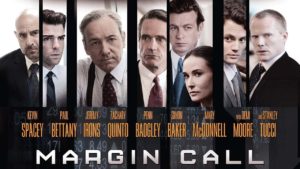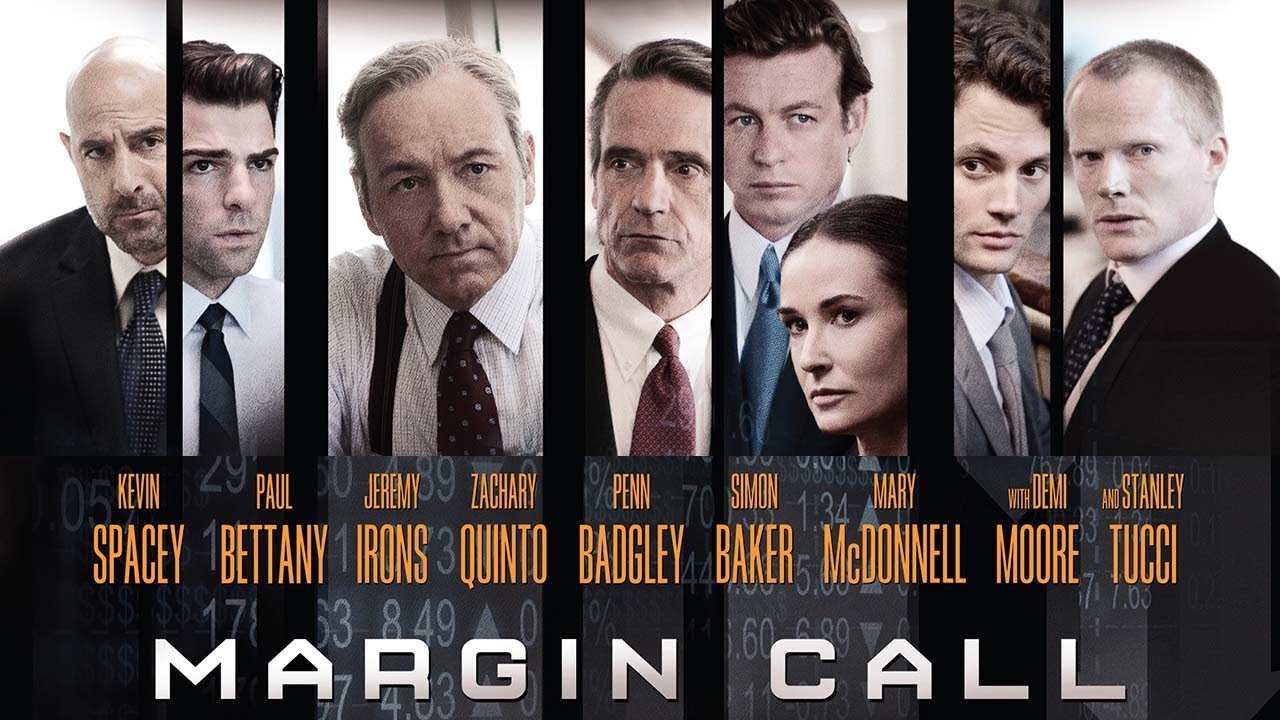
Margin Call

Margin Call

Posted on October 20, 2011 at 6:50 pm

A
Lowest Recommended Age: High School
MPAA Rating: Rated R for language
Profanity: Constant profanity and bad language
Alcohol/ Drugs: Drinking, smoking
Violence/ Scariness: Tense confrontations, job loss, betrayal
Diversity Issues: None
Date Released to Theaters: October 21, 2011
Date Released to DVD: May 1, 2011
Amazon.com ASIN: B005FITIGO
Margin Call
Copyright Roadside Attractions 2011

Investors can make bets by promising to buy stock at a higher or lower price than the current day’s valuation.  If all goes well, they never actually have to buy the stock.  They can keep buying and selling the bets with borrowed money without ever having to buy the underlying securities.  But if it does not go well, the investor gets what is known as a margin call and has to come up with the cash.

The financial meltdown of 2008 was like a margin call for America, and we will be paying off that debt for a long time.  This movie, as tightly wound as a thriller, takes us through a fictionalized version of the night when it all tipped over from going well to not going well at an enormous Wall Street company, and it was time to pay the piper and a lot of others as well.

“You guys ever been through this before?” asks Will (Paul Bettany), as some serious looking people in suits start tapping people on the shoulder and saying, “I’m afraid we have to speak with you” to the people in cubicles  “Best to ignore it, keep your head down, go back to work.  Don’t watch.”

“The majority of this floor is being let go today,” says the serious woman in a suit.  She speaks of “certain precautions that may seem punitive.”  She glances down at the paperwork when she speaks of “your — 19 — years” with the (never-named) company.  And then we see people carrying cardboard boxes of belongings out the front door of a shiny skyscraper, their eyes blinking in the unaccustomed sunlight.

This is nothing new, as Will’s comment informs us.  It is a routine, if brutal pruning of the staff.  This is a cutthroat business and periodically some throats get cut.  And periodically Will has to speak to those left behind: “These were good people and they were good at their jobs, but you are better.  We will not think of them again.”  Back to work watching all those screens with all those numbers.

But one of the departed has left something behind.  There is evident irony in the name of the division that has been gutted.  It is the Risk Management group.  And the 19-year veteran who has been shown the door has been working on a new analysis of the firm’s position.  He turns his thumb drive over to the young colleague who has been kept on, Peter Sullivan (Zachary Quinto), a literal rocket scientist with “a PhD in propulsion,” who plugs a few holes in the formula that reveal that the firm is in their terms, “projected losses are greater than the current value of the company.”  In other words, on the verge of collapse.  That is when it gets interesting.  Sullivan has proven that there are going to be some devastating losses.  The question is who will pay for them.

The rest of the long night will be devoted to answering that question.  It is like a long game of musical chairs, except that these people get to decide when to stop the music so they can get to the chairs before everyone else.

The guy at the top is John Tuld (Jeremy Irons).  Given a choice between reputation and money, he has no hesitation in choosing money.  He tells the head of sales, Sam Rogers (Kevin Spacey) to sell the ticking time bomb securities by assuring their clients that they are solid investments, even though Rogers points out that no one will ever trust them again.  “You’re selling something you know has no value.”  “We’re selling to willing buyers at fair market value so that we can survive.”

Rogers is not the only one who raises concerns, moral and financial.  But writer-director J.C. Chandor lets us see when and how each of them topple, and what makes them topple, which turns out to be money.  Dale repeatedly says there is nothing that can get him to go back inside the building and yet there he is, back in the building.  Rogers says he will not sell these risky securities to clients because “you don’t sell anything to anybody unless they’ll come back to you for more.”  But he does.

This could just as easily be set in the scuzzy world of the real-estate salesmen of “Glengarry Glen Ross” or the “leave the gun, take the cannoli” world of “The Godfather.”  Chandor keeps enough of the real story to keep things vivid and meaningful but does not get mired in jargon.  Crisp performances by everyone keep things taut until a surprising detour at the end.  For the first time we leave the world of glass and concrete for an intensely personal moment of loss and grief.  “Our talents have been used for the greater good,” one character says, reminding us that the very selection process that takes people who are capable of more tangible contributions are unable to resist the big money that pays them a many-times multiple for financial engineering over mechanical engineering.  And reminding us, too, that if we let people who care only about money make the decisions they will make decisions that are only about money for them.


(more…)

Related Tags:


Drama DVD/Blu-Ray Inspired by a true story Movies -- format Thriller

The Mighty Macs

Posted on October 20, 2011 at 6:44 pm

B+
Lowest Recommended Age: 4th - 6th Grades
MPAA Rating: G
Profanity: None
Alcohol/ Drugs: None
Violence/ Scariness: Some mild marital tension and disagreements in the workplace, a girl is sad after a break-up
Diversity Issues: A theme of the movie
Date Released to Theaters: October 21, 2011
Amazon.com ASIN: B004OBNMMO

Basketball coach Cathy Rush (Carla Gugino) arrived at tiny Immaculata College in 1972, at just the right moment for her, for the team, and for the game. Restrictive rules that had “protected” female players from a full-court game had just been revised.  For the first time, there was going to be a national championship for the women’s teams.  And while people were still asking back then, “If she is married, why is she working?” that question would soon be considered inappropriate and ultimately almost unfathomable.

That context and an excellent cast gives this more heft than the typical based-on-a-true-story saga of the underdog team that became national champions. The always-excellent Gugino, in a series of wonderful 1970’s outfits, shows us Rush’s sense of purpose, even when she faces challenges like a Mother Superior (Ellen Burstyn) who is horrified to think that her girls might be “athletes” and a husband who cannot understand why she is there.  Her devotion to the girls as people as well as players is nicely shown.  And is is good to see the nuns treated respectfully, not made into caricatures or made to seem stuffy, quaint, or cute.  They are portrayed as people, too.  We are reminded of their sense of purpose when Rush asks the Mother Superior for equipment and uniforms.  The Mother Superior says she is welcome to anything she has and then shows the coach her small, spare, room with little more than a cot and a rosary.

Marley Shelton plays Sister Sunday, a young nun struggling with her calling who becomes the assistant coach.  Her sweetness and sincerity are a good complement to the coach’s flinty determination.  In a scene where they go to a bar in civilian clothes, Shelton shows us how the sister’s faith supports her strength and integrity.

Rush had no coaching experience.  The team had just one ball and the gym had burned down.  She was the only one who applied for the job and she was paid $450 for the entire season.  She might have thought of it at first as “something to keep me busy” while her husband was on the road as an NBA referee, or “a perfect place for someone who was not ready to assume her role in society,” but she learned that her role in society was exactly where she was. Her most important contribution is shown by the updates at the end.  She did not just coach a team of champions.  She created a new generation of coaches who took what she taught them to the first women athletes to have the opportunities created by Title IX.


(more…)

Related Tags:


Based on a true story Movies -- format Sports
Johnny English Reborn

Johnny English Reborn

Posted on October 20, 2011 at 6:43 pm

The first Johnny English spy spoof came out in 2003.  The spy parts were not exciting enough and the comedy parts were not funny enough to make material that has been done by everyone from James Coburn and Dean Martin to Mike Meyers and Jackie Chan seem fresh.  And yet, he’s back — the movie no one much liked has a sequel no one asked for.  There’s just one reason: people who do not speak English loved it.  The original made a ton of money in countries where audiences could enjoy the pratfalls and ignore everything else.  And so, passing through quickly on its way to being dubbed for international release, we have “Johnny English Reborn.”

Rowan Atkinson is best in small doses.  Even at under two hours, this goes on much too long as it appears to go down a check-list of spy movie clichés, only to deploy jokes that are almost as well-worn.  There is one great Parkour chase scene and a couple of genuinely funny moments but it drags on with Atkinson doing the same shtick over and over — the disconnect between his assessment of his capability (high) and his actual capability (low).   And lots of crotch hits.

Someone has certainly watched a great many spy movies and so the settings replicate Bond staples like the snowy retreat, the men’s room, the secret headquarters, and the ashram.  But like the first one, most of the action isn’t exciting and most of the jokes are not funny.  Perhaps the dubbed version is better.


(more…)

Related Tags:


Action/Adventure Comedy Series/Sequel Spies
Café

Café

Posted on October 20, 2011 at 8:13 am

Café is about that place we all wish we could find, a coffee shop that makes its customers feel at home.  Jennifer Love Hewitt plays the girl behind the counter who provides advice and support for the regulars.  But then a customer gets a disturbing message on his laptop that causes everyone to question the nature of reality and free will.  This touching and thought-provoking film from Marc Erlbaum is worth a look.


Related Tags:


Drama Romance Spiritual films
Interview: Coach Cathy Rush of ‘The Mighty Macs’

Interview: Coach Cathy Rush of ‘The Mighty Macs’

Posted on October 19, 2011 at 8:00 am

Coach Cathy Rush arrived at tiny Immaculata College at a moment when there were big changes in women’s basketball.  The rules were changed to allow women for the first time to play the all-out game by the same rules as the men.  And for the first time there was a national championship.  Coach Rush took her team to the national title for three of the first four years.  And this week, a movie based on her story is opening.  It is called “The Mighty Macs.”

I was delighted to get a chance to speak to Coach Rush about her experiences at Immaculata and what she is doing now.

You must be very excited about the movie!

The excitement is really building as we approach the premiere.  I’ve been traveling around doing pre-release screenings and we’ve had standing ovations.  We showed it in New York and they were ecstatic.

What was the rule change that was so important in the early 70’s?

This goes back to the 1930’s when my mother was playing basketball.  They didn’t think women could run up and down the court more than once or twice so there were three players on one side and three on the other and you never went full court.  You were not allowed to cross half-court. One group of three would shoot and the other side was just defense.

Because women were too frail?

Absolutely!  The Olympics didn’t have a marathon for women until the 90’s.  And then people realized women were capable of more.  In the 60’s it had morphed into a huge scoring game where it was too easy to score.  One player in Iowa was averaging 58 points a game.  It was too easy to score when you were playing three on three?

Did you have a nun as an assistant coach as happens in the movie?

That is actually not true but part of the Immaculata story could never be repeated because of the community that was there and was so important.  The Mother Superior was not really with us in the beginning so the assistant coach character was the embodiment of all the nuns who loved us and prayed for us and did extraordinary things to support us.  Even after we started winning there was some controversy about whether Immaculata should be known as a jock school.  Everyone had to wear skirts to class and the dining hall — it was a different era.

Wasn’t it a challenge that you did not have a chance to recruit talented high school players?

Whoever showed up on your college campus was who you used.  Coincidentally — we’ve often thrown around the idea of Divine Intervention — Theresa Shank Grentz was intending to go to Mount St. Mary’s.  Her family home burned down and the family basically got out with what they had on.  She didn’t have money or clothes.  So she ended up commuting to Immaculata and was one of our strongest players.  Because there were no scholarships we had nothing to offer players except the chance to be a part of the program.  I did start recruiting later on and found Mary Ann Crawford Stanley who was fabulous.  So we decided not to leave in fate’s hand and recruit some players but all we could offer them was a good education and a good program.

I think it is a testament to your vision and leadership that so many of your players became coaches — even more than that they became champions.  What inspired them to follow in your footsteps that way?

Their experience at Immaculata, certainly, but also Title IX had just come in and major universities realized they had to find coaches and provide a little equality, well, not a whole lot but a little.  So these people went right into Division 1 jobs.  Part of it was the opportunity that they had.  Teresa was a biology-chem major and I asked how that prepared her to coach and she said she should have been a Psych major.  We’ve also had a bunch of doctors and other amazing women.  They came to Immaculata for an education first.

You had some unusual drills in the movie — were those things you really did?

We did a lot of stuff.  I did bring in boys to compete against.  We had 11 kids on the team and when we went from the first five to the second five the competition was not at good, so we brought in the boys.  I was blessed to be in the Philadelphia area where there were great men’s coaches who knew the 5-member game and they were kind enough to let me see all of that and put it into our own system so I was very, very lucky.

What is important for a coach to know?

Coaching is really teaching.  We’re all teachers of some kind — parents are teachers, too.  The players who became coaches do not coach like me; they are all smart enough to coach within the framework of their personality.  I was not a screamer.  I didn’t have to yell to get across what we needed to do.  Being so young, I had kind who were two and three years younger than me but there was no question of my authority.  I was Mrs. Rush or Coach.  People need to lead by example.

The movie makes it clear how much some things have changed since the 1970’s.

I was a 60’s woman and not the Berkeley 60’s.  I was from a small town and went to a conservative college and then coached at an even more conservative college.  It was a different time.  My life plan at that time was to get married, teach for three years, and have a family and never work again.  When I say that to kids today, they do not understand it.  But in those days people had different expectations for their sons than their daughters.

What are you doing these days?

I have a girls’ basketball camp.  This is our 41st year, our biggest year ever, over 9000 kids in camp.  My youngest son runs the business and every now and then I come in and tell him what he’s doing wrong .

You’re still coaching!

That’s right!


Related Tags:


Behind the Scenes Sports The Real Story
THE MOVIE MOM® is a registered trademark of Nell Minow. Use of the mark without express consent from Nell Minow constitutes trademark infringement and unfair competition in violation of federal and state laws. All material © Nell Minow 1995-2026, all rights reserved, and no use or republication is permitted without explicit permission. This site hosts Nell Minow’s Movie Mom® archive, with material that originally appeared on Yahoo! Movies, Beliefnet, and other sources. Much of her new material can be found at Rogerebert.com, Huffington Post, and WheretoWatch. Her books include The Movie Mom’s Guide to Family Movies and 101 Must-See Movie Moments, and she can be heard each week on radio stations across the country.

Website Designed by Max LaZebnik