Socalled: A Documentary about a Klezmer/Hip-Hop/Cowboy/Video-Artist
Posted on March 19, 2010 at 3:42 pm
Socalled is a documentary with 18 short films about klezmer hip-hop music and video Montreal-based artist Josh “Socalled” Dolgin, featuring Katie Moore, Fred Wesley, C-Rayz Walz, David Krakauer, Matt Haimovitz, Arkady Gendler, Benjamin Steiger Levine, D-Shade, Gonzales and lounge legend Irving Fields. For a limited time, the entire Socalled movie is available for viewing for 99 cents on YouTube.
A show of hands, everyone. If you think it’s a good idea to begin a movie for children by killing off a young boy in an industrial accident as his father looks on, raise your hand. Anyone?
I didn’t think so. And yet, that is how Astro Boy comes to be in this updated version of the Japanese animated series that achieved popularity in the U.S. as a television series in various versions over the years and more recently as a computer game. The title character (voice by an Americanized Freddie Highmore) is a robot re-boot created by brilliant scientist Dr. Tenma (voice of Nicolas Cage) to replace his son Toby, who was killed at Dr. Tenma’s lab when he tried to get in to see an experiment. Devastated by the loss, the scientist creates a super-robot programmed with the memory and mind of his dead child. And then he rejects the robot as an inadequate substitute. Even if the rest of the movie were “The Care Bears Meet My Little Pony,” the loss and grief of the first 20 minutes are so totally dissonant that the film cannot recover.
It’s like “Pinocchio” crossed with “Blade Runner” as Astro Boy goes through an existential crisis in discovering that he may have Toby’s memories and emotions, but he also has hands and butt cheeks that turn into artillery. He ends up being treated as a human by robots and a robot by the humans he meets, abandoned children living on the planet that everyone else has left because it is deemed no longer habitable (and yet somehow they are able to order pizza). In the midst of all of the shoot-outs there are some moments that have charm and some images that show some wit, especially an enormous junked robot that Astro brings back to life with a charge from his blue power source (unfortunately carrying the initials of an anti-Semitic conspiracy theory). But then the President (voice of Donald Sutherland) wants to use Astro’s technology for evil, and everything comes down to shooting. Any nuance or imagination or point is lost in the battle, and so is any reason to see this film.
I have seldom seen the stars of a movie look as thoroughly uncomfortable as Sarah Jessica Parker and Hugh Grant in this drearily low-concept would-be comedy, “Did You Hear About the Morgans?” Parker plays Meryl Morgan, a Manhattan real estate broker so high-powered she is featured on the cover of New York Magazine, who has recently left her husband, Paul (Grant) because he cheated on her. Paul, a high-powered lawyer, has been trying to win her back with gifts and entreaties, but she is resisting.
And then they end up stuck together, unplugged from all of their various electronic devices and their supremely efficient assistants (wasting the talented Elisabeth Moss of “Mad Men”), and about as far away from Manhattan as you can get. They are sent to the small town of Ray, Wyoming by law enforcement authorities after they witness a murder to protect them from being the professional killer’s next victims. And so we’re in the land of city slickers vs the hicks as a form of extreme marital therapy. It’s all sit-, no com.
The jokes were old when “Green Acres” was new. New Yorkers can’t sleep out west because there are no sirens and car horns and they can’t breathe because the air is too clean! Isn’t it cute that people play bingo and shoot guns! (“Oh, my God, it’s Sarah Palin!” Meryl says when she sees Mary Steenburgen as a rifle-toting U.S. Marshall.) One lame stereotype after another (Meryl learns to shoot a gun and milk a cow! Paul squirts his own eyes with bear repellent! Hicks are all Republican and carnivores! Let’s bring everyone together for a dance and a rodeo!) only underscores how self-absorbed, annoying, and entirely unattractive the characters are and how much contempt the film has for its audience. Our primary motivation for wanting them to stay together is that it’s the best way to punish them for creating this awful film. Let them torture each other the way they tortured us.
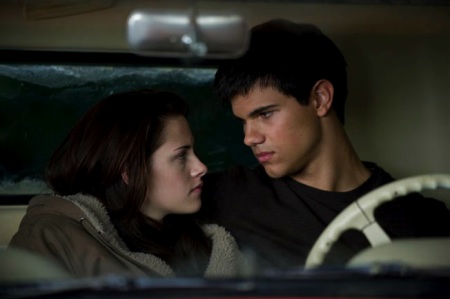
“You’re good with weird,” a character tells Bella mid-way through “The Twilight Saga: New Moon.” That’s an understatement. In the first Twilight movie, as in the first of the series by Stephanie Meyer, high school student Bella Swan (Kristen Stewart) moved to the rainiest town in the US, Forks, Washington and fell deeply in love with Edward (Robert Pattinson), who looked like a teenager but was in fact a vampire who was more than 100 years old. He and his “family,” the Cullens, are sort of vampire vegetarians, living on animal blood. But there are other vampires who continue to prey on humans, and they almost killed Bella before Edward rescued her. And then they lived happily ever after until it was time for another book/movie, and that is where we begin.
Edward, convinced that their relationship will always put Bella in danger, leaves, telling her he will never see her again. She is devastated and isolates herself from everyone. She discovers that Edward appears to her when she is in danger, so she takes some foolish risks, just to feel close to him. But then the quiet support and gentle teasing of her friend Jacob (Taylor Lautner) begin to make her feel that she is able to be a part of the world again. Like Edward, Jacob loves Bella and would do anything to protect her. And like Edward, Jacob has a secret. He is part of a tribe of wolf-people. Like “The Hulk,” his anger manifests itself in a powerful transformation. And Bella finds herself at the center of a centuries-old war between the vampires and the wolves.
The wildly popular Twilight Saga has the core elements of girl-friendly romances from “Wuthering Heights” to “Titanic:” a boyfriend who is not approved by parents who is utterly undone by the appeal of the female lead, and something to make sure that their relationship is about longing, not satisfaction. Just in case you aren’t paying close attention, we see Bella sleeping with a copy of “Romeo and Juliet” on her pillow, and her English class watching a video of the play. The teacher calls on Edward to recite one of Romeo’s speeches. And later, Edward, like Romeo, believes that his love is dead and decides he cannot live without her.
There is a lot of longing. Characters exchange meaningful looks and take an extra beat before responding to allow for some strategic intakes of breath and swelling of the score. There are moments that are more perfume commercial than movie. And as in the book, this big love Bella and Edward feel is expressed mostly in talking about the big love they feel. In a way, this is wise; we never see them doing or seeing anything that would interfere with our ability to project onto them whatever the specifics of our own fantasies of love look like. All we know or need to know is that Bella and Edward have the big, total, all-encompassing, would do anything for each other love. Just like Romeo and Juliet.
And we have Lautner’s excellent abs, which play such a significant role they should have their own billing. Lautner also has an easy confidence and sincerity on screen that nicely leavens the intensity and drama of the Bella-Edward connection. The screenplay is seasoned with some humor and a reference to self-referential cleverness that is almost meta.
New director Chris Weitz does not have Catherine Hardwicke’s feel for the rhythms of teenage interactions and the intensity of teen romance. And he does not have her ability to tell the story through the settings; we miss the lush natural world of the first chapter. Weitz and screenwriter Melissa Rosenberg also have to grapple with a transitional story that translates less well to screen than the first one. But the film benefits from his greater experience with special effects and a bigger budget. He catches the spirit of the story and allows the natural chemistry between his leads do the rest. And that is enough to make this movie enormously enjoyable and keep us looking forward to the next one.
Before he was the best-known clergyman in America and a spiritual adviser to Presidents, Billy Graham was a young man struggling with doubt and searching for a way to be of service. This sensitive and respectful film about Billy Graham’s early years stars Armie Hammer as Graham.
I spoke to Hammer about the challenges of taking on the role of a man people know so well.
How did you come to this project?
One day my agent called and said, “I have your next movie. That’s all you need to know.” I fell madly in love with it, knew i had to do it. The next thing I knew, I was in Billy Graham world.
it was the approach i responded do. i knew who he was the way every one else on the planet knows, but this was the human, how he found his faith, how his faith was shaken, how the love of his life was given and almost taken away. We start at the beginning and end when Billy Graham the preacher eclipse Billy Graham the person.
What are the challenges and pitfalls of portraying a real person who has inspired so much respect and affection?
You want to be so careful and pay respect to the Grahams, make something they like and love, and give them the most honest and real portrayal so they can say, “I remember that, I said that.”
I studied his autobiography, Just As I Am. It was an amazing tool for me to use. I also used the internet where you can see private, personal videos that show how he was when he was not preaching. His preaching was his signature enthusiasm but I wanted to see what he was like when he was just talking, where you see his personality.
What made Graham so special?
It was definitely his blind faith — the fact that he whole-heartedly without question or doubt at all found his beliefs and did not waver. He was so human and could take the gospel and make it accessible. He would not say he was the smartest person in the world but he had the gift of faith. In this story, he and Templeton go through a crisis of faith but react differently.
His approachability and simplicity was what made him so good at communicating with people. He is the most honest and good human being that ever walked this planet. He never had a scandal because he did not have a scandalous bone in his body. He created the Modesto manifesto to make sure that he and his men could withstand temptation. He called them together and said, “Ministers are falling to the left and right. What we have to say is too important. Go to your room for an hour and think about what it is that is the cause of these ministers’ downfall.” They all had the same things on the list — sex, money, pride, lying. He said, “Here is what we will do. We will have an outside firm to do the money, none of us will ever be alone in a room with a woman, we will never lie about our numbers of followers or criticize others.” Those are the kinds of decisions that made him unique.



 . It was an amazing tool for me to use. I also used the internet where you can see private, personal videos that show how he was when he was not preaching. His preaching was his signature enthusiasm but I wanted to see what he was like when he was just talking, where you see his personality.