
Imagine That

Posted on October 6, 2009 at 8:00 am

Title aside, there is not much imagination in this formulaic story of a daddy who discovers the value of his daughter’s imaginary friends — and then learns that it is his daughter who matters most of all. But I am an unabashed sucker for daddy-daughter movies, the little girl is adorable, and I was immensely relieved to see Eddie Murphy in a movie that is not terrible, so I found myself smiling.

Murphy plays Evan Danielson, who is very good at his job as an investment advisor but not very good as a husband and father. Although he and his wife Trish (the always-graceful Nicole Ari Parker) have recently separated, his primary concern is his competition at the office with Johnny Whitefeather (Thomas Haden Church), a competitor at the office who uses his Native American heritage to sell his investment ideas to clients.

Perhaps because of the separation, Evan’s daughter Olivia (adorable Yara Shahidi) has become very attached to a security blanket she calls her “goo-ga.” When it is over her head, she talks to her princess friends. All of this is distracting and frustrating for Evan, who is caring for Olivia full-time while Trish is busy with work. But then he discovers that Olivia’s imaginary friends have some real-life insights into the companies he is analyzing. And as he spends time with Olivia to get access to the secrets of her imaginary friends, he discovers how much more important she is than any investment or promotion or client could ever be.

This much we knew going in. And parts don’t work at all. The entire Whitefeather plot line is clumsy and borderline racially insensitive, especially when it involves his son. There is too much about business and investments that will be confusing to children. Martin Sheen is underused. But DeRay Davis as Danielson’s former football-player friend is wonderfully natural and leaves us wanting to know more about his character.

Basically, it’s a little “Liar Liar” and a little “The Game Plan” and lighter-weight than both if such a thing is possible. But there is a reason this theme connects so successfully. As with “The Game Plan,” the little girl has the power in this relationship. She is not a bully or a brat and she is not selfish. She is wise and has a degree of control that is a very compelling and reassuring fantasy for children. By encouraging her father to do silly things she helps him to relinquish his own sense of control and need for success and connect to his capacity for fun and play. Shahidi and Murphy have an easy chemistry on screen that comes across as authentically sweet. Murphy will never be a subtle performer but he limits himself to just one role and seems to enjoy portraying the straight-laced but superbly professional Danielson and allowing him to thaw without overdoing it. And any time Murphy does not overdo it, that’s worth seeing.
Related Tags:


Comedy Elementary School Family Issues For the Whole Family

Year One

Posted on October 6, 2009 at 8:00 am

The two-doofus comedy probably goes back to ancient times, so why not set it there? The always-funny Michael Cera and the frequently-funny Jack Black join forces like Hope and Crosby in an only intermittently-funny movie that is just a series of sketches set in ancient days — prehistoric, Biblical, Roman, and Egyptian. Cera plays Oh, a gatherer, and Black is Zed, a hunter. They are pals who are evicted from their stone-age village and wander off, meeting up with Cain and Abel, Abraham and Isaac, and the residents of Sodom. In yet another “what was the MPAA thinking” moment, the film has been assigned a PG-13 rating, despite jokes about incest, circumcision, orgies, castration, and ingestion of human waste.

The juxtaposition of modern sensibility and prehistory provides some funny contrasts. Oh and Zed are amazed to see their first wheel and when they ride in their first vehicle they raise their arms as though they were in a roller-coaster, even though it cannot keep up with a guy strolling alongside. And then they get their first carsickness. Some things are eternal — like insecurity with the opposite sex, bullies, and the bad guys having English accents. And it is fun to see a modern perspectives combined with ancient situations.

But more doesn’t work than does. Cain does not just kill Abel; he pounds him — and any potential for humor — into the ground. It isn’t enough that a pagan priest be corrupt and gay; he has to be hairy. The movie is too spotty to be comic and too listless to be heretical. There’s no point to it, just a series of gags — in both senses of the word.

Related Tags:


Comedy
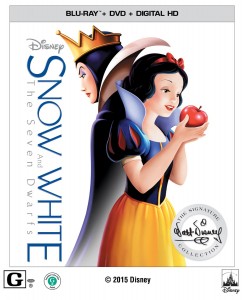
Snow White and the Seven Dwarfs

Snow White and the Seven Dwarfs

Posted on October 5, 2009 at 8:00 am

A-
Lowest Recommended Age: All Ages
MPAA Rating: G
Profanity: None
Alcohol/ Drugs: None
Violence/ Scariness: Some scary scenes, scary witch
Diversity Issues: Passive female heroine dreams of being rescued by prince
Date Released to Theaters: 1937
Date Released to DVD: February 2, 2016
Amazon.com ASIN: B01711CIF0

Copyright Disney Studios 2016
Disney’s new Signature Collection release of its first animated feature film on Blu-Ray is gorgeously restored and filled with behind-the-scene extras and a wonderful opportunity to catch up with the one that is still “the fairest of them all.”

Snow White (voice of Adriana Caselotti) is a sweet girl whose step-mother, the Queen (voice of Lucille LaVerne), is vain and cruel. Snow White dreams of a prince to love, and meets the Prince of her dreams when she is fetching water for the castle. Meanwhile, each night, the Queen looks into a magic mirror and asks who is the fairest one of all. The mirror tells her that it is she, and she is satisfied. But one night, the mirror tells her that Snow White has become more fair, and the Queen, consumed with jealousy, tells her huntsman to take Snow White to the forest and kill her.

The tender-hearted huntsman cannot kill her and instead tells her to run away. Racing through the forest terrified, she collapses in tears. But she makes friends with the animals, who live in the woods and they lead her to a small cottage. Once inside, she cleans up the mess, singing “Whistle While You Work.” She thought, when she saw the small beds, that children lived in the house, but it turns out that it is the home of seven dwarfs, who work each day digging jewels from a mine.

When they come home, they are surprised to find her stretched out across their beds, sound asleep. But they soon make friends and are delighted to have her stay and take care of them.

Eventually, the Queen discovers that Snow White is still alive. The Queen makes a poisoned apple and turns herself into an old hag so she can deliver it to her. Snow White at first follows the dwarfs’ advice not to speak to strangers, but finally takes a bite of the apple and collapses. The Queen runs away and falls into a steep ravine.

The dwarfs are heartbroken and create a beautiful crystal bier for her to lie on. The prince discovers her there and gives her a kiss, which awakens her, whereupon he carries her off to live happily ever after.

Children used to today’s Disney stories may be surprised by a more passive heroine and by a score more classical than pop. But in addition to its historical value as the first animated feature, it is still a delight, with memorable songs and characters. It is hard to remember that before Disney the dwarfs in the Snow White story had no names and no individual characters. Sneezy, Sleepy, Grumpy, Dopey, Doc, Happy, and Bashful are all vivid characters, and their dance number with Snow White is a highlight.

This movie provides a good opportunity to discuss jealousy, and how to handle it. And, of course, it raises issues about women and beauty, about women’s role in the home, and about finding happiness only through dreams of “Someday My Prince Will Come.” Blended families are often sensitive about the traditional fairy tale villain being the “wicked stepmother,” and some children will need reassurance.

Extras in this edition include Disney’s own comments about the film and a feature about the influence of this groundbreaking animated feature, plus never-before-released storyboards of a deleted scene where the prince meets Snow White.

Talk to kids about how characters like Snow White might be different if they were created today, and make sure that they see a range of alternative role models. Note: The movie is very scary when Snow White is running through the forest (though reassuring when the animals turn out to be friendly) and when she bites the apple; the Queen is especially scary when she turns into the old hag. By today’s standards, Dopey might well be considered an insensitive stereotype of a developmentally disabled person.

Families who see this movie should discuss these questions: Why is the Queen jealous of Snow White? Why is being beautiful so important to her? Why did Snow White stay at the castle? Why did the huntsman disobey the Queen’s orders? Why did the dwarfs love Snow White so much?

Families who enjoy this movie should watch some of the other versions of the Snow White story, including the Faerie Tale Theatre production with Elizabeth McGovern.

Related Tags:


Animation Based on a book Classic DVD/Blu-Ray Pick of the Week Fantasy For the Whole Family Musical Romance

Two ‘Toy Stories” in Three Dimensions!

Posted on October 2, 2009 at 8:00 am

In anticipation of the release of Toy Story 3 in 3D, Disney is issuing the first two as a 3D double feature. The original Toy Story was the first computer-animated feature film but what make it successful was its heartwarming story about rival toys, Woody the cowboy (voice of Tom Hanks) and astronaut Buzz Lightyear (voice of Tim Allen). The sequel, Toy Story 2 is even better, with a rescue story that is wise as well as funny and some touching insights about love and loss. Whether they are already family favorites or your children are just old enough to enjoy them for the first time, this double feature is worth a trip to the theater.

Related Tags:


3D Animation Classic For the Whole Family Movie Mom’s Top Picks for Families

Three Movies Examine Our Struggle to Understand God

Posted on September 29, 2009 at 2:59 pm

Three new and very different movies have one thing in common — they all ask their characters and their audiences to think about the nature of God and faith. This week we have a perky romantic comedy with Ricky Gervais and Jennifer Garner called “The Invention of Lying.” As the title suggests, it is about a world in which everyone tells the literal, concrete truth all the time. And then one man figures out that he can lie, and that since no one else is aware that lies even exist, he can pretty much get away with everything. Since no one lies, everyone is completely gullible. So much is clear from the trailers. But Entertainment Weekly reports that there is a more controversial element to the film and that one of the “lies” the Gervais character comes up with is the idea of God.
Gervais, who also co-wrote and directed the film, has responded to concerns from bloggers.

1. No one has seen the film.

2. Even if the film suggests there is no God, it is a fictional world. One of my favourite films is ‘It’s a wonderful life’ and at no time am I offended by the suggestion in this wonderful work of fiction that there is a God.

3. If the film was not set in a fictional world and suggested there is no God then that’s fine too, as it is anyone’s right not to believe in God.

4. By suggesting there is no God you are not singling out Christianity.

5. Not believing in God cannot be blasphemous. Blasphemy is acknowledging a God to insult or offend etc.

6. Even if it was blasphemous, which it isn’t, then that’s OK too due to a little god I like called “freedom of speech.” That said, I am not trying to offend anyone. That would be a waste of such a privilege.

7. I am an atheist, but this is not atheist propaganda. When creating an imaginary world you have to make certain decisions. We decided also that there would be no surrealist art, no racism, no flattery, no fiction, no metaphor, and no supernatural. However, we decided that apart from that one “lying gene”, humans evolved with everything else as we have it today. Joy, hope, ambition, ruthlessness, greed, lust, anger, jealousy, sadness, and grief. It’s just a film. If any of the themes in it offend you or bore you, or just don’t make sense to you, you should put everything right when you make a film.

I really hope everyone enjoys the film and keeps an open mind. I believe in peace on Earth, and good will to all men. I do as I would be done by, and believe that forgiveness is one of the greatest virtues. I just don’t believe I will be rewarded for it in heaven. That’s all.

I have a different take, which I will discuss in my upcoming review.
Perhaps an even more unexpected place for a discussion of God and faith than a comedy is in Michael Moore’s latest documentary, “Capitalism: A Love Story.” Moore is well-known for his attacks on the Bush administration (“Farenheit 911”), insurance companies (“Sicko”), and our treatment of guns and violence (“Bowling for Columbine”). In this new film, he takes on the financial crisis. His argument turns out to be based not as much in economics as in his own Catholic faith. He even interviews the priest who performed his wedding ceremony to help make his point that the current system is not just bad policy; it is not WWJD. The media often creates the impression that faith-based politics are right-wing and it is provocative and refreshing to see a different point of view.
And then there is a movie that is going to be difficult to put in any category, because it is the new film from the Coen brothers, who are masters of genre — both evoking and transcending them. According to the New York Times, their new film “A Serious Man” “is both a Job-like parable of Jewish angst in a 1960s Midwestern suburb and a bleakly antic meditation on divine intent, the certainty of uncertainty and the mysteries of Jefferson Airplane lyrics.
The film’s central character is a scientist who seeks the advice of three rabbis to help him find meaning and purpose. That makes this film unusual in two respects — the portrayal of Jewish theology and the portrayal of clergy as a place to go for guidance.
And I am glad to see movies providing some guidance as well, by engaging us in very different ways about issues so profound and pervasive that it is only through a variety of approaches we can begin to understand what we believe.

Related Tags:


Commentary Spiritual films Understanding Media and Pop Culture
THE MOVIE MOM® is a registered trademark of Nell Minow. Use of the mark without express consent from Nell Minow constitutes trademark infringement and unfair competition in violation of federal and state laws. All material © Nell Minow 1995-2026, all rights reserved, and no use or republication is permitted without explicit permission. This site hosts Nell Minow’s Movie Mom® archive, with material that originally appeared on Yahoo! Movies, Beliefnet, and other sources. Much of her new material can be found at Rogerebert.com, Huffington Post, and WheretoWatch. Her books include The Movie Mom’s Guide to Family Movies and 101 Must-See Movie Moments, and she can be heard each week on radio stations across the country.

Website Designed by Max LaZebnik