The Unknown Known

Posted on April 3, 2014 at 5:59 pm

B+
Lowest Recommended Age: Middle School
MPAA Rating: Rated PG-13 for some disturbing images and brief nudity
Profanity: Mild language
Alcohol/ Drugs: None
Violence/ Scariness: Wartime violence, terrorism,
Diversity Issues: A theme of the movie
Date Released to Theaters: April 3, 2014
© 2014 Radius/TWC
© 2014 Radius/TWC

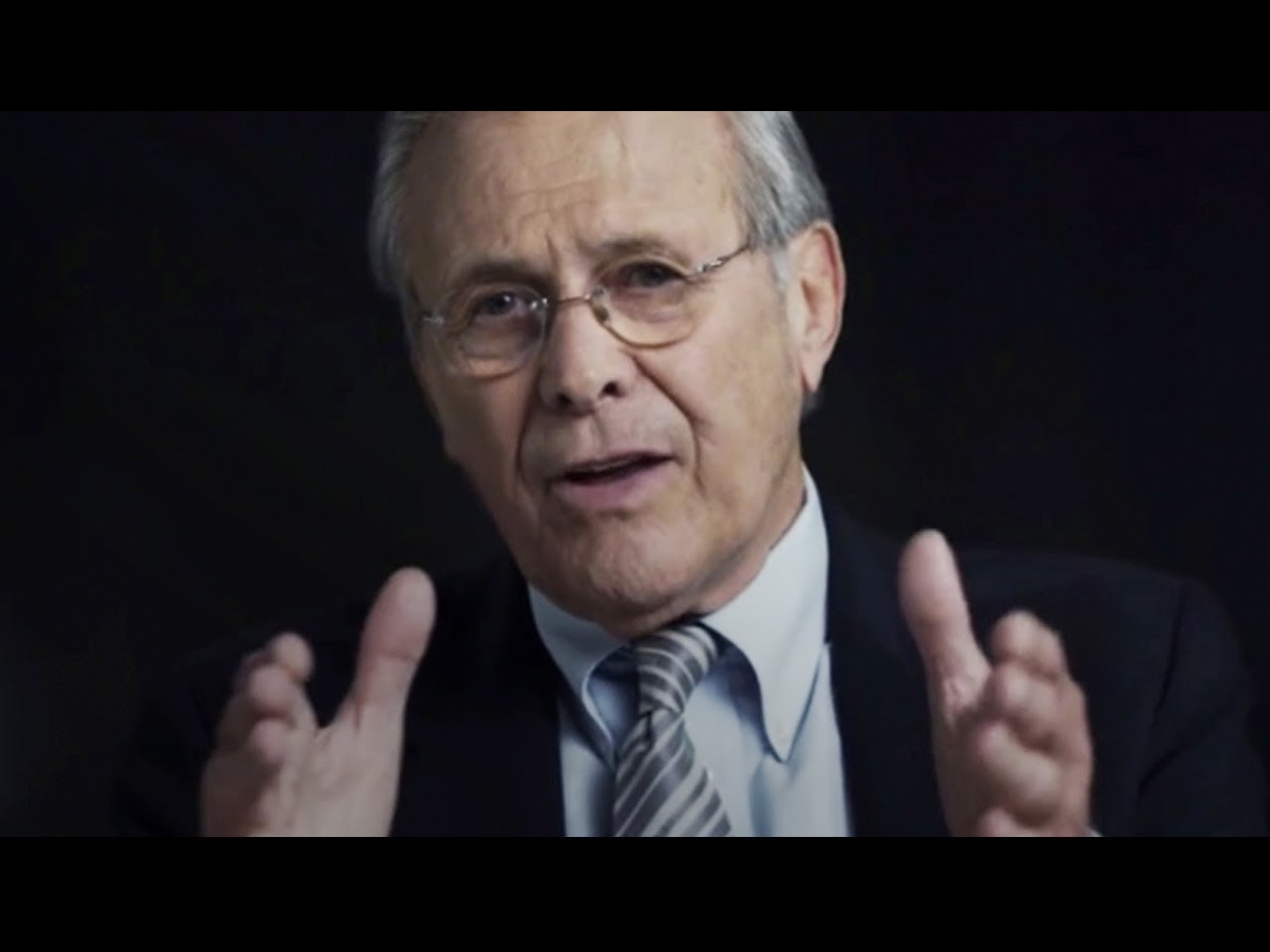
Errol Morris turns his famous “interrotron” camera on two-time Secretary of Defense Donald Rumsfeld for something between a bookend and a counterpoint to his Oscar-winning The Fog of War: Eleven Lessons from the Life of Robert S. McNamara. But this SecDef (as they say in the Pentagon) is not here to confess or apologize even in part, as McNamara did.

He says, in the movie’s final exchange, that he is not sure why he agreed to submit to more than 30 hours of what must have felt more like the cross-examination in “A Few Good Men” or even a detainee interrogation than the back-and-forth press briefings Rumsfeld conducted during the early days of the wars in Iraq and Afghanistan. We see many clips from those celebrated exchanges, at the time referred to as the best show in Washington, and still undeniably entertaining. Rumsfeld’s good humor and confidence were bracing and reassuring at a time when everything seemed to be what he would call an unknown unknown. Like Jack Nicholson in “A Few Good Men” he does not think we can handle the truth. He may be right.

He’s not here to explain.  What he is here to do is to repeat the same version of the story, despite the fact that the audience has had the benefit of making some of those unknowns more known.

Rumsfeld’s constant memos, perhaps 20,000 by his count over his final term at Defense, were called “snowflakes” by the staff, based on their color and frequency. It must have seemed like an avalanche. Morris shows us long shelves of folders filled with snowflakes. He has Rumsfeld read some portions aloud, beginning with his famous taxonomy of information. There were known knowns, things we know and know to be true. There were known unknowns, things we do not know and wish we did. There were unknown knowns, things we do not realize that we know. And unknown unknowns, things we don’t know and don’t know that we need to know. Yes.

But what we do with those categories is the tough part, especially when assigning facts. The boxes and labels are nice and neat. The things we do and do not know are not. Rumsfeld often seems Wittgensteinian when he calls for dictionary definitions or makes a distinction between a Pentagon term and standard English. But definitions are not answers.

“Pearl Harbor was a failure of imagination,” Rumsfeld says. So, we gather, was 9/11. Vietnam was “the inevitable ugly ending of an unsuccessful effort.” How do we not make that mistake again? How do we destroy terrorists without a Hydra effect, creating two more for every one we cut down? We might think those answers are known unknowns. But Rumsfeld does not have the luxury of waiting to be sure.

He tells us he found out the US was going to invade Iraq when he was called into a meeting with then-Vice President Dick Cheney (Rumsfeld’s former assistant in the Nixon White House), along with Saudi Ambassador Prince Bandar. And that he never read the Justice Department legal memos about “enhanced interrogation.” He insists that he never said and the American people never thought there was a connection between Saddam Hussein and the 9/11 attacks. Cut to tape of the press conference where he called Saddam a liar for denying there was a connection.

Rumsfeld is aware of the inherent conflicts. He cheerfully acknowledges the inconsistency between two principles: Belief in the inevitability of conflict can be one of its causes. And if you wish for peace, prepare for war. Plus: all generalizations are false, including this one. He sounds like a zen master, but a jolly one. His good humor can be disconcerting, but not chilling. At the time, it was reassuring to us and undeniably disconcerting to our enemies. Rumsfeld often seems exceptionally forthright, as when he calmly discusses his two offers to resign following the revelations of abuse at Abu Ghraib.  Would you rather have someone in that job who is grim?

His demeanor comes across today as oddly disengaged.  He tears up once, telling about a visit to a gravely injured soldier who was not expected to live, but who did.  There are no stories about those who did not.

Morris sometimes overdoes it, with a celestial choir and a snow globe of the Washington Monument as repeated commentary/symbols. Repeated sped-up shots of traffic in Washington, obviously far after the events being discussed, add little.

One can’t help thinking that part of what draws Morris to this story is his own belief in the capacity for absolute truth, in its way as limited as Rumsfeld’s belief that he can tie down the unknown unknowns tightly enough to support a military strategy.  Or disinfect a morally compromised decision.  But then, how many decisions in wartime or in time of terrorism are not morally compromised?  There are unknown knowns, and unknown unknowns, and there are also political and historical quagmires.

Parents should know that this film has disturbing subject matter and some graphic images of the victims of “enhanced interrogation” and abuse.

Family discussion: Once you have created the categories of “known knowns” and “known unknowns,” how do you know when you have enough information to decide? What qualities should one have to serve as Secretary of Defense? What surprised you about this version of the story and why?

If you like this, try: The Fog of War, No End in Sight, also by Morris, and Taxi To the Dark Side

Related Tags:


Documentary Movies -- format Politics War

American Hustle

Posted on December 19, 2013 at 6:00 pm

american-hustle

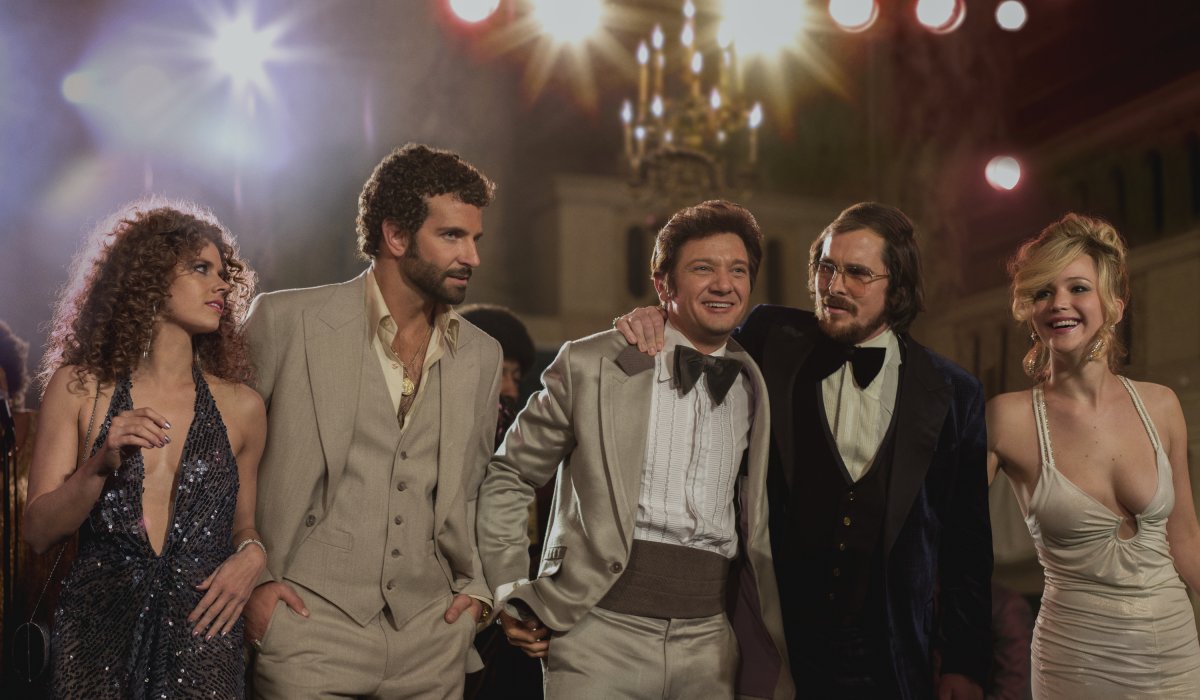
“Some of this actually happened,” the movie’s opening shot deadpans.  It is true that the United States government both threatened and paid a con man to help them con some bigger fish and then accidentally ended up conning some of the biggest fish ever caught — six US Congressmen and a Senator.  David O. Russell directed and co-wrote “American Hustle,” the story of 1970’s fraud, insanity, and betrayal, plus a lot of “what were we thinking” hair and clothes and a rockin’ soundtrack, from “Goodbye, Yellow Brick Road” to “How Can You Mend a Broken Heart,” “Does Anybody Really Know What Time it Is?” and the inevitable “Horse With No Name.”

The storyline has so many layers of double-cross, lies, betrayal, grandiosity, and sheer insanity that the audience may feel they are getting lost, but in a way, that is the point, and of course, that is the decade for it.  I mean, look at the home perm on Bradley Cooper, who plays the hotdog FBI agent Ricky DiMaso as something of a cross between Starsky, Hutch, and Huggie Bear.

And then there is the hair on Christian Bale as Irving Rosenfeld.  It can perhaps best be described as an edifice.  As the movie begins, we are treated to the painstaking assembly of his pompadoured comb-over, remarkable to witness and a dead-on detail that lets us know who we will be following for the rest of the film.  He is a phony, he is all about making the surface look better than it should, and  he will do whatever it takes to put forward the image that will sell whatever he is trying to sell. Ascot, check.  Pinky rink, check. Briefcase full of cash, check.

Flashback.  Rosenfeld is the master of at least half a dozen medium-sized scams when, at a party, across the room, he spies a beautiful woman.  It is Sydney Prosser (Amy Adams).  They share a love of Duke Ellington and a talent for re-invention.  “My dream” she tells us, “more than anything, was to become anything else than what I was.”

They cook up an almost-legal scam, taking  up-front fees on the promise of using their connections to obtain loans from some vaguely defined “London connections.”  All is fine until they get busted.  And DiMaso, intrigued by their world of deception, persuades them to work for him to bring down some big-time criminals.

But things get complicated and messy.  DiMaso’s boss (a terrific Louis C.K.)  is reluctant to have federal officers engage in criminal activities, even to catch other criminals.  One of the great joys of this film is when the boss keeps trying to tell DiMaso an ice-fishing story that never gets to the point because the hotheaded DiMaso keeps interrupting him.  Rosenfeld is married to an unhappy, volatile wife named Rosalyn (a dazzling performance of astonishing depth and mesmerizing assurance by Jennifer Lawrence) and stepfather to her son.  He has to find a way to resolve things with the FBI, the mob, and the politicians.

The unfinished ice-fishing story is the point.  This is not a nice, linear explanation for what happened.  This is a bunch of stories that intersect in a maze of all seven of the deadly sins plus a few that should also be on the list.  Brilliant performances by everyone in the cast (including Alessandro Nivola as an FBI official and an unbilled guest star as a guy from the mob) and a witty, insightful script are what hold it together.  Lawrence makes us furious at and sorry for her character at the same time, and she is sizzlingly funny.

The purpose of this film is not to illuminate the particular events of Abscam.  It is to meditate on the irrepressible American enthusiasm for self-invention and the thicket of betrayal and damage that can be the result.  It is about the stories we tell, even the ones like the ice fishing story that never get to make a point.  Russell himself can’t resist tweaking the details, making the characters more interesting and sympathetic than they really were.  But that wouldn’t be a good story.

Parents should know that this film has very strong adult material including constant bad language, explicit sexual references and situations, nudity, drinking and drug use, extensive criminal behavior and betrayal.

Family discussion: Who are the biggest con artists in this story?  How do the characters determine who deserves their loyalty?  Was justice done?

If you like this, try:  “Flirting with Disaster,” “The Fighter,” and “Silver Linings Playbook,” from the same director


Related Tags:


Based on a true story Crime Drama Politics Satire

Electoral Dysfunction — A New Documentary from Mo Rocca

Posted on October 28, 2013 at 3:59 pm

Election day is coming next week, and Mo Rocca (“The Daily Show,” “CBS Sunday Morning,” “Wait, Wait…Don’t Tell Me”) has a new documentary about the state of elections in today’s America, with the backdrop of the 2008 Presidential election.  Rocca set out on a road trip to see how voting works – and doesn’t work. He heads to Indiana, home to (then) some of the strictest election laws in the country, and meets Democrat Mike Marshall and Republican Dee Dee Benkie, who take him inside their efforts to get out every vote. As he progresses on his journey, Mo searches for the Electoral College; investigates the heated battle over Voter ID and voter fraud; critiques ballot design with fashion mogul Todd Oldham; and explores the case of a former felon who was sentenced to ten years in prison—for the crime of voting. Irreverent, engaging and nonpartisan (and selected for viewing at the conventions of both major parties), this documentary is for voters across the political spectrum who want their votes to count.

Related Tags:


Documentary Politics

The Fifth Estate

Posted on October 17, 2013 at 6:05 pm

B
Lowest Recommended Age: High School
MPAA Rating: Rated R for language and some violence
Profanity: Very strong language
Alcohol/ Drugs: Drinking
Violence/ Scariness: Some violence including murder of two people and footage of military killings
Diversity Issues: None
Date Released to Theaters: October 18, 2013
Amazon.com ASIN: B00BEIYRYM

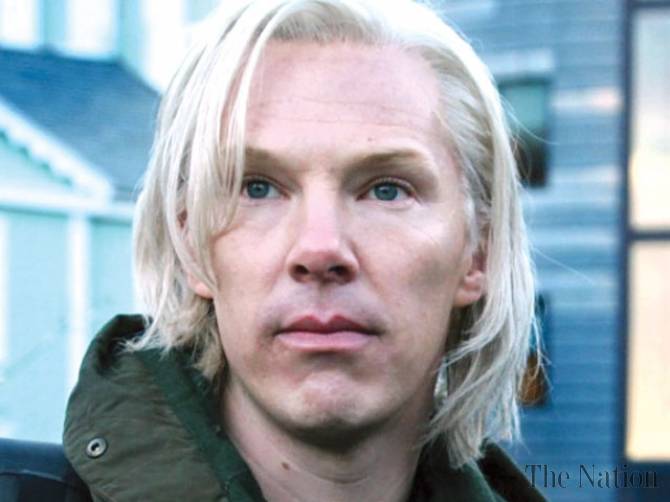
the-fifth-estateIn late medieval times, when people first began to divide each other into groups defined by status and power, they began to speak of a “first estate” (the clergy), a “second estate” (the nobility, which also at the time meant the government), and a “third estate” (the common people.  Later, the “fourth estate” was added to describe journalists and what today we call news media.  Julian Assange, the Australian teenage hacker turned founder of Wikileaks is singular, unprecedented, gui generis.  He collects masses of “secret” data and publishes it without editing, digesting, analysing, or redacting any of it.  And so, this movie, with Benedict Cumberbatch as the white-haired Assange, is called “The Fifth Estate.”

This movie, from director Bill Condon (“Kinsey,” “Dreamgirls”), and based on a book by Assange’s now-estranged former partner Daniel Berg (played in the film by “Rush’s” Daniel Brühl) at times feels as though it is un-digested and un-analyzed.  As a government official forced to resign due to some of the disclosures says near the end of the film, “I don’t know which of us history’s going to judge more harshly.”  I would advise anyone interested in Wikileaks to begin with the documentary, “We Steal Secrets: The Wikileaks Story,” directed by Alex Gibney.

Assange says that he has two goals for what he calls “a whole new form of social justice.”  He says he wants transparency for institutions and privacy for individuals.  The problem, or, at least, one problem is that institutions are made up of individuals.  And so, when one of Wikileaks’ early scoops is a list of British members of the far right “National Party,” it does not bother him that the members’ contact information is disclosed.  Assange is an absolutist.  He refuses to edit or redact (remove identifying information from) any of the documents he publishes.  “Editing reflects bias,” he says.  He is also something of a monomaniac and a megalomaniac, at least in the view of his one-time colleague.  According to this film, he grew up in an odd Australian cult called “The Family,” with severe beatings, and has been diagnosed as being on the autism spectrum.  He is very protective of his own privacy as he exposes the secrets of others.  And, as they say, just because you’re paranoid does not mean they’re not really out to get you.  Once Assange starts exposing the secrets of the wealthy and powerful, they start coming after him, and the thing about being wealthy and powerful is that they have the resources to inflict a lot of harm.  Two of his sources are murdered.

Condon does his best to minimize the scenes of people staring intently into monitors while they bang on the keyboards.  He has some nice visualizations to evoke the experiences, some fantastic, some just the rocky topography of Iceland, one of many places Assange hid.  And he takes a balanced approach.  Everyone would agree with some of what Assange has uncovered.  And everyone would object — even be horrified — by something he has done.  Both sides quote Orwell.  Big Brother is watching.  Like “The Social Network,” the movie focuses on the rise and fall of the friendship and partnership more than the impact of the product they were working on.  In this case, that is in part because we don’t know what that impact will be.  But in this case, we do know that the impact is transformational.  This is not some Facebook advertiser using an algorithm on your status posts to figure out what to sell you.  This is a 22-year-old destroying the confidentiality that allows candid conversations between diplomats, including information about the foreign nationals who are giving them information.

Assange explains early in this film that the program he has developed to protect the identity of the providers of leaked documents is to drown them in false and phony data.  He can say that editing reflects bias, but in the case of terabytes of information dumped in undigested and unredacted form, the data dump can be just as distorting.  Like the journalists Assange worked with on the Bradley Manning material, this film tries to put some shape and perspective on a story that is still too big and too new to frame as a definitive narrative.  But it is an absorbing story and as good an assessment as we can get for now.

Parents should know that this film has very strong language, violence including shooting and wartime scenes with some disturbing images.

Family discussion:  What is the answer to the State Department official’s question about whose side history will be on?  Who should decide what gets released?  If Wikileaks makes other organizations accountable, who makes Wikileaks accountable?  Do you agree with the two things Assange says you need to have to succeed?

If you like this, try: the documentary “We Steal Secrets: The Story of Wikileaks,” read up on the most recent leaker, Edward Snowden, and take a look at the Wikileaks page

Related Tags:


Based on a true story Drama Movies -- format Politics
THE MOVIE MOM® is a registered trademark of Nell Minow. Use of the mark without express consent from Nell Minow constitutes trademark infringement and unfair competition in violation of federal and state laws. All material © Nell Minow 1995-2025, all rights reserved, and no use or republication is permitted without explicit permission. This site hosts Nell Minow’s Movie Mom® archive, with material that originally appeared on Yahoo! Movies, Beliefnet, and other sources. Much of her new material can be found at Rogerebert.com, Huffington Post, and WheretoWatch. Her books include The Movie Mom’s Guide to Family Movies and 101 Must-See Movie Moments, and she can be heard each week on radio stations across the country.

Website Designed by Max LaZebnik