
New Year’s Eve

Posted on December 8, 2011 at 6:41 pm

Something seemed familiar to me as I watched Garry Marshall’s New York-based follow-up to his multi-star, multi-story LA-set romantic comedy, Valentine’s Day.  It was something that went beyond the predictability of its sitcom-ish formulas and check-list of romantic comedy conventions, and it finally hit me when the wonderful Sofía Vergara appeared on screen.  Part of what makes “Modern Family” so delightful is the way its characters address, tweak, and transcend the usual comedic stereotypes.  But it became sadly clear that all Marshall and screenwriter Katherine Fugate can think of to do with this beautiful and talented actress is make her into a caricatured Latina hot mama.  And that was when I figured it out.  She was Charo and we were on a big budget version of The Love Boat.  Like the television series that ran from the late 1970’s to the mid 1980’s, “New Year’s Eve” is an assortment of stories about love featuring a lot of big stars and with depth and imagination and sincerity that can only be measured with micrometers.

But that doesn’t mean that it is not entertaining, first for the fun of seeing so many stars cross the screen and second because so much is going on that the weakest parts are over before you realize how weak they are.  It would be quicker to list the stars who are not in this movie than those who are.  Oscar-winners Robert De Niro (as a terminally ill patient in the hospital), Halle Berry (as his nurse), and Hillary Swank (as the person in charge of the ball-dropping, Ryan Seacrest-led festivities in Times Square) are joined by Tony-winner Cherry Jones as owner of a music company, plus television luminaries Seth Meyers of “SNL” as an expectant father, Sarah Jessica Parker (as a wardrober who works with the Rockettes), and “Glee’s” Lea Michelle.  Then there’s “Little Miss Sunshine’s” Abigail Breslin in way too much mascara as a young teen who rebels when her mother says she cannot go to Times Square, rom-com princess Katherine Heigel as a caterer at a fancy party, rocker-turned-actor John Bon Jovi as a rock star, rapper-turned actor Common, and “High School Musical’s” Zac Efron as a delivery guy who delivers more than the mousy secretary played by Michelle Pfeiffer expects.  Returning “Valentine’s Day” stars (playing new characters) Ashton Kutcher is a guy who hates New Year’s Eve and gets stuck in an elevator and Jessica Biel is a woman who wants to have the first baby born in 2012 so she can win some money.  And Josh Duhamel is the guy who is trying to get back to Manhattan to find the mystery woman he kissed at midnight a year ago.  And we also get Hector Elizondo, of course, who is for Marshall what John Ratzenberger is to Pixar, a lucky charm who appears in every film and is always welcome.

It benefits from dropping some of the cruder elements that marred “Valentine’s Day” but even as a fairy tale it goes over the top with not one but two characters called on for impromptu televised appearances that has a tired, crowded, over-excited and tipsy New York audience aww-ing and applauding like parents at a kindergarten Christmas pageant.  All these people and situations leave no room for stories or characters, just snippets that barely have time to make an impression and the casting itself becomes a distraction with meaningless “wait, wasn’t that…?” appearances in the briefest of roles.  That’s just as well, as the stalled elevator and race to give birth at 12:01 do not have much to offer and the dialog has some syrupy lines about forgiveness and second chances that got unintended laughs from the audience.  Even at just a few moments, Duhamel’s efforts to get back into the city drag on too long with a pointless segment about an RV ride with a preacher’s family.  But by the time he makes it to his mystery date, though, we are on his side.  (Am I the only one who thought it was not a great match, though?)  As in the last film, there is poignant scene involving military fighting overseas.  Pfeiffer, Berry, and De Niro manage to create some genuinely touching moments out of sheer star power.  The outtakes over the credit sequence at the end are the best part, though they remind us how much more these stars are capable of.  A better title might be “Groundhog Day” because it sure feels like we’ve seen it all before.

(more…)

Related Tags:


Comedy Date movie Romance Series/Sequel
My Week with Marilyn

My Week with Marilyn

Posted on December 1, 2011 at 6:00 pm

“Her skin does not reject the light.”

That was impressionist painter Pierre Auguste Renoir’s answer when asked why he used one favorite model so many times.  And it describes the luminous beauty of Marilyn Monroe, who almost half a century since her death still stands as the ultimate screen goddess.  “I have an Aunt Minnie back in Vienna who would show up on time and know her lines, but who would pay to see my Aunt Minnie?”  That was what director Billy Wilder said to Monroe’s frustrated co-stars in “Some Like It Hot,” when he told them that they had to be perfect in every take because he was going to use whichever one happened to capture her getting it right. That was Marilyn Monroe, born Norma Jean Mortenson, the daughter of a mentally unstable woman, raised in foster homes, married for the first time at age 16, later an international superstar, married to the biggest athlete in the country (baseball hero Joe DiMaggio) and then to one of the most distinguished literary figures in the world (playwright Arthur Miller), and dead by an overdose of pills at age 36.

Shortly after she married Miller, Monroe went to England to make a film called “The Prince and the Showgirl” with Sir Laurence Olivier, who also directed.  She was not only the movie’s star; in an effort to demonstrate her ability and depth she had formed her own production company and was studying method acting with Lee Strasberg.  Colin Clark, who was third assistant director (a gofer) on the film, wrote not one but two memoirs of his experience, including The Prince, the Showgirl, and Me: Six Months on the Set With Marilyn and Olivier, which inspired this film, with Michelle Williams as Monroe and Kenneth Branagh as Olivier.

Even the radiant Williams will never be able to match Monroe as a screen presence.  But her performance is thoughtful, nuanced, complex, and magnetically compelling, like Monroe herself.  While it is the slightest of stories — an inexperienced and insecure young man is dazzled by Monroe who briefly makes him think he can rescue her — it is an improvement over the typical biopic.  Williams captures Monroe’s mercurial, even prismatic nature, her strength and her vulnerability, and especially her understanding of her own appeal.  “Should I be her?” she asks almost mischievously, with a sense of fun in being able to demonstrate how Norma Jean can turn herself into Marilyn and back again.  But her reasons for letting a young gofer “accidentally” see her naked are more complicated.  She is under enormous pressure and desperate for the kind of respect no one is willing to give her.  Her third marriage is falling apart.  She has a pattern of asking men to save her and then testing them beyond their ability.  Like Rita Hayworth, who famously said that men went to bed with Gilda (her sultriest role) and woke up with her, Monroe is the victim of a kind of Catch-22.  She wants to be loved for herself but has spent too many years being “her” and is not willing to risk being less effective.  When she says (while skinny-dipping with Clark) that men in Hollywood are so old, it conveys a great deal about the price she paid for her absent father and need for fame.

Monroe had more than met the eye.  This movie has less, but what it does have is highly watchable for Williams’ performance and a juicy turn by Dame Judi Dench as Dame Sybil Thorndike and for, I hope, inspiring watchers to return to the original, Monroe herself.


(more…)

Related Tags:


Based on a book Based on a true story Biography Date movie Drama Romance
The Muppets

The Muppets

Posted on November 22, 2011 at 6:00 pm

A
Lowest Recommended Age: All Ages
MPAA Rating: Rated PG for some mild rude humor
Profanity: None
Alcohol/ Drugs: None
Violence/ Scariness: Some tense confrontations
Diversity Issues: None
Date Released to Theaters: November 23, 2011
Date Released to DVD: March 19, 2012
Amazon.com ASIN: B006JTS5OO

Let the joy be unrestrained.  The Muppets are back.  It turns out that deep inside Jason Segal, best known for raunchy Judd Apatow comedies and for playing the monogamous Marshall on “How I Met Your Mother,” is at his core a puppet nerd whose highest and best use is in pushing Disney (which now owns the rights to the Muppets) to let him co-write and co-star in the happiest family movie of the year.  And it is accompanied by a “Toy Story” short film that is, minute for minute, the funniest movie of the year.

Segal plays Gary, a sweet small-town guy who is devoted to his brother Walter and his girlfriend of ten years, Mary (Amy Adams), a teacher.  Gary and Walter are devoted fans of the old Muppet Showand they spend many happy hours watching reruns.  When Gary takes Mary on their first visit to the big city of Los Angeles, they bring Walter along so that he can realize his dream of touring the Muppet studios.  Mary was hoping for something a bit more romantic but good-heartedly agrees to share the trip with Walter as long as Gary promises a special anniversary dinner for just the two of them.

The Muppet studio is broken-down and covered with cobwebs.  The only other people on the tour are a couple who mistakenly thought they were at Universal Studios.  Walter wanders off and overhears the dastardly Tex Richman (Chris Cooper) plotting to buy the studio.  He will promise to preserve the Muppets legacy and then tear it down to drill for the oil underneath.  To save the studio the Muppets have to raise $10 million.  But they have gone their separate ways.  Can they get the band back together?  And if they do, does anyone still want to see them?  When Gary gets caught up in helping the Muppets, will he forget the anniversary dinner?

Segal and co-screenwriter Nicholas Stoller have seamlessly continued the story of the the captivating Muppets, with their unique blend of sweetness and self-deprecating insouciance. It’s what Danny Thomas used to call “treacle cutters” that keep the Muppets fresh and appealing, expertly countering every corny joke with heart and every tender moment with humor.  With joyously sunny musical numbers composed by “Flight of the Conchords” co-star Bret McKenzie and cameos by everyone from Mickey Rooney to Sara Silverman and Neil Patrick Harris, this film is utterly true to the spirit of the original television series and pure delight for both fans and newcomers.


(more…)

Related Tags:


Based on a television show Comedy DVD/Blu-Ray Pick of the Week For the Whole Family Musical Romance Series/Sequel Talking animals
The Twilight Saga: Breaking Dawn Part 1

The Twilight Saga: Breaking Dawn Part 1

Posted on November 17, 2011 at 6:19 pm

In trying to balance the hopes of the passionately devoted fans of the Twilight series (are there any other kind?), who want to see every single word of the books up on the screen and the realities of cinematic storytelling that limit a feature length movie script to about 110 pages, Summit Entertainment has opted for a third priority, the maximization of ticket sales.  The decision to split the fourth and last book of the series into two movies may satisfy the most avid of the Twihards but the result is a movie that is sluggish and dragged out.  And when “Twilight” gets dragged out, that exposes the weakest parts of what even many fans acknowledge is the most problematic of the four books, with too much time to focus on some of the story’s most outlandish absurdities.

In the last episode, 18-year-old human Bella Swan (Kristen Stewart) became engaged to 100-plus-year-old vampire Edward Cullen (Robert Pattinson) and this one begins with the delivery of the wedding invitation.  Bella’s mother is excited.  Her father is resigned.  And Jacob (Taylor Lautner), the wolf-boy who shares a mystical connection with Bella, is so angry that he has to take his bad wolf self up to run around Northern Canada for a while.  Meanwhile, Bella has the usual wedding jitters — will she be able to walk in those high, high heels Alice is making her wear?  Will the friends and family on both sides manage to get through the wedding without killing each other — literally?  And will she survive a wedding night with a vampire?  She does not have to worry about whether Jacob will take his shirt off because that happens in the first ten seconds of the film.

Even some Twilight fans admit that author Stephenie Meyer wrote herself into something of a corner by the time she started the last book.  She has said that the idea for the human/vampire love story came from her commitment to writing about a loving relationship where physical intimacy was impossible.  But in the last volume (so far), she decided to go there anyway.  There are some things one can suspend disbelief for more easily in a book than more explicitly portrayed in film and a flashback to a 1930’s Edward watching Elsa Lanchester’s “Bride of Frankenstein” as he waits to pounce on human prey (meticulously chosen, Dexter-style — killers only) elicited laughter from the audience, as did the literally bed-smashing wedding night.  A bigger problem is that four movies in, Bella and Edward still do not have much to talk about beyond how much they love one another and the logistics of their very mixed marriage.  Edward actually researches vampire babies on the internet (a take-me-right-out-of-the-movie product placement from Yahoo search which should inspire nothing more from the audience than a Google search to see whether Yahoo still exists).  And, frustratingly, Meyer begins to bend the rules of her own world, where blood means one thing in one scene and then everyone seems to forget about it in another.  There is a very weird detour into a pro-life/pro-choice debate — is the creature Bella is carrying a child or a fetus?  If, as it appears, continuing the pregnancy means certain death for her, should she have an abortion?
I’m enough of a fan to have enjoyed the wedding scene and even the honeymoon, even with the cleaning crew at the perfect getaway with an ocean view glaring at Edward because in their simple native way they can tell he is a demon.  And I liked seeing Edward respect Bella’s relationship with Jacob.  I laughed, but I was touched, too, when Bella, terribly sick with the pregnancy, is cold, and all three of them realize that only Jacob, the human furnace, can warm her up, and even when he and Edward do a sort of Vulcan mind meld to figure out what Bella and the baby need.  But the best scene in the movie is the one that comes midway through the credits, featuring the much-missed Michael Sheen, letting us know that the final chapter will be less sap and more action.


(more…)

Related Tags:


Action/Adventure Based on a book Drama Fantasy Romance Series/Sequel
West Side Story

West Side Story

Posted on November 15, 2011 at 8:00 am

A+
Lowest Recommended Age: Preschool
Profanity: Mild language
Alcohol/ Drugs: Reference to drugs, smoking
Violence/ Scariness: Gang violence, characters killed
Diversity Issues: A theme of the movie
Date Released to Theaters: January 1, 1970
Date Released to DVD: November 15, 2011
Amazon.com ASIN: B005BDZN62
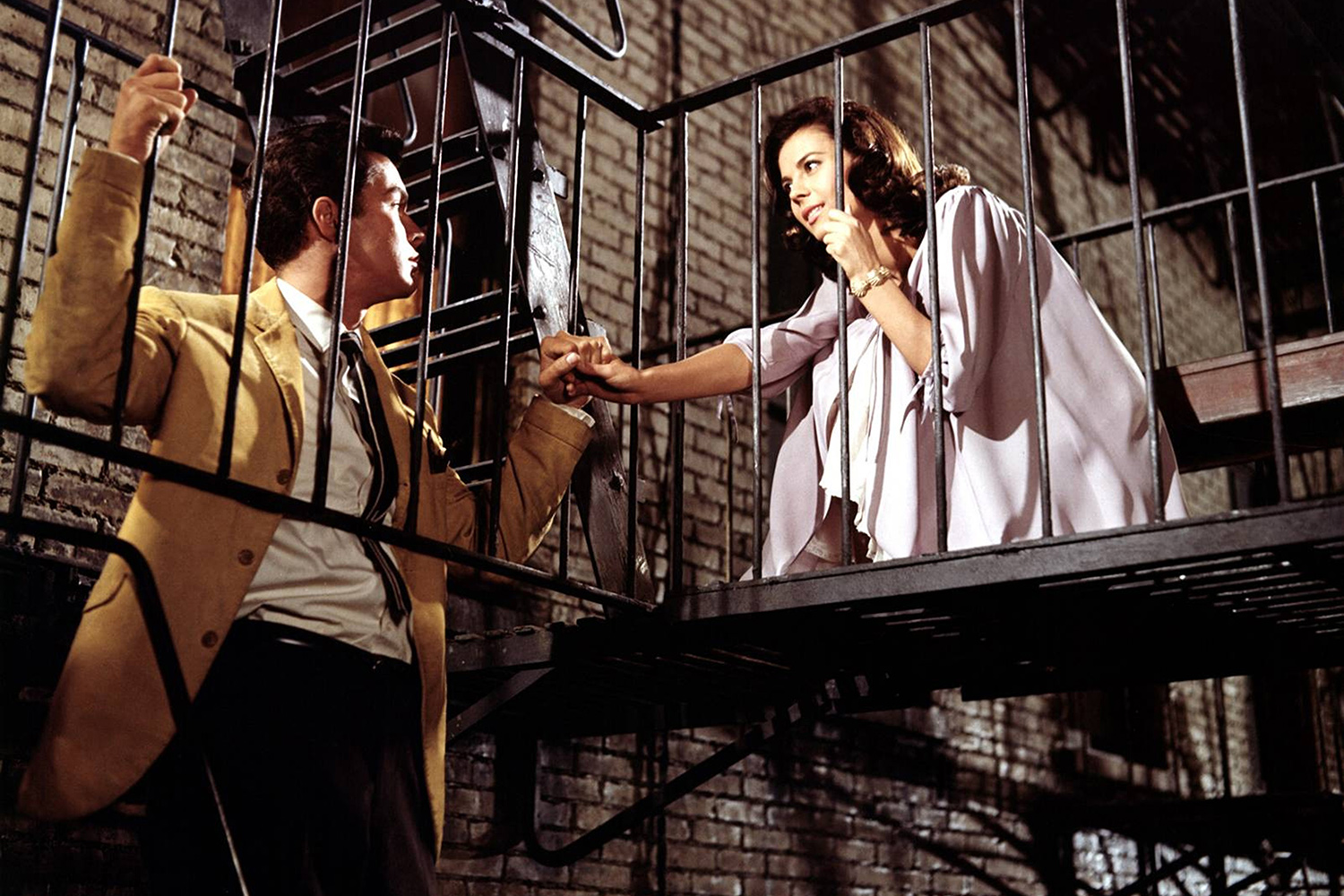
Actress Natalie Wood and Richard Beymer in a scene from the movie “West Side Story” (Photo by Donaldson Collection/Getty Images)

In honor of the 50th anniversary of this American classic there is a new Blu-Ray release of West Side Story: 50th Anniversary Edition.  Modeled on “Romeo and Juliet,” this movie puts the star-crossed lovers in two warring gangs in the slums of New York.  The opening dance number brings us up to date. The Sharks (Puerto Ricans) and and the Jets (Anglos) have blown up a series of petty insults and turf disputes into a war over who will rule the territory.   The leader of the Jets, Riff (Russ Tamblyn), goes to see his best friend Tony (Richard Beymer), the former leader of the gang.  Riff asks Tony to come to the dance that night to support him as he negotiates fight terms with Bernardo (George Chakiris), the leader of the Jets.  Tony has outgrown the gang, and wants more from life, but he and Riff are friends “womb to tomb,” so he agrees to go.  Moreno and Chakiris both won Oscars for their performances, two of the ten won by this movie, including Best Picture.  The brilliant music and lyrics are by Leonard Bernstein and Stephen Sondheim.
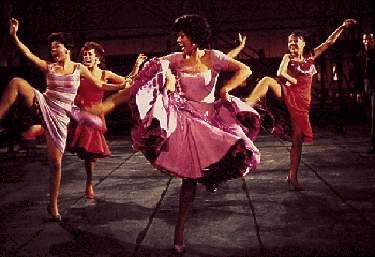
Bernardo’s sister Maria, just arrived in the US, is getting ready for the dance, begging to have her dress cut just a little lower.  Bernardo’s girlfriend, Anita (Rita Moreno), watches over her protectively.  At the dance, well-meaning Mr. Hand tries to get the teenagers to mix with each other, but tensions are high.  As each side dances furiously, everything seems to stop for Tony and Maria, who see each other and are transformed.

Bernardo is furious when he sees them together, and he takes Maria home.  But that night, Tony visits her, and they declare their love for each other.  She asks him to make sure there is no fighting, and he agrees.  At the “war council” he persuades them to make it a fist fight only, and he feels successful.  But Maria wants him to make sure there is no fighting of any kind, so he agrees to try to stop them.  Things get out of control, and Bernardo kills Riff with a knife.  Tony, overcome with grief and guilt, grabs the knife and kills Bernardo.

Running from the police and the Jets, Tony finds Maria.  They dream of a place where they could always be safe and together.  Anita agrees to take a message to Tony, but when she is harassed by the Jets, she angrily tells them that Maria is dead.  Blinded by grief, he stumbles out into the night, and is shot by one of the Sharks.  Maria holds him as he dies, and together, the Sharks and Jets carry him away.

The story retains its power, but the gangs are endearingly tame to us now.  Can it be that once there were gangs who fought with fists and knives?  This is a good opportunity to explore the reasons that people fight.  Anita says that the boys fight like they dance, “Like they have to get rid of something, quick.”  According to her, they are getting rid of “too much feeling.”  Kids understand that idea and may like to talk about what “too much feeling” feels like to them.  The music and dances in this movie do as much to tell the story as the dialogue and plot, and they illustrate this idea especially well.

One important difference between this movie and “Romeo and Juliet,” is that in Shakespeare’s play, the older generation plays an important role.  In “West Side Story,” the few adults who appear are ineffectual and tangential, like Mr. Hand (John Astin), who thinks he can get the kids to be friends by having them dance together.  Listen to the lopsided music-box song he plays for them, and see what a good job it does of expressing both what he is trying to accomplish and how hopeless it is.

            And, of course, this is an important movie to use in talking about prejudice.  See if you can get kids to watch carefully enough to figure out why the Sharks and Jets resent and mistrust each other.

Family discussion: If you were going to adapt the story of “Romeo and Juliet” today, what groups would the boy and girl come from? Where do you see the most prejudice today?  Listen to the song about “America,” with the Sharks and their girlfriends disagreeing about whether America has been good or bad to them. Which side do you agree with?  Are they both right?  Why? In the song “Tonight,” both sides sing, “Well they began it!”  Have you ever seen people act that way? One of the boys tells Doc “You was never my age.”  What does he mean?  Do all teenagers feel like that at times?  Have you ever dreamed of a special place where you could always be safe?  What would it be like? Tony has to decide how he can be loyal to his friend and loyal to Maria.  Why is that hard?  Who else in the movie has to make a decision about loyalty? If you could talk to Tony and Maria, what would you tell them to do?

Connections:  This is a great double-feature with “Romeo and Juliet” or the 1997 version, “William Shakespeare’s Romeo + Juliet.”  It is fun to see how much of the movie’s structure is taken from the play.  In both, the lovers see each other at a party, and are immediately overcome.  In both, the boy comes to see the girl later that night.  Juliet speaks to Romeo from a balcony.  Maria speaks to Tony from a fire escape.  Romeo and Tony are both pulled back into the fight due to the deaths of their friends.  In both movies, tragedy results from missed messages.  There are some important differences, too.  Juliet dies, but Maria does not.


Related Tags:


Based on a play Classic Drama DVD/Blu-Ray Pick of the Week Musical Romance Tragedy
THE MOVIE MOM® is a registered trademark of Nell Minow. Use of the mark without express consent from Nell Minow constitutes trademark infringement and unfair competition in violation of federal and state laws. All material © Nell Minow 1995-2026, all rights reserved, and no use or republication is permitted without explicit permission. This site hosts Nell Minow’s Movie Mom® archive, with material that originally appeared on Yahoo! Movies, Beliefnet, and other sources. Much of her new material can be found at Rogerebert.com, Huffington Post, and WheretoWatch. Her books include The Movie Mom’s Guide to Family Movies and 101 Must-See Movie Moments, and she can be heard each week on radio stations across the country.

Website Designed by Max LaZebnik