It may be a three-star movie about a four-star chef, but it is still a sweet summer treat and a great date night hors d’oeuvre.
Kate (Catherine Zeta Jones) just does not understand what everyone’s problem is. All she wants is to have every single detail in her kitchen meet her uncompromising standards. And for every single detail in her life to be as easy for her as coming up with an exquisite new recipe to enchant her foodie groupies. Is that too much to ask?
Apparently, it is, because the owner of the restaurant where Kate presides (one could never say “is employed”) has insisted that she get therapy if she would like to continue to preside. It is not good for business if Kate insults customers who fail to appreciate the subtle flavors and delicate complexities and just want undercooked steak. So, Kate goes to therapy, where she recounts the details of her food preparation in terms so swoonably delectable that for a moment both patient and therapist get a glimpse of a perfectible world. But that would mean a world in which we could be in control. And Kate is reminded of just how little control she has when her adored sister is killed in an automobile accident, leaving Kate as guardian for her young niece, Zoe (Little Miss Sunshine’s Abigail Breslin).
Director Julie Taymor is best known for Broadway version of “The Lion King,” which is itself best known for its visual splendor. And least known for its plot. There is visual splendor in this story of characters coping with the 60’s, to the tune of Beatles songs, but not much by way of plot. And the song covers by most of its stars are strictly with Beatles Night on “American Idol.” In one of those early episodes before much elimination.
For people who remember the 60’s, the movie’s look and sound will be poor competition for the kaleidoscopic visual and aural brilliance of the original Beatles creations and the story and characters will be superficial and simplistic compared to the kaleidoscopic upheavals of the era.
Those who know the Beatles’ work will find the movie’s references uninspired recreations rather than re-imaginings or responses. The character names say it all: Jude, Lucy, Max, Sadie, Rita, Prudence, JoJo, Dr. Robert, Mr. Kite, get it? Too on the nose. Max has a hammer. The singer and her band play on the roof until the police come to shut them down. People not familiar with the 60’s will wonder what the fuss was about.
There are some very clever touches in the staging of the musical numbers, as when at an induction physical, the Uncle Sam posters sing “I Want You” or in a couple of scenes where one song is played in sharply contrasting contexts. There are also some brilliant images, especially when the characters experiment with hallucinogens. But the story and characters are thin and so are the singing voices of most of the performers, with Eddie Izzard’s Mr. Kite, Bono’s Dr. Robert, and newcomer Dana Fuchs as a Janis Joplin-eque Sadie as welcome exceptions.
But they are supporting roles with too-brief appearances as the center stage goes to the featherweight story about a romance between blue collar Liverpudlian Jude (Jim Sturgess) and an American suburban princess named Lucy (Evan Rachel Wood) whose boyfriend was killed in Viet Nam. Lucy’s brother Max (Joe Anderson) and Jude move into one of those adorably Bohemian, summer of love, starving artist garrets in Greenwich Village, run by Sadie (Fuchs). They are soon joined by Jimi Hendrix-ish JoJo (Martin Luther) and unhappy-in-love Prudence (T.V. Carpio), who came in through the bathroom window, get it? Jude wants to be an artist; Lucy wants to protest the war. And everybody goes on a magical mystery tour and meets Dr. Robert and Mr. Kite.
It is overlong and under-written, visually vibrant but thematically transparent. The characters are more alive in the original Beatles songs than they are on the screen. And that leaves us nowhere, man.
Parents should know that the characters in this movie drink, smoke, and use drugs, including marijuana and hallucinogenics. They briefly use strong language and there are some emotional confrontations. The movie includes battle violence in Viet Nam, police brutality, and an offscreen explosion of a bomb built by protesters against the war. Characters are injured and there are sad offscreen deaths. Images include nudity, some stylized, and non-explicit sexual situations. A strength of the movie is the loyal and supportive relationships between characters of racial, gender, and sexual orientation diversity.
Families who see this movie should discuss some of their parents’ and grandparents’ experiences during the 1960’s. And they should listen to the original versions of the Beatles songs. Why are these songs so enduring and what groups today are producing songs that people will still want to hear in 40 years?
This movie starts out badly, gets much worse, and then after it is just dull for a while, it veers off into a whole new category of awful. Stay away.
The premise is promising. How do we know? Because it has been done with various levels of success before, first and best in Noel Coward’s Blithe Spirit, where just as a widower is celebrating his new marriage, the ghost of his ex-wife appears to stir things up. Everything that one did right, this one did wrong, however. That one had wit and charm and a storyline that was supple and surprising. This one: none of the above.
Rated PG-13 for some language, sexual humor, and partying
Profanity:
Some crude language
Alcohol/ Drugs:
Drinking
Violence/ Scariness:
Tense confrontations, comic peril
Diversity Issues:
Diverse characters, some stereotyping
Date Released to Theaters:
September 21, 2007
This updated fairy tale has some clever riffs on “Snow White” but never makes use of the considerable talents of its star, Amanda Bynes.
Copyright Morgan Creek 2007 Sydney (Bynes) is a college freshman who wants to join Kappa, the most exclusive sorority on campus, though she is more comfortable on a construction site than at a cotillion. “You know how people joke about being raised by wolves? I was raised by construction workers,” she explains and we cut to her devoted father (“The Dukes of Hazzard’s” John Schneider) illustrating the facts of life for her with plumbing supplies. When she knew she was dying, Sydney’s mother wrote her a letter, telling her how much she loved being in the sorority. Now Sydney wants to fulfill her mother’s dream.
But Sydney does not meet the standards of the Kappa president, Rachel Witchburn (Sara Paxton). She is not blonde, she is not a size 2, and, worst of all, Sydney fails to recognize Rachel’s supreme domination over just about everything on campus — especially the handsome Prince Matt Long as Tyler Prince, the campus McDreamy.
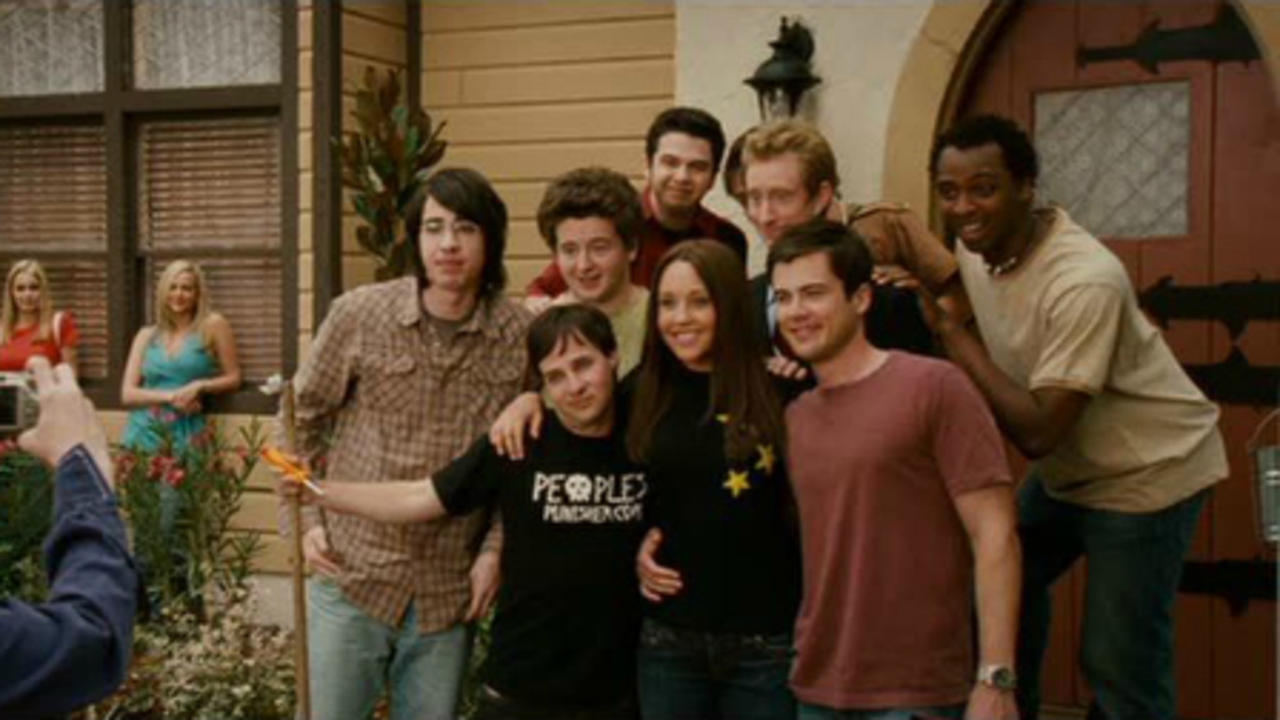
Rachel boots Sydney out of the sorority in a humiliating public ceremony. There is only one place left on campus that will take her in, the ramshackle house occupied by the campus outcasts. There are seven of them. One has allergies and sneezes a lot. One is an exchange student with jet lag who sleeps all the time. One is bashful. One is grumpy. All are nerdy. And Rachel has a plot to tear their house down so her family can build a shiny new rec center for sorority and fraternity members only.
Echoes of the Snow White story provide the movie’s brightest moments. Rachel checks constantly to make she is still considered the fairest in the land, not in a magic mirror but in the campus “hot or not” website. The poisoned apple? An Apple laptop with an important homework assignment gets infected with a virus. And of course in the big moment Sydney is awakened by a kiss from the Prince.
It is less cute when a nasty trick has the seven dorks naked at a campus party and when they march past Rachel with a mean-spirited “Hi, Ho!” It makes it harder for us to stay on the side of the good guys when they descend to the terminology of the bad guys. And it goes overboard on the geek factor; drawing less from fairy tales than from “Revenge of the Nerd”-style caricatures. For a movie that is supposed to be all about inclusion and respecting the dork within each of us, it has a lot of fun at their expense.
Bynes is captivating despite a role that does not give her much to do but display tomboyish good spirit behind some really unfortunate hair and make-up. She looks trapped in a 1970 Yardley ad, all fake tan, shag haircut, and pale eye shadow. She can make a retort sound spirited, not snappish, as when she tells Rachel that she doesn’t “speak priss.” Her best moments are with Long, who has a great smile and a rare ability to listen to what other performers are saying without thinking he has to be doing something every second he is on screen. Newcomer Jack Carpenter as Sneezy/Lenny brings warmth and humanity to a thinly written role as the most sociable of the dorks.
But director Joe Nussbaum does not trust his performers, the material, or the audience. He keeps the tempo so synthetically sitcom-y you expect to hear a rim shot and a laugh track. Everything is exaggerated. Every joke is an elbow in the ribs. Like Rachel, he is checking his “hotness” every couple of minutes. And like Rachel, his score could use some improvement.
Parents should know that this movie has some vulgar humor and strong language (references to “hos,” b-word), implied nudity, and a drinking game at a party. A strength of the movie is its emphasis on inclusion and the importance of treating diverse people respectfully, and Sydney reaches out to all groups on campus, from the Hassids to the band geeks, cross-dressers, and Goths.
Families who see this movie should talk about when they most felt like outsiders or dorks and what they can do to make sure that people around them feel included and appreciated for who they are.
Families who enjoy this movie will also enjoy other takes on classic fairy tales like Ella Enchanted and Shrek. Barbara Stanwyk and Gary Cooper co-starred in an earlier update of Snow White, Ball of Fire.
Rated PG-13 for language, some innuendo and sexuality.
Profanity:
Some strong language (s-word, b-word)
Alcohol/ Drugs:
Drinking (as liberating and empowering), characters get tipsy
Violence/ Scariness:
Comic violence including slaps
Diversity Issues:
None
Date Released to Theaters:
January 18, 2007
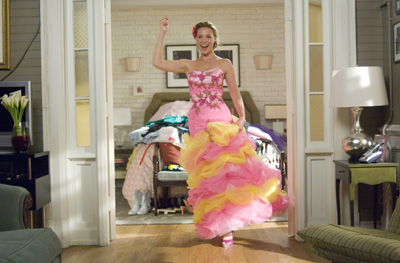
Jane has a special closet in her apartment filled with 27 dresses so ugly that only two things can be true: (1) they were all bridesmaid’s dresses, and that means (2) all 27 brides assured her that they could be shortened and worn again.
Jane (Katherine Heigl of “Grey’s Anatomy” and “Knocked Up”) is a natural caretaker. After her mother died when she was a child, she took care of her sister. She has taken care of 27 different brides, helping out with wedding details that have her over-stuffed day-planner bristling with yellow sticky reminders. In her job, she takes care of her boss, George (Edward Burns), the too-good-to-be-true mountain-climbing CEO of an impeccably politically correct corporation. She makes sure he gets his breakfast burrito and picks up his dry cleaning. In her few spare moments, she sighs with love for George or sighs with hope over the weekly write-ups of the most romantic weddings in the Sunday paper. Her dreams are of white dresses, tossed bouquets, and big cakes with lots of icing. Her reality is…dreams.
Just as she decides to let George know how she feels, urged on by her best friend Casey (the marvelous Judy Greer, wasted in an underwritten role as the movie’s designated sleep-around friend), Jane’s globe-trotting model sister Tess (Malin Akerman) arrives and she and George immediately decide to get married, with guess who taking care of all the cake, flower, and decoration details. All of this is so distracting that Jane barely has time to notice the killer smile of Kevin, a cynical reporter (the marvelous James Marsden, almost-wasted in an under-written role that seems left over from an old Clark Gable character). For no reason except the demands of the increasingly flimsy plot, Kevin is required to keep a couple of obvious secrets.
Heigl is the real deal, with girl-you-wish-lived-next-door imperishable but accessible beauty, appealing, endearing, vulnerable, with understated comic timing. Marsden, too, has charm to spare. Both hold our interest and keep us rooting for them even when the script does its best to get in the way. Do we really need yet another scene with characters letting go by getting tipsy and singing 80’s songs? Akerman (“The Heartbreak Kid”), in her second role in five months as a selfish, irresponsible, and all-around nightmare bombshell who impulsively gets engaged, struggles with an impossible task as she tries to be both over-the-top obnoxious and sympathetic at the same time. What does work is Heigl and the dresses and the fact that, like Jane, most of the audience loves to get misty at weddings. Watching this film is like waiting to catch the bride’s bouquet, more anticipation than fulfillment.

 ,
,  ,
,  , and
, and  but slightly above
  , maybe somewhere around
  .
. 
 and
and  .
.  , where just as a widower is celebrating his new marriage, the ghost of his ex-wife appears to stir things up. Everything that one did right, this one did wrong, however. That one had wit and charm and a storyline that was supple and surprising. This one: none of the above.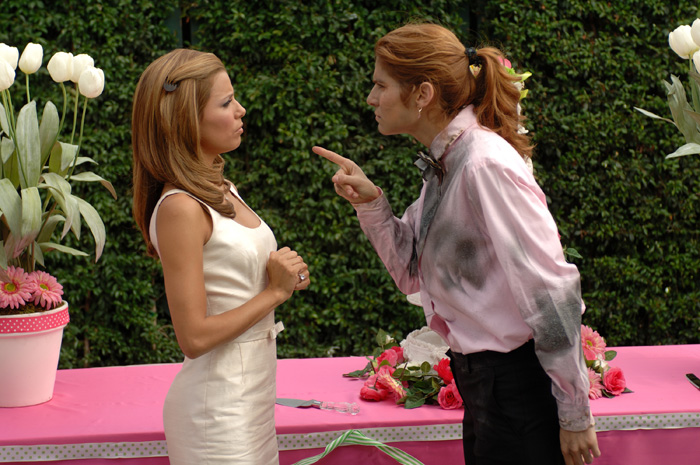
 and
and  . Barbara Stanwyk and Gary Cooper co-starred in an earlier update of Snow White,
  .
. Jane has a special closet in her apartment filled with 27 dresses so ugly that only two things can be true: (1) they were all bridesmaid’s dresses, and that means (2) all 27 brides assured her that they could be shortened and worn again.