A new Harry Potter story is coming! But unless you can get tickets to see it on stage in London next month, you won’t find out what happens in “Harry Potter and the Cursed Child.”
Mary Poppins Returns — With Emily Blunt and Lin-Manuel Miranda
Posted on May 31, 2016 at 4:41 pm
Hamilton writer/star Lin-Manuel Miranda and Emily Blunt will bring us Disney’s new sequel, “Mary Poppins Returns.” P.L. Travers wrote six books about the magical nanny so there is a lot of great material for new adventures. This will be exciting!
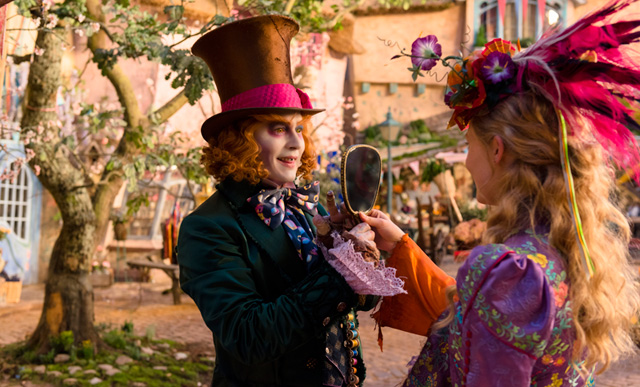
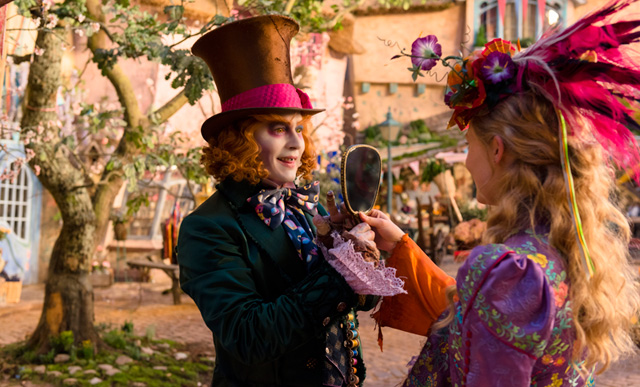
“Alice Through the Looking Glass” the movie has almost no relationship to Alice Through the Looking Glass, the book by Lewis Carroll in spirit, character, or storyline. That might possibly be all right if the spirit, character, or storyline were in any way worthwhile, but it is not. Gorgeous production design and some cool stunts do not make up for a story that begins as passable and ends as painful.
Tim Burton, who produced this one, previously gave us an “Alice in Wonderland” with an adult Alice (Mia Wasikowska) replacing the little girl of the story and spending way too much time in the above-ground “real” world as she attends a party, turns down a proposal of marriage from the odious Haimish (Leo Bill), and accepts instead the offer from his father to serve as crew on a merchant ship.
In “Looking Glass,” we first see Alice, now captain of the ship, in an exciting escape from pirates that show us her courage and love of adventure. But when the ship returns to port in London, she finds that Hamish’s father has died, leaving him in charge, and he refuses to let her go back to sea. In his home, she finds a mirror over a fireplace that is a portal back to Wonderland, led by the former caterpillar, now-butterfly (voice of of the much-missed Alan Rickman).
Having already imported the talking flowers, chess pieces, Tweedledum and Tweedledee, and the Jabberwocky from “Through the Looking Glass” into the first film, conflating the first story’s Queen of Hearts (the “Off with the head!” one) with the second story’s Red Queen (the chess one) this movie takes — but makes no use of — the first book’s characters like the Cheshire Cat and the White Rabbit, and then has a completely invented story about time travel.
This has many disagreeable aspects, but the worst is when it puts Sasha Baron Cohen as the embodiment of Time into a scene with Johnny Depp as the Mad Hatter and allows them to try to out-grotesque each other in a manner clearly intended to be charming. It is not.
Neither is the plot, which relies heavily on just the kind of treacly heartstrings-plucking backstories that Carroll would never have allowed, asking us to feel sympathy for outrageous behavior and affection for caricatures. The first film’s attempt to create a warm, devoted friendship between Alice and the Mad Hatter was rather ooky. In the sequel, we are asked to believe that she has returned to do whatever it takes to help him because they love each other so much.
To paraphrase the folks behind “Seinfeld,” in the Alice world, there should be no hugging and no apologizing — and no heartfelt professions of affection, especially when they are not in any way justified by the characters’ history with each other.
Alice is needed on the other side of the mirror because the Mad Hatter has found something that has convinced him that his family is still alive, and not killed by the Jabberwock as he had thought. Why is this so important? Is it because he misses them so? Not really. It is because he feels bad about his behavior and needs to see them again so he can be forgiven. The disconnect between the expressions of devotion and the narcissistic reality of behavior is disturbingly cynical. Alice decides the only way she can save his family is to go back in time to the Jabberwock battle, which means she has to retrieve the chronosphere from Time himself, and that leads to more time travel as she solves various not-very-mysterious mysteries and Time chases her to get it back. Not that any of it makes any sense, logically or emotionally.
The production design is imaginative and witty, but it is buried under a gormless, hyperactive mess of a film. The book is endlessly witty and imaginative and delightful with all kinds of wordplay, math puzzles, and chess references from Carroll (aka Charles Dodgson), a math professor. The movie wastes all of that opportunity. Look at the title — the movie should be about a reverse world, not a heist/time travel saga that only concludes you can’t change history. If I had the chronosphere, I’d use it to go back to the moment I sat down to watch this movie so I could go home.
Parents should know that this film has extended fantasy peril with many disturbing images, discussion of loss of parents, brief image of someone dying, and bullying.
Family discussion: If you could go back in time, what time would you pick? Why did the Hatter and the White Queen have a hard time telling their families how they felt?
Rated PG-13 for sequences of violence, action and destruction, brief strong language and some suggestive images
Profanity:
Brief strong language
Alcohol/ Drugs:
None
Violence/ Scariness:
Extended comic book/action peril and violence, characters injured and killed
Diversity Issues:
A metaphorical theme of the movie
Date Released to Theaters:
May 27, 2016
Date Released to DVD:
October 3, 2016
Amazon.com ASIN:
B01G9AXWH2
Copyright 20th Century Fox 2016
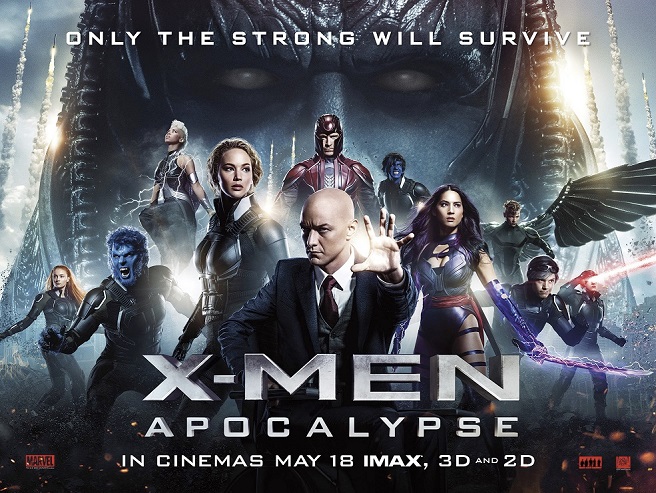
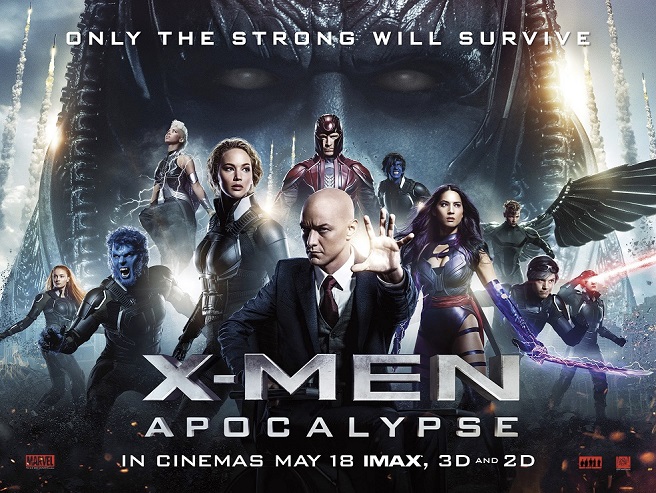
We love superheroes, but most of the time what makes a superhero movie work is the supervillain. Just as the Avengers on the other side of the Marvel Universe move into X-Men territory by having the supes fight each other, with a villain in “Civil War” who is a mere human, with the most human of motives and goals rather than Loki’s “let’s blow up the universe and roast marshmallows on the flames” sort of threat, the X-Men, whose primary plotlines rest on the shifting loyalties of its mutant members, switches direction toward a more Loki-esque bad guy.
That would be the first mutant of all, going all the way back to ancient Egypt, where he was a god. He is resurrected, he is nearly omnipotent, and he is played by one of the most exciting actors in movies, Oscar Isaac. But there are three big problems with Apocalypse, and that means there are three big problems with the movie.
First, we never really understand that “nearly” part about his powers, and therefore we cannot judge the threat he poses in any given confrontation. Second, Isaac is a superb actor with deeply expressive eyes and voice. Yet he is put into a mask that conceals his eyes and given a double-tracked distortion of his voice. The big, hulking outfit also impairs the precise, distinctive physicality he has brought to roles as different as “Star Wars” ace Po Dameron, the title folk musician of “Inside Llewyn Davis,” and billionaire Nathan Bateman (“Ex Machina”). The power of his presence as a performer is all but muted just when we need a character to be terrifying.
Plus, we’ve seen ancient Egyptian super villains before. After the many versions of “The Mummy,” we need something more than he’s from the time of the pyramids plus chanting. But there is a very cool opening sequence that brings us through history to 1983, the pre-digital era when overhead projectors in classrooms represented cutting-edge technology. And Magneto seems to have found peace, in a small town, with a factory job, and a loving wife and daughter.
Of course, that can’t last. And soon he has experienced yet another devastating loss, and returns to his bad, furious, destructive self — until someone who is even more furious and destructive comes along.
When I say that this episode is a “Muppet Babies” take on the X-Men, I do not necessarily mean that in a bad way. Origin stories are intriguing, and the X-Men have always had an adolescent quality, with the onset of their mutant powers coming with puberty and acting as a heightened metaphor to examine the sense of uncertainty, anxiety, and isolation that comes with the physical and emotional changes that separate teenagers from their childhood. It is intriguing to see Scott (Tye Sheridan) rubbing his red eyes as he becomes Cyclops. But Sophie Turner does not have the screen presence of Famke Janssen as the young Jean Grey, in part because her telepathic gift is not as cinematically dynamic.
Quicksilver (Evan Peters) once again provides the high point, not just in a darker showpiece callback to the sensational Pentagon kitchen scene in the last film but in the film’s brief but most emotionally authentic scene, involving his relationship to Magneto. In a movie about mutants with superpowers, the best moment is human.
Parents should know that this film includes extended comic book-style action violence, with characters injured and killed and some disturbing images, skimpy costumes, and some strong language.
Family discussion: What is the biggest challenge in getting the X-Men to work together? Which powers would you like to have?
If you like this try: the other X-Men movies, especially “Days of Future Past”