Dumb and Dumber To

Posted on November 13, 2014 at 5:52 pm
Copyright 2014 Universal

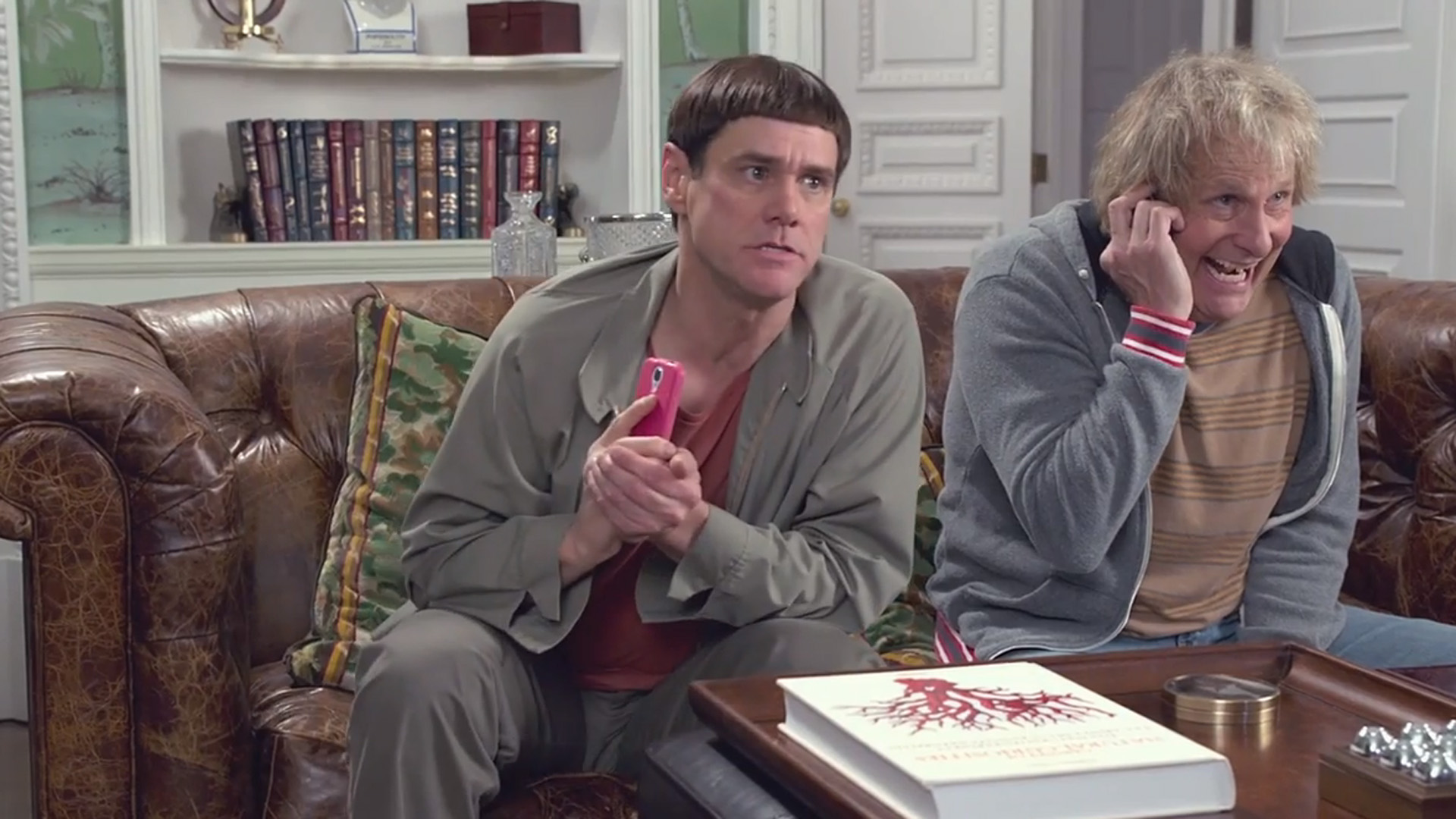
A poorly timed cameo appearance by Honey Boo-Boo’s sexual predator-consorting Mama June is dumb.  Making a sequel 11 years after the original “Dumb and Dumber” and the best-forgotten prequel “Dumb and Dumberer: When Harry Met Lloyd” is dumber.  Too. Jeff Daniels and Jim Carrey do their best and clearly enjoy themselves, but 20 years after the original, it just isn’t as funny.  It feels like those late-era Three Stooges comedies, past the Shemp era, even past Joe Besser, with Curly Joe.  As Lloyd (Carrey) says, comedy is all about timing.  And this one is too late.

Factor this into your assessment of this review.  The movie relies heavily on the viewer’s familiarity with and affection for the original, which I do not share.  Also, I do not find jokes about stupidity funny, don’t care much for slapstick, and I am not a fan of potty humor.  If any of the following appeals to you, then by all means buy a ticket: naming a character after a crude sexual act, a snot bubble, feeding someone with fingers that have just been up someone’s butt, changing an adult diaper,  holding a bag of urine with one’s teeth, jokes about lobotomies and shock treatments, a cat ingesting meth and swinging from a chandelier, slicing off a portion of the male anatomy, giving a young girl having her first period a cork, an elderly lady in a nursing home tricking a man into sexual touching (when he removes his hand, there’s dust on it!), potentially inscestuous thoughts, and a character who confuses lepers and leprechauns.

Like the first one, this is a road movie.  Harry (Daniels) says he needs a new kidney, so he has to find a donor who is a match.  His parents inform him that he was adopted.  Someone else might have picked up on the fact that they are Asian, but of course that never occurred to our heroes.  But Harry finds out that he has a daughter who herself was adopted by a Nobel-winning scientist.  When Lloyd takes one look at her photo, she imprints on him like Renesmee on Jacob, setting us up for a little potential incest joke later on, only exceeded in its inanity by the discovery that our heroes are not exactly clear on what makes babies.

So Harry and Lloyd set out to find this girl and see if she will donate a kidney.  She is representing her father at an event where he is to receive an award, and he has given her a package with his latest discovery to turn over to charity for the good of humanity.  His wife Adele is planning to kill him and get the package back so she and her lover can sell the discovery and live happily ever after on the millions he tells her it is worth.

Carrey’s choices are always fascinating, even when the movie is at its grossest and most disgusting.  He has a ferocity and fearlessness and a sheer joy in committing to the character that rises above the lazy material.  Kathleen Turner, as the character with the filthy name, still has that magnificent husky voice and acerbic delivery.  It is too bad that one of the jokes is about how she is a “Titanic whore.”  Rob Riggle shows up not once, but twice,  as identical twins.  Even though he does not have much to do other than appear in some bizarre disguises and one really atrocious haircut, the movie picks up when he’s on screen.

I did appreciate a welcome (if gentle) parody of the TED Talks.  And I admit that I laughed three times, which were pretty much the only three jokes that were not about bodily functions or substituting faux outrageousness for humor.  It can be funny to be politically incorrect.  But political incorrectness is not itself funny.  There is a lot of great comedy in dumb characters.  But not when the script is as dumb as they are. To.

Parents should know that this movie has material that would receive an R rating if it were not a comedy.  The movie includes strong and crude language, drinking and drugs, extremely vulgar sexual references, extensive bodily function humor, brief nudity, and fantasy/comic violence including a murder plot, guns, poison, and ninjas.

Family discussion:  How does this movie compare to the original?

If you like this try: “Stuck on You” and “Shallow Hal,” from the same writers/directors

Related Tags:


Comedy Scene After the Credits

Big Hero 6

Posted on November 6, 2014 at 5:59 pm

B+
Lowest Recommended Age: Kindergarten - 3rd Grade
MPAA Rating: Rated PG for action and peril, some rude humor, and thematic elements
Profanity: None
Alcohol/ Drugs: None
Violence/ Scariness: Cartoon-style peril and violence, sad death, grieving parent becomes destructive
Diversity Issues: Diverse characters
Date Released to Theaters: November 7, 2014
Date Released to DVD: February 23, 2015
Amazon.com ASIN: B00O4ZC57
Copyright 2014 Walt Disney Studios

Hiro (Ryan Potter) is a super-smart kid who likes to hustle underground robot fighters with his deceptively cute-looking little bot.  He has no interest in going to school until the older brother he adores (Daniel Henney as Tadashi) brings him to the robot lab at the university he attends.  When Hiro sees all of the lovable nerds (and one non-nerdy slacker named Fred who dresses as the school mascot) making awesomely cool creations, he gets very excited about joining them.  He has to invent something spectacular to get admitted, and so he gets to work and comes up with something extraordinary, a system of tiny bots who can form themselves into almost anything.

But then Tadeshi is killed trying to rescue his professor from a fire.  Hiro is devastated.  The brothers were orphans.  While their aunt (Maya Rudolph) does her best, Hiro and Tadeshi were all that was left of their family, and now Hiro is devastated at being alone.  He refuses to go anywhere or talk to anyone.

But Tadeshi left someone behind.  It turns out he was working on developing a robot called Baymax, designed to be a kind, reassuring, gentle healer.  Baymax is equipped with extensive diagnostic and treatment capacity but his look is intended to be non-threatening.  He looks like a big, white balloon, or, as one character says, like a marshmallow man.  He is as far from a weapon or fighter as it is possible to be.  But when Hiro and the robotics nerds find out that Hiro’s invention has been stolen and will be used for destructive purposes, they get together to use their skills, their courage, and, most of all, their sense of what is right to save the day.

The film, loosely inspired by Marvel’s comic book, is filled with engaging characters and imaginative touches.   The setting is “San Fransokyo,” a California/Japan mash-up that seems familiar and real but also intriguingly foreign.  It is a pleasure to see Disney’s most diverse set of protagonists ever, race, gender, and even economic. The bending of stereotypes is done with an effortless flair. And it is great to see a movie for the family that acknowledges the fun and excitement of being smart and working hard.  We get a lot of movies for kids about the importance of friends and family, following your dreams, and being yourself, and all of that is here, too.  But we don’t get many about solving problems through study and experimentation.  It’s very nice to see a film that recognizes that it is cool to be smart.

NOTE: Please stay all the way through the credits for an extra scene that is a lot of fun, especially if you are a Marvel fan.  And be sure to get there on time as the Oscar-nominated pre-feature short film “Feast,” about a hungry puppy, is completely charming, hilarious, and sweet.

Parents should know that this film includes cartoon-style action, peril, and violence, very sad sibling death (off-camera), other characters apparently killed, grieving parent who becomes destructive, and brief potty humor.

Family discussion: What kind of robot would you like to build? Which of the characters is most like you?

If you like this, try: “The Iron Giant,” “Wreck-It Ralph,” and “Bolt”

Related Tags:


3D Animation Comic book/Comic Strip/Graphic Novel DVD/Blu-Ray Pick of the Week Scene After the Credits

The Boxtrolls

Posted on September 25, 2014 at 5:59 pm

A-
Lowest Recommended Age: Kindergarten - 3rd Grade
MPAA Rating: Rated PG for action, some peril and mild rude humor
Profanity: None
Alcohol/ Drugs: None
Violence/ Scariness: Cartoon-style peril and some violence, comic allergic reaction, references to disturbing violence, some gross images
Diversity Issues: A theme of the movie
Date Released to Theaters: September 26, 2014
Date Released to DVD: January 19, 2015
Amazon.com ASIN: B00HLTDARS
The-Box-Trolls-2
Copyright LAIKA Studios 2014

LAIKA Studios (Paranorman and Coraline) has created another  loveably crooked world, this time inspired by Alan Snow’s Here Be Monsters! (The Ratbridge Chronicles).  It’s their first period setting, a sort of slightly bent Edwardian with a touch of steampunk, in the town of Cheesebridge.  LAIKA’s motto may be “No straight lines, no right angles, no perfect circles,” but this wobbly community is rigidly stratified, with the White Hats at the top of society, nibbling on exotic cheeses in the elegant Tasting Room and hosting elegant parties, the lower class Red Hats desperate to be accepted by them. There is an entirely separate group, the gentle Boxtrolls, who live underneath the city, turning rubbish into Rube Goldbergian machines and tending their garden.  They are called Boxtrolls because of their attire — discarded cardboard boxes.  And their names come from the boxes they wear: Fish, Fragile, Shoes, and Specs.
And then there is Eggs (Isaac Hempsted Wright).  He thinks he is a Boxtroll, but he is a human, left as a baby by his father, who was trying to keep him safe.  Apparently Cheesbridge follows Noam Chomsky’s theories of language: while the Boxtrolls speak in a sort of mumbly pidgin talk, Eggs speaks flawless and rather aristocratic-sounding English.  Their happy life is disturbed by Snatcher (Sir Ben Kingsley), the leader of the Red Hats, who conducts raids to capture the Boxtrolls.  He knows they are harmless, but he has persuaded the White Hats that the Boxtrolls capture and eat human children so that they will depend on him to exterminate them.  If Snatcher gets rid of all of them, the Mayor of Cheesebridge has promised to give him a White Hat and allow him into the sanctum sanctorum, the Tasting Room.  There is one problem, though.  Snatcher, despite his protestations to the contrary, is massively lactose-intolerant.

Mayor Lord Portly-Rind (Jared Harris) and his wife Lady Portly-Rind (Toni Collette) have a daughter named Winnie (Elle Fanning, the sister of “Coraline” star Dakota Fanning).  She longs for them to pay attention to her.  Their neglect has led her to develop a macabre fascination with what she imagines are the atrocities of the Boxtrolls and she decides to investigate.  When she finds out that the Boxtrolls are harmless, she agrees to help Eggs tell her father that Snatcher has lied.  Eggs will need to be persuaded that he is in fact human and then taught some of the basics of human interaction so that he can deliver the message.

The word “immersive” is often used to describe movies with 3D effects that seem to make the images surround the viewer by extending both in front of and behind the screen.  But LAIKA’s films are more deeply immersive than that because of the intricacy of the world they create.  Most animated movies use miles of code to show us how every individual hair in an animal’s fur rustles in the wind.  But the handmade touch and infinite care of LAIKA’s stop-motion films, where figures and props are nudged ever so slightly for each individual frame and craftspeople spend months creating practical (not digital or virtual) effects to evoke water, fire, and clouds, creates an environment that is tantalizingly complex and invites many viewings to explore its wonders.

LAIKA is perfectionist in its dedication to not being perfect.  It embraces the messiness of life.  The Boxtrolls’ cavern is grimy and dank, and the Portly-Rind home filled with dessicated finery, but both are brimming with endlessly inventive detail, especially the elaborate mechanics of the Boxtrolls’ cave and the meticulous choreography of the White Hats’ ball.  Every single object reflects the care taken by the filmmakers and every detail reflects some element of character and story, which are messy as well.  Winnie, who has so much, is lonely and neglected.  But she is brave and honest.

Eggs, who has so little, is surrounded by love.  He is loyal and courageous.  And Snatcher, who is so desperate for acceptance that he will don an elaborate disguise, make libelous accusations, and put his health and even his life at risk, is ultimately not really able to destroy the Boxtrolls.  His henchmen, played by Tracey Morgan, Nick Frost, and Richard Ayoade are less wicked than existentially confused, trying to persuade themselves that they are on the right side.

The visuals are deliciously grotesque at times, but the message is a sweet one: families come in all sizes and shapes, sometimes biological, sometimes not, but what defines them is love.

NOTE: Be sure to stay through the credits to see some existential ponderings by the characters and a brief cameo by animator/CEO Travis Knight.

Parents should know that there are some comic but grotesque and macabre images.  Characters are in peril and apparently killed, though shown later to be imprisoned.  A character appears to have lost his mind.  Another character explodes (offscreen).

Family discussion: Why was it so important for Snatcher to be a White Hat?  Why didn’t Winnie’s parents pay more attention to her?  Why did some of the Red Hats think they were the good guys?

If you like this, try: “Coraline,” “Paranorman,” and “Monster House”

Related Tags:


3D Animation Based on a book DVD/Blu-Ray Pick of the Week Fantasy For the Whole Family Scene After the Credits Stories About Kids

Tusk

Posted on September 18, 2014 at 5:59 pm

Copyright 2014 SModcast Pictures

You can make a good movie about slackers, for example “Slackers,” from Richard Linklater and “Clerks” from Kevin Smith. But you can’t make a good movie by a slacker, and Smith does not seem willing to be anything more. There are flickers of interesting possibilities in his latest film, his first foray into horror. Justin Long nails his early scenes as Wallace, a sort of Smith wannabe. We learn later in flashbacks that he was once a sweet, geeky guy who cried in “Winnie the Pooh.” He was conversant enough with literature to recognize quotes from “The Rime of the Ancient Mariner” and Hemingway. But he found out he could make money and attract groupies by being obnoxious and outrageous. Wallace and his best friend Teddy (Haley Joel Osment) host a podcast something between Smith’s own SModcast, Tosh.0 and the skankier sub-reddits. It’s called “Not-See Party,” get it? In case you don’t, Wallace has a sign-off in a fake German accent. What, too soon?

We first see them helpless with laughter over a found video along the lines of the “Star Wars kid,” but this one is a “Kill Bill” wannabe who accidentally slices off his own leg at the thigh. A real laff-riot! This is such a bonanza of a topic for the Not-See Party duo that Wallace decides to visit the kid in person, at his home in Manitoba, Canada. But when he gets there (following a not-funny encounter at the border with an official who warns him not to be flippant about hockey in Canada), Wallace discovers that the despondent kid has committed suicide. Bummer for the podcast! Seeking some other poor slob to make fun of so the trip won’t be wasted, Wallace comes across an intriguing flier in a men’s room, a man named Howard Howe, a retired sailor, who says he has stories to tell. Wallace rents a car and drives two hours into Howard’s remote house (beautifully creepy interiors by John D. Kretschmer, a highlight of the film). He sips at the tea offered to him by the genially eloquent Howard (as he prefers to be called), at first condescending but thinly disguising his snark, then impressed in spite of himself with Howard’s stories of WWII and being shipwrecked, and then, suddenly, very, very, very, very sleepy.

The tea was spiked. Howard has something very gruesome in mind, which we discover along with the terrified Wallace.

The idea for this film came up in a SModcast conversation with Smith and friend and producer Scott Mosier discussing an ad placed by a homeowner who was offering a living situation free of charge, if the lodger would agree to dress as a walrus. Their can-you-top-this riffs on the possibilities suggested by the ad led to a twitter campaign with the hashtag #walrusyes. And that is why it feels at times as though the screenplay was pieced together by tweets. A major Hollywood star shows up in disguise for a stunt-ish, winking-at-the-screen turn as a Quebecois detective in pursuit of Howard Howe, not nearly as funny or charming as intended. While there are hints of something deeper — the conversation about how Wallace as devolved as a person, with his girlfriend missing the “old Wallace,” the similarities between “Wallace” and “Walrus” — the real possibilities of the storyline about humanity, inhumanity, and what separates us from the animals, are blithely bypassed for random detours and red herrings (maybe red mackerels). It is another disappointment from Smith, who may not write all of his scripts while stoned, but they sure feel like it.

Parents should know that this is a horror film with many graphic and disturbing images of torture and mutilation. Characters are injured and killed. It also includes strong language, drinking and smoking, and sexual references and situations, with brief male rear nudity.

Family discussion: Are we supposed to think that Wallace somehow deserved or asked for what happened to him? How do you interpret the final scene?

If you like this, try: “The Skin I Live In” and “Boxing Helena” — and Eugene Ionesco’s classic Rhinoceros

Related Tags:


Horror Scene After the Credits

Dolphin Tale 2

Posted on September 11, 2014 at 5:59 pm

Copyright Warner Brothers 2014

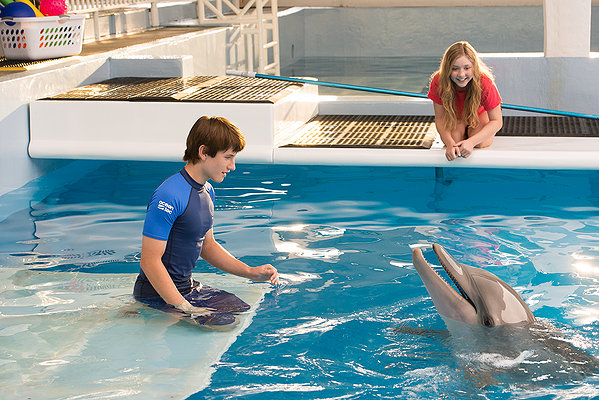
The warmest, wisest, most pleasurable live-action family film of the year is “Dolphin Tale 2,” even better than the 2011 original. This really is that rare movie for the whole family.

The first film was inspired by the true story of Winter, a rescued dolphin who was able to thrive in Florida’s Clearwater Marine Aquarium after an innovative new prosthetic tail helped to protect her spine and allow her to swim. She has been an inspiration to millions of visitors in person and via webcam, especially to wounded veterans and other adults and children with disabilities. In the original, directed by Charles Martin Smith (Terry the Toad in “American Graffiti” and Farley Mowat in Never Cry Wolf, a sensitive loner named Sawyer (Nathan Gamble) bonds first with the wounded dolphin and then with the staff who care for the marine animals, especially aquarium head Clay (Harry Connick, Jr.) and his pretty daughter Hazel (Cozi Zuehlsdorff). Ashley Judd played Sawyer’s mother, Kris Kristofferson played Clay’s houseboat-dwelling dad, and Morgan Freeman played crusty Dr. McCarthy, who figures out how to make the prosthetic comfortable and stable.

Everyone returns for this follow-up, and this time Charles Martin Smith does triple duty as writer, director, and actor, appearing as a strict but not unsympathetic USDA official responsible for making sure the facility meets federal standards in caring for the animals.   He may refer to Winter at CMA1108, but he is trying to do what is best for her.

The kids have gone from middle school to high school. They are now experienced marine animal specialists, and spend most of their time at the aquarium, much of that in the water. We see how capable and knowledgeable they are when they assist in the rescue of an injured dolphin they name Mandy and a sea turtle ensnared in fishing line they dub Mavis. And we see how deeply they care for the animals when the veteran of their dolphin population, a 40-year-old deaf dolphin who is “paired” with Winter, dies suddenly. This is more than a sad loss. Dolphins are deeply social creatures. If Winter cannot or is not willing to be be paired with another dolphin, she will die.  The USDA inspector says that if they cannot find a friend for Winter in 30 days, she will have to be moved.

Mandy’s arrival seems providential. But then the best thing happens, which is also the worst thing. They are able to restore Mandy to health.  But that means that she can no longer remain in captivity, which is just for animals who can no longer take care of themselves.  The motto of the facility is three words: rescue, rehabilitate, release.  “You didn’t build this place to keep animals,” Clay’s father reminds him.  “You built it to heal them and let them go.”  The wrenching task of weighing those competing considerations is sensitively presented as a moral issue, an economic issue, and as a part of growing up that Hazel and Sawyer must understand.  It is an issue of more complexity than we normally get to see in family films, and it is presented with exceptional insight.  A scene where Hazel follows Sawyer’s mother’s advice to speak to Clay the way she would like to be spoken to is a small gem that got some appreciative laughs of recognition from the audience. Smith knows his audience, though, and expertly seasons the storyline with cute animals, especially Rufus the pelican, who is back for more comic relief. Even with Rufus, though, the slapstick moments are just part of the story.  His protective concern for Mavis is genuinely touching.

A storyline about whether Sawyer will accept an opportunity to take a special semester at sea is less intriguing.  But Gamble’s quietly sincere and thoughtful performance grounds the film, with Zuehlsdorff (who provides a sweet song over the closing credits) more ebullient, but never less than completely real and in the moment. The completely natural performances of the two leads perfectly matches the sun-drenched naturalism of the setting, utterly at home in the water, interacting with the dolphins, or struggling to grow up. When Dr. McCarthy sits down next to the conflicted Sawyer to hand him a family heirloom, Sawyer says knowingly, “I’m about to get a lesson here, aren’t I?” He is, and we are, too, but it is a good lesson and it goes down easy. So does the film, ambitious in scope but light in presentation. And it is no disrespect to the movie to say that the best part is the closing credits, where we see Wounded Warriors and other people with disabilities coming to visit Winter and Hope for inspiration and, somehow, a sense that they are being understood and cared for.

Parents should know that this film includes mild peril, some scenes of animal and human injuries and a sad animal death.

Family discussion: What was the lesson of the watch? What were the best reasons for releasing Mandy? For keeping her? Did they make the right decision?

If you like this, try: The original film — and watch Hope and Winter online

Related Tags:


Animals and Nature Environment/Green For the Whole Family Inspired by a true story Scene After the Credits Series/Sequel Stories About Kids
THE MOVIE MOM® is a registered trademark of Nell Minow. Use of the mark without express consent from Nell Minow constitutes trademark infringement and unfair competition in violation of federal and state laws. All material © Nell Minow 1995-2026, all rights reserved, and no use or republication is permitted without explicit permission. This site hosts Nell Minow’s Movie Mom® archive, with material that originally appeared on Yahoo! Movies, Beliefnet, and other sources. Much of her new material can be found at Rogerebert.com, Huffington Post, and WheretoWatch. Her books include The Movie Mom’s Guide to Family Movies and 101 Must-See Movie Moments, and she can be heard each week on radio stations across the country.

Website Designed by Max LaZebnik