
Smile of the Week: Let’s Boogey to the Elf Dance!
Posted on December 18, 2011 at 8:00 am

Posted on December 16, 2011 at 3:49 pm
A classic moment from one of the best-loved holiday treats, Rudolph the Red Nosed Reindeer
The very touching story behind the Rudolph song and its creator, Bob May, was told by his friend, my beloved late uncle, Stanley A. Frankel, in a magazine story more than sixty ago.
Rudolph that Amazing Reindeer
by Stanley Frankel
His lovable antics have delighted millions of children; here is the inspiring story of how he was born when a father tried to comfort an unhappy little girl.
On a december night in Chicago ten years ago, a little girl climbed onto her father’s lap and asked a question. It was a simple question, asked in childish curiosity, yet it had a heart-rending effect on Robert May.
‘‘ Daddy, ’’ four-year-old Barbara May asked, ‘‘ why isn’t my Mommy just like everybody else’s mommy? ’’
Bob May stole a glance across his shabby two-room apartment. On a couch lay his young wife, Evelyn, racked with cancer. For two years she had been bedridden; for two years, all Bob’s small income and smaller savings had gone to pay for treatments and medicines.
The terrible ordeal already had shattered two adult lives. Now, May suddenly realized, the happiness of his growing daughter was also in jeopardy. As he ran his fingers through Barbara’s hair, he groped for some satisfactory answer to her question.
For Bob May knew only too well what it meant to be ‘‘different. ’’ As a child he had been weak and delicate. With the innocent cruelty of children, his playmates had continually goaded the stunted, skinny lad to tears. Later at Dartmouth, from which he was graduated in 1926, Bob May was so small that he was always being mistaken for someone’s ‘‘little brother.’’
Nor was his adult life much happier. Unlike many of his classmates who floated from college into plush jobs, Bob became a lowly copy writer for a New York department store. Later, in 1935, he went to work writing copy for Montgomery Ward, the big Chicago mail-order house. Now, at 33, May was deep in debt, depressed and miserable.
Although Bob didn’t know it at the time, the answer he gave the tousle-haired child on his lap was to catapult him to fame and fortune. It was also to bring joy to countless thousands of children like his own Barbara. On that December night in the shabby Chicago apartment, May cradled the little girl’s head against his shoulder and began to tell a story …
Once upon a time there was a reindeer named Rudolph — the only reindeer in the whole world that had a big red nose. Naturally, people called him ‘‘ Rudolph the Red- Nosed Reindeer. ’’ As Bob went on to tell about Rudolph, he tried desperately to communicate to Barbara the knowledge that, even though some creatures of God are strange and different, they often enjoy the miraculous power to make others happy.
Rudolph, Bob explained, was terribly embarrassed by his unique nose. Other reindeer laughed at him; his mother and father and sisters and brothers were mortified too. Even Rudolph wallowed in self- pity.
‘‘Why was I born with such a terrible nose?’’ he cried.
Well, continued Bob, one Christmas Eve, Santa Claus got his team of four husky reindeer– Dasher, Dancer, Prancer and Vixen– ready for their yearly round- the- world trip. The entire reindeer community assembled to cheer these great heroes on their way. But a terrible fog engulfed the earth that evening, and Santa knew that the mist was so thick he wouldn’t be able to find any chimneys.
Suddenly Rudolph appeared– his red nose glowing brighter than ever– and Santa sensed at once that here was the answer to his perplexing problem. He led Rudolph to the front of the sleigh, fastened the harness and climbed in. They were off! Rudolph guided Santa safely to every chimney that night. Rain and fog– snow and sleet– nothing bothered Rudolph, for his bright nose penetrated the mist like a beacon.
And so it was that Rudolph became the most famous and beloved of all reindeer. The huge red nose he once hid in shame was now the envy of every buck and doe in the reindeer world. Santa Claus told everyone that Rudolph had saved the day– and from that Christmas Eve onward, Rudolph has been living serenely and happily
… Little Barbara laughed with glee when her father finished. Every night she begged him to repeat the tale– until finally Bob could rattle it off in his sleep. Then, as Christmas neared, he decided to make the story into a poem like ‘‘ The Night Before Christmas’’– and prepare it in booklet form, illustrated with crude pictures, for Barbara’s personal gift.
Night after night, Bob worked on the verses after Barbara had gone to bed, polishing each phrase and sentence. He was determined his daughter should have a worthwhile gift, even though he could not afford to buy one.
Then, as May was about to put the finishing touches on ‘‘ Rudolph, ’’ tragedy struck. Evelyn May died. Bob, his hopes crushed, turned to Barbara as his chief comfort. Yet despite his grief, he sat at his desk in the quiet, now-lonely apartment, and worked on ‘‘ Rudolph’’ with tears in his eyes.
Shortly after Barbara had cried with joy over his handmade gift on Christmas morning, Bob was asked to an employees’ holiday party at Montgomery Ward’s. He didn’t want to go, but his office associates insisted. When Bob finally agreed, he took with him the poem — and read it to the crowd. At first the noisy throng listened in laughing gaiety. Then they became silent — and at the end, broke into spontaneous applause.
Several Ward executives asked Bob for copies. Then someone suggested: why not put the poem into booklet form as a free gift of Ward customers the following Christmas? Next year, 1939 — a year in which Bob labored to pay his debts and keep Barbara fed and clothed — 2,400,000 copies of the book were printed and given free to youngsters whose parents were customers at the hundreds of Montgomery-Ward stores all over the country.
The story of the reindeer caught on immediately. Psychologists, teachers and parents hailed Rudolph as a perfect gift for children. Newspapers and magazines printed stories about the new hero. Ward’s stores and catalogue offices, placing orders for the following Christmas, asked for 3,000,000 copies.
Meanwhile, May won acclaim — but little else. Montgomery Ward owned the copyright. Yet May was happy in the knowledge that his child — and millions of other children — loved his red-nosed reindeer.
Then the war came, and the giveaway project was shelved. Throughout the war years, however, requests poured in for Rudolph books, toys, games, puzzles, records– all nonexistent. And the demand mounted each Christmas season as parents got out the old Rudolph book and read it to growing families of new Rudolph enthusiasts.
Meanwhile, Rudolph’s success did things to Bob May. He forgot his pessimism, began to laugh again and associate with friends. And among those friends was a pretty brunette, a secretary at Montgomery Ward’s. In 1941, Bob married Virginia Newton. Together they created three new Rudolph fans — Joanna, Christopher and Ginger.
Finally the war was over — and Ward executives planned a new Rudolph book for Christmas, 1946. More than that, a message came from Sewell Avery, president of Ward’s. Touched by the beauty and simplicity of the Rudolph story, he ordered the copyright turned over to Bob — so that May could receive all royalties.
In 1946, 3,600,000 Rudolph booklets had been distributed by Ward’s. Promptly a deluge of demands for Rudolph products swamped Ward’s and Bob May. Businessmen wired, telephoned and called, seeking permission to manufacture toys, puzzles, slippers, skirts, jewelry and lamps.
A special recording of the poem was made by Victor. Maxton Publishers, Inc., bought the rights to produce a bookstore edition in 1947. Parker Brothers brought out a Rudolph game. Even Ringling Brothers-Barnum and Bailey circus proudly exhibited a pony, equipped with antlers and an electrically lighted red nose, called ‘‘Rudolph the Reindeer.’’
Christmas of 1947 was the brightest ever for Bob May, his family and Rudolph. Some 6,000,000 copies of the booklet had been given away or sold — making Rudolph one of the most widely distributed books in the world. The demand for Rudolph-sponsored products increased so much in variety and number that educators and historians predicted Rudolph would come to occupy a permanent niche in the Christmas legend.
Sellouts all over the country inspired merchants to make even more elaborate plans for Christmas, 1948. A special feature is the cartoon in Technicolor directed by Max Fleischer and narrated by Paul Wing which is being run this Christmas season in thousands of film houses. Manufacturers are already blueprinting Rudolph merchandise for 1949-1950-1951– with each item sold returning a royalty to Bob May.
His fortune has now been made, and the years ahead look even brighter. Today, Bob is still a shy, thin, affable man who wants more than anything else to build security for himself and his family. He still works at Ward’s– now as retail copy chief– and tackles the job with the same perseverance which has characterized his whole life.
Through his years of unhappiness, the tragedy of his first wife’s death and his ultimate success with Rudolph, Bob May has captured a sense of serenity. And as each Christmas rolls around, he recalls with thankfulness the night when his daughter Barbara’s question inspired him to write the poem that closes on these lines: But Rudolph was bashful, despite being a hero!
And tired! (His sleep on the trip totaled zero.)
So that’s why his speech was quite short, and not bright — ‘‘ Merry Christmas to all, and to all a good night! ’’

Posted on December 15, 2011 at 8:00 am
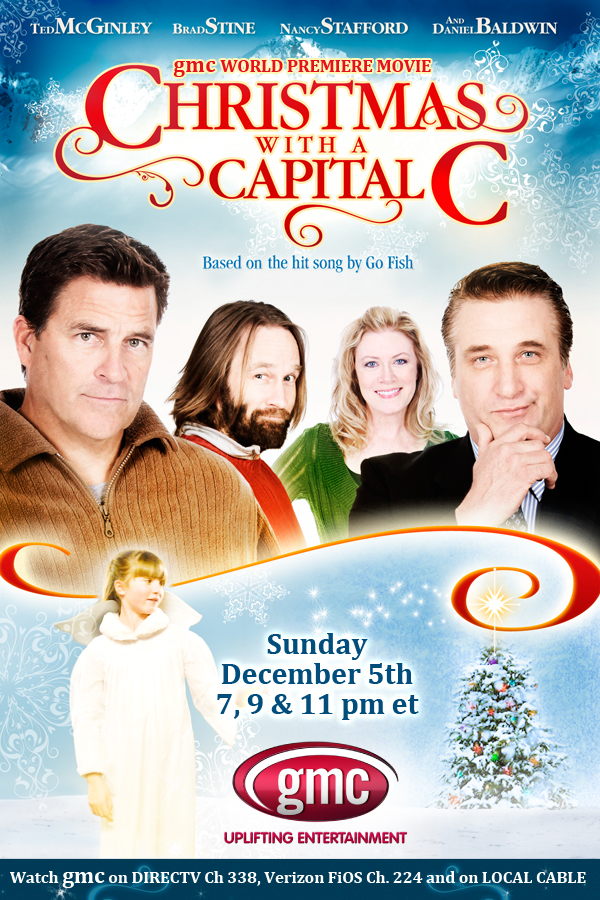 The beautiful and talented Nancy Stafford (“Matlock”) stars in the heartwarming Christmas with a Capital C

Tell me about the character you play in this movie.
I love this movie and I love my character! I play the heart and soul of the film, all due to the fabulous work of Andrea Gyertson Nasfell, who wrote the movie. I play the wife of the mayor of a small town in Alaska, played by Ted McGinley. We’re the kind of town where everyone gathers together at Christmas big time and we have a tradition of putting the nativity scene in the city park. And then a long-time childhood friend comes back to town and challenges us with a legal battle to remove the religious display from city property and gets an injunction, the town is split. Some people think we ought to make it more inclusive and get rid of the name “Christmas” but others say “we can’t let these folks to roll all over us.” My character is the one who brings some reason and some heart. She says instead of being combative and argue our way into agreement, why don’t we put our feet to faith and allow our actions instead of argument be the thing that is louder? Why can’t we be Jesus with skin on and do what Jesus said He had come to do, to be Emmanuel, the God with us, and be the heart and soul and mind of Christ for the people around us. The whole city launches a Christmas with a Capital C campaign of acts of kindness and service. We give away hot chocolate and wash people’s windows and do things for the homeless and those who have a little less. It changes the heart of the Grinch character but it also changes the whole town. I love the film because it makes the world recognize how ridiculous it is to try to take Christ out of Christmas but it is also a message to the church. It’s not to say we should not stand up for truth and righteousness but it is to say that our positive actions, our loving response to the people around us, even those who don’t agree with us, that changes people’s hearts.
Your character really tells people to start with themselves and that will change people more than arguing with them.
I got to say the best speeches in the film!
Tell me about your “Grinch” character.
Daniel Baldwin, one of the bad Baldwin boys. He’s a lovely guy, but plays a hardened character who grew up in the town but has gone off and seen the world and has had some unfortunate run-ins with Christians who have turned him off big-time. I can relate to that. I grew up in the church myself but when I went to college and didn’t have to go to church I chose not to. I had some issues with what I saw as hypocrisy in the church. So I get it! I was a prodigal for 15 years before I darkened the door of a church again. So I know there are a lot of people who don’t have a problem with Jesus but they have a problem with the church. So this guy comes back and he is hurt and disappointed and he does not want to participate or have it in his face. But he is a hurting and broken man. He has some vulnerability. So in the story when our daughter gives him cookies and it’s such a literal picture of her peeking in the window and seeing what was really happening in his house, like peeking into his soul and seeing that he is destitute on the inside.
Is it important to you that the projects you work on reflect your faith?
Yes, it is terribly important to me. I have been blessed to do two faith-based projects. For a lot of years I did not want to do them. I have been lucky enough to have some success in secular marketplace and only in the past few years I have seen Christian films that can hold up in the marketplace of films, that are looking better and better. But even though I have done secular work my faith has still been the driving force on what I choose to do. It dictates everything I do in life. I am not going to do anything that is counter with a Kingdom value. Over the years, as a result, I’ve worked less and less, but God is gracious and won’t let me leave the business. Part of it is the projects I turn down and part is just the roles for women over 50 in Hollywood. But I am speaking a lot and doing conferences and retreats and writing books and ministering to women, so my world is more spread out.
Do you have a favorite Bible verse?
There are so many! But I love Isaiah 61. They are life verses for me. They resonate to my heart and have been transforming for me. When the old prophet Isaiah is telling of Jesus coming, the pre-incarnate Christ talking through this prophet saying. “I’ve come to preach the good news, bind up the broken-hearted…oil of gladness instead of despair.” The great exchange we get when we have a life in Christ continues to touch me.
I’d love to hear about your new book.
I love this book! It’s called The Wonder of His Love: A Journey to the Heart of God


Posted on December 13, 2011 at 12:46 pm
Tennessee Williams’ only comedy is this neglected gem of a movie about two couples at Christmas. It has never been available on DVD so your only chance to see it is tonight on Turner Classic Movies.
It stars a very young Jane Fonda as a nurse who impulsively marries her favorite patient, a Korean War veteran (Jim Hutton) who is still struggling with what today we might call post-traumatic stress. He tries to cover up his nervousness with a lot of bluster and instead of a romantic honeymoon she finds herself driving with him in a hearse to visit his best  Army buddy (Tony Franciosa), who is having his own marital problems, in large part due to his interfering father-in-law, who is also his boss. Three of the 1960’s finest character actors fill out the cast, including John McGiver and, in a rare appearance together, Jack and Mabel Albertson (real-life brother and sister).
It is a bittersweet comedy about endearing characters and it is nice to see some Tennessee Williams characters show some generosity, sweetness, and hope. The reconciliation of the two couples is genuinely touching and it is a wonderful holiday treat for those looking for something a little different.
http://www.youtube.com/watch?v=q4tR0G03240
Posted on December 13, 2011 at 8:00 am
As the latest Chipmunks movie opens up this week, we remember how it all got started, with the Grammy-winning 1958 song, “Christmas Don’t Be Late:”
http://www.youtube.com/watch?v=917SpFHHUU0&feature=relatedThe singing chipmunks were created by songwriter Ross Bagdasarian, who had appeared in the Alfred Hitchcock movie, “Rear Window” (as the piano player across the courtyard, playing one of his own compositions) and had some success as the co-writer of the Rosemary Clooney hit, “Come On-a My House” and writer/performer of the novelty song, “The Witch Doctor.” He came up with the idea of recording songs at high speeds to make the voices sound amusingly squeaky. The 1958 song “Christmas Don’t Be Late” was his first chipmunks recording and he played Dave and did all the voices, naming the three chipmunks after record executives. Later recordings used women’s voices. His son, Ross Bagdasarian Jr., is now responsible for bringing Alvin, Simon, Theodore and their long-suffering manager Dave to a new generation.


