The Secret Life of Walter Mitty

Posted on December 24, 2013 at 6:00 pm

B+
Lowest Recommended Age: Middle School
MPAA Rating: Rated PG for some crude comments, language and action violence
Profanity: Some mild language
Alcohol/ Drugs: Drinking and drunkenness
Violence/ Scariness: Action-style peril, no one seriously hurt, references to sad parental death
Diversity Issues: None
Date Released to Theaters: December 25, 2013
Date Released to DVD: April 15, 2014
Amazon.com ASIN: B00H7KJTCG

Ben Stiller in a still from The Secret Life of Walter Mitty

We all know what it feels like to be Walter Mitty, imagining ourselves as achievers and darers far beyond our normal lives. The original short story by James Thurber is about a middle-aged, hen-pecked man who daydreams about dashing adventures as he is out running errands with his wife.  In this version, directed and starring Ben Stiller, Walter runs the photo library for LIFE Magazine.  (For you young people out there–this is not a metaphor.  There actually was a photojournalism magazine called LIFE.  From 1936-1972 it was kind of like a proto-version of Buzzfeed that came in the mail every week.  Before television and the internet, it was our first chance to see what the rest of the world looked like, with gorgeous, indelible, iconic images of movie stars and ordinary people, world leaders, athletes, and military battles.)

Every day, Walter walks to work past enormous, blown-up images of LIFE covers and the magazine’s motto: “To see the world, things dangerous to come to, to see behind walls, draw closer,to find each other and to feel. That is the purpose of life.”

Like George Bailey in “It’s a Wonderful Life,” Walter once planned to see the world but family obligations kept him at home.  Now, he spends his days as a “negative asset manager” cataloguing images taken by the dashing photojournalist Sean O’Connell (a rugged gem of a small performance from Sean Penn).  While one is risking his life, the other takes no risks at all.  He can barely bring himself to touch the computer key to “wink” at a woman on a dating website.  When asked to fill in the “been there, done that” space on his profile, he realizes he has not been anywhere or done anything.

She isn’t a stranger.  Cheryl (Kristin Wiig) has just come to work for LIFE.  If he cannot work up the nerve to cyber-wink at her, you can bet he does not know how to begin to talk to her in real life.  Walter might have stayed in his quiet, safe, lonely little world forever, living through his daydreams and half-living in reality.  But there comes a time when real life intrudes on dreams.

Things are coming apart at LIFE and in life.  The magazine has a new boss (nicely smarmy Tony Scott) who uses a lot of smug corporate-speak like “Some of you are non-vital.”  Walter’s mother (Shirley MacLaine!) is moving into assisted living.  And Sean sends in a roll of film with what he says is his best image ever, with a special note for Walter.  But that image is missing.  And to find it, Walter will have to discover how close he can get to being the daring, adventurous hero of his dreams.

As a director, Stiller is developing a more assured visual style and there are some bracingly robust images, befitting a story about LIFE photographs, the man who takes them and the man who sorts them, the man who goes places and the man who looks at the pictures of places.  The only way to find Sean’s photo is to find Sean. He takes pictures in places so remote and exotic they are not reachable by text messages or Skype.  That means a journey, physical and spiritual, through rocky, icy terrain and using every kind of transportation, including helicopter and boat.

The film is filled with lovely and surprising touches.  The story unfolds organically.  Like a video game hero, the items Walter gathers along the way turn out to be vital in keeping him on his journey.  Along the way, Walter keeps checking in by phone with the tech support guy who was supposed to fix his online dating “wink” function, as though he does not realize how his life is transforming around him.  I won’t give away the surprise by naming the actor on the other end of the phone; I’ll just say that he is ideal for the part. I liked  seeing Walter drew Cheryl into his search very naturally, and how Walter was able to be shy but still very capable around her and around her young son.  There are moments of true exhilaration and the end has an unexpected sweetness. If you’ve been daydreaming about a great film for the family to enjoy together over the holidays, take them on a journey to see this one at your local theater.

Parents should know that this film has some sexual humor, mild language, and action-style peril, reference to sad death of parent

Family discussion: Why was it hard for Walter to take risks? Which of his real-life adventures was the scariest?

If you like this, try: “Stranger than Fiction”

Related Tags:


Based on a book Comedy Date movie Drama DVD/Blu-Ray Pick of the Week Remake Romance

Her

Posted on December 24, 2013 at 6:00 pm

B+
Lowest Recommended Age: Mature High Schooler
MPAA Rating: Rated R for language, sexual content, and brief graphic nudity
Profanity: Very strong language
Alcohol/ Drugs: Drinking
Violence/ Scariness: Tense emotional confrontations and loss
Diversity Issues: None
Date Released to Theaters: December 25, 2013
Date Released to DVD: May 12, 2014
Amazon.com ASIN: B00HEKSZVK

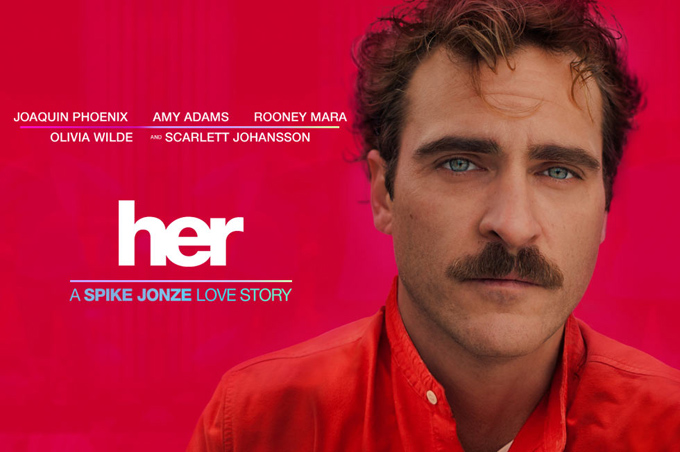
her-joaquin-phoenix-spike-jonze

“Transition objects” are usually thought of as the stuffed toys toddlers hold onto so as a way of feeling more secure as they begin to separate from their parents and navigate the bigger world.  But we all have them.  We all carry real or virtual talismans to keep us from feeling adrift or abandoned.

And we all understand the bliss and torment of the Rorschach test stage of love, as what we project onto the objects of our physical and emotional desire has to give way to the reality of who they are.  If we’re lucky, it’s even better than we imagined and they feel that way about us, too.

Director Spike Jonze (“Being John Malcovich,” “Where the Wild Things Are”), working from his own screenplay, combines these two ideas in a wistful love story set slightly in the future simply called, in a reflection of its longing, “Her.”  Joaquin Phoenix plays Theodore and his job as a ghost writer of analog letters makes a kind of sense as the logical next step in a world where communication by text and Skype might make the idea of an old-school correspondence more valuable just as the ability to create them is barely vestigial.

Theodore spends his days writing letters of great tenderness and affection but there is none in his own life.  Recently divorced from Catherine (Rooney Mara) for reasons we never learn, he is withdrawn, isolated, alone.  When he is not working, he stays in his spare, generic apartment and plays a video game.  And then a new operating system comes on the market that is so responsive it virtually (in both senses of the word) achieves consciousness.  (Apparently, no one there has seen “Terminator,” because this sounds a lot like Skynet to me, but perhaps that is the weaponized version.)  Theodore decides to give it a try.

The new operating system calls herself “Samantha” and she has two enormously appealing qualities.  First, she has the throaty, intimate voice and delicious laugh of Scarlett Johansson (a performance of magnificent warmth and wit).  Second, she is utterly devoted to Theodore and utterly formed by him.  It is that most gratifying of relationships because he is everything to her and she is content for him to be so.  Plus, she is wonderfully competent, sorting through thousands of emails in a fraction of a second to organize them and, along the way, learn everything about him.

Theodore is not ready for a real relationship with a woman who might want something from him or be different from what he visualizes or idealizes.  But Samantha seems perfect, both in her innocence and in her progress.  He has the pleasure of explaining the world to her and his spirit opens up as he sees her curiosity, appreciation, and engagement.  He is reassured that the people around him (his boss, played by Chris Pratt, his neighbor and college friend, played by Amy Adams) seem to think it is perfectly normal to have a virtual girlfriend.  Samantha seems happy about it, too.

But as we have seen in “Lars and the Real Girl,” “Ruby Sparks,” George Bernard Shaw’s “Pygmalion” (which became the musical “My Fair Lady’), there’s no happily ever after in a relationship with a creation.  Samantha’s growth trajectory is astronomical.  No single human can really have her.  And the human qualities she lacks turn out to be important for a relationship, too.

Jonze’s story may be set in the future but it is an ancient one, going back to  the original Greek myth about the sculptor who fell in love with the statue he made and whose name became the title of Shaw’s play.  It is an eternal story because it is a more extreme version and thus a powerful metaphor about the risks and pleasures of intimacy.  Jonze tells that story here with great sensitivity and lyricism, the kind of artistry that machinery can never replace.

Parents should know that this movie includes strong language, sexual references and situations and nudity, and tense and sad experiences.

Family discussion:  Would you like to have an e-friend like Samantha?  What makes those relationships easier than interacting in real life?  What makes them harder?

If you like this, try: “Lars and the Real Girl,” “Ruby Sparks,” “Pygmalion,” “Catfish,” and “You’ve Got Mail”

Related Tags:


DVD/Blu-Ray Pick of the Week Romance Science-Fiction

Walking with Dinosaurs 3D

Posted on December 19, 2013 at 6:42 pm

B
Lowest Recommended Age: Kindergarten - 3rd Grade
MPAA Rating: Rated PG for creature action and peril, and mild rude humor
Profanity: Some schoolyard language
Alcohol/ Drugs: None
Violence/ Scariness: Dinosaur predator violence and peril, sad death of parents
Diversity Issues: None
Date Released to Theaters: December 20, 2013
Date Released to DVD: March 24, 2014
Amazon.com ASIN: B00HDKJESO

walking_with_dinosaurs

Dinosaur movies pretty much all have the same plot.  Unless it is a fantasy like “Jurassic Park,” the story is pretty simple: the dinos have to migrate and there are a lot of encounters and adventures along the way. What separates Walking With Dinosaurs 3D from earlier entries like “The Land Before Time” and Disney’s then-state-of-the-art “Dinosaur” is the beauty and majesty of the great creatures, marred a bit by a jokey script with too much focus on poop and barf jokes, silly winks at the audience about the animals’ “future as an oil field,” and distracting anthropomorphism.

A brief prologue set in modern day has a brother and sister visiting their paleontologist uncle (“Star Wars’” Karl Urban) in Alaska.  The girl is excited by the broken tooth found by her uncle and happy to accompany him to the dig to see if they can find more bones.  But her older brother is bored.  “I’m not really into digging for dead things.”  He’d rather text his friends about how lame everything is.

But then a bird (voice of John Leguizamo) appears to explain that “Every fossil tells a story.”  He transforms into his prehistoric ancestor, garishly colored with trailing trail feathers and toothy-looking protuberances from his beak, to narrate the story of his friend Patchi (voice of Justin Long), from just after hatching as the runt of the nest to adulthood and becoming a father with his own eggs to guard.

Our hero is Patchi, a Pachyrhinosaurus (thick-nosed lizard), whose early run-in with a predator leaves a hole in his frill that helps us identify him as he goes from hatchling to adolescent to adult.  He is a cheerful, curious, friendly vegetarian, a bit in the shadow of his alpha male older brother, Scowler (voice of Skylar Stone).  Their father is the pack leader who shows the rest of the tribe the way when it is time to migrate.  But along the way there is danger, especially from predatory meat-eaters who find the plant-eaters delicious.  Patchi’s parents are killed (off-screen) protecting their young.  Scowler takes over via head-butt battle, and it looks like he may take over the pretty female Patchi likes as well (Tiya Sircar as Juniper).  Will brains triumph over brawn?

Kids in the audience seemed to enjoy the slapstick and potty humor and it is possible that it tempered the scarier themes.  It will certainly make fans of the television series happy, and, I hope, inspire curiosity about the real stories that fossils tell.  Viewers with more serious interest in dinosaurs will want to take advantage of the Blu-Ray’s “Cretaceous” option and skip the human voices.

Parents should know that this film has dinosaur-era violence, characters in peril, injured and killed, sad deaths of parents, and potty humor.

Family discussion:  Why did Patchi and Scowler make different choices?  Which was your favorite kind of pre-historic creature and why?

If you like this, try: the television series and visit your local natural history museum to learn more about dinosaurs

Related Tags:


3D DVD/Blu-Ray Pick of the Week Movies -- format Talking animals

Inside Llewyn Davis

Posted on December 19, 2013 at 6:00 pm

A-
Lowest Recommended Age: Mature High Schooler
MPAA Rating: Rated R for language including some sexual references
Profanity: Strong language
Alcohol/ Drugs: Drinking, drug use and drug overdose
Violence/ Scariness: A few punches, drug overdose
Diversity Issues: None
Date Released to Theaters: December 20, 2013
Date Released to DVD: March 10, 2014
Amazon.com ASIN: B00DVZ414C

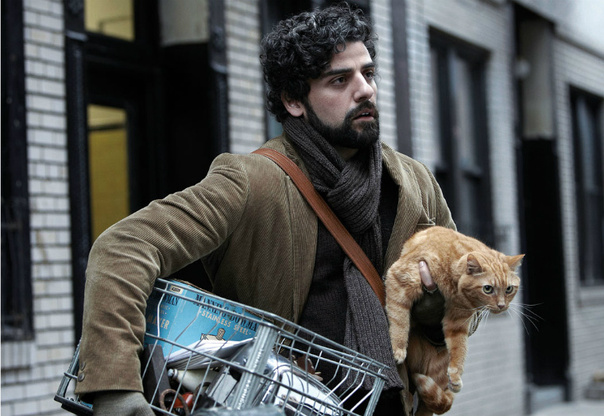
Inside-Llewyn-Davis-cat

Oscar Isaac gives the best performance of the year as the title character in the most intimate and profound movie yet from the Coen brothers.  The story is set in the New York folk music world of 1961 and the Coens insisted on filming the songs live rather than pre-recording, and one of the wonders of this film is the way that Isaac makes each song more than a musical performance — each is a part of his characterization that tells us who Davis is and where he is on a week-long journey we will see in near Sisyphian terms.  The breaths and pauses are as much a part of the performance as the notes he plays and sings.  When he is not singing, Davis reacts very little, and one of the great pleasures of this film is seeing Isaac convey immense conflict and sensitivity to us in the audience while those around him see only his superficial expressionlessness.  In one scene, a doctor offhandedly gives him surprising news about someone else.  In that one moment he says almost nothing but conveys a dozen different emotions and questions and losses.  This is the story of a man who expresses himself only through his music.  But he does not have the gifts to make him successful enough to support himself or achieve any sense of security and acceptance.

The Coens like to put their central characters under a lot of stress, and in this film Davis must deal with disappointment and anger all around him and his own sense of frustration in not being able to honor the songs that are his whole world by making them as important to others as they are to him.  Ultimately, it becomes a larger story about the way all of us struggle to find meaning and a place for ourselves.  And all of that is to the heavenly music impeccably curated by T. Bone Burnett and performed by a cast that includes Justin Timberlake, Carey Mulligan, and Broadway’s Stark Sands.  The Coens also like to create physical environments that reflect the internal pressure (the peeling wallpaper in “Barton Fink” was almost another character).  Here, the re-creation of early 60’s Greenwich Village is relatively low-key and naturalistic, but there are still cramped corridors with impossibly acute vectors to amplify Davis’ external manifestation of the grungy world that seems to have no exit.

The film’s title, “Inside Llewyn Davis,” is the also the name of a record album made by the early 1960’s folk singer played by Isaac.  We first see him singing in a Greenwich Village club, performing “Hang Me, Oh Hang Me,” a song that “was never new and never gets old.”

The folk singers of the early 60‘s thought of themselves as truly authentic in a world where suburban materialism and conformity were idealized.  A movement that presaged and in some ways helped to spark the counterculture and protest of the late 60’s was, of course, inherently inauthentic itself.  Folk music is beautiful wherever it is sung, even in the kind of homogenized, commercial versions looked down on by Davis (and gently mocked in “A Mighty Wind”).  But what makes it authentic is that it is music sung by folk in their community, not by professional musicians in a New York club.  The essence of the struggle any artist — or any person — faces between integrity and selling out is explicit here.  Davis criticizes his friend and sometime lover as “careerist” for trying to get ahead in the music business.  But he himself makes a trip to an influential producer to see if he can get better bookings.  And as authentic as Davis may think he is, he is contemptuous the performances by a soldier and a woman from the country, both of whom arguably have a better claim to “authenticity” than he does.

Like all Coen brothers anti-heroes, Davis is a man under pressure.  He has nowhere to live, and sleeps on couches he scrounges from friends.  He seems to have no sense of gratitude.  He shows some sense of responsibility.  He spends the night at the home of a benign Columbia professor who loves his music, stopping to play a cut from the album he made with his former partner (Isaac sings with Marcus Mumford).  Then, when he is leaving, the professor’s marmelade cat slips out the apartment door just as it swings shut and locks behind him.  Davis scoops up the cat and takes him on the subway, calling the professor’s office to let him know the cat is safe.  He then drops the cat off at another apartment he often uses as a place to stay, the home of singing duo Jim (Justin Timberlake) and Jean (Isaac’s “Drive” wife, Carey Mulligan), where he finds out that Jean is (1) pregnant and (2) furious because it might be his.  He again responds responsibly, if not graciously.  And when Jim (of course not knowing anything about his relationship to Jean) arranges for Davis to get a quick gig as a session musician for a silly but irresistible little novelty ditty called “Please Mr. Kennedy,” he gives it his best.

We follow Davis over the course of a week, one frustrating encounter after another, with Jean, with the head of the tiny record label that produced his last record, a doctor who performs abortions, his silent father in a nursing home, his suburban sister, on a long ride to Chicago with a jazz musician (Coen brothers regular John Goodman) and his near-silent driver (Garrett Hedlund), a nerve-wracking audition with an important producer (F. Murray Abraham).  In each of them, Davis is subdued. He has feelings, but he expresses them in his music.  There is something in these ancient songs about death, betrayal, and injustice that touches his heart. Singing them is his deepest connection to himself.  “Just exist?” he asks his sister, when she suggests he give up folk music.  But even when he wants to give up, he can’t.

Davis knows that things seem hopeless for him.  He tries to slide his box of remaindered LPs under a table only to find an almost-identical box of another singer’s records there already.  He looks out of the car window at a highway exit that he and we know could lead to an important chance at connection and meaning.  We see around Davis what he cannot.  We see him make a decision as he leaves the recording studio that suits his purposes at the moment but that we know he will be bitter about forever. A young, tousled-hair singer goes on at the club and we know he will transform the world in a way Davis can not.  But in a very real and very satisfying way, the Coens and Isaac have reclaimed him for us with their own story that was never new, and never gets old.

Parents should know that this film includes strong language, a fistfight, references to sex, adultery, abortion, and suicide, drinking, smoking, and drug use and overdose.

Family discussion:  Why was it so hard for Llewyn to succeed?  What do we learn about him from the decision not to go to Akron?  From his heckling of another performer?

If you like this, try:  “Don’t Look Back” and “A Mighty Wind” — and the Showtime concert featuring the music from the film, “Another Day, Another Time”

Related Tags:


Drama DVD/Blu-Ray Pick of the Week Inspired by a true story Musical

Anchorman 2: The Legend Continues

Posted on December 17, 2013 at 6:00 pm

B+
Lowest Recommended Age: Mature High Schooler
MPAA Rating: Rated PG-13 For crude and sexual content, drug use, language and comic violence
Profanity: Strong and crude language
Alcohol/ Drugs: Drinking
Violence/ Scariness: Comic but graphic violence
Diversity Issues: A theme of the movie
Date Released to Theaters: December 18, 2013
Date Released to DVD: March 31, 2014
Amazon.com ASIN: B0083XXVFW

anchorman 2

Will Ferrell and his crew beat the sophomore slump with just the right mix of stuff we want to see again (yes, there will be jazz flute, a rumble with the other news teams featuring wildly improbable surprise guest stars and weapons, and a clueless character being yanked into a new understanding of women) and stuff that’s new (some surprisingly sharp satire about the current state of the news business and its origins in the shift to the 24 hour news cycle in the 80’s — and a twist on the infamous closet of potent man-scents featuring Sex Panther).

The first obligation of a sequel is to undo everything that happened in part one.  Ron Burgundy (Will Ferrell) and Veronica Corningstone (Christina Applegate), married, with a son, and sharing the anchoring duties in San Diego,  find their happily ever after ending torn asunder when their boss (the first of several surprise guest stars) promotes her to a network job and fires him as local anchor. He tries working as an announcer at Sea World, and is soon on the brink of losing that job, too.  Ron Burgundy was put on this earth to “have salon-quality hair and read the news.”  What can he do next?

Something happens that no one could have anticipated.  A zillionaire (think cross between Ted Turner and Rupert Murdoch) gets the idea for a 24 hour news channel.  And that means they’ll hire anyone.  Soon, Ron gets the band back together (Paul Rudd, Steve Carell, and David Koechner) and they’re on their way to two crazy destinations: New York and the 80’s.

“Anchorman” was not a huge hit when it was first released, but it has become, well, kind of a big deal, since it came out (especially unrated) on DVD.  It is one of those films that improves on repeated viewing, not because there are subtle jokes you miss the first time around but because its silly but good-natured humor make it particularly suitable for repeated viewings with friends reciting the catch phrases and acting out the goofiest bits.  That primes the audience for this next one, with a lot of silly, over-the-top comedy and “what were we thinking”-music, personalities, and styles of the era as in the first film.  (The terrific soundtrack includes classics like “Ride With the Wind,” “Muskrat Love,” “Feels so Good,” and “This is It.”)

In the original, the set-up was having the smug, macho world of the local anchors was invaded by a woman — and one who was vastly more intelligent and professional than they were.  This time, there is a woman who is not a subordinate or a peer; Ron Burgundy and his team have a new boss, Linda Jackson (Meagan Good).  She is not only a woman; she is black.  This provokes a whole extra layer of fear and fascination in Ron Burgundy.

Another difference — he is not the alpha male at the new station.  His team goes on the air in the middle of the night.  Prime time goes to the handsome and arrogant Jack Lime (James Marsden).  Ron rashly bets Jack that he will beat him in the ratings.

The sneaky genius of this movie is the way it makes sense out of Ron’s kind of genius response to this idiotic bet, and the way it explains pretty much everything that’s gone wrong with the world ever since. It turns out that the sense of superiority that keeps us laughing at Ron Burgundy may be overshadowed by his sense of superiority in laughing at us.

Parents should know that this film has very raunchy and explicit humor for a PG-13, with a lot of crude jokes and strong language, including bigotry humor.  Characters drink and use drugs and there is comic but graphic violence including a suicide attempt.  NOTE that there are alternate versions available including a much raunchier unrated version.

Family discussion:  Why was Ron so afraid of Linda?  Who should own the news?

If you like this, try: the original “Anchorman”

Related Tags:


Comedy DVD/Blu-Ray Pick of the Week Series/Sequel
THE MOVIE MOM® is a registered trademark of Nell Minow. Use of the mark without express consent from Nell Minow constitutes trademark infringement and unfair competition in violation of federal and state laws. All material © Nell Minow 1995-2026, all rights reserved, and no use or republication is permitted without explicit permission. This site hosts Nell Minow’s Movie Mom® archive, with material that originally appeared on Yahoo! Movies, Beliefnet, and other sources. Much of her new material can be found at Rogerebert.com, Huffington Post, and WheretoWatch. Her books include The Movie Mom’s Guide to Family Movies and 101 Must-See Movie Moments, and she can be heard each week on radio stations across the country.

Website Designed by Max LaZebnik