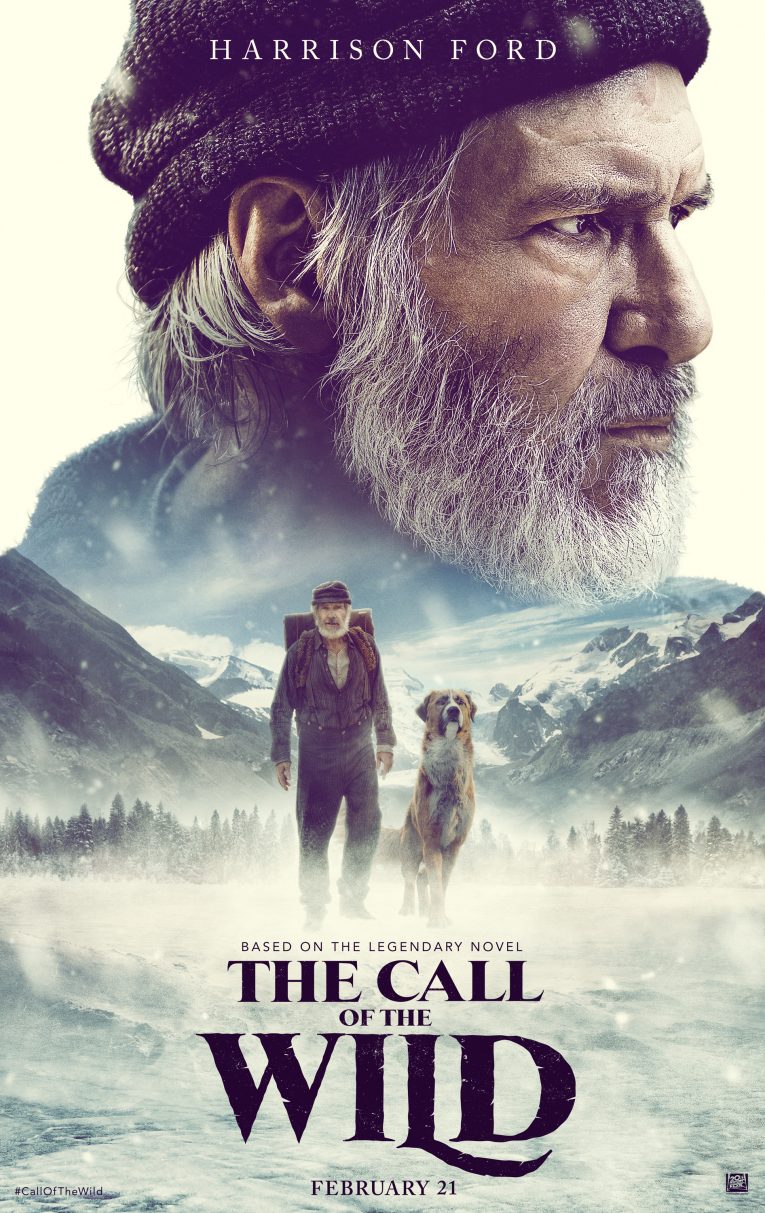
Harrison Ford made me believe he was talking to Greedo and Jabba the Hutt in the early “Star Wars” films and those characters were as low-tech as Gumby and Pokey compared to the technology used to create Ford’s canine co-star in “The Call of the Wild.” And yet, I never bought it. Instead of getting caught up in the story, I kept wondering how they achieved the effects, like the interactions between the CGI dog with the real-life people and props around him. A lot of work clearly went into scanning a dog from every angle, and getting the muscles, fur, weight, and shape to look real. But the dog still seems synthetic compared to the animals in movies like “A Dog’s Purpose” and Disney’s own annual nature films (even compared to fully animated characters in the original “101 Dalmatians” and “Lady and the Tramp”). And so does the story.
The problem is less the technology, which is very impressive, than it is the uneven storyline, which zigzags from slapstick to poignance to action. The Alaskan and Canadian scenery is spectacular, the production design is exceptional, and Ford brings heart and dignity to his role, including the narration throughout the film. But the movie is uneven in tone and in its sense of its audience—it is too sad and violent for young children and too superficial for older audiences. The many-times-filmed story has here been sanitized a bit for modern audiences (less racism, for example), but it is rougher than the typical PG film, including animal abuse, and sad deaths of both canines and humans.
Parents should know that this film includes peril and violence affecting animals and humans, sad deaths of dogs and people, guns, animals beaten with clubs, and some mild language.
Family discussion: What did Buck learn from his first experience pulling a sled? From his rescues? From the wolves?
If you like this, try: “A Dog’s Purpose” and “A Dog’s Way Home”
Rated PG-13 for some language and sexual references
Profanity:
Some strong language
Alcohol/ Drugs:
Alcohol
Violence/ Scariness:
None
Diversity Issues:
None
Date Released to Theaters:
February 14, 2020
Copyright IFC Films 2019
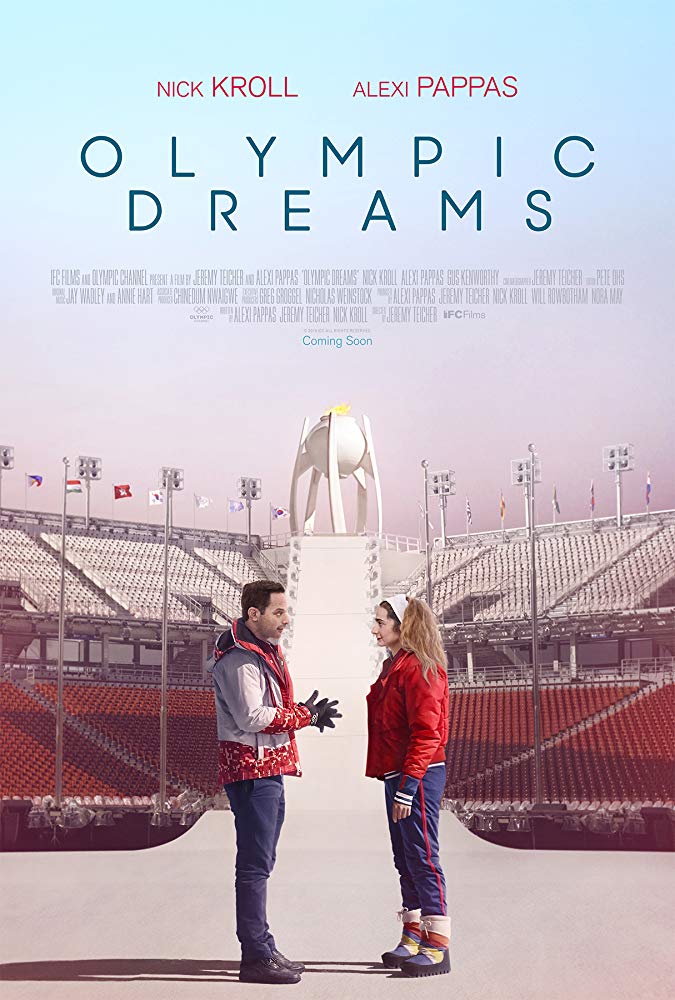
“Olympic Dreams” is a slight but sweet story set inside a big, colorful, dramatic world, the Olympics. It is the only movie ever filmed inside the actual Winter Olympic Athletes Village, and the behind the scenes settings and encounters are a lot of fun to see, giving us an idea of the vast scope and international culture of the games. Alexi Pappas, who represented Greece in the 2016 summer Olympics 10,000 meter race, co-wrote and stars in the film with her co-star, Nick Kroll, and the director (and her husband), Jeremey Teicher.
Pappas plays Penelope (a tribute to her Greek heritage), an American cross-country skier whose event is on the first day, so once it is over, she does not really have anything else to do. Kroll plays Ezra, a dentist who has volunteered to be on the medical team at the Games. There are not a lot of dental issues, so he, too, has a lot of free time. Much of the movie is just the two of them at various places in the Olympic Village, having awkward conversations. Her side is awkward because she has done nothing but prepare for the Olympics her whole life and has not had much opportunity to have non-sports competition related interactions. His side is awkward because he is an awkward guy, trying to re-connect with his ex long-distance and generally anxious.
So, kind of like “Before Sunrise” if the two people involved were older, less open, and not as good at putting their feelings into words. Much of the film has a gentle, improvisational tone that is appealing, and Kroll in particular shows his range. Pappas is not as experienced an actor, and her director/husband lingers longer on her face than a non-husband might have chosen to do. Real Olympian Gus Kenworthy is a natural in a small role as a sympathetic athlete, and it would be great to see him do more films. The bittersweet romance does not have much depth, but the novelty and natural interest of the setting and the small incidental details provide enough interest to make up for it.
Parents should know that this film has some strong language and sexual references.
Family discussion: What will Alex do next? How did she make Ezra think differently about his options?
If you like this, try: “Before Sunrise” and “Medium Cool” (which also used a real-life setting, the 1968 Democratic convention in Chicago, as background to a fictional story).
Rated PG-13 for sexuality and brief strong language
Profanity:
Brief strong language
Alcohol/ Drugs:
Social drinking
Violence/ Scariness:
Sad deaths of parents
Diversity Issues:
None
Date Released to Theaters:
February 14, 2020
Date Released to DVD:
May 11, 2020
Copyright 2019 Universal
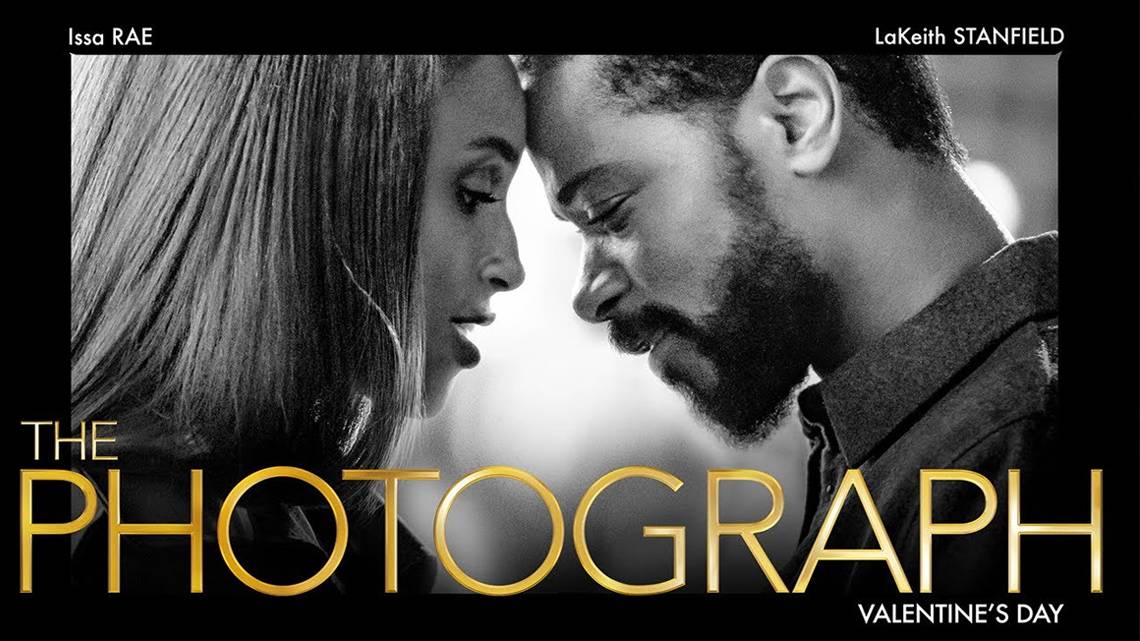
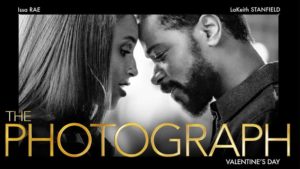
Of all the reasons to see a movie, there is none better than this: two gorgeous, immeasurably magnetic and talented actors falling in love on screen. And so, the universe (and Universal) have given us a luscious valentine of a movie, Issa Rae and Lakieth Stanfield starring in “The Photograph,” the kind of romantic drama audiences keep complaining they don’t make any more. From the steamy moments with a storm outside the window to an Al Green LP to flirtatious banter about the relative merits of Kendrick Lamar and Drake, the swoony romanticism is captivating all the way to the last moment.
Rae (who also co-produced) plays Mae, an art curator mourning the recent death of her mother, Cristina (Chanté Adams), a talented photographer who was, as she describes herself in a video interview, better at taking pictures than at love. Rae is sorting through her mother’s things, assembling a retrospective exhibit of her work. And she is sorting through her feelings about her mother, already complicated, with additional complications coming from a letter to “my Mae” she left behind. Cynthia’s instructions were for Mae to read the letter before delivering a second sealed letter to her father.
Stanfield, always a most thoughtful and charismatic actor, plays Michael, a reporter who happens on Cristina’s photos when he interviews a man who knew her before she left him and her home in Louisiana for a career in New York. He meets Mae when he is researching a story about Cynthia’s life. Stanfield played the break-up boyfriend in the popular Netflix films “Someone Great” and “The Incredible Jessica James,” (along with memorable appearances in “Short Term 12,” “Atlanta,” and “Sorry to Bother You””). He gets to be the romantic lead here, and his performance beautifully conveys his character’s confidence and vulnerability, and his immediate connection to Mae.
Both Mae and Michael are hurting from recent break-ups. And Michael has applied for a job in London, so that makes it difficult to start a new relationship in New York. But as always, the real obstacle to romance is the struggle between the yearning for intimacy, for truly knowing and being known, and the fear of exactly that. It may be lonely to be single, but it is safe, or it feels that way. “I’m comfortable” being unhappy and jaded, one of them says.
We go back in time from the present-day story of Mae and Michael to see the story of young Cristina and Isaac (Rob Morgan in present day, Y’lan Noel of “Insecure” in the past). They have a strong connection, but he is rooted in Louisiana and she has ambitions that can only be realized in New York. We see Cynthia’s conflicted relationship with her own mother (a terrific Marsha Stephanie Blake). We see her resolve, even after her heart is broken when she learns she cannot expect Isaac to wait for her forever.
But the heart of the film is the romance between Mae and Michael, with a suitably gorgeous score by Robert Glasper and lush cinematography by Mark Schwartzbard. I have complained in the past about the failure to light the skin of black performers correctly, especially when there are white performers in the same scene. Schwartzbard lights them beautifully, bringing out all of the rich, golden tones of their skin. Interestingly, most of the photos taken by Cynthia that we see are black and white, striking images, but all in shades of gray. We’re told she hated having her own picture taken, but we see one, taken by Isaac, tellingly a bit out of focus. And we see her take one self-portrait, holding then-four-year-old Mae in the Louisiana house she shared with her own mother. But we never see the image. Instead, we see them ourselves, through Schwartzbard’s beautiful cinematography.
Lil Rel Howery provides (as usual) some warm humor as Michael’s brother, with the always-wonderful Teyonah Parris as his wife, and up and coming star Kelvin Harrison Jr. is excellent in a small role as an intern in Michael’s office. Along with Chelsea Peretti as Michael’s boss and Courtney B. Vance as her sympathetic father, the cast gives the central characters the context of a larger world, where we see them as real people of accomplishment and confidence who have to learn how that fits with the vulnerability of allowing themselves to need and be needed in a romantic relationship.
“The Photograph” is a beautiful story, beautifully told, filled with heart and wise about love.
Parents should know that this film includes sexual references and a situation, issues of paternity, sad deaths of parents, drinking, and brief strong language.
Family discussion: Why couldn’t Christine tell her daughter the truth? What would you ask someone to get an idea of who they are?
If you like this, try: “Beyond the Lights,” “The Bridges of Madison County,” “Love Jones,” and “Something New”
Birds of Prey (and the Fantabulous Emancipation of One Harley Quinn)
Posted on February 6, 2020 at 5:20 pm
B
Lowest Recommended Age:
Mature High Schooler
MPAA Rating:
Rated R for strong violence and language throughout, and some sexual and drug material
Profanity:
Very strong and crude language
Alcohol/ Drugs:
Brief drug use
Violence/ Scariness:
Extended and very graphic peril and violence, characters injured and killed, disturbing images
Diversity Issues:
A theme of the movie
Date Released to Theaters:
February 7, 2020
Date Released to DVD:
May 11, 2020
Copyright Warner Brothers 2020
At last, the sisters are doing it for themselves, on screen and off. “Birds of Prey (and The Fantabulous Emancipation of One Harley Quinn),” directed by Cathy Yan and written by Christina Hodson (“Bumblebee”), it has the ladies of the DC universe band together when the guys (Batman and Joker) are (literally) out of the picture.
We all know that when you’ve been dumped, you’ll need some recovery time, and if that involves Cheez-Whiz straight from the can, we won’t judge. You’ll need to adjust your social media settings, too. In the case of Harley Quinn (co-producer Margot Robbie), that can mean blowing up what used to be your special place. As an observer notes, that’s how “she just publicly updated her relationship status.”
Unfortunately, in the case of Harley Quinn, whose relationship with impulse control has been even more volatile than her relationship with the madman she calls Mr. J, has made many, many enemies, helpfully identified by name and grievance on screen so we can keep up. Without Mr. J as protector, it’s olly olly oxen free for anyone who wants revenge.
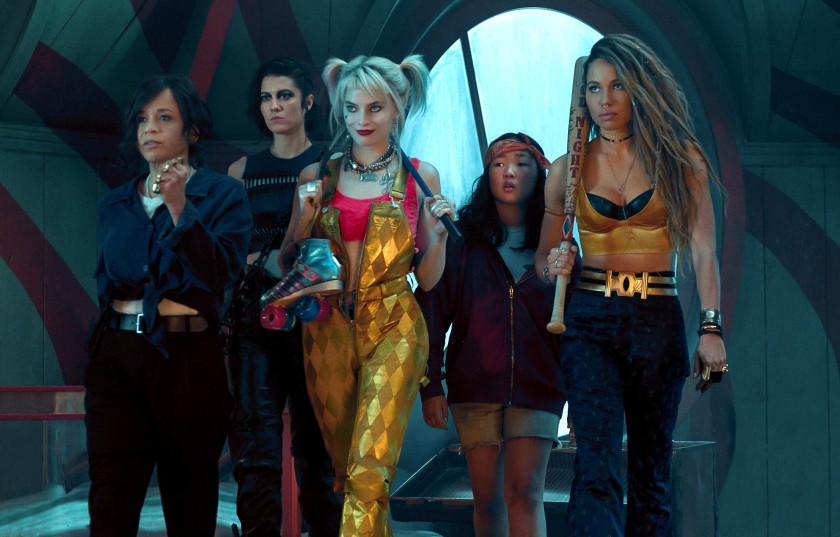
As Harley causes even more trouble and tries to hide or protect herself from those coming after her, she comes across the sole survivor of a mob family who is now an assassin dedicated to killing every man responsible for her family’s murders. She is still figuring out a name and a purpose once her targets have all been wiped out but one thing she has completely figured out is the crossbow. She will be known as The Huntress, and she is played by the always-terrific Mary Elizabeth Winstead. Dinah Lance (Jurnee Smollett-Bell) is a chanteuse in a club run by mobster Roman Sonasis (Ewan McGregor) with his henchman Victor Zsasz (Chris Messina). When Roman learns that she has some mad fighting skills, he makes her his driver.
There is the young girl thief Cassandra Cain (Ella Jay Basco), who picks the wrong pocket. Trying to get to the bottom of all of this is a tough cop named Renee Montoya (Rosie Perez) who is too honest to get promoted. Over the course of the film, the female characters will not always be on the same side. Some even betray each other. But when a girl needs a hair tie (in the middle of a big fight scene in a super-creepy abandoned amusement park beyond the wildest nightmares of Scooby-Doo, well, sisterhood is powerful.
Perhaps not as fun as it wants to be, but the movie has high spirits and a refreshing perspective that goes a bit deeper than just grrrl power. The carnage (with disturbing images and sounds) is intense and Harley does not always find the sweet spot between deranged creepy and deranged endearing. Deadpool may be nutty and naughty, but he is true-hearted, an anti-hero who is more hero than anti. As mesmerizing as Robbie is in the role, the storyline might have worked better with one of the other characters as the lead. It’s fantabulous that she is emancipated, but now she has to decide who she wants to be.
Parents should know that this film includes constant and very graphic peril and violence, with many characters injured and killed, disturbing sounds and images, knives, crossbow, guns, explosives, chases, very strong and crude language, nude images, brief drug humor, and some potty humor.
Family discussion: How did the early experiences of Harley and Huntress affect the way they made decisions? How is this like and different from other superhero movies?
If you like this, try: “Deadpool” and the “Birds of Prey” television series
Rated R for violence, language throughout, sexual references and drug content
Profanity:
Constant very strong and crude language
Alcohol/ Drugs:
Drugs and drug dealing, overdose
Violence/ Scariness:
Constant very intense and graphic violence, guns, poison, arson, many characters injured and killed including young adults
Diversity Issues:
None
Date Released to Theaters:
January 24, 2020
Date Released to DVD:
April 20, 2020
Copyright 2019 STX
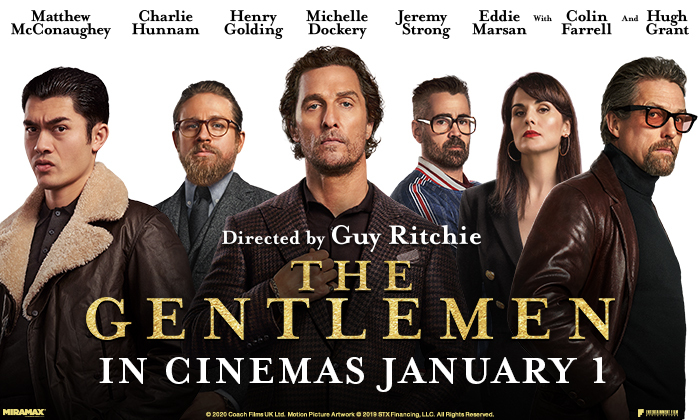
Writer-director Guy Ritchie is back where he belongs. “The Gentlemen” is, like his early films “Lock, Stock, and Two Smoking Barrels” and “Snatch,” a nasty, twisty, stylish, and darkly comic crime thriller set in England and featuring low-life characters with impenetrable accents. This is a relief after his plodding mis-matches like “Aladdin” and “King Arthur: Legend Of The Sword,” though I got a kick out of seeing the poster for his underrated “Man from UNCLE” in this film.
It starts with a bang (a blood-spattered shooting in a pub) and then goes back in time, a story within a story, with Hugh Grant, as someone Ritchie considers even less worthy of respect than murderous, drug-dealing criminals — a sleazy tabloid reporter named Fletcher with a long-lens camera, a friend who can lip-read, and a story he wants to sell for 20 million pounds. Grant himself has had his problems with sleazy tabloid reporters and is clearly enjoying himself tremendously and getting some revenge in the role. His performance is deliciously devastating.
The person he wants to blackmail is Michael Pearson (Matthew McConaughey), an American expat with a highly successful marijuana growing and distribution business. Pearson is trying to sell the business so he can retire, and is about to close on an offer from another American expat drug dealer, the effete Matthew (“Succession’s” Jeremy Strong). They’re in the stage that business types call due diligence, confirming the valuation of 400 million pounds. Michael has another offer, from a thuggish upstart known as Dry Eye (“Crazy Rich Asians'” Henry Golding). His bid is much lower in cash, but he plans to make up the difference with threats.
All of this is well known by Michael’s closest associate, Ray (Charlie Hunnam). But Fletcher, who has shown up unexpected and uninvited in Ray’s home, is relishing the chance to tell the story, even setting it up as though he is pitching a movie, even providing details of film stock and lenses, which the movie we are watching obediently demonstrates, reminding us of the air quotes that keep the bloodiest parts of the story from getting too bleak.
Michelle Dockery, a long way from Lady Mary on “Downton Abbey,” is also having a lot of fun playing Michael’s wife, as tough as he is or tougher, with a Cockney accent and as sharp as her Louboutin stilettos. You could almost see the Lady Mary of 2020 having the same cooperative arrangement with Michael that the other estate-poor gentry do in the film. Some of the twists are not as twisty as they intend and some of the characters are not as colorful as the movie thinks they are, but it is still a welcome return to what Ritchie does best.
Parents should know that this is a crime drama with extended and very graphic violence, many characters injured and killed including young adults with devastated parents, disturbing images, guns, poison, arson, murder, kidnapping, sexual references, drug dealing and overdose, and constant very strong and crude language.
Family discussion: Would you say that there are any good guys in this movie, or at least better guys? Who, and why? What will happen to Michael next?
If you like this, try: “Lock, Stock, and Two Smoking Barrels,” “Get Shorty,” and “Layer Cake”