
The Company You Keep

Posted on April 11, 2013 at 6:13 pm
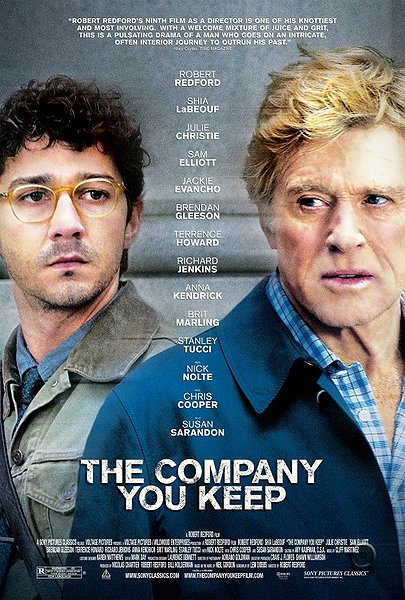
I can’t help thinking that even though this movie is based on a novel by Neil Gordon, it is primarily a trip down memory lane for director/star Robert Redford.  Shia LeBeouf plays Ben, an idealistic investigative reporter a la Redford in “All the President’s Men.”  Redford himself plays a “Three Days of the Condor”-style guy on the run from the government and the aging radical living under another name from “Sneakers.”  There are the buried family tensions of his first filmas a director, “Ordinary People.” And let’s not forget — no matter how much we try — the long debates about philosophy and policy in his last directing/starring movie, Lions for Lambs,  For a moment, I thought he was going to jump off a cliff a la “Butch Cassidy and the Sundance Kid.”

There’s nothing wrong in wrestling with the same themes, especially themes as meaty as the conflicts between our larger responsibilities as citizens and our responsibilities as family members and friends and when the ends justify the means — or when the means just make you into the same kind of bad guy as the people you are fighting.

Redford plays a single dad and small town lawyer who, it turns out, has been living under an assumed name for longer than he lived under his own.  When a suburban mother of two teenagers (Susan Sarandon) turns out to be a long-missing fugitive sought by the FBI for her role in a bank robbery that led to the felony murder of a guard (himself a father of two children).  The robbery was the last act of a splinter group from the anti-war Weather Underground.  (Apparently, this fictional theft was inspired by the 1981 Brinks robbery by members of the Weather Underground and Black Panthers.)

Ben, a reporter at a failing newspaper called the Albany Sun-Times, does some research and discovers that the man known as Jim Kent (Redford) is really Nick Sloan, also a fugitive accused of participating in the robbery.  Jim/Nick leaves his 11-year-old daughter (singing sensation Jackie Evancho, sweetly natural) with his brother (Chris Cooper), and goes on the run, contacting the old gang (including Nick Nolte, Richard Jenkins, and Julie Christie), none of whom are very happy to see him.

Meanwhile, both the FBI (Terrance Howard and Anna Kendrick) and the reporter are chasing after Jim/Nick with all kinds of high-tech surveillance (FBI) and looking at old microfilms for the kinds of esoteric newspaper archives and property records that are not even online (reporter).

There is some talk about protest here, with a pause for a professor’s lecture to his class about determination to make absolutely sure we do not miss the point.  And there is more talk about parents and children and how they change the calculus of responsibility and a great big metaphor of a character who is supposed to represent all of that.

Like “Lions for Lambs,” this is a talky film, but the balance this time is more on the side of story, and the non-stop parade of top-tier actors hold our interest.  The title is as much about our relationship as long-term fans of these masterful performers as it is about the characters who have been hiding out as they come to grips with their failures and betrayals.

Parents should know that there are glimpses of wartime and protest violence and characters use strong language.  The movie includes drinking and drug dealing.

Family discussion: How did having children make people evaluate their options differently?  Do you agree with Ben’s decision at the end?  How did the characters show their different ideas of loyalty?

If you like this, try: “Running on Empty” and “Steal This Movie”

Related Tags:


Not specified
The Muppets

The Muppets

Posted on November 22, 2011 at 6:00 pm

A
Lowest Recommended Age: All Ages
MPAA Rating: Rated PG for some mild rude humor
Profanity: None
Alcohol/ Drugs: None
Violence/ Scariness: Some tense confrontations
Diversity Issues: None
Date Released to Theaters: November 23, 2011
Date Released to DVD: March 19, 2012
Amazon.com ASIN: B006JTS5OO

Let the joy be unrestrained.  The Muppets are back.  It turns out that deep inside Jason Segal, best known for raunchy Judd Apatow comedies and for playing the monogamous Marshall on “How I Met Your Mother,” is at his core a puppet nerd whose highest and best use is in pushing Disney (which now owns the rights to the Muppets) to let him co-write and co-star in the happiest family movie of the year.  And it is accompanied by a “Toy Story” short film that is, minute for minute, the funniest movie of the year.

Segal plays Gary, a sweet small-town guy who is devoted to his brother Walter and his girlfriend of ten years, Mary (Amy Adams), a teacher.  Gary and Walter are devoted fans of the old Muppet Showand they spend many happy hours watching reruns.  When Gary takes Mary on their first visit to the big city of Los Angeles, they bring Walter along so that he can realize his dream of touring the Muppet studios.  Mary was hoping for something a bit more romantic but good-heartedly agrees to share the trip with Walter as long as Gary promises a special anniversary dinner for just the two of them.

The Muppet studio is broken-down and covered with cobwebs.  The only other people on the tour are a couple who mistakenly thought they were at Universal Studios.  Walter wanders off and overhears the dastardly Tex Richman (Chris Cooper) plotting to buy the studio.  He will promise to preserve the Muppets legacy and then tear it down to drill for the oil underneath.  To save the studio the Muppets have to raise $10 million.  But they have gone their separate ways.  Can they get the band back together?  And if they do, does anyone still want to see them?  When Gary gets caught up in helping the Muppets, will he forget the anniversary dinner?

Segal and co-screenwriter Nicholas Stoller have seamlessly continued the story of the the captivating Muppets, with their unique blend of sweetness and self-deprecating insouciance. It’s what Danny Thomas used to call “treacle cutters” that keep the Muppets fresh and appealing, expertly countering every corny joke with heart and every tender moment with humor.  With joyously sunny musical numbers composed by “Flight of the Conchords” co-star Bret McKenzie and cameos by everyone from Mickey Rooney to Sara Silverman and Neil Patrick Harris, this film is utterly true to the spirit of the original television series and pure delight for both fans and newcomers.


(more…)

Related Tags:


Based on a television show Comedy DVD/Blu-Ray Pick of the Week For the Whole Family Musical Romance Series/Sequel Talking animals

The Company Men

Posted on January 20, 2011 at 6:04 pm

Remember all those executives George Clooney fired last year in Up in the Air? Here is their story.

Ben Affleck, Chris Cooper, and Tommy Lee Jones play characters who work at an enormous conglomerate and feel confident in their value to the organization and not at all the kind of people who get laid off. That might have been true in past recessions. But they come from the heavy building side of the company. That might have been how the company started, but in the post-meltdown world it is the past, not the future. CEO James Salinger (Craig T. Nelson) explains that the future of the company is in health care, infrastructure, and power generation.

And so, “difficult decisions had to be made in situations where redundancies surfaced.” And therefore euphemisms had to used, the passive voice employed — so often the case when everyone else is pretty much unemployed.

The first to go is Bobby Walker (Affleck), a top salesman who has the bad luck to be selling something that is not health care, infrastructure, or power generation. He walks into the office bragging about his 86 at the golf course before work, and shortly after is walking out with everything in a cardboard box. Phil Woodward (Cooper), a factory guy who made it to the executive suite — and who has a daughter very excited about the senior class trip to Italy — doesn’t last much longer. And finally, the head of the division, Gene McLary (Jones), the CEO’s oldest friend, is riding the euphemism and cardboard box express, too.

It turns out that people who are fired go through the same Elizabeth Kubler-Ross stages that we experience in facing death, though not exactly in the same order. In these cases, it seems to be anger first, and then denial. They may skip bargaining and go straight to depression. And not everyone makes it to acceptance. Bobby goes from “I can’t let anyone know I lost my job” to “I need to look successful” to “We can’t leave our home,” to accepting the sequential blows of his wife’s return to work, moving back to his parents’ home, and asking the brother-in-law who always needles him about the big shot life for a job helping to put up drywall.

Writer/director John Wells (television’s “ER”) has a good feel for the corporate world — the analyst meetings in hotel ballrooms, the Wall Street jargon, the CEO pay packages. And he has a television writer’s economy for evoking the range of situations and emotions. While he also has a television writer’s feel for structure, he seems locked in to television drama’s three-part storyline, just too conventional, predictable, and neat, especially in the last half hour. It comes down too hard on the facts we all know too well, the imperial CEOs (with pay 700 times that of the average worker), the difference between what is legal and what is ethical, the difference between building something other than figures on a balance sheet, the “real people” honor and generosity of the people who get their hands dirty literally rather than metaphorically.

It’s the small details and moments that work best in this film. The layoffs come to people with busy lives predicated on keeping jobs they once thought depended only on ability and integrity. Everyone has an event to attend; everyone has a lovely house to pay for. Gene comes home to the gleaming surfaces of his gracious home and peeks at the five-figure price tag on his wife’s new table. Phil is told by a cheery but frank “outplacement” counselor that he should remove “ancient” references like service in Vietnam from his resume and dye his hair. There’s an understated moment where the brother-in-law (a fine Kevin Costner) shows that a real leader puts his workers first. Rosemary DeWitt can convey more about her understanding and support in putting lotion on her legs than most actresses can do with a page of dialogue. And the movie delivers the message that the workforce is not all that gets downsized; so do dreams, hopes, plans, pride.

(more…)

Related Tags:


Drama Inspired by a true story

Adaptation

Posted on December 19, 2002 at 2:31 pm

There are people who care so passionately about something that it fills them up completely. And then there are the rest of us, who can never lose themselves that way, people who divide their interest and attention and always hold a little bit of themselves back to observe and judge.

“Adaptation,” like the book that inspired it, is about both kinds of people and the way that each sometimes longs to be in the other category. The book is The Orchid Thief by New Yorker author Susan Orlean. By nature, by culture — by definition — a writer is at the furthest end of the scale in the observer/judge category. Orlean begins to write about Lohn Laroche, a man who even by the fevered standards of those utterly captured by “orchidelerium” is utterly obsessed. She realizes that she is not just writing about Laroche or about orchids but about the nature of obsession itself. In a way, she becomes obsessed with obsession.

The main character in the movie becomes obsessed with Susan Orlean’s obsession with John Laroche’s obsession with orchids. He is Charlie Kaufman (played by Nicolas Cage), the Hollywood screenwriter hired to adapt Orlean’s book for the screen.

The real-life Kaufman wrote the beguilingly twisted “Being John Malcovich” and the all-but-unseen “Human Nature.” The movie opens with Kaufman’s attack of insecurity as he meets with a producer to discuss The Orchid Thief. As he struggles to adapt it, his self-doubt, underscored by the contrast with his confident identical twin brother Donald (also played by Cage) becomes an almost insurmountable obstacle. But the real obstacle is not his weakness, but his strength. While his brother casually dashes off a ludicrous screenplay about a serial killer with multiple personalities, utterly unconcerned about issues like consistency, Charlie agonizes about the imperviousness of Orlean’s book to adaptation. Finally, he decides that he movie should be about that problem, and he proceeds with such girl-on-a-ketchup-bottle-with-a-picture-of-a-girl-on-a-ketchup-bottle thoroughness that in the opening moments, the screenplay is credited to both (the real-life) Charlie and (the fictional) Donald.

Like “Malcovich,” this movie has moments of bizarre humor in the context of profound and genuine questions about identity, inversion, inspiration, obsession, and meaning and meta-meaning and meta-meta-meaning. Kaufman loves writing for the same reason Laroche loves the orchids — for their difficulty and fragility. It has some sharp Hollywood satire and some wildy funny plot twists. This is the kind of movie that makes fun of emotional turning points inspired by platitudes but then, when it throws one in (in the middle of a jungle environment that is real and symbolic), it’s a very nice one: “You are what you love, not what loves you.”

The performances are marvelous, particularly Meryl Streep as Orlean and Chris Cooper as Laroche. Ron Livingston’s performance as Charlie’s agent is a small comic gem, Brian Cox is masterful as a screenwriting expert, and Judy Greer is radiant as an orchid-loving, pie-serving waitress.

Parents should know that the movie has very mature material, including very strong language, brief nudity, sexual references and situations (including masturbation and a porn website), drinking, smoking, and drug use. There is a brief but very explicit scene of a baby being born. The movie has quasi-comic violence, but characters are injured and killed. Characters break the law, including stealing from nature preserves and making psychotropic drugs.

Families who see this movie should talk about how we chose our passions – or whether they choose us. Do Laroche and Orlean envy each other? Does Charlie envy Donald? Why did Charlie the real-life screenwriter divide himself in two in the movie portrayal? Why did he take real-life characters like Susan Orlean and John Laroche and have their movie characters do things that they never did? What do you learn from Laroche’s reason for not fixing his teeth? If you were going to re-create yourself as a movie character, what would you write? This movie both uses and makes fun of many movie conventions – which ones did you spot?

Families who enjoy this movie will also enjoy seeing “Being John Malcovich” (very mature material) and other dark movies about Hollywood like “Day of the Locust” and “The Player.” They might also enjoy Cage in the face-switching movie “Face Off” and some other twin movies like “A Stolen Life” and “The Parent Trap.”

Related Tags:


Not specified

American Beauty

Posted on December 13, 2002 at 5:16 am

Lester Burnham (Kevin Spacey) is a 42-year-old man who has lost touch with anything that made him feel alive. His wife Carolyn (Annette Benning) is a realtor, so highly focused that she is clenched. His daughter Jane (Thora Birch) is a sullen teenager. Both barely disguise their contempt for him, which he accepts as his due. All three members of the family are desperately unhappy, but they have no way to connect to each other or make any change.

One night, at a high school basketball game, Lester sees a vision that transforms him. Angela (Mena Suvari) performs in a pom-pom routine with Jane. Lester is overcome by her youth and beauty, and for the first time in his memory, she gives him a goal. He wants to make love to her.

He quits his job, begins to work out, smokes some very expensive marijuana supplied by the teenage boy next door, and buys the red Firebird he dreamed of back when he was passionate about his dreams. The boy next door (Wes Bentley) uses the money he makes from selling drugs to buy video equipment, with which he films everything he sees, especially Jane.

Lester, who narrates the film, informs us at the beginning that he will be dead by the end. As in the classic Hemingway short story, “The Short Happy Life of Francis Macomber,” Lester becomes passionate and vital at last, which is unsettling to everyone around him.

Teens are likely to consider this movie profound in the way that their parents considered “The Graduate” profound. Lester, like Dustin Hoffman’s character Benjamin Braddock, is trying to get away from “plastics.” Carolyn has buried her feelings with motivational tapes, a $4000 sofa, and mantras like, “I WILL sell this house today!” Lester has escaped from a crushing feeling of inauthenticity by becoming numb. By telling the truth to himself and those around him he is like the child in “The Emperor’s New Clothes,” saying that the suburban dream is empty and that they will not allow themselves to be ordinary. And, most important, the teens are the real heroes of the movie, having already realized that the dream is empty. What they may not realize is that the real tragedy of Lester and Carolyn is that they once knew that, too, and it did not prevent them from losing themselves.

Parents should know that the movie’s rating comes from graphic, bloody violence (including child abuse), extremely raw language, nudity, sex (including teen sex), and drug use that is very positively portrayed. Parents of teens who see the movie may want to discuss the sexual behavior of the teenagers it portrays. One who relishes her sexual power and enjoys telling her friends the lurid details is revealed to be a virgin. Another is saving for highly unnecessary breast augmentation surgery. The boy with the camera is a voyeur. The girl he spies on is captivated by his attention. Like many of the characters in the movie, she is only able to feel real when she is perceived by others. She is painfully aware that her parents do not really look at her. This movie is not for most teens, but those who do see it should use it as a way to begin a conversation about the ways that families communicate, the choices we make about sex and drugs, and the ways that we find meaning in a complicated world.

Related Tags:


Drama Family Issues
THE MOVIE MOM® is a registered trademark of Nell Minow. Use of the mark without express consent from Nell Minow constitutes trademark infringement and unfair competition in violation of federal and state laws. All material © Nell Minow 1995-2026, all rights reserved, and no use or republication is permitted without explicit permission. This site hosts Nell Minow’s Movie Mom® archive, with material that originally appeared on Yahoo! Movies, Beliefnet, and other sources. Much of her new material can be found at Rogerebert.com, Huffington Post, and WheretoWatch. Her books include The Movie Mom’s Guide to Family Movies and 101 Must-See Movie Moments, and she can be heard each week on radio stations across the country.

Website Designed by Max LaZebnik