
Horrible Bosses 2

Posted on November 25, 2014 at 5:58 pm

Copyright 2014 New Line

Maybe it’s just the proximity to the horrible “Dumb and Dumber To,” but the cheerily offensive “Horrible Bosses 2” made me laugh. Full warning — it begins with an elaborate sight gag as our hapless heroes demonstrate their new product on a relentlessly cheery morning show. When the product, a “Shower Buddy” that combines the soap and shampoo with the shower head, demonstrated by Kurt (Jason Sudeikis) does not work at first, Dale (Charlie Day) kneels down behind it to make some quick repairs. His back-and-forth motions in the vicinity of Kurt’s lower torso make it appear to be a sexual act. This is followed by an expression of interest in the Shower Buddy by the TV host (the wonderful Keegan Michael Key), until he hears the name of the company. The trio has combined their three names: Nick, Kurt, and Dale, to sound like a racist epithet. If you’re still with me, then this is your movie.

Nick (Jason Bateman), Kurt, and Dale are very happy to be free of their horrible bosses and running their own company, especially when a wealthy entrepreneur named Bert Hanson (Christoph Waltz) places a large order. The guys rent a manufacturing facility, hire staff (mostly girls Kurt wants to have sex with, plus a black felon they are scared of and a Latina woman they can’t understand), and go into production. They are proud to report to Hanson ahead of schedule. But it turns out that Hanson planned from the beginning to bankrupt them and take over their company. They are back in the world of horrible bosses again.

They get some advice from one of their old horrible bosses, Dave Harken (Kevin Spacey), now serving his jail term, and from M****F**** Jones (Jamie Foxx), the criminal they sought guidance from in the last movie, not realizing that his crime was only pirating “Snow Falling On Cedars.” They decide the best option is to kidnap Hanson’s spoiled, arrogant son (Chris Pine) and hold him for ransom. Their plot requires some laughing gas as a sedative, so they visit the dental office of Dale’s former horrible boss, the sexually predatory Julia (Jennifer Aniston), not knowing her sex addiction support group is going to be meeting there.

The kidnapping plot does not go well. They are not even sure how to spell kidnapping when they write it with permanent marker on their dry-erase board. But there’s a surprising twist that gives the story a second wind. Waltz and Pine, not known for comedy, are both excellent, especially Pine, clearly enjoying himself enormously. A lot of the humor is sheer outrageousness, much of it racist or sexist or both, but some of it is pleasantly loopy, like a doorbell that plays Badfinger. The three guys have great chemistry. And nobody is better at playing a horrible boss than Spacey. But the highlight of the film is the outtakes over the end credits, showing us that this movie was more fun to make than to watch.

Parents should know that this movie includes extremely crude, offensive, and graphic sexual references and situations, nudity, constant very strong language, and violence including murder.

Family discussion: Who was the worst boss you ever had? Who was the best?

If you like this, try: The first “Horrible Bosses” movie and “Ruthless People”
Related Tags:


Comedy Series/Sequel

Django Unchained

Posted on December 24, 2012 at 6:00 pm

How do you solve a problem like Tarantino?

The prodigiously talented writer/director is a master of style, sensation, and a uniquely muscular kind of cinematic storytelling that builds on a stunning ability to mash up high and low art in a singular and wildly entertaining combination shot through with pure cinematic testosterone and filled with saucy variations on dozens of other films.

But then there is the content of the films, which it seems that Tarantino looks at as just another tool for jacking up a movie’s adrenalin.  In “Pulp Fiction,” there was the shock of a literal shot of adrenalin to the heart of an overdosing character and the frisson of hired killers whose biggest concern about blowing someone’s head off is the challenge of getting the blood off the car upholstery.  The purest expression of Tarantino’s art is in the “Kill Bill” movies, where he wastes no time on plot, just the minimum nod to the simplest and most relatable of  motives — revenge.

In “Django Unchained,” as in his last film, Tarantino uses an actual historic atrocity almost as an afterthought or a placeholder.  Like The Bride’s revenge motive, the Holocaust and slavery — and endless uses of the n-word by both black and white characters — are used to justify massive carnage, and, apparently, for no other reason.  With “Kill Bill,” the less we knew about the specifics of the reason for the revenge, the better.  With “Inglourious Basterds” and “Django Unchained,” we are already aware of the horrors that give the characters license to wreak destruction (artfully).  But it is, ultimately, empty.  Put another way: sound and fury, check.  Signifying: nothing.

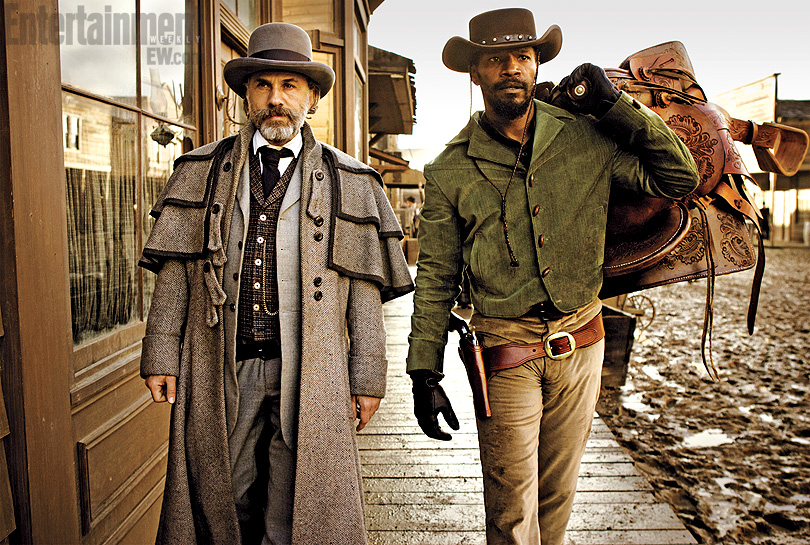
Foxx plays the title character.  As the movie begins, slave dealers are marching a group of slaves in leg irons and with the scars of whip marks along their backs, through the wilderness.  A cheerful man with an elegant, cultured manner pulls up in a cart with a big tooth mounted on a spring.  He is passing as a dentist.  He cordially offers to buy a slave but when the brutish, dull-witted men refuse, and the first massive slaughter of the story is underway, and all the other slaves set free.  The man is Dr. King Schultz (Christoph Waltz, who won an Oscar as a Nazi for Tarantino’s “Inglourious Basterds”).  He is a bounty hunter who hunts down “wanted dead or alive” men and kills them to collect the reward.  In those pre-Google image search days, he needs Django to identify three brothers.  The information on the wanted posters is not enough for a positive identification.  He is opposed to slavery, so he makes a deal.  He will keep Django a slave only long enough to complete the job.

Django proves so adept at the bounty hunter business that Schultz offers to bring him on as a partner.  “Kill white people and get paid for it? What’s not to like?” Django replies.  Django wants to rescue his wife, Broomhilda (Kerry Washington).  When they tried to escape from their owner, they were separated and sold.  Schultz says that Django will not be able to do it alone, and promises to help him get her back.  Their travels take them through several different adventures and many nods and winks to other films (Franco Nero, the original Django, shows up in a brothel bar), including a completely hilarious scene with a bunch of proto-Klan types who can’t get the eyeholes right in their masks and some completely horrifying scenes with a slave torn apart by dogs and a seemingly endless “mandingo fight” to the death.  Broomhilda is now owned by a man named Candy (his plantation is called Candyland).  He is utterly corrupt and despicable, but even worse is his house slave (Samuel L. Jackson), because he betrays other slaves.

Tarantino gets top marks for style, as always.  The violence and historical reversals are possibly intended to be empowering (oddly, Broomhilda is surprisingly less powerful than the usual Tarantino female characters).  On the contrary, it is dispiritingly disrespectful to the people who suffered unspeakable atrocities.  And Tarantino’s increasing distance between style and substance grows less palatable with each film.

Parents should know that this film includes extremely brutal, graphic, bloody, and disturbing violence with many characters injured and killed, an extended fight to the death, whipping and torture, prostitutes, slaves, some nudity, and constant very strong language including many uses of the n-word.

Family discussion:  Why did Stephen tell Calvin his suspicions about Django?  How does this movie show the influences of spaghetti westerns, American westerns, and “Blazing Saddles?”  Any other inspirations?

If you like this, try: “Inglourious Basterds” and “Kill Bill”

Related Tags:


Action/Adventure Drama Epic/Historical Western

Carnage

Posted on January 12, 2012 at 6:23 pm

Some boys are arguing in a park but we are too far away to hear what it is about.  One of them whacks another in the face with a stick.

And then we are in a spacious apartment as the parents of the two boys are at the computer, finishing up a joint statement about what happened.  The parents of the boy with the stick are Nancy and Alan Cowan (Kate Winslet and Christoph Waltz), who have come to the home of the boy who was hit, Penelope and Michael Longstreet (Jodie Foster and John C. Reilly) for a civilized conversation about what happened.  Everyone is polite, even gracious.  The Longstreets have decorated for guests with a vase of tulips and offer homemade cobbler.  The Cowans compliment their hosts.  There ar social smiles and reassuring comments all around.  The Cowans walk toward the elevator to go home.

And then — they don’t whack each other in the face with sticks.  It’s much worse than that.

Based on the Tony award-winning play by French playwright Yasmina Reza and scripted by Reza and director Roman Polanski, this is a sly and ultimately devastating story about the thin veneer of civilization and its uneasy co-existence with the savage spirit within us all.  If things had gone well, the Cowans might have made it to the elevator and as soon as its doors closed both couples would have immediately started talking about how impossible the other couple was and how superior their own child was.  But the Cowans just can not let that last statement go, so they march back into the Longstreets’ apartment to begin to attack, first with thinly veiled digs, then with stark, direct statements, then with insults, then with chaos.

This is not just about the social hypocrisy of privileged New Yorkers.  The play was originally French and the director is originally Polish and famously living outside the United States to avoid imprisonment for statutory rape.  Its treatment of its characters is as brutal as their treatment of each other.  Every shred of pretense is stripped away — the pretense of a loving relationship, of being good parents, of concern for the injured child, of concern for each other and for the world at large.  Everything politely overlooked in the first half hour (Alan’s constant interruptions to answer his cell phone to defend a drug in litigation over the adverse side effects, a cherished item, the tulips, the merits of the cobbler) comes back up (literally and graphically, in the case of the cobbler).  The Longstreets bring out the hard liquor and cigars and alliances shift from couples-based to gender-based to everyone for his and her self.  Reza makes it about more than the fatuous insularity of upper-class New Yorkers but does not go overboard.  When Michael trashes Penelope’s concern for the deprivations and injustice in Africa, both are portrayed as insular and unhelpful.  And a hopeful note in a coda shows her to be gentler with her characters than they are with each other.

(more…)

Related Tags:


Based on a play Comedy Drama

The Green Hornet

Posted on May 3, 2011 at 8:00 am

Anyone here remember Van Williams?

He was the star of the 1966-67 television series, “The Green Hornet.” But the only thing anyone remembers about the show today was the actor who played the title character’s martial arts and automotive expert sidekick, Kato: Bruce Lee. The tradition continues with this new film. Jay Chou (“Curse of the Golden Flower”) has the screen charisma, timing, and fight skills to make Kato watchable. That guy who plays the Hornet? Not so much.


In fact, the three things wrong with this movie are: Seth Rogen co-produced, Seth Rogen co-wrote, and Seth Rogen stars. Seth Rogen the co-producer and writer badly over-estimates the appeal of Rogen the performer. When called upon to play a clueless schlub, he can convey a certain shambling lack of pretension or artifice with some appeal. He was perfect as the brainless jello character in “Monsters vs. Aliens” and held his own fairly well as a secondary character in “Funny People,” “Superbad,” and “Knocked Up.” He may have some meta aspirations in casting himself as a self-indulgent and irresponsible playboy who decides to become a force for justice. But he doesn’t even make a persuasive dissolute. When he tries to do more, he loses all of the affection from the audience he ever mustered in playing guys who were better than they knew. Here is is so much less than his character believes to be and is supposed to be, he comes across as full of himself and egotistical; it’s as though his success in Hollywood and his hyphenate status have finally gone to his head. And even though he apparently recognizes his limited range by reducing the character arc to about an inch and a half; even after Britt decides to become a sort-of grown-up and a sort-of crime-fighter, Rogen the writer and Rogen the actor keep him pretty much an immature dope all the way through. It wears thin long before the movie is half over.


It also drags down the parts of the film that do work, especially Chou, whose precise, understated delivery is a nice counterpoint to Rogen’s messy stumbles. Michel Gondry (“Eternal Sunshine of the Spotless Mind,” “Be Kind, Rewind”) has a gift for whimsy that adds visual interest. An impossibly souped-up supercar has an old-fashioned turntable for playing disarmingly retro LPs. He slices up the screen into segments resembling something between “The Thomas Crown Affair,” the opening credits of “The Brady Bunch,” and that Breck shampoo commercial about “and they they told two people and they told two people.” And he makes good use of the depth of 3D in the fight scenes. We get Kato-vision to see how he sizes up the opposition, with a clever variation later on. Oscar-winner Christoph Waltz (“Inglourious Basterds”) manages to make more of the villain than the script gives him and there’s a nice cameo from the ubiquitous James Franco (giving us time to think that he would make a great Hornet).

Rogen is falling into the Adam Sandler/Peter Pan trap, the endless boy-man, alternately wolfish toward and intimidated by girls (Cameron Diaz has the thankless role) and incapable of taking responsibility at home or at work. At one point, Kato literally puts him in a diaper. The only reason to give the audience such a mess is so we can have the fun of seeing him learn some lessons. But he never does. This is a hornet that’s all buzz, no sting.

(more…)

Related Tags:


3D Action/Adventure Based on a television show Comic book/Comic Strip/Graphic Novel Crime Fantasy Remake Superhero

Trailer: The Green Hornet

Posted on June 23, 2010 at 2:51 pm

Seth Rogan and Jay Chou star in next January’s release, “The Green Hornet.”

Not excited yet? Well, wait for this — it also includes Cameron Diaz and Tom Wilkenson (“Michael Clayton”) and as the bad guy, this year’s Oscar winner Christoph Waltz of “Inglourious Basterds.” And here’s the part that gets my heart doing flip-flops — it is directed by Michel Gondry of “Eternal Sunshine of the Spotless Mind” and “Be Kind Rewind.” Hmmm, I hope the DVD includes a sweded version.

Related Tags:


Comic book/Comic Strip/Graphic Novel Trailers, Previews, and Clips
THE MOVIE MOM® is a registered trademark of Nell Minow. Use of the mark without express consent from Nell Minow constitutes trademark infringement and unfair competition in violation of federal and state laws. All material © Nell Minow 1995-2026, all rights reserved, and no use or republication is permitted without explicit permission. This site hosts Nell Minow’s Movie Mom® archive, with material that originally appeared on Yahoo! Movies, Beliefnet, and other sources. Much of her new material can be found at Rogerebert.com, Huffington Post, and WheretoWatch. Her books include The Movie Mom’s Guide to Family Movies and 101 Must-See Movie Moments, and she can be heard each week on radio stations across the country.

Website Designed by Max LaZebnik