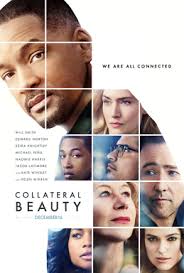
Collateral Beauty

Collateral Beauty

Posted on December 14, 2016 at 4:41 pm

Copyright 2016 Warner Brothers

With typical understated euphemism, the military calls the damage inflicted on non-target sites and civilians “collateral damage.” Screenwriter Allan Loeb calls his new film a fable and he asks us to consider the possibility of “collateral beauty,” beauty that is revealed only when our pain forces us to pay attention. Emily asked in Thornton Wilder’s Our Town, “Does anyone ever realize life while they live it…every, every minute?” The State Manager answers, “No. Saints and poets maybe…they do some.” This movie would add, “And those who are grieving.”

Howard (Will Smith) is confident, charming, and successful when we first see him, asking his partners and the employees of his advertising agency, “What is your Why?” He is not asking them to participate in a discussion of existential metaphysics and man’s search for meaning. He was asking them to think about how to describe their client’s products to answer the potential customers’ Why questions. Death, Time, Life, according to Howard, are what we grapple with. “We long for love, we wish for more time, we fear death.” Products that help people feel that they have some control over mortality and intimacy are the ones that will sell.

But three years later, Howard has suffered the most shattering loss of all, the death of a child. He sits in his office creating elaborate domino structures and then watching them fall. He’s “the domino champion of crazytown” and the jobs of everyone in the company are at stake.

Howard no longer even speaks to his friends and colleagues, Whit (Edward Norton), Claire (Kate Winslet), and Simon (Michael Pena) and he no longer meets with clients. The business is in trouble. They have one hope — a sale of the company. But Howard will not discuss it, and he controls the majority of the stock.

Desperate, Whit, Claire, and Simon hire a detective (Ann Dowd) to help them build a case that Howard is not mentally stable enough to control his voting shares. She tells them Howard has been writing letters to express his pain. He has written to Death, to Love, and to Time. And so Whit, Claire, and Simon hire three actors to play the roles of Death (Helen Mirren), Love (Keira Knightley), and Time (Jacob Latimore), to answer Howard’s letters. Best case scenario, they make it possible for him to move forward by engaging directly with his questions about life and pain and loss and meaning. Worst case scenario, they document his mental instability so they can override his ability to block the deal.

White, Claire, and Simon each have their own problems, it turns out, and the actors provide some gentle guidance on that as well. And Howard is provoked into responding. Each encounter makes it possible for him to take another step toward re-engaging with the world, including attending a grief support group for parents whose children have died.

I was touched by the film’s willingness to do what it asks Howard to do — to confront death, love, and time and ask what it all means and why it hurts so much. Its heartfelt sincerity and lovely performances beguiled me into its world. It is worth seeing for Mirren’s exquisitely witty turn alone. She is clearly having a great time playing the part of a Capital R Theatrical Capital-A Actress. Norton is also excellent, especially in scenes between Whit and his tween daughter who is furious at him for cheating on her mother. Naomie Harris as the leader of the support group has a sweet gravity that is as important to bringing some grounding to Howard as his conversations with the embodiment of abstract concepts. And Smith brings all of his full-out charisma to the role of a man who cannot figure out how to go on when he has lost everything that matters because his view of the world has been shattered into sub-atomic particles and nothing makes sense. Howard has become a man who spends days adjusting the precise placement of elaborate domino structures and then knocks them down and leaves the room without watching the way they knock each other down.

The raw elements of Smith’s acting anchor the more fanciful and symbolic elements of the story, tenderly told, with a conclusion of warmth, healing, and perhaps some connection to a fourth spirit, hope.

Parents should know that this film includes themes of loss and devastating grief, including death of children, and a few swear words.

Family discussion: If you wrote letters to Time, Death, and Love, what would you say? What other concepts would you write to? What is collateral beauty, and does it take a profound loss to be able to see it?

If you like this, try; “Our Town,” “Truly, Madly, Deeply” and “The Pursuit of Happyness”
Related Tags:


Not specified
Rogue One: A Star Wars Story

Rogue One: A Star Wars Story

Posted on December 13, 2016 at 12:00 pm

Copyright Disney 2016

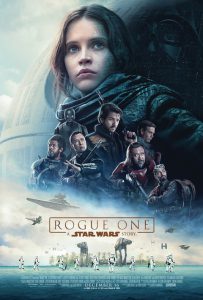
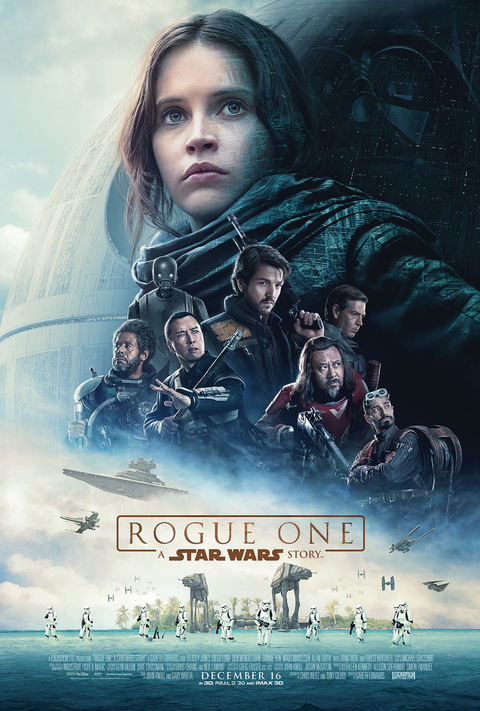
I know, I know, you want me to tell you how it ranks against the other “Star Wars” movies.  I’m going to say somewhere between “A New Hope” and “The Force Awakens.”  It is a worthy addition to the canon, gorgeously imagined, with striking images, intriguing and richly diverse characters, a suspenseful plot, a worthy adversary, an amusing sidekick, some romantic sparks, and a very satisfying answer to one of the most persistent questions from the very first film in 1977.  And without getting heavy-handed or preachy, it touches on some complicated and timely issues.

Once again, we are reminded that this takes place a long time ago, in a galaxy far far away, and thankfully the text ends there and we are immediately in the middle of the action. A little girl with pigtails is breathlessly racing home to tell her parents that the threat they have been preparing for has arrived. “It’s happened. He’s come for us.” “You know what to do.”

The girl is Jyn Erso. Her father Galen (Mads Mikkelsen) was a scientist who once designed weapons for the Empire. He got away and has been living on an isolated farm, but the Empire’s Orson Krennic (Ben Mendelsohn) has found him. He is there to bring Galen back to finish work on the planet-killing weapon we know well from “A New Hope.” Galen explains why he left. “You’re confusing peace with terror.” Krennic responds crisply, and creepily, “You have to start somewhere.”

Jyn’s escape has been well-rehearsed. She knows where to hide. Her mother was supposed to go with her, but could not resist trying to protect her husband. She is killed, Galen is captured, and Jyn is rescued, kind of, by outlaw Saw Gerrera (a dashing Forest Whitaker).

The grown-up Jyn (Felicity Jones of “The Theory of Everything”) has clearly been taking care of herself — and not trusting anyone else — for a long time. But she is captured by the rebel forces, who have received a message smuggled out by a pilot named Bodhi Rook (a terrific Raz Ahmed). The Rebel Alliance wants Jyn to get to her father and find out how to stop the terrifying new weapon, the planet-killing Death Star. Jyn, who did not know whether her father was dead or alive, and hoped he was dead because it would mean that he was not helping the Empire and not abandoning her, must re-think her view of the world (in her case, I guess, the galaxy) and of herself.

Led/accompanied by Rebel Alliance hero Cassian (Diego Luna), his pilot/sidekick droid K-2SO (winningly voiced and motion-captured by Alan Tudyk in one of the film’s most memorable highlights), a blind monk with mad martial arts skills (Donnie Yen) with his firepower-packing friend Baze Malbus (Wen Jiang), and the renegade pilot, Jyn crosses the galaxy to try to rescue her father and stop the Death Star.

So, to recap: good characters, good action, great scope, and just the right amount of fan service. I’m not sure that the digital re-animation of “A New Hope” characters are worth the distraction. And I am not entirely on board with the ending.

No more for risk of spoilers. But there is so much going on, it is worth pointing out some details that might be overlooked in the middle of all the action. Note young Jyn’s stormtrooper doll, an Ozymandias-like massive statue, prone on the sand, the issue of factions within the rebel community, the bigger issue of moral responsibility for actions committed for the larger good, echoes of familiar wartime images from the D-Day landing to hooded prisoners and IEDs in civilian areas.

K-2S0, like Rook and “Force Awakens'” Finn, was formerly with the Empire. It/he has been reprogrammed but a sort of data pentimento has it/him a bit loopy and the result is a dry, even sarcastic wit that adds a bit of a twist to the seriousness of the storyline. This film, more canon-adjacent than linear, has some of that same sense of independence and even improvisation, a welcome waystation before the next chapter of the saga.

Parents should know that this film includes extended sci-fi action-style violence, with many characters injured and killed. There are sad deaths including death of parents, and some disturbing images, including monsters. The script by Chris Weitz and Tony Gilroy is wise enough not to try to answer questions about the complex quandaries of oppression and rebellion, but wise enough not to overlook them.

Family discussion: How did the governance of the Empire and the Rebel Alliance help or hinder their decision-making? How did the hologram message change Jyn’s mind? What does it mean to carry a prison with you?

If you like this, try: “Star Wars” IV, V, VI, and “Force Awakens”

Related Tags:


Fantasy Science-Fiction Series/Sequel
Contest: Jungle Book

Contest: Jungle Book

Posted on December 13, 2016 at 8:00 am

Copyright 2016 Disney

Win a copy of Disney’s live action “Jungle Book!”

Send me an email at moviemom@moviemom.com with Jungle in the subject line and tell me your favorite jungle animal. Don’t forget your address! (U.S. addresses only). I’ll pick a winner at random on December 20, 2016. Good luck!

Related Tags:


Contests and Giveaways
Miss Sloane

Miss Sloane

Posted on December 8, 2016 at 5:30 pm

Copyright 2016 Filmnation

Striding confidently down the halls of the Congressional office buildings, picking up the check in restaurants with crisp white tablecloths and extensive wine cellars, and, inevitably, at fundraisers, lobbyists are impossible to miss in Washington, D.C. They wear discreetly expensive suits. In fact, they are usually pretty discreet about everything, whether it is handing over money or making threats. Especially when they are making threats.

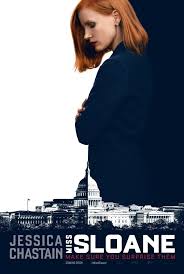
The film’s title may use the quaint honorific “Miss Sloane,” but do not let that mislead you. Elizabeth Stone (Jessica Chastain in a subtle, vibrant performance) is not looking back. She is a top lobbyist and she tells us right away that means that she always must be thinking ahead. “Lobbying is about foresight and anticipating your opponent’s moves and plotting countermeasures.” She is all about tactics, she is ruthless, and she is determined. “Make sure you surprise them and they don’t surprise you.” Everything about her is controlled and knife-edged. Her sheet of red hair is cut so severely it could slice through granite.

There are a fews signs of stress, though. When she thinks no one is looking, she pops some white pills. Some nights she goes to a hotel to spend time with a male escort. And she is rattled when the one she is used to seeing is not there and the new one (Jake Lacy as Forde), but not so rattled that she declines.

The most significant sign of stress is that in a meeting with a very lucrative prospective client, instead of listening politely when he explains his plan to create a group to promote the idea of women opponents to any restrictions on gun ownership, she laughs, harshly and derisively. Her boss (Sam Waterston) is furious. But for Elizabeth it is just one moral outrage too many. In what she herself recognizes is a “Jerry Maguire” move, she quits, taking her staff with her — except for Jane (Alison Pill), her closest aide, who opts to stay with the high salary and opportunity for partnership. Elizabeth is going from one extreme to the other, working to oppose the gun lobby on behalf of a small non-profit run by Rodolfo Schmidt (Mark Strong, usually the bad guy but here fine as an idealist).

The smart script by first-time screenwriter Jonathan Perera and brisk direction from John Madden (“Shakespeare in Love”) make this a solid Washington thriller with some telling (and accurate) details, moral dilemmas, and plot twists that keep you guessing until the last ten minutes.

Parents should know that this film includes strong and crude language, substance abuse, sexual references and a mildly explicit situation, and corruption and betrayal.

Family discussion: Why did Elizabeth allow herself to be so consumed by the job? Why did she decide to make a change? What would she recommend to improve politics and government?

If you like this, try: the documentary about a real-life lobbyist who went to prison, “Casino Jack and the United States of Money” featuring former Congressman Bob Ney

Related Tags:


Drama Politics
The Edge of Seventeen

The Edge of Seventeen

Posted on November 17, 2016 at 5:42 pm

Copyright 2016 STX
Copyright 2016 STX
A psychiatrist once told me that just as an infant can have fevers that would be lethal in an adult, a teenager can have symptoms that would be evidence of psychosis at any other stage of life. Mood swings, the feeling that everyone is looking at you, disordered thinking, bizarre appearance: you might be having some sort of breakdown, or you just might be an adolescent. Stories about that intensely traumatic age connect to those of us who have been through it and those who are in the midst of it with a visceral sense of recognition, and, if we’re lucky, a bittersweet humor.

“Edge of Seventeen,” written and directed by Kelly Fremon Craig, captures the intensity and chaos and drama drama drama of this age. Hailee Steinfeld plays Nadine, who, like many 17-year-olds, is certain that she is the only person on earth who truly understands what it is to suffer. She actually has experienced a terrible loss, the death of her father, which has left her remaining family fragile. Her older brother Darian (Blake Jenner of “Everybody Wants Some!!”) compensates by being perfect in every disgusting way possible, from Nadine’s perspective. He is handsome, talented, athletic, and popular. That leaves nothing left for her but to be awkward and miserable.

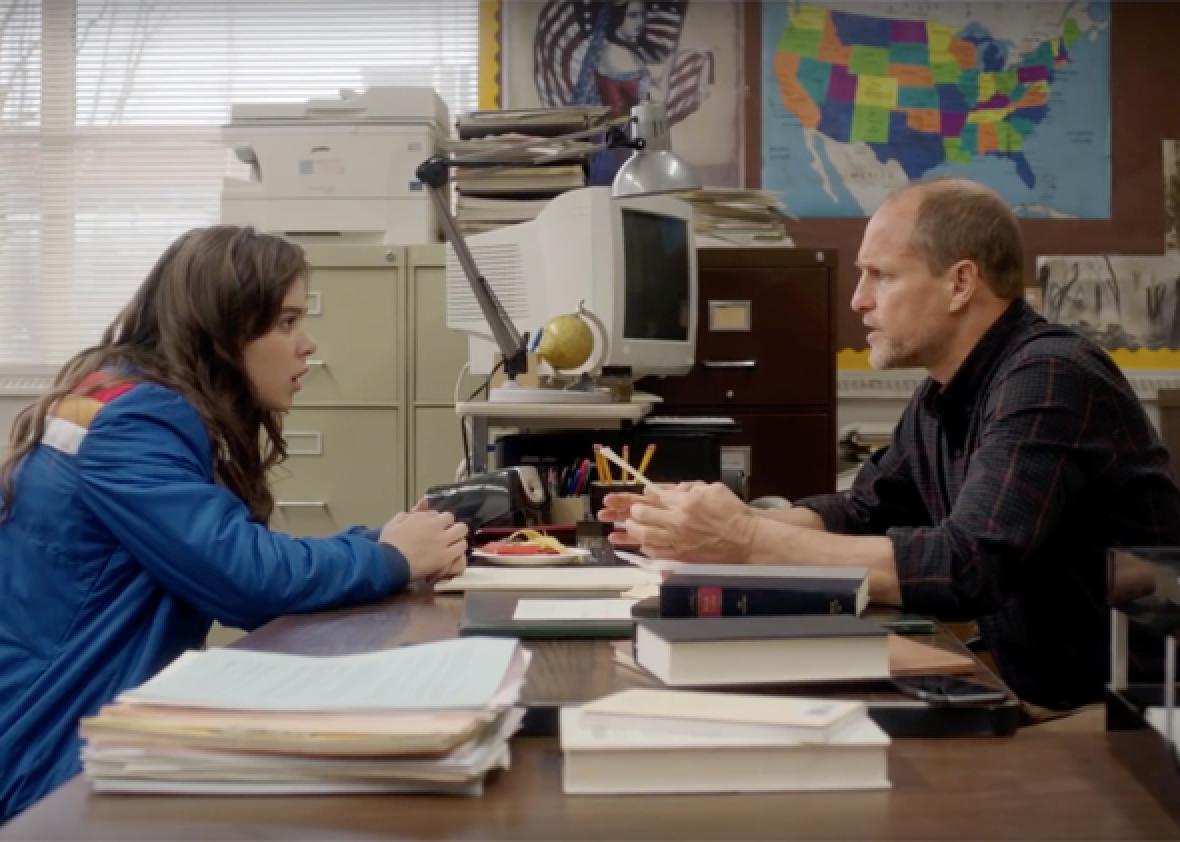
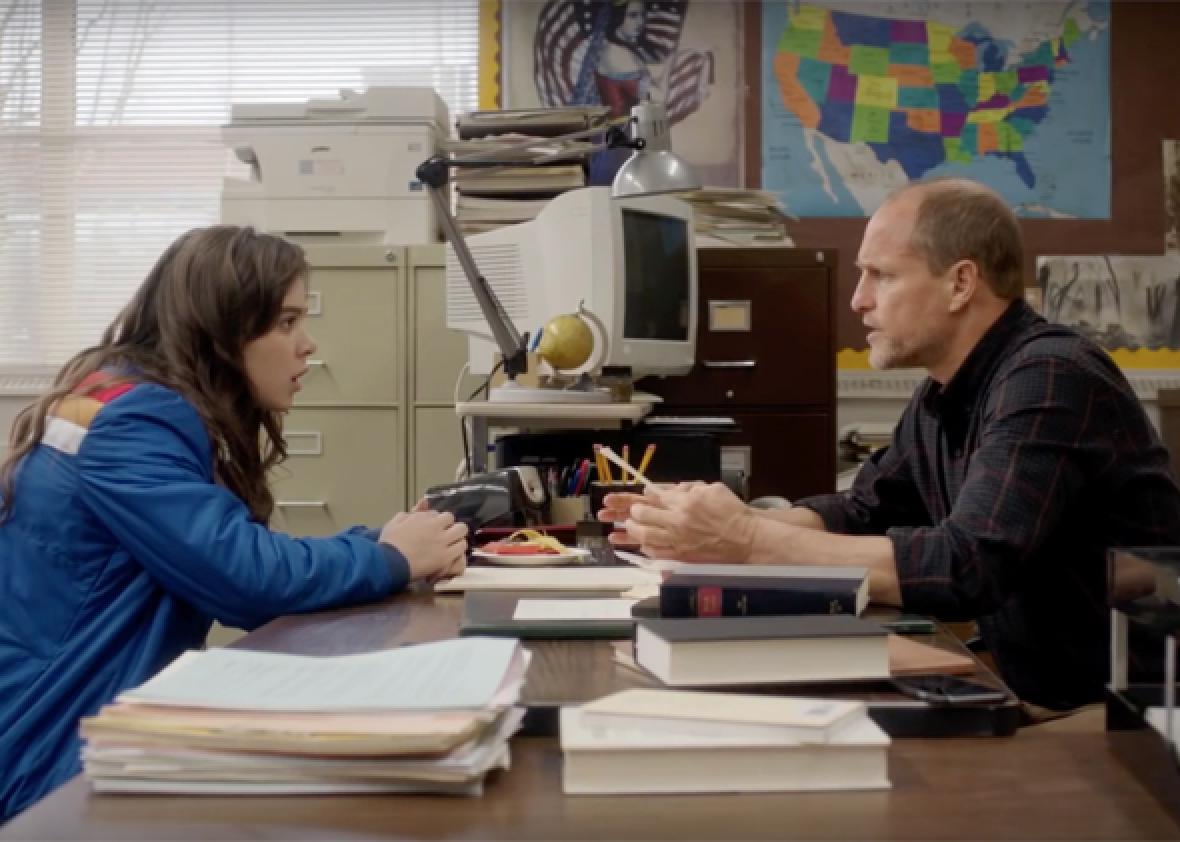
The only thing good in her life, she thinks, is her endlessly supportive and understanding BFF Krista (Haley Lu Richardson), who sympathizes with Nadine about the misery of having no father, a perfect brother, and a crush on an unattainable boy who works at Petland in the mall (Alexander Calvert as Nick). She also has a teacher named Mr. Bruner, played with perfectly dry, understated wit by Woody Harrelson, who knows teenagers well enough to understand that the best way to reassure Nadine is not to try to comfort her. When she trounces into the classroom where he is eating lunch alone to tell him she has to kill herself, he responds by noting mildly that in fact she has just interrupted his own creation of a suicide note. “As some of you know, I have 32 fleeting minutes of happiness per school day during lunch which has been eaten up again and again by the same especially badly dressed student and I finally thought, you know what, I would rather have the dark, empty nothingness.” She thinks she wants everyone to be as fraught as she is. He knows how to strike just the right balance of detachment and sympathy.

So when she tries to cancel a sexually explicit invitation to Nick but accidentally sends it instead, Mr. Bruner is there to take a look and point out that she should be more careful about run-on sentences. The reason she is talking to him about it instead of Krista is that Krista, the single good thing in her life, has committed the ultimate betrayal. She and Darien are in a relationship. Nadine is in such a severe state of collapse that she does not notice that there is a smart, handsome, very nice boy interested in her (Hayden Szeto in a star-making performance as Erwin).

The film itself has that same perceptive sympathy for the agonies of adulthood, allowing us to laugh at Nadine only because we know she’ll be fine — she’s going to grow up and make this movie.

Parents should know that this movie has very explicit and crude language, sexual references, and non-explicit sexual situations, a car accident with a sad (offscreen) death of a parent), and teen drinking.

Family discussion: How did Nadine, Darien, and their mother express their grief differently? Is it easier being the perfect one? What do you do to feel better?

If you like this, try: “Rocket Science,” “Thumbsucker,” and “The Duff”

Related Tags:


Comedy Coming of age Drama Romance School Stories about Teens
THE MOVIE MOM® is a registered trademark of Nell Minow. Use of the mark without express consent from Nell Minow constitutes trademark infringement and unfair competition in violation of federal and state laws. All material © Nell Minow 1995-2026, all rights reserved, and no use or republication is permitted without explicit permission. This site hosts Nell Minow’s Movie Mom® archive, with material that originally appeared on Yahoo! Movies, Beliefnet, and other sources. Much of her new material can be found at Rogerebert.com, Huffington Post, and WheretoWatch. Her books include The Movie Mom’s Guide to Family Movies and 101 Must-See Movie Moments, and she can be heard each week on radio stations across the country.

Website Designed by Max LaZebnik