Money Monster

Money Monster

Posted on May 12, 2016 at 5:58 pm
Copyright Smokehouse Pictures 2016

Director Jodie Foster, in her most ambitious project so far, shows an impressive command of the language of film and a discerning eye for the gulf between the way we like to think of ourselves and the way we are in “Money Monster,” which begins promisingly but then pulls its punches with a disappointingly conventional last 40 minutes. It aims for “The Big Short” plus “Dog Day Afternoon,” but comes up just ahead of “Man on the Ledge.”


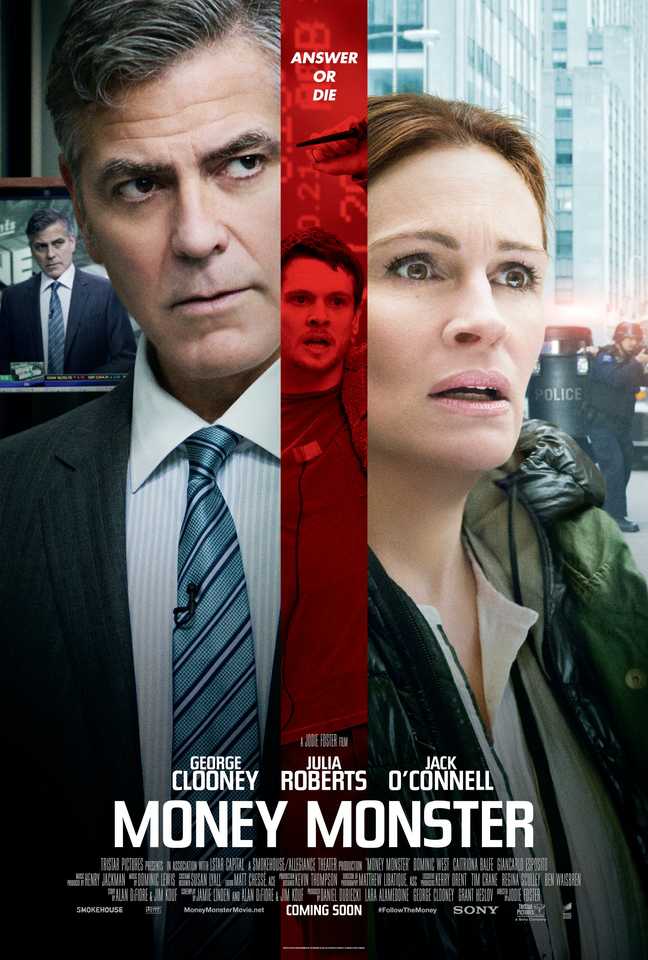
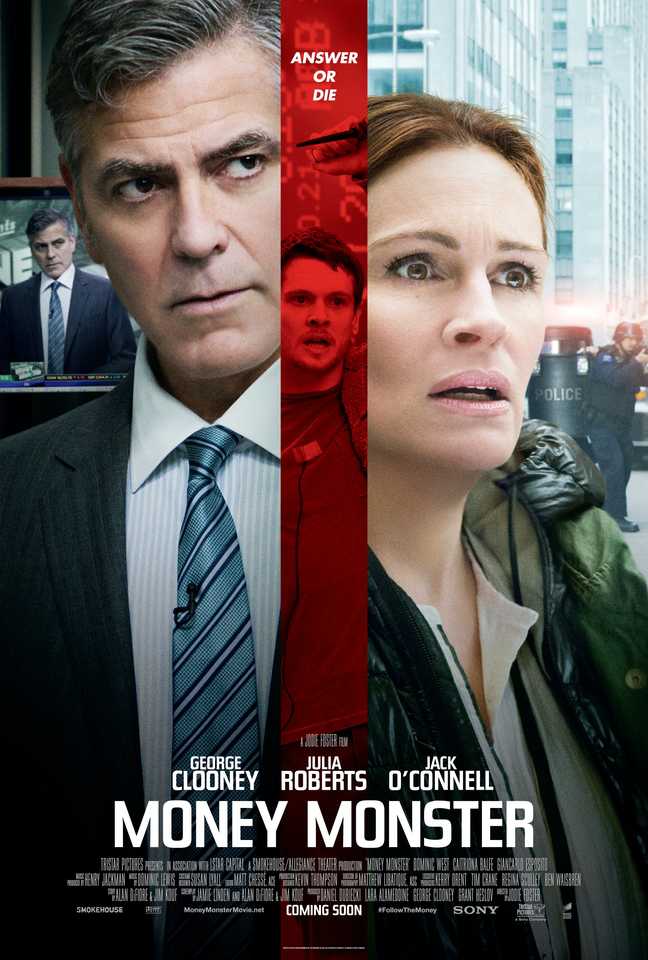
George Clooney plays Lee Gates, the host of a Jim Cramer-style television show about investing that is more dazzle than reporting. He dances with back-up girls, he amplifies his commentary with movie clips and outrageous stunts. Every episode has a stock buy recommendation “of the millennium,” and on this night he has to announce that one of his previous favorites, IBIS, has suffered a precipitous drop in the stock price due to a “glitch in its algorithm.” IBIS is one of those buzzword-y Wall Street darlings that no one really understands, but it has to do with a fully automated system for “high-frequency trading.”

Gates, a long-time enthusiast of the company, has invited the IBIS CEO (Dominic West as Walt Camby) to be a guest on the show, but the company’s director of communications, Diane Lester (Caitriona Balfe) is appearing instead, explaining that Camby is on an airplane and cannot be reached. Before her segment, though, a man named Kyle (Jack O’Connell of “Unbroken”) walks onto the set. He has a gun, and he takes Gates hostage, forcing him to wear a vest packed with explosives. He invested everything he had in IBIS, based on Gates’ glib assurances.

In the booth, speaking to Gates via earpiece, is his producer, Patty Fenn (Julia Roberts). As a producer, she is used to being the only grown-up in the room (and a little tired of having to be one). She quickly evaluates the situation and keeps things going moment to moment while she tries to figure out a way for the situation to end without anyone being hurt.

Foster skillfully takes us from the intensity of the hostage standoff on live television to show us what is going on with the police led by Captain Powell (Giancarlo Esposito), trying to find out more about the man with the gun and evaluating potential strategies for disarming him, and to the efforts to track down Camby both by Patty’s staff and by IBIS insiders. A couple of unexpected twists and some well-timed comic relief help hold our interest. And Clooney gives one of his most nuanced performances as a man who has spent a lot of time and burned a lot of bridges trying not to think too hard about the impact he has had on people. As both he and Patty use the skills that made them successful in the world of infotainment — and a few new skills, too — the natural chemistry between Clooney and Roberts and their combined star power keep the tension level high. But Kyle and Camby are under-written and the last 20 minutes are a disappointment with a resolution that is too easy and too Hollywood. We know who the monster is, here and we wish the movie knew it, too.

Parents should know that this film includes constant strong language, violence including gun, bomb, characters injured and killed, betrayal and illegal behavior, and sexual humor and situations, and drug use.

Family discussion: What makes Lee change his mind about Kyle? Would you take investing advice from Lee? What does it mean to say “we don’t do journalism?”

If you like this, try: “Dog Day Afternoon,” “John Q,” and “The Big Short”
Related Tags:


Drama Television
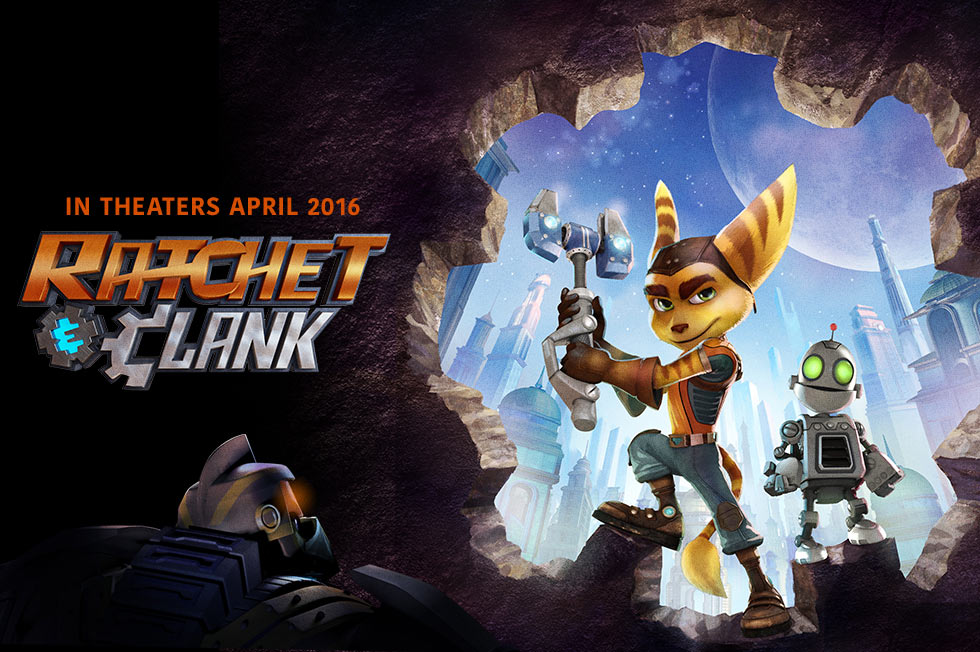
Ratchet & Clank

Ratchet & Clank

Posted on April 28, 2016 at 5:50 pm

Copyright 2016 Focus Features

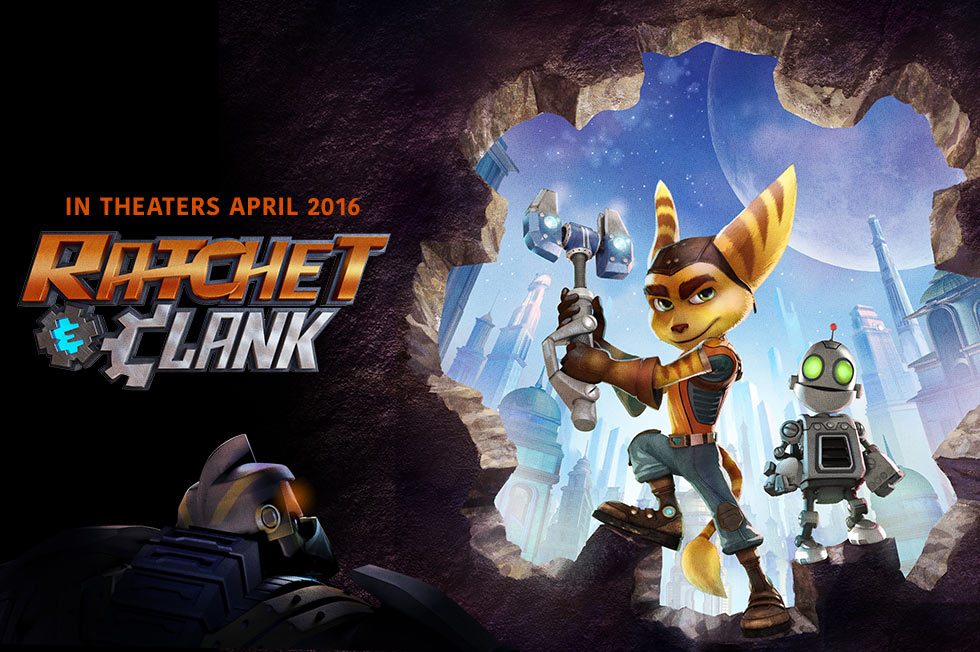
Roger Ebert famously declared that a video game could not be art, giving rise to howls of protest. I believe that videogames, like movies, can and will rise to the level of art. But movies like “Ratchet & Clank” will continue to be compelling arguments to the contrary. Video games have striking visual design and some promising characters, though, in my limited experience, they are superficially sketched in to give the player room to inhabit them fully. If most of them don’t have what we might consider a plot, they have as much of a plot premise as many action movies: the world is under attack! And yet, so far no video game has successfully made the leap to a movie with enough of a story to succeed even as mildly entertaining.

Playstation’s Ratchet & Clank games, with names like “Full Frontal Assault” and “Tools of Destruction” are renowed for their varieties of weaponry. “With all that hardware at hand, it’s no wonder Ratchet, a wrench-wielding Lombax, and his robot buddy Clank, have itchy trigger fingers. Think about it. You can choose from burning, bombing, exploding or obliterating your enemies. So go ahead, blow it up. Blow it all up. It isn’t the size of your weapons that count. It’s how many you have and better yet… How you use ’em.”

So, not much by way for storyline or character and not exactly child-friendly. So, I am not sure what inspired Focus Features to turn that into a movie that is rated PG (“for action and some rude humor”) and intended for children.

Ratchet (James Arnold Taylor) is a well-meaning but not entirely competent Lombax, a talking fox-like orphan of mysterious origin who works as a mechanic in a garage owned by Grimroth (John Goodman). His heroes are the Rangers, an elite fighting squad led by the preening, jut-jawed Captain Qwark (Jim Ward). When the planet is under attack from the evil Chairman Drek (Paul Giamatti) and mad scientist Dr Nefarious (Armin Shimerman), the Rangers decide to take on another member and Ratchet is determined to be the one to join the team.

That slight framework leads to a lot of shooting scenes with different weapons and some minor plot developments about shifting loyalties as a runt robot created for Drek becomes Ratchet’s partner, Clank (David Kaye), and Qwark, his feelings hurt by Ratchet’s popularity, is lulled by Drek’s promises of support. And then more shooting.

Without the interactive element of a game to make up for the thin characterization and repetitive plotline, the settings and action scene set-ups are generic and under-imagined, only reminding us of how much better original films like “Megamind” and “Monsters vs. Aliens” were in handing similar material.

Parents should know that this movie has a lot of sci-fi, action-style peril and weapons, with the entire galaxy at risk, though the film makes it clear that the planets being blown up are not occupied. There is brief bodily function humor.

Family discussion: Why was Qwark the leader of the Rangers? How many characters changed their loyalties in this movie, and what were their reasons? Why didn’t Qwark listen to Elaris?

If you like this, try: “Monsters vs. Aliens” and “Megamind”

Related Tags:


Animation Based on a video game
Mother’s Day

Mother’s Day

Posted on April 28, 2016 at 5:20 pm

Copyright 2016 Open Road Films
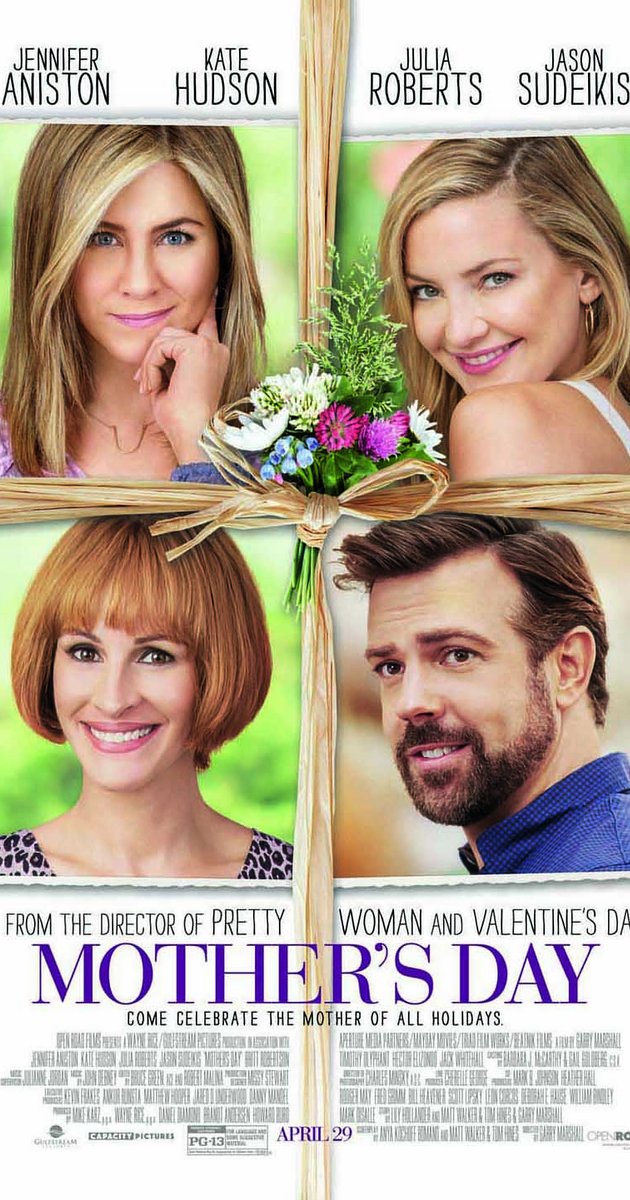
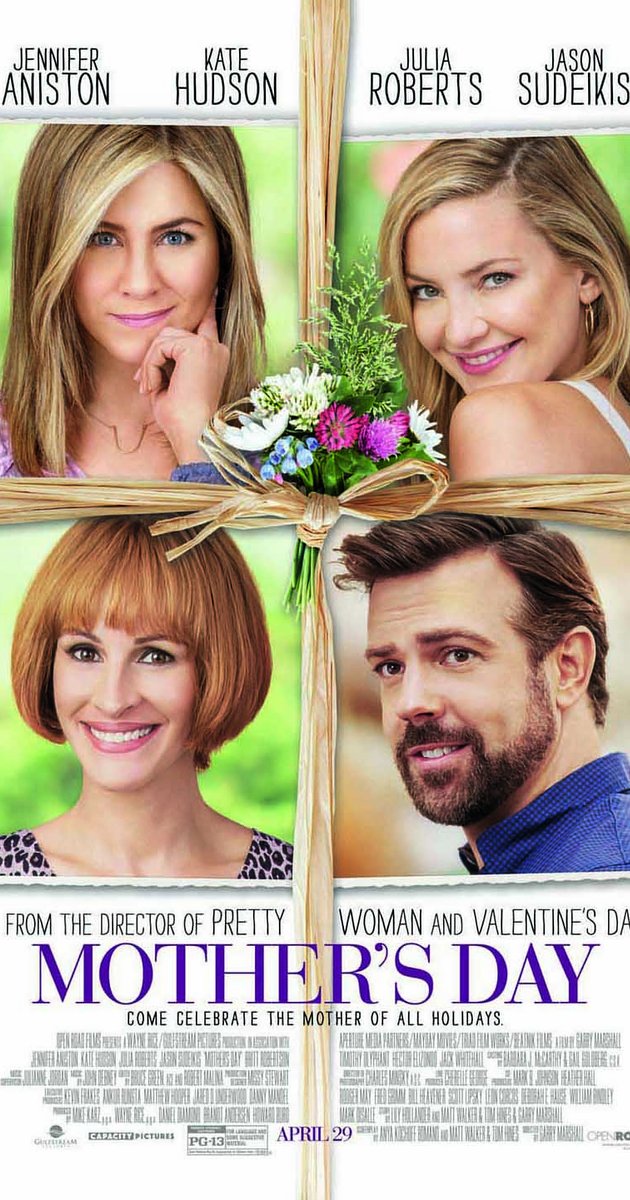
I tried, Garry Marshall, I really did, but you finally broke me. I did my best to enjoy Valentine’s Day (I called it a tweet of a movie but gave it a B for being mildly entertaining) and New Year’s Eve (I called it a big budget version of the old television series “The Love Boat” and gave it a C, but managed to find some genuinely touching moments). I was fully expecting to find some light entertainment with a galaxy of big stars showing that they can make lackluster material shine a little bit.

So, if “Mother’s Day,” the third in Marshall’s big star/tiny script mash-ups keyed to a holiday, was no worse than the first two, I was determined to give it the benefit of the doubt. I have a mom; I am a mom, I wrote a book about the best movie mothers, and so I’m the prime audience for a bunch of stories about the tenderest and often the most fraught of relationships, mother and child. If it managed to be inoffensive, I would have recommended it. But with this film, Marshall and his inexperienced co-screenwriters cross the tipping point from merely synthetic to downright vile, with apparently no notion of the difference between humor that points out the virulence of bigotry and “jokes” that treat racism and homophobia like just another cutesy personality quirk.

As with the earlier films, there are a lot of characters presenting variations on the theme. But the characters do not even rise to the level of stereotypes and the storylines couldn’t fill a fortune cookie. There is a chasm-sized disconnect between the film’s assumptions about our belief in any of them and its ability to deliver that level of interest. Not one thing is believable even in heightened, glossed-over movie terms. Everyone lives in gorgeous homes and there are no concerns about money. Intrusive product placement gives the film a sleasy infomercial vibe even as it pretends to make fun of home shopping channels hawking cheesy merchandise. Some odd random shots of individuals who have nothing to do with the story are either friends of the filmmaker or evidence that at one time the movie was even worse and got recut. It’s creepy that it takes place in the very diverse city of Atlanta but everyone is white except for the characters whose primary job is to serve as a racial stereotype. Pretty much everyone in the film is a stereotype, but the white ones are not offensive, just dull. The non-white ones are both.

A quick recap of the set-ups — very quick so neither one of us will nod off in stunned boredom. Sandy (Jennifer Aniston) is a single mom with two sons who is upset because her ex (Timothy Olyphant) has married a beautiful young woman. Kristin (Britt Robertson of “Tomorrowland”) loves the father of her baby, an aspiring stand-up comic, but she won’t accept his marriage proposal because she was adopted and thus thinks she does not know who she is. Sisters Jesse (Kate Hudson) and Gabi (Sarah Chalke), who live next door to each other, have not told their bigoted, RV-driving, redneck parents about their spouses — Jesse is married to an Indian-American (Aasif Mandvi) and Gabi is married to a woman (Cameron Esposito). And sad widower Bradley (Jason Sudeikis) has to cope with being a single dad of two daughters. Julia Roberts, in a disastrous orange traffic cone of a hairdo (it’s actually a wig leftover from “Notting Hill”), is also on board as a shopping channel mogul presumably because Garry Marshall gave her her big break in “Pretty Woman” and she will do anything for him.

A series of exposition-heavy introductory scenes (Bradley and his daughters standing at the gravesite: “I can’t believe it’s been a year,” another character explaining, “I have abandonment issues,” Sandy, Jesse, and Gabi helpfully recapping everything that is going on in their lives to each other like the crawl at the bottom of the CNN screen) is followed by a series of micro-complications that fall somewhere between a 6th grade skit and a one-season basic cable sit-com, following by a series of contrived and cloying “resolutions.” The only clunky device left out is words of wisdom from a clown. Oops, no such luck. It’s there. And it’s not over! There are the most lifeless bloopers in the credits in the history of bloopers in the credits.

This is all larded with cornball slapstick wildly outdated “hilarity” that includes a man wearing a woman’s pink silk bathrobe, a man falling off a balcony, a man embarrassed at having to buy tampons for his daughter, a woman with her shirt ripped open holding supposedly professional design presentation model that looks like a third grade diorama, and the same woman getting her arm stuck in a vending machine.

It gets worse. Cops run down a speeding vehicle and make the only non-white character lie down on the ground. It gets resolved when one of the officers recognizes him; the issue of racial profiling is portrayed as a joke. So is a crack about a little person named “Shorty.” The stand-up comic ends up holding his baby and not delivering any jokes during his crucial make-it-or-break-it set, jokes which were not only funny but which might have made it funny and meaningful. Same for this wilted bouquet of a movie. Give Mom breakfast in bed instead.

Parents should know that this film includes discussions of bigotry but also insensitive portrayals of racism and homophobia, brief strong language, sad off-screen death of a parent, family issues about divorce and remarriage, some strong language, and alcohol, including scenes with a baby in a bar.

Family discussion: How did meeting Miranda make Kristen think differently about marriage? What should Jesse have told her parents about her husband?

If you like this, try: “Valentine’s Day” and “New Year’s Eve”

Related Tags:


Comedy Family Issues Series/Sequel
Tale of Tales

Tale of Tales

Posted on April 28, 2016 at 5:15 pm

Copyright 2016 IFC Films
Who ever said that fairy tales were for children?

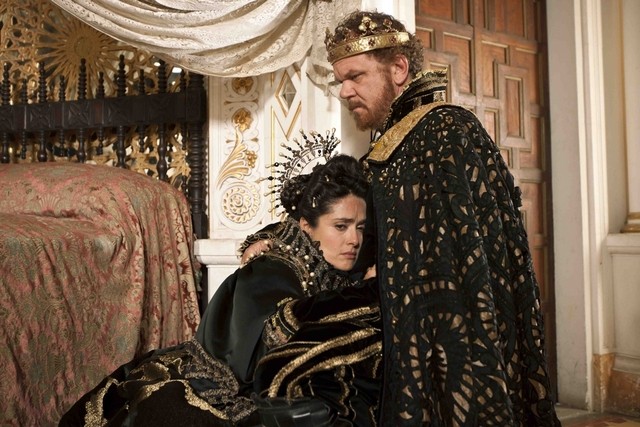
The visually striking “Tale of Tales” is based on three stories from Giambattista Basile that go back a hundred years before the Brothers Grimm. Basile, whose book was subtitled “entertainment for little ones” was the first person to write down these folk tales, including early versions of Cinderella, Rapunzel, and other classic stories. The three tales here, inspired by Basile’s stories, have fairy tale elements — wishes, magic, monsters, a princess to be won by whoever gives the right answer, a queen who will do anything to have a child. And there are lush, gorgeous, and wildly imaginative images. But these are not for children. These are straight out of the primordial ooze of the collective unconscious. These are not so much stories about enchantment as they are about desire, hubris, terror, all of the the deepest and most untamed emotions. Don’t expect anyone to live happily ever after.

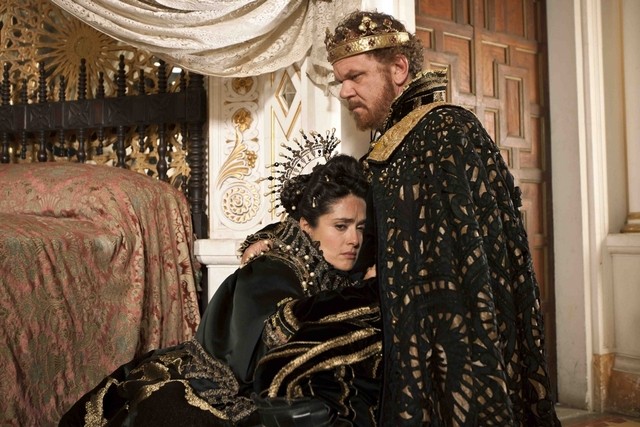
The Queen of Longtrellis (Salma Hayek) is inconsolable. She wants a child. A wizard offers her a solution. If she eats the heart of a sea monster, prepared for her by a virgin, she will become pregnant, but it will be at the cost of a life. She agrees. And her husband, the king (John C. Reilly) is killed capturing the monster. The virgin prepares the heart, and the queen devours it. She and the virgin both become pregnant and deliver identical sons.

The King of Strongcliff (Vincent Cassel) is a libertine. He hears the voice of an old woman singing (Hayley Carmichael) and, believing her to be young and beautiful, tries to get her to agree to sleep with him. She agrees, provided that they keep the lights off. But he peeks and horrified by her appearance, has her thrown out of the window.

And the King of Highhills (Toby Jones) has a beautiful and devoted daughter, Violet (Bebe Cave). She prepares a song to show her love for her father but as she performs, he is distracted by a flea on his hand, which fascinates him so much that he keeps it for a pet, feeding it and fattening it up until it is the size of a pig. When it dies, he has it skinned and offers Violet’s hand in marriage to the first one who can correctly identify the animal it came from. But the one who knows the answer is an ogre.

Each of these stories explores issues of pride, selfishness, and greed. The Queen wants more than a child; she wants all of his love. The old woman wants superficial beauty and the power it can bring and the lecherous king wants sex and a beautiful wife. A woman is consumed — literally — with jealousy. Another king can’t see the love of his daughter because he is preoccupied with his grotesque pet. Director Matteo Garrone, with his first English language film, gives the stories a hallucinatory quality with rapturous images on the brink between dream and nightmare.

Parents should know that this film includes nudity, sexual references and situations, monsters, fairy tale violence and explicit and disturbing images.

Family discussion: How do these fairy tales differ from the ones more familiar to modern audiences? How do each of these stories deal with the theme of pride?

If you like this, try: “The Brothers Grimm” and “Time Bandits”

Related Tags:


Based on a book Fantasy
Barbershop: The Next Cut

Barbershop: The Next Cut

Posted on April 14, 2016 at 5:13 pm

Copyright 2016 Warner Brothers
Copyright 2016 MGM

In 1991, Ice Cube was barely into his 20’s when he starred in Boyz N The Hood, one of the most powerful American films of the 20th century, a searing indictment of gang violence and a tribute to one of the truly great fathers in movie history. Fifteen years later, in the third of his “Barbershop” films (fourth if you include “Beauty Shop“), he is now playing the father role but still taking on the tragic toll of gang violence.

It is a gentler film, but it does not pretend that these are gentler times. One of the first images we see is a “No Guns Allowed” sign in the barbershop. Later, when a gang leader comes in for his regular appointment, he hands over two guns to be locked away while he’s in the chair. And there are moments that echo scenes in “Boyz” about the pressure put on young men to join gangs, the danger of the initiation rituals, and the challenges of being a father to a teenager.

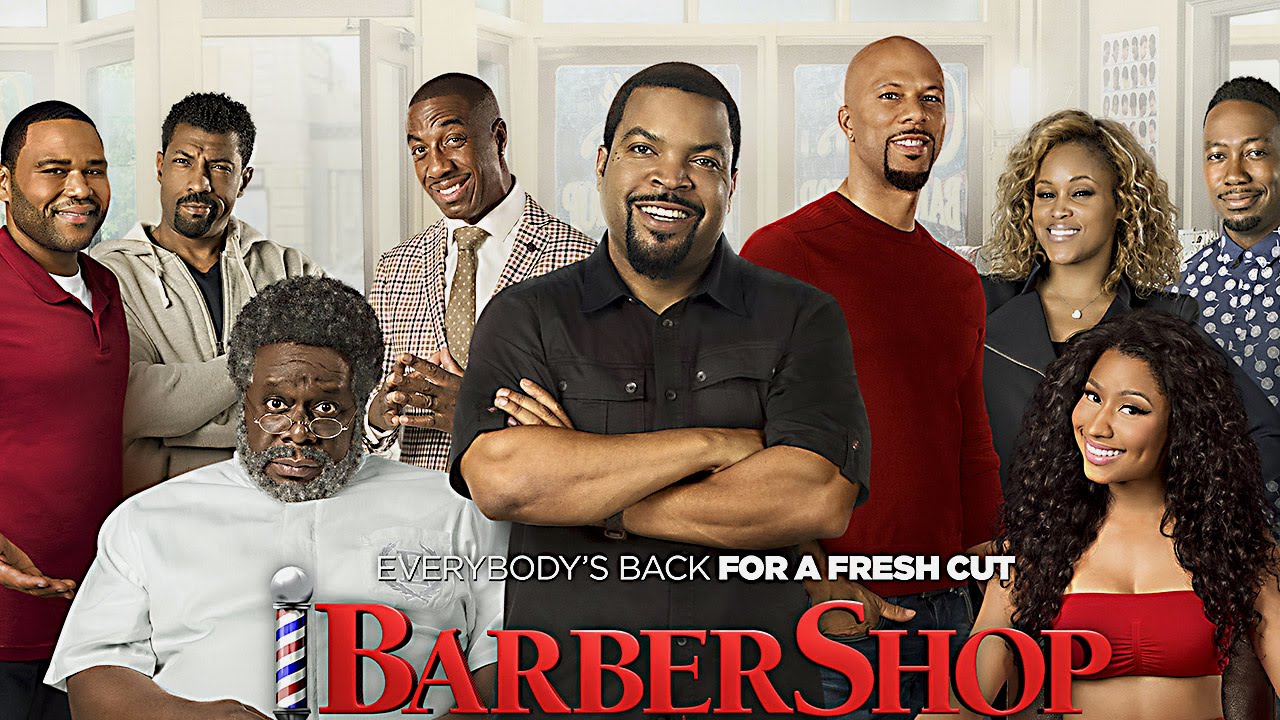
The sharp, witty, and heartfelt screenplay is by “Black-ish’s” Kenya Barris and “Survivor’s Remorse’s” Tracy Oliver, and it is directed with warmth and style by Malcolm Lee (“Roll Bounce,” “Undercover Brother”). The original cast returns, led by Ice Cube as Calvin, Cedric the Entertainer and Eve as barbers (Eve’s Terri’s is still trying to protect her apple juice), Sean Patrick Thomas as the upwardly mobile Jimmy (now working for the mayor of Chicago), and Anthony Anderson as the up-to-something but not very good at it J.D. They’re joined by the always-hilarious J.B. Smoove as a jack-of-all-trades and master of most, the always-appealing Common as Rashad, Calvin’s friend and Terri’s neglected husband, the always-terrific Regina Hall as Calvin’s partner on the beauty-shop side, and the always-enticing Nicki Minaj as Draya, a hairdresser who might be interested in Rashad.

Calvin is worried about his 14-year-old son, Jalen (Michael Rainey Jr.), who is wearing dreads and a lot of attitude. He is spending a lot of time with Rashad’s son, Kenny (Diallo Thompson), and worries that he may be a bad influence. He worries more about the constant gang violence in their community, both the threat and the appeal it has for young boys. He thinks it might be time to leave the neighborhood and go somewhere safer.

All of these storylines and more are deftly handled, but, as with the first film, what makes it work is the talk, the constant banter that sways in and out of heartfelt discussion of all the big issues: race, gender, politics, community, family, and love. The talk is intimate and enticing, never stooping to explain its references for anyone’s definition of “mainstream” audiences. That gives it a satisfying warmth and authenticity.

As before, Cedric the Entertainer is the outrageous elder statesman of the group as Eddie, the one who goes there and gives everyone else a chance to react. There are mostly-genial accusations about what men and women want from each other, whether other minorities have the same historical and current struggles as African-Americans, the impact of celebrity scandals like Bill Cosby and R. Kelly, and what anyone can do to stop the violence. Once again, the role of the barber shop as community center, demilitarized zone, and even temporary housing makes this a place we want to keep coming back to.

NOTE: Stay for the credits as there is a funny extra scene.

Parents should know that this film includes sexual references and a non-explicit situation, strong language including racial epithets, gang-related violence, and characters who are injured and killed (off-screen). Characters drink and sell marijuana.

Family discussion: What should families like Calvin’s do to make their communities safer? Who else can make a difference? Where is your favorite place to go hang out and talk to friends?

If you like this, try: the earlier films, Chris Rock’s documentary “Good Hair,” and, for older audiences, “Chi-Raq” and “Boyz N the Hood”

Related Tags:


Comedy Race and Diversity Scene After the Credits Series/Sequel
THE MOVIE MOM® is a registered trademark of Nell Minow. Use of the mark without express consent from Nell Minow constitutes trademark infringement and unfair competition in violation of federal and state laws. All material © Nell Minow 1995-2026, all rights reserved, and no use or republication is permitted without explicit permission. This site hosts Nell Minow’s Movie Mom® archive, with material that originally appeared on Yahoo! Movies, Beliefnet, and other sources. Much of her new material can be found at Rogerebert.com, Huffington Post, and WheretoWatch. Her books include The Movie Mom’s Guide to Family Movies and 101 Must-See Movie Moments, and she can be heard each week on radio stations across the country.

Website Designed by Max LaZebnik