The Boss

The Boss

Posted on April 7, 2016 at 5:30 pm
Copyright 2016 Universal
Here is what Judd Apatow and Paul Feig know that Melissa McCarthy and Ben Falcone do not: a character can be hilariously obnoxious or endearing but not both, even when played by the irresistible McCarthy. Apatow and Feig have made the best use of Melissa McCarthy’s endless comedic talents, and it is instructive to see how they did it. In “Bridesmaids” (produced by Apatow, directed by Paul Feig), McCarthy played a strange woman with some social deficits but capable (she was right about the air marshall, played by Falcone, who is her husband and co-screenwriter and director of “The Boss”), loyal and self-aware. In “Spy,” written and directed by Feig, McCarthy is awkward and deferential, but she is capable and brave, and she knows it. In “This is 40,” McCarthy has a small role as an angry mother complaining about the main characters’ child. Her fearlessness and improvisational skills, highlighted in a post-credit sequence, were a highlight of the film.

She gave a thoughtful performance in a dramatic role as a single mother in “St. Vincent,” and she was wonderful as a cheerful chef in “Gilmore Girls.” But in other films, including “Identity Thief,” “Tammy,” and now “The Boss,” McCarthy makes the fundamental mistake of committing to an obnoxious character given to outrageous and inappropriate behavior and then insisting that by the end of the movie the other characters and we in the audience have to love her. If she wants to play characters like that, the narrative of the movie has to be about thwarting or triumphing over her in some way. But she can’t insult and cheat everyone for ninety percent of the movie and then expect us to hope for her to have a happy ending.

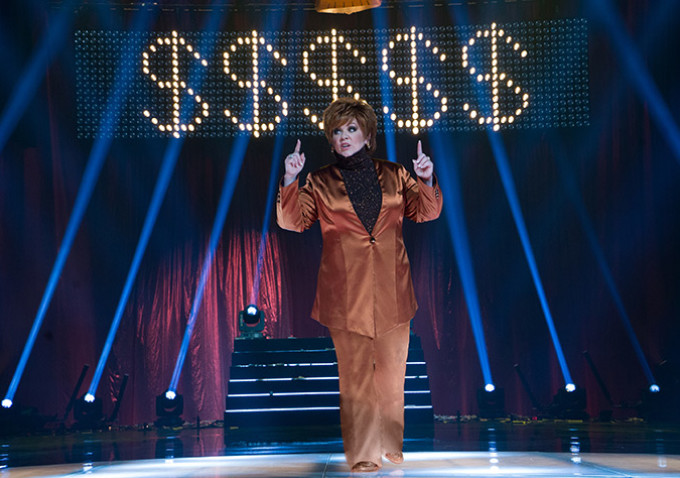
In “The Boss,” McCarthy plays Michelle, the 47th-richest woman in America and the CEO of three companies, at least one of which seems to be either a shady multi-level marketing scheme or some sort of “let me show you how to be rich scam.” She comes out to screaming applause from a huge crowd to brag about her wealth. Nice touch: some of the audience wearing Michelle-style red pixie-cut wigs. Less nice touch: she raps along with T-Pain. Michelle is rude to everyone and ruthless in business to a ridiculously counterproductive degree. For example, she brags to her rival (and ex-boyfriend) that she is making a fortune based on some insider information, which he then reports to the SEC, and which then gets her thrown in jail, Martha Stewart-style.

Five months of a country-club prison equipped with tennis courts (and, apparently, a manicurist because she has professionally done French tips), Michelle discovers she has lost her jobs and all her money. She drags her Vuitton luggage over to the apartment of her level-headed former assistant, Claire (a game Kristen Bell), a single mom with a daughter named Rachel (Ella Anderson). When Michelle tastes Claire’s delectable brownies and sees Rachel’s Dandelions troop (think Girl Scouts or, more accurately, think Troop Beverly Hills), she sees her path to a return to moguldom.

McCarthy, swathed to the chin in turtlenecks that make her look like she is recovering from whiplash, gives herself a one-note role. She is mean, she cheats, she says wildly inappropriate things to children, and she is selfish to a sociopathic degree. Michelle the character and McCarthy the co-scriptwriter give those around her very little to do, criminally under-using Bell, Kathy Bates, Margo Martindale, and Kristen Schaal. Peter Dinklage, as Michelle’s former colleague and boyfriend-turned rival is a bright spot, having a lot of fun going way over the top with pretentiousness, competitive fury, and lust. There’s an “Anchorman”-style rumble between the raspberry beret-topped brownie girls and their cookie-selling former troop. There’s a clever joke about finding just the right place to sell the brownies and there are a couple of very funny lines. But Michelle wears out her welcome very quickly and the resolution is unearned and cloying.

NOTE: There is an “unrated” DVD release. It is hard to imagine how much more offensive it could possibly get.

Parents should know that this film includes extensive strong and crude language, often directed at children, very crude sexual references, drinking, drugs, and comic peril and violence.

Family discussion: How did Michelle’s childhood experiences affect her relationships and priorities? What were the qualities that made her successful in business?

If you like this, try: “Spy” and “Bridesmaids”

Related Tags:


Comedy Scene After the Credits
My Big Fat Greek Wedding 2

My Big Fat Greek Wedding 2

Posted on March 24, 2016 at 5:46 pm

The original “My Big Fat Greek Wedding” was a charming surprise, a fresh, honest story about a young woman trying to find a way to be true to herself despite her loving but overwhelmingly intrusive Greek-American family. This 15-years-later sequel is an overstuffed, undercooked cash grab, operating at the low level of a basic cable sit-com with a juiced-up laugh track. There’s a big difference between finding it funny when a family has what therapists call boundary issues and bombarding the audience with overshares. Or, as Toula tells us just to make sure we understand, “We see no difference between hugging and suffocation.”

Copyright Universal 2016

The original was an exaggerated but affectionate portrayal of family dynamics that are familiar to anyone who struggled to find a distinctive individual direction despite family expectations to the contrary, which is pretty much everyone. The sequel is grotesque caricature, repeating and coarsening the humor of the first one, with repeated clunky set-ups for each of its obvious twists. The first one was a sleeper made for a shoestring that became one of the highest-profit films of all time, released in the same month as a big-budget special effects flop, “Pluto Nash,” with a mirror image record-breaking balance sheet — it lost almost as much as “Big Fat Greek Wedding” made. This sequel won’t set any records in either direction. It has some appealing characters and mild humor. But it devalues the franchise so badly that it is retroactive, diluting any remaining affection for the first one.

The couple who had the titular nuptials in the 2002 film were Toula (screenwriter Nia Vardalos), the daughter of Greek-American restaurant owners who dreamed of working with computers as a travel agent, and Ian (John Corbett), a WASP-y vegetarian teacher. At the engagement party, her parents brought a battalion of cousins named Nicky. His parents brought a bundt cake. An adorable culture clash! Is this a great country or what!

Fifteen years later, Toula, Ian, and their 17-year-old daughter Paris (Elena Kampouris, lovely even in ghoulish makeup) live next door to her parents, Gus (Michael Constantine), who still believes that the Greeks invented everything and Windex can cure anything, and Maria (Lainie Kazan), who still lets him think he runs everything. Toula tries hard to make everyone happy as she is sandwiched between a daughter who needs her less than she wants her to and parents who need her more than she wants them to. “Just when my daughter doesn’t want me around anymore, my parents need me more than ever.”

All the relatives live right nearby and everyone is up in each other’s business all the time and Hollywood Greek-Americans John Stamos and Rita Wilson, who produced the film, show up for an obvious gag and can the Stamos character, a TV newscaster really have a tagline involving shooting a finger-gun?

Toula’s big fat Greek family is supposed to be loveable, but they are just shrill and annoying. Either Aunt Voula (Andrea Martin) is going into excruciating detail on her sex life or her medical quirks or Gus is trying to find a nice Greek boyfriend for Paris to marry so she can have lots of Greek babies. Ian is now the high school principal and Tula is back where we first met her, working in her parents’ restaurant and even has to don her old glasses. They want Paris to stay near them in Chicago when she goes to college. Like Toula in the first film, Paris wants more independence. Like Toula’s parents in the first film, Toula and Ian do not want to let her go. Meanwhile, their focus on the family has led Toula and Ian to lose touch with one another. So, hey, why not another makeover for Toula?

And this is a Big Fat Greek Wedding film, so there must be another wedding. It turns out that Gus and Maria’s marriage license from half a century ago in Greece was never signed. So, Gus has to persuade Maria to marry him all over again and that means giving her the wedding of her dreams. Opa!

It is filled with the kind of stereotyping that would elicit howls of protest from anti-defamation groups if not made by Greeks themselves. That doesn’t prevent the ugly stereotyping of non-Greeks, all portrayed as thin-blooded and snobbish, except for Ian and the real-life Ian, the actor husband of Vardalos, as a kind-hearted cop who married into the family. A revelation about a family member who is gay could have led to some interesting moments, given the family’s very narrow concepts of masculinity, but it is too busy with jokes about how gross an old man’s nudity is. Even Gus would agree that this is beyond the powers of Windex.

Parents should know that this movie has some crude humor, sexual references, and a non-explicit situation. There is some scuffling, a non-serious medical emergency, social drinking, and tipsiness.

Family discussion: Ask family members about how they handled parent-child conflicts about independence — and weddings. Why was it important for Maria that Gus propose to her?

If you like this, try: the first film and another film from Vardalos, “Connie and Carla”

Related Tags:


Comedy Family Issues Romance Series/Sequel
Batman v Superman: Dawn of Justice

Batman v Superman: Dawn of Justice

Posted on March 23, 2016 at 11:00 am

Copyright Warner Brothers 2016

After the refreshing superhero palate-cleanser that was “Deadpool,” it’s tough to get back into the ponderous, self-important, choir-of-angels soundtrack, too long by at least 45 minutes. Even the title is much too long. Do we really need another scene (and then ANOTHER scene) of Bruce Wayne’s parents being shot in a comic book movie? But that is not going to daunt director Zack Snyder, who lives for this sort of thing, and so here we are. The movie is literally and metaphorically murky, with muddy cinematography that turns every character’s eyes into pupil-less, drone-looking pools, except for the guys who can make theirs glow, via effects so retro they could have come from the old Flash Gordon serials. The storyline is secondary at best, just a series of setups for action sequences. It’s no secret that if you want to have a human fight Superman, you have to find some kryptonite to make him susceptible to human weapons. But then when we need him to be back to full strength, there he is. At a crucial moment, the turning point is simply ridiculous. So much of the chaos could have been circumvented if a couple of the characters ever had a conversation — or a cell phone. And everything stops when character takes the time for a detour into computer files that do nothing but set up the next movie. Isn’t that what extra scenes after the credits are for?

Batman and Superman have a lot in common — they were both orphaned as children and long before Spider-Man learned that with great power comes great responsibility, they were both living that credo, standing for, as the Superman radio and television program said, “Truth, justice, and the American way.” Indeed, they had a long comic book bromance going until the 1980’s, when they began to be at odds, focusing on what separated them. They are, after all, literally from different worlds. Brooding loner Batman/Bruce Wayne (Ben Affleck) is a vastly wealthy industrialist, his only confidant the trusty butler Alfred (Jeremy Irons). Superman/Clark Kent (Henry Cavill), was sent to Earth from Krypton as a baby, then found, adopted, and raised with a lot of love and support on a bucolic farm by the Kents. When he grows up, Clark Kent works as a reporter alongside the woman he loves, Lois Lane (Amy Adams).

An alien attack on Gotham destroys Wayne Enterprises’ headquarters building in a brief action sequence more arresting and visually striking than the ones that follow. Wayne, watching Superman up in the sky and suffering devastating loss and guilt over the deaths of his employees, is not sure whose side Supe is on. After the attack, Superman is treated as a hero, but Wayne is not the only one who is suspicious and threatened by someone so powerful that no earth laws could stop him if he decided to go rogue. Later, when Lane is captured, Superman’s rescue operation ends up with many people dead and many questions unanswered.

Lex Luthor (Jesse Eisenberg, enjoying his twitches), as rich and powerful as Wayne, seems to be behind various nasty ventures, and is very, very interested in getting hold of some kryptonite, despite the objections of a Kentucky Senator (Holly Hunter). So, a lot of people here are concerned about power — how to use it, how to constrain it, how to balance it — and that would be a great issue to explore in a superhero movie in 2016, but this one is more interested in whether a rich guy with a utility belt can beat a guy with super-strength, invulnerability, laser-vision, super-speed, and the ability to fly, and then whether anyone can defeat a big monster who bursts from Kryptonian primordial ooze.

Any Batman movie has to have an elegant society party. This one is, hosted by Luthor, and a mysterious woman (Gal Gadot, by far the best part of the movie) shows up to tantalize Wayne with her beauty and steal the very data he was there to steal himself.

And any Superman movie has to have a trip to the Fortress of Solitude, so that happens, too, and all I could do was wish I was there instead of watching this film.

Parents should know that this film includes constant comic book style fantasy violence with many explosions, and massive destruction, nukes, supernatural and military weapons, scary monster, characters injured and killed, some strong language, alcohol including drinking to deal with stress, and non-explicit nudity and a sexual situation.

Family discussion: How would/should the world respond to a real-life superhero who could not be subjected to our laws? Or to a vigilante like Batman?

If you like this, try: the Tim Burton and Christopher Nolan Batman movies and the comic books

Related Tags:


Fantasy Series/Sequel Superhero
The Divergent Series: Allegiant Part 1

The Divergent Series: Allegiant Part 1

Posted on March 17, 2016 at 5:26 pm

Copyright 2016 Lionsgate
I can’t help it. They’re all beginning to run together in my head. How many post-apocalyptic stories featuring hot young stars as the brave teen heroes who are the only ones who can save the day for freedom and middle aged, classically trained actors as the totalitarian villains trying to stop them can we have?

At some point, I forget which one has Meryl Streep (“The Giver”), which one has Julianne Moore (“The Hunger Games”), which one has Patricia Clarkson (“Maze Runner”), and which one has Kate Winslet and Naomi Watts (“The Divergent Series”). When this latest and second-to-last installment of the “Divergent” series has its lead characters scaling an enormous wall in response to a message from an entirely unknown source outside (like “Maze Runner”) and the romance heats up (“Hunger Games”) and another distinguished actor shows up to explain what is going on (“The Giver”), the narratives all sort of begin to merge.

So, let’s try to get it straight. “Divergent” is the one where a post-apocalyptic Chicago had genetically modified its inhabitants so that they each had one strength: compassion, intelligence, courage, honesty, and peacefulness. At age 16, each person is tested and assigned to the appropriate faction. He or she must leave the family; the faction is the family now. The test reveals that Beatrice “Tris” Prior (Shailene Woodley) is “divergent,” with multiple strengths. That makes her a threat to the system and to the people who control it, led by Jeanine (Kate Winslet), who was killed at the end of the last chapter. As this film begins, Tris and Four (Theo James) are deciding what to do about a message calling on them to leave Chicago to find out more about what role the Divergents can play to solve the problems that led to the creation of the faction system. Tris believes she must answer the invitation, but Four worries that it could be a trap.

Four’s mother, Evelyn (Naomi Watts), formerly a leader of the rebel forces, is now beginning to show Jeannine-like tendencies (yes, this is a lot like “Hunger Games”), allowing public executions. She tells Four, her long-estranged son, she is doing it for him, but he sees what she is doing as yet another betrayal.

Tris and Four make it beyond the wall (an extreme version of rappelling is the film’s best action sequence and the only one to match the adrenalin-surge and dynamism of the earlier film’s zip-wire scene) and, behind a digital “camo wall” find a community of “pures,” non-genetically modified people, led by David (Jeff Daniels), who explains in near-folksy genial terms that Chicago was an experiment and its inhabitants were constantly monitored, somewhere between lab rats and “The Truman Show.” Meanwhile, Four, her brother Caleb (Ansel Elgort) and her friends have been assigned to either monitor or fight (with some cool new drone gear).

There are some fancy visuals but as with the earlier chapters no special effects are close to the impact of Woodley’s hazel-colored doe eyes or James’ smoulder. And there’s a bright spot when we meet a new character, Matthew, sympathetically played by Bill Skarsgård, who looks more like the younger brother of “Madame Secretary’s” Erich Bergen than the real-life brother of the various handsome members of the Skarsgård family.

But the plot is overly complicated on the surface, padded (really, can we stop turning three books into four movies?), confusing, and unsatisfying, without the exhilaration we felt as Tris discovered and deployed her power in the first two. She spends too much time in a room listening to David, and a visit to Providence for a meeting with the Council is poorly handled. If this movie had a faction, it would be: placeholder until the last chapter.

Parents should know that this film includes extensive sci-fi/action violence with guns, explosions, and crashes, with many characters injured and killed, brief strong language, and non-explicit nudity in shadow.

Family discussion: Why did Evelyn think she had to use force, despite what had happened before? How did Four and Triss look at the invitation from outside the wall differently? Why did David lie?

If you like this, try: the earlier films in the series and the “Hunger Games” and “Maze Runner” films

Related Tags:


Action/Adventure Based on a book Science-Fiction Series/Sequel Stories about Teens
The Young Messiah

The Young Messiah

Posted on March 10, 2016 at 5:17 pm

Copyright 2016 Focus
We have a very clear picture of Jesus’s birth, and it is endlessly re-enacted and depicted each year at Christmas time. But we know almost nothing about His childhood, other than his astonishing the elders with his depth of knowledge.

“The Young Messiah,” “inspired by scripture and rooted in history,” shows us His early years. It is a reverential, respectful portrayal of Jesus at age 7, as the Romans were trying to find and kill Him, and as He was just beginning to understand His power and purpose. It is based on the book by Anne Rice.

Jesus is played by sweet-faced Adam Greaves-Neal. We first see Him listening to a young girl who is teaching him to draw a camel. When a bully gives her a hard time, Jesus steps in to defend her and the bully starts attacking Him. A mysterious hooded figure tosses an apple core to trip up the bully, who falls, hits his head on a rock, and dies. No one else could see the man in the hood, and Jesus is blamed for the boy’s death.

The young Messiah insists on visiting the body, and it is there He performs His first miracle, bringing the boy back to life. This is an extraordinary moment because no one, even Jesus himself, knew such a thing was possible or that He was capable of it. And yet Jesus is so young, and his compassion so deep, that it seems completely natural for him. It confirms the greatest hopes but also the greatest fears of Mary and Joseph as it makes him a target for the Romans. And, like all parents, they have to find a way to protect their child and to answer His questions, though both are difficult and both at the same time seem impossible. “How do we explain God to His own son?” Even more difficult, how can they explain to Him a world in which the road is lined with crucified Jews and babies were murdered because the Romans were so afraid of Him? And how should they guide Him in using a power no one really understands? Mary can only say, “Keep your power inside you until your Father in Heaven shows you the time to use it.”

As Jesus and his family travel from Egypt to Jerusalem, Herod sends a soldier named Severus (Sean Bean) to find the boy and kill Him. Severus is not worried about reports that the boy can perform miracles. “There’s only one miracle,” he says, brandishing his sword. “Roman steel.”

Greaves-Neal is not really an actor, but his performance has an appealing dignity and tenderness. “Am I dangerous?” he asks, not “Am I in danger?”

It is especially good to see the young Jesus portrayed as compassionate but also intensely curious about the world. That thirst for knowledge and understanding is as inspiring to those around Him as His miracles.

Parents should know that this film include Biblical violence including crucifixion, bullying, and characters are injured and killed.

Family discussion: What do we learn about Jesus from his reaction to the bully? How did his curiosity about the world and scripture help him understand his purpose?

If you like this, try: “Risen” and “The Gospel of John” and read my interview with director Cyrus Nowresteh

Related Tags:


Drama Epic/Historical Spiritual films
THE MOVIE MOM® is a registered trademark of Nell Minow. Use of the mark without express consent from Nell Minow constitutes trademark infringement and unfair competition in violation of federal and state laws. All material © Nell Minow 1995-2026, all rights reserved, and no use or republication is permitted without explicit permission. This site hosts Nell Minow’s Movie Mom® archive, with material that originally appeared on Yahoo! Movies, Beliefnet, and other sources. Much of her new material can be found at Rogerebert.com, Huffington Post, and WheretoWatch. Her books include The Movie Mom’s Guide to Family Movies and 101 Must-See Movie Moments, and she can be heard each week on radio stations across the country.

Website Designed by Max LaZebnik