
The Walk

The Walk

Posted on October 1, 2015 at 12:17 pm

If you have vertigo or acrophobia, you will have trouble with “The Walk,” the story of Frenchman Philippe Petit’s tightrope walk between the towers of the World Trade Center. If you don’t have vertigo or acrophobia, you might have after you watch the movie, with the most stunningly realistic 3D effects ever put on screen. At least I think they’re still just on the screen. It sure feels like it goes on way, way behind it.

Copyright 2015 Sony
Copyright 2015 Sony

“Man on Wire,” a documentary about Petit’s 1974 stunt, or, as he might prefer to say, coup, won an Oscar in 2008. In this film, Joseph Gordon-Levitt, with an accent that just manages to avoid Pepe LePew dimensions, plays Petit, a street performer who saw a photograph of the World Trade Center in the waiting room of his dentist and was instantly consumed with the dream of a walk in the sky, more than 1300 feet above the sidewalk, between the towers. Like Petit himself, the movie does not bother with the question of why this might be a good thing to do. If pressed, he might just say, like Mallory, “Because it’s there.” The problem is that he doesn’t have an answer but still keeps talking and talking. For no reason we keep going back to Petit narrating the story from the torch of the Statue of Liberty. It is distracting and dull.

Petit could not or would not articulate it, but I think I know why. When huge institutions get together to create a world-record setting edifice — taller than the Eiffel Tower, the Frenchman notes — there is something irresistibly enticing about coming back as a lone soul and literally topping it. Director Robert Zemeckis, who can get more excited about the technology than the story in his films, may identify with that challenge. Petit wanted to walk across the sky, with an audience to appreciate it. And Zemeckis wants to recreate that experience for us, taking us to the roof of the Towers, and inviting us to look down.

Still, while we love movies about dreamers of impossible dreams who make them come true, we do like to have a reason, and Petit edges over the line from audacious dreamer to inconsiderate narcissist, despite Gordon-Levitt’s considerable appeal. This lends a hollow quality, overcome less from the story of the film to what is in our own hearts as we watch, knowing what the tragedy that lies ahead for the World Trade Center.

What works well in the first part of the film is Petit’s tutorials with a tightrope master played by Sir Ben Kingsley and the procedural elements once Petit and his team get to New York and start preparing as though they are getting ready to rob a bank. Indeed, it becomes a heist film of a sort because they have to find different ways to sneak into a building that is still under construction and gather the information they need to figure out how to install the cable and keep it from swaying or buckling. And then to install it. There are a lot of problems along the way, including Petit stepping on a nail and injuring his foot and dropping his black turtleneck from the roof when he is trying to assume his performer persona. They omit, however, my favorite detail from the documentary: Petit explains that in America, if there’s pencil in your pocket everyone assumes you are part of the construction team and are entitled to be there. Like the loss of the buildings themselves, Petit’s ability to exploit lax security is a poignant reminder of what we no longer have.

The last half hour or so of the film is breathtaking and well worth the price of admission in IMAX 3D. You will feel that you are on the tightrope with Petit. As the crowd gathers below and the police arrive (who thought a police helicopter would be a good idea?), Petit is suspended in the clouds, mentally, emotionally, and physically. For just a moment, Zemeckis and Gordon-Levitt bring us up there with him, and his dream, however frivolous and ephemeral, becomes ours.

Parents should know that this film has very risky and dangerous behavior, vertiginous 3D effects, brief nudity, some strong language, and smoking and drinking.

Family discussion: What big dream would you like to make come true? Who would you want to be your team?

If you like this, try: the documentary “Man on Wire”
Related Tags:


3D Based on a true story Drama IMAX
The Intern

The Intern

Posted on September 24, 2015 at 5:55 pm

Copyright Warner Brothers 2015
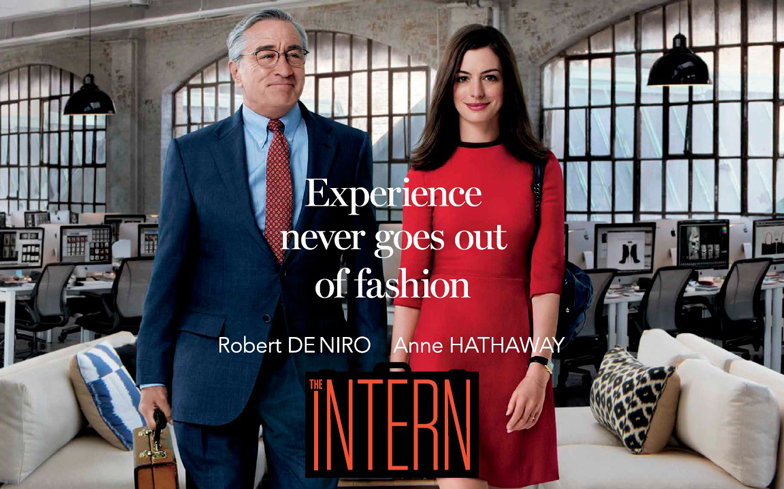
Oh, to live in Nancy Meyers-land, where the 60’s and 70’s really are a golden age, where AARP-eligible Oscar winners go to be universally adored by bright young people, and where every sumptuously spacious but cozy home has the kitchen of your dreams. It’s not a coincidence that more than once in the movie one character compliments another on the decor. Or that you can now buy it all yourself to collect your own accolades, making the movie into an infomercial. It’s soft-focus, feel-good, female empowerment. So of course it’s all to a soundtrack of Pottery Barn-like upscale easy listening songs like “All About That Bass (No Treble).”

Following in the beautifully shod footsteps of Eli Wallach (“The Holiday”), Diane Keaton (“Something’s Gotta Give”), and Meryl Streep (“It’s Complicated”) comes Robert De Niro, with infinite charm and grace in a role he seldom gets to take: an ordinary guy.

De Niro plays Ben, 70 years old, living in Brooklyn, a widower after a long, happy marriage, retired, and looking for something to do. He has traveled, visited his grandchildren, taken classes. There is a single woman his age (Linda Lavin) who would love to date him. But he wants something more. “The nowhere to be thing hit me like a ton of bricks.”

And then he sees a flier. A local start-up is looking for “senior interns,” for no other reason than to make a cute movie plot, but okay. It’s an online sales company, selling fashion with some special ability to make sure the items fit properly), and he still uses a flip phone, but Ben decides to apply. And he is undaunted that applicants, instead of submitting a resume, are asked to upload a video about themselves. “I want to be challenged,” he explains, “and needed.”

He gets the job and is assigned to the start-up’s visionary but harried CEO, Jules Ostin (Anne Hathaway). Is the name supposed to make us think of Jane Austen? Could be. She has an only-in-movies adorably precocious moppet and a shaggy (in a cute, artisanal, Brooklyn way) devoted stay-at-home-dad of a husband. And, guess what? They live in an exquisitely decorated brownstone with a couple of legos and a backpack sprinkled around for relatability. Plus, she is played by Anne Hathaway, so she is stunningly beautiful in a we’d-totally-be-best-friends-if-she ever-met-me sort of way. She gets to channel her “Devil Wears Prada” co-star Meryl Streep as the boss who can be terrifying, but she knows and we know she’s there to be loveable, not scary. And he is endlessly calm and resourceful, whether cleaning up the office junk pile, crunching data, giving dating advice, or retrieving a disastrously mis-sent email.

In the normal world of movies, Jules would have a lot to teach Ben about being up with the times and there would be all kinds of cute/funny scenes with him learning what a hashtag is while imparting a few Yoda-like gems of wisdom. But this is Nancy Meyers-land, so the lessons all go the other way. And those lessons are not so much “why don’t you do it this way” as “you can do it!” It is undeniably refreshing, especially to those of us closer in age to Ben than Jules, but let’s face it. This is less a movie than it is comfort food and a glossy shelter magazine wishbook, sprinkled with fairy dust and truffle powder.

Meyers is all about you-go-girl empowerment, so her films are delectable visions of soft-focus fantasy, but there are some revealing moments of personal payback, too, as in her treatment of a wandering husband. It crosses the line from pleasant daydream to selfishness, entitlement, and denial. It’s one thing to create a fairy tale. It’s another to promote the idea that women can “have it all” without a lot of other people having a lot less. And maybe next time we could add some people of color to the cast. This is Brooklyn, for goodness’ sake. It’s practically a living version of “It’s a Small World.” How did the cast get so white?

But Ben’s handkerchief rule? That’s the real deal.

Parents should know that this film features adult themes including adultery and male sexual response. There are references to a sad death, drinking, including drinking and medication to deal with anxiety, and characters use some strong language. There is an awkward and unfunny joke about a child possibly having bipolar disorder.

Family discussion: What most surprises seniors and millennials about each other? What would you like to do when you retire? Do you agree with Jules’ decision?

If you like this, try: “It’s Complicated” and “The Holiday”

Related Tags:


Comedy Drama
The Maze Runner: The Scorch Trials

The Maze Runner: The Scorch Trials

Posted on September 17, 2015 at 5:51 pm

Copyright 20th Century Fox 2015

The first Maze Runner movie had an arresting premise and a solid structure, literally and metaphorcally. Thomas (Dylan O’Brien), with his memory wiped, arrived at a mysterious facility called The Glade, populated entirely by teenage boys. It turned out to be an enormous maze that re-arranged itself every night, when horrible monsters called The Grievers came out and one sting from them caused madness.

Thomas figured out how to escape from the maze at the end of the film, but the triumph was tempered by indicators that his worst problems were just beginning and by our knowledge that there were two more books in the series by James Dasher scheduled to be made into movies. “The Scorch Trials” is the second.
This sequel is very much a transitional film, with non-stop action and not much story. It’s as though Dasher decided to throw just about every bad thing possible at Thomas and his small band of escapees from The Glade.

They are greeted warmly by a man whose first indicator of untrustworthiness is that he does not introduce himself. When asked, instead of saying his name, he says, “You can call me Janson” (Aiden Gillen). But the teenagers are so happy to have a shower, food, and real beds that they are not inclined to question the bleak, prison-like structure with high security doors. And Janson’s promise to send them to a place free of the virus and blight that wiped out most life on earth sounds so good that they believe it, especially when they see the other teenagers in the facility cheering each night as another group is selected to leave for the haven he described.

But Thomas is skeptical, and when Aris (Jacob Lofland), a boy who has been at the facility for weeks, takes him on a tour through the air ducts, they discover that instead of being brought to a wonderful new home the teens who have a genetic immunity to “the flare” disease that wiped out most humans are being taken to a medical facility to be drained of their blood for doctors working to find a cure, even at the expense of the kids’ lives. Thomas leads yet another escape, though Janson taunts him that no one can survive the Scorch, the wasteland conditions outside the bunker. Thomas and his friends, including Aris, battle sandstorms and lightning, zombies, and outlaws.

So much happens that it gets repetitive. If a major character appears trapped and you hear a bang, you can bet the bang is a last minute save from behind the bad guy. Some red shirts don’t make it and there are some twists of alliances and betrayals, but eventually it is more video game than story, raising questions that are more “how does this make sense?” than “looking forward to the answers in part three!”

Parents should know that the film has constant very intense peril and extensive violence including zombies, lethal medical procedures, guns, and explosions, suicides, some very disturbing images, many characters injured and killed, a kiss, some strong language, and teen substance abuse.

Family discussion: How is Thomas different from the other characters in the way he evaluates his options? Why did Teresa make her controversial decision?

If you like this, try: the books and the first movie in the series, the “Hunger Games” and “Divergent” movies

Related Tags:


Action/Adventure Based on a book Drama Science-Fiction Series/Sequel Stories about Teens
Grandma

Grandma

Posted on August 27, 2015 at 5:50 pm

Copyright Sony 2015
Copyright Sony 2015

Lily Tomlin is cranky, feisty, tough, and utterly irresistible in this story of a grandmother who has to visit past decisions about her own life in order to help her teenage granddaughter. Tomlin plays the aptly named Elle (French for “she”), a feminist poet. Her work is respected and influential but that has not translated into financial stability. She has recently cut up her credit cards and made a wind chime out of them.

As we first see her, she is dumping her much younger girlfriend, Olivia (Judy Greer). No “it’s not you; it’s me.” No, “I’ll always remember the good times.” No lyrical meditations on love and loss. Not even any arguments or accusations. Just “It’s over. Leave.”

And then Elle’s granddaughter arrives. Her name is Sage (Julia Garner), and she has a head of fuzzy, soft curls that make her look like a dandelion. She is young and vulnerable but determined. She needs help, and it is clear that she would not be there if she had any other option. She is scheduled to have an abortion that afternoon, but she needs $630. And so Grandma and Sage set off in Elle’s clunker of a car, making desperate visits to people who might be able to help them. So we see a series of encounters, sad, angry, poignant, romantic, score-settling, each impeccably performed by an outstanding cast of actors in small scenes with deepening impact. We learn more about Elle’s life, the wrenching loss she is still mourning, the kindness and unkindness she has shown, and the way she has and has not dealt with the consequences. Standouts include Nat Wolff (“Paper Towns”) as the father, Laverne Cox as a sympathetic tattoo artist, Marcia Gay Harden as Elle’s brisk businesswoman daughter, and Sam Elliott as Elle’s ex.

Writer/director Paul Weitz (“About a Boy”) has taken a story that could be a parody of the worst nightmares of Fox News fans and made it into a very human story of love, loss, and overcoming the fear of intimacy. It is about the families we create and the perfect love we must feel for imperfect people.

Parents should know that this film has very strong and crude language, drinking, drugs, teen pregnancy, and extended discussion of abortion.

Family discussion: Why does Elle break up with Olivia? Why don’t Elle and her daughter get along? Why is the film called “Grandma” and not “Elle” or “Elle and Sage?”

If you like this, try: “The Daytrippers”

Related Tags:


Drama Family Issues
We Are Your Friends

We Are Your Friends

Posted on August 27, 2015 at 5:35 pm

Copyright Warner Brothers 2015

Director Max Joseph brings some of the “Catfish” sensibility to “We Are Your Friends,” with an intimate, documentary feel and a storyline about people in their 20’s who have big dreams but not much understanding about how to achieve them or even about the nature of their relationships. Joseph is the quieter co-host of “Catfish,” the MTV series sequel to the film that added its name to the lexicon, meaning an online relationship with someone who is not as described or presented. In “We Are Your Friends” (named for the Justice vs. Simian song) four bros hang out together, trashing each other and everyone else, promoting parties, enjoying easy access to drugs and girls, and reassuring each other that fame and fortune lies ahead. They feel like besties, but it’s just inertia and a shared fear of moving forward. In reality, they are very different.

Cole (Zac Efron) is a talented DJ who knows how to combine “the rhythm of a caveman” with a kickin’ bass line to “get the crowd out of their heads and into their bodies.” His pals are hot-tempered Mason (Jonny Weston), low-key drug dealer and aspiring actor Ollie (Shiloh Fernandez) and quiet but thoughtful Squirrel (Alex Shaffer of “Win Win”). They get jobs facilitating real estate deals (calling people in foreclosure) for a wealthy businessman (Jon Bernthal, all rough charm and menace in an excellent performance). And Cole meets James (Wes Bentley with Wolverine-style facial hair), a big shot DJ who has performed all over the world and who has a girlfriend/assistant named Sophie who looks like a Sports Illustrated swimsuit model, because she is played by Emily Ratajkowski, who is one. Ratajkowski was better in “Gone Girl.” Here she does more posing than acting.

There’s nothing wrong with a coming of age story about a young person with a strong creative drive who needs to learn to develop a singular voice, and Efron is, as always, an appealing actor. But too much of it seems borrowed from other films and the situations and settings (San Fernando Valley, aimless young men who party too much and wear their pants too low, the empty and foreclosed houses and predators who flip them) are washed out and played out. The big lesson for Cole is learning to develop a distinctive sound. But the scene where the scales fall from his eyes — or ears — so that he begins incorporating the sounds around him like that wacky carriage ride scene in “The Great Waltz” is just silly. It never persuades us that EDM is anything but derivative, mostly because the movie is, too.

Parents should know that this film has a lot of adult material including very strong language, crude sexual references and situations, nudity, drinking, smoking, extended drug use and drug dealing including marijuana, PCP, ecstasy, and cocaine, a fatal overdose, and a painful scene of foreclosure.

Family discussion: Why did Squirrel say the best part was before the evening began? What did James mean about the meaning of the word “irreparable?”

If you like this, try: “Magic Mike” and “Echo Park”

Related Tags:


Drama Scene After the Credits
THE MOVIE MOM® is a registered trademark of Nell Minow. Use of the mark without express consent from Nell Minow constitutes trademark infringement and unfair competition in violation of federal and state laws. All material © Nell Minow 1995-2026, all rights reserved, and no use or republication is permitted without explicit permission. This site hosts Nell Minow’s Movie Mom® archive, with material that originally appeared on Yahoo! Movies, Beliefnet, and other sources. Much of her new material can be found at Rogerebert.com, Huffington Post, and WheretoWatch. Her books include The Movie Mom’s Guide to Family Movies and 101 Must-See Movie Moments, and she can be heard each week on radio stations across the country.

Website Designed by Max LaZebnik