
Lone Survivor

Posted on January 9, 2014 at 6:00 pm
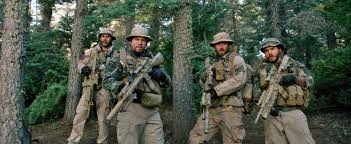
lone survivorDirector Peter Berg is as good as it gets when it comes to putting a particular kind of male chemistry on screen. If he was writing instead of filming, he would dunk his pen in testosterone, beard stubble, and sweat.  Whether it is the small town Texas football community of “Friday Night Lights,” the disastrous bachelor party of “Very Bad Things,” or the aliens and explosions of the under-rated “Battleship,” Berg understands the rhythms of guy-talk that circles around the still core of pure masculinity. There are nearly as many f-words per minute in this film as in the record-breaking “Wolf of Wall Street.” But there the language was used to show off, to convey bravado, for shock and awe. Here the heirs to a long tradition of colorful military argot almost have air quotes around the language. It’s almost a mirror image; on Wall Street, they use bad words to seem tougher. These Navy Seals use bad language with irony — they know that no words can be as tough as they really are or express what they have really seen and done. For them, the inadequacy of even the most provocative language is the joke.

This is the true story of a disastrous Navy SEAL mission in Afghanistan, based on the book Lone Survivor: The Eyewitness Account of Operation Redwing and the Lost Heroes of SEAL Team 10 by Marcus Luttrell. We know from the title and from the earliest moments of the movie that Luttrell, played by Mark Wahlberg, will be the only one still around at the end of the movie.  And so, we steel ourselves, knowing we will spend just enough time with the characters to become attached to them before they are sent off on a doomed mission to take out a ‘bad guy” in Afghanistan and start getting killed.

As in most military dramas, real and fictional, there are archetypal characters.  There’s a new addition and a hardened vet.  And there is Luttrell, a medic, a witness, like Ishmael in Moby Dick the survivor who carries the stories of the others with him.

This is not “action violence,” with super-effective weapons on our side and endless just-misses from the enemy, along with exciting explosions and instant death.  This is messy, dirty, blood-gushing and agonizing wartime violence.  Berg pays tribute to these men by showing us that their courage, dedication, and skill were unparalleled and the tragic stupidity of war presented them with a series of awful choices and unthinkable danger.  At one point, when they have been spotted by (apparent) civilians, including a young boy, they stand there and discuss their options — let them go and risk having them tell the enemy where they are, tie them up and risk having them die of predators or starvation, or kill them, preserving the mission but putting into question the larger issues, from what happens when it gets reported on CNN and what we are fighting for if that is who we’ve become.  That may be the most heartbreaking moment of the film — until the end, when we see the real faces of the brave young men who died.  They knew what they owed us.  Perhaps this movie will help remind us what we owe them.

Parents should know that this movie includes constant wartime peril and violence with many characters injured and killed, children in peril, guns, explosions.  There are very disturbing and graphic images of characters being hit with bullets, many sad deaths, as well as constant very strong and sometimes crude language.

Family discussion: What elements of the training and briefings were important to helping the SEALS do their job?  What more did they need? Who was right in the discussion of what to do when they were “compromised” in being spotted by civilians?

If you like this, try: “Act of Valor,” with real-life Navy SEALS playing fictional versions of themselves and “We Were Soldiers,” about the early days of the American involvement in the Vietnam War.


Related Tags:


Based on a book Based on a true story War

Milk

Posted on March 10, 2009 at 8:00 am

“My name is Harvey Milk and I want to recruit you!”

This disarming introduction became the trademark of the man who would become the first out gay man to hold major elective office in the United States. With this greeting, Milk let his audience know that he understood their fears of homosexuality and could not only make a little gentle fun of them but could make fun of himself, too. He did want to recruit his audiences, not to being gay but to fighting for justice.

As the movie begins, Milk (Oscar-winner Sean Penn) is about to turn 40 and feels that he has never done anything important. So he and his boyfriend Scott Smith (James Franco) move to San Francisco, open a camera store, and begin to get involved in the community and to become active in opposing a system that perpetuated bigotry and abuse of the gay community. After running unsuccessfully, he makes an important change in his approach — instead of running against something, he starts to run for something, to talk about hope. He becomes a respected leader. He forges some unexpected alliances — with the Teamsters and with people who want pooper-scooper laws. He is elected to San Francisco’s Board of Supervisors. But he has enemies. There are threats. And finally, he is killed, along with the city’s mayor, by one of his former colleagues, Dan White (Josh Brolin).

This film has some of the elements of the traditional biopic, but Oscar-winning screenwriter Dustin Lance Black spares us the shorthand formative childhood experiences and minimizes the internal struggles. From the first moment we see Milk, picking up a stranger coming out of the subway on the eve of his 40th birthday we see a man who is already completely comfortable with who he is, a man of great sweetness and humor (both as in good humor and as in wit).

Every performance is impeccable, especially Penn, Franco, and Brolin. But what makes the movie so vibrant is the exquisitely evoked setting, not just the meticulously re-created Castro neighborhood of the 1970’s but the era, the moment, when so much seemed against what they were trying to achieve (the archival footage shows a casual homophobia that is a powerful reminder of how far we have come, even in an era of state initiatives to ban gay marriage. The sweetness and thrill of a heady new sense of possibilities in the pre-AIDS era is almost unbearably poignant. It is a tragic story but it is also a story of hope. It was hope, after all, that Milk learned to bring to his community. That community grew to include the entire city, and now, thanks to this film, to all of us.

Related Tags:


Based on a true story Drama

Speed Racer

Posted on September 16, 2008 at 8:00 am

Andy and Larry Wachowski, the folks behind the Matrix trilogy, have taken the iconic but decidedly low-tech 1960’s Japanese cartoon character and put the pedal to the metal with dazzling effects and electrifying action. Do what Speed Racer does — put on your red socks and GO!

Even as a child, Speed Racer could only think of one thing, making cars go as fast as possible. Not surprising — he was surrounded by racing. The family business was race cars. His father (John Goodman) built them and his older brother drove them. When his brother is killed in a crash, Speed (Emile Hirsch) takes over. On and off the race track he battles the competition, even when they do not fight fairly. By his side are his parents, his little brother, his and his girlfriend Trixie (Christina Ricci, looking like a real-life version of an anime heroine with her enormous eyes).

The plot is pretty much the same as the cartoon series, meaning light-weight and a little incoherent. Basically, evil forces are trying to stop Speed from winning the race. The sections with the kid brother and his chimp are slow points for everyone over age 9 but it is all great fun, with a hero to believe in and visuals that are both reassuringly retro and stunningly innovative. Every wallpaper and fabric, each car, helmet, and racetrack is meticulously designed to evoke a mash-up between Speed’s Norman Rockwell-style, solidly heartland home and the souped-up super space age world outside. The Wachowskis re-invent the color wheel with reds and yellows that make fire engines and school buses seem pale.

The dialogue is pared down to essentials: “You think you can drive a car and change the world? It doesn’t work like that!” “Maybe not, but it’s the only thing I know how to do and I gotta do something.” The plot is no more significant (or confusing) than in the cartoon originals. All we need to know is that in the world of Speed Racer you can drive a car and change the world — if you drive it very, very fast.

Related Tags:


Action/Adventure Based on a television show Comic book/Comic Strip/Graphic Novel Fantasy

Into the Wild

Posted on March 3, 2008 at 8:04 pm

Every one of us at times hears the call of the wild, to match the wild of the outdoors to the wild that is inside us, to leave behind all of the petty complications of civilization and test ourselves down to the deepest essence, to test our nature, in both senses of the word.
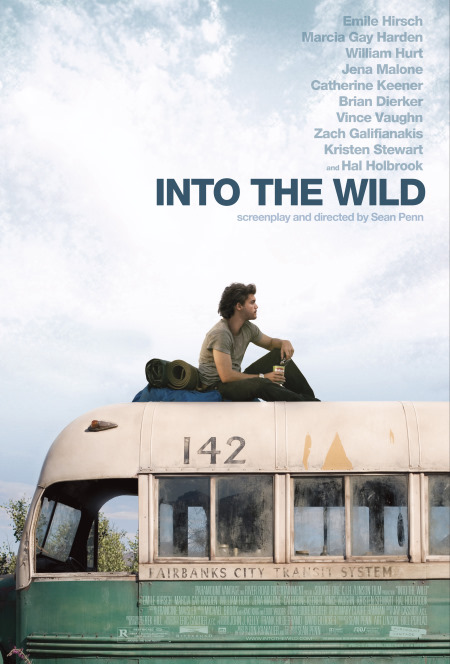
In 1992 Christopher McCandless left behind everything — family, friends, jobs, money, even his name, and went on a journey to find something that felt authentic to him. Actor Sean Penn has written and directed a superb film based on the best-selling book about his journey and its tragic conclusion.IntoTheWildPoster.jpg

(more…)

Related Tags:


Based on a book Based on a true story Biography Drama

Emile Hirsch Goes Into the Wild

Posted on September 24, 2007 at 10:18 pm


Emile Hirsch gives a magnificent performance in one of the year’s best films, Into the Wild. I met with him in Georgetown to ask him about making the film.
What does Sean Penn as an actor bring to directing?
He has that whole wealth of experience since he’s done it on the actor’s side. So you trust him so much. Everything he asked me to do, certain things I was hesitant to do, he did first. He ate squirrel. He went first on the Colorado River. He let me know I could do it. Sean was an incredible director. He let me learn for myself, He helps you bring out the best in yourself and there’s no greater gift.
All of the movies Penn has written and directed are in some way about lost children. Why do you think that is?
He is a man of high intellect but also a very keen instinct. A lot of his choices are on an instinctual level in a very pure way. One of the things I admire about him so much is the kind of strong-willed instinct that he has and the confidence to trust that instinct and move forward. Where so many people are in the back rubbing sweaty palms, he is doing it. He wanted to do this movie because he always had a really strong wanderlust, as do I. It was infectuous, the idea that you want to go out and live your life all the way and have more meanng, live it while you have it.
You play a real-life character who died of starvation in Alaska. Did he have poor judgment? Was he self-destructive? Where would he have gone next?
He made a couple of really crucial errors, not bringing things with him like a map. But he purposefully did not bring them because he wanted to shave he margin of error. He shaved it a little too much. He had amazing wanderlust and also had a lot of personal problems.
Did he learn from the people he met or were they just way-stations on his journey to sever all ties?
He was very determined. The people on the road started to open his eyes, but it took the total solitude for him to find himself and what the meaning of his life could possibly be.
It’s quite a contrast to go from this film to your next film, “Speed Racer.” How do you prepare for such different genres?
The directors of “Speed Racer,” the Wachowski brothers, the guys who did The Matrix, have a particular sensibility about performances they expect. It was like being in a sauna for eight months and jumping into an ice bath without a break — with the lid locked!
Were there elements of the real-life story that were especially meaningful to you in portraying Chris McAndless?
The abandoned bus he lived in, which he called “the magic bus.” It was like a waystation, always symbolzing the journey, Where he learns about himself. It symbolizes the question, “Where is he going?” And I read the books he was reading, Walden by Thoreau, Emerson, Dr. Zhivago by Pasternak, Jack London’s Call of the Wild. What Chris did was very similar to what Thoreau did.

Related Tags:


Actors Interview
THE MOVIE MOM® is a registered trademark of Nell Minow. Use of the mark without express consent from Nell Minow constitutes trademark infringement and unfair competition in violation of federal and state laws. All material © Nell Minow 1995-2026, all rights reserved, and no use or republication is permitted without explicit permission. This site hosts Nell Minow’s Movie Mom® archive, with material that originally appeared on Yahoo! Movies, Beliefnet, and other sources. Much of her new material can be found at Rogerebert.com, Huffington Post, and WheretoWatch. Her books include The Movie Mom’s Guide to Family Movies and 101 Must-See Movie Moments, and she can be heard each week on radio stations across the country.

Website Designed by Max LaZebnik